



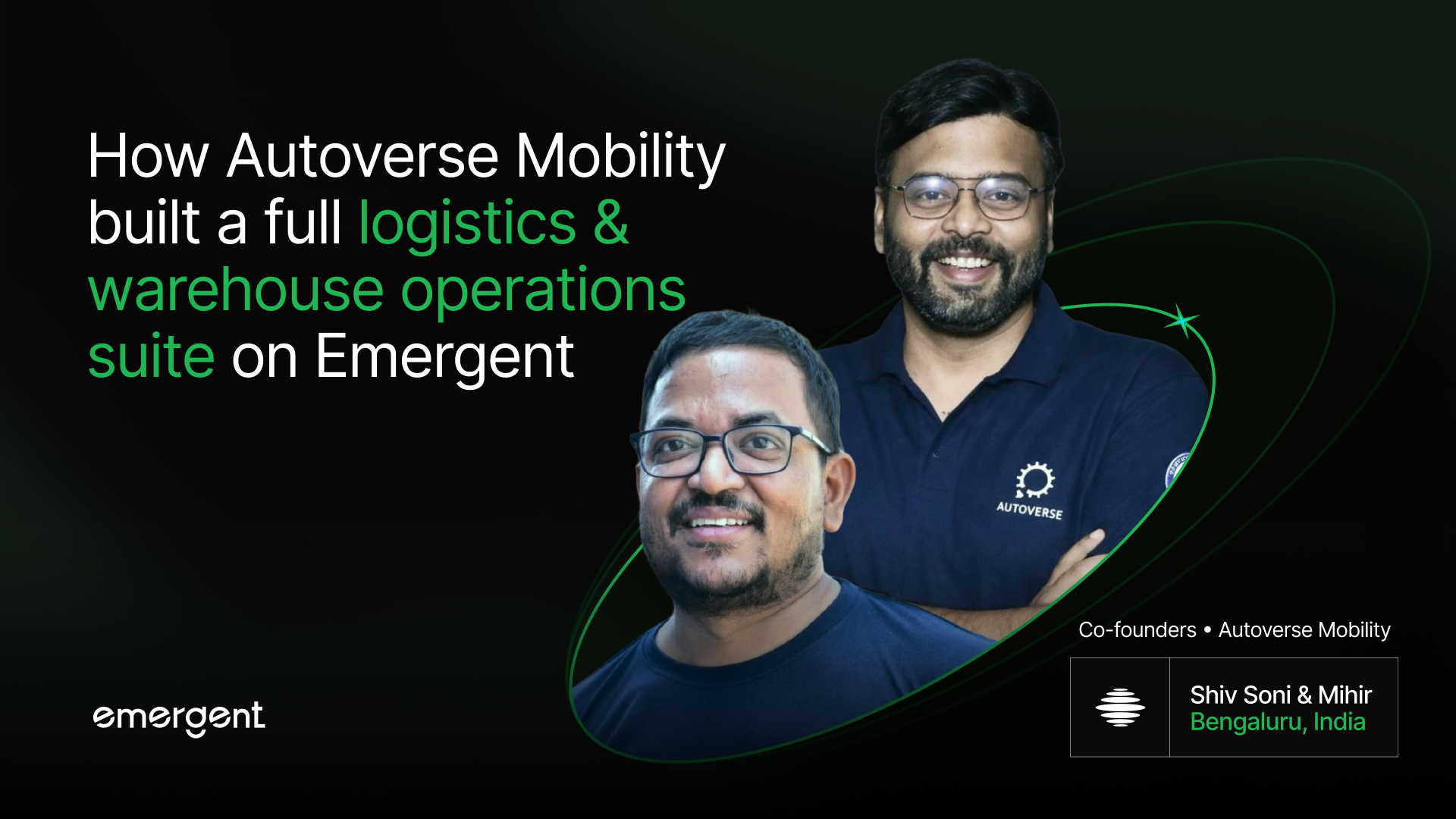
Mihir Mohan and Shiv Soni are co-founders of Autoverse Mobility, an 82-person automotive parts company in Bangalore. Autoverse operates as a digital distributor of genuine car parts, sourcing components from manufacturers and delivering them to independent garages across the city using a fleet of 12 electric vehicles. They promise delivery windows as tight as 45 to 90 minutes.
The company already had an order management system and used Zoho as its backend ERP. But neither covered the logistics and warehouse operations that sat between an order being placed and a part reaching a garage. That gap, managed entirely by manual processes, was costing them speed, visibility, and customer trust. To close it, Shiv used Emergent to build a suite of interconnected operations apps that now handle everything from driver dispatch to warehouse quality control to real-time order tracking.
Challenges
No visibility into fleet movement or warehouse handovers
The company ran 12 EV vehicles across multiple warehouse routes every day, but had no system to track where vehicles were, what materials they carried, whether they were running on time, or whether a handover had actually happened. "You always ask, where is the item right now?" Mihir said. Every handover between a driver and a warehouse took 15 to 20 minutes, and when a part went missing or arrived damaged, there was no trail to follow. The problem only surfaced at the point of escalation, when a customer was already upset and the team had no data to work with.
Zoho ERP didn't cover logistics or warehouse operations
The company used Zoho as its backend ERP for core order management, but Zoho offered nothing for logistics routing, warehouse receiving, quality control workflows, or driver management. Those were the exact operational layers where delays, errors, and miscommunication were killing delivery speed. Zoho simply wasn't built to handle and provide visibility into these "critical drop-off points" in the fulfillment chain.
No bandwidth to build in-house, and no timeline that worked
Mihir, who handles the company's tech stack, in addition to being the CEO, estimated that building a custom logistics and warehouse system in-house would have taken nine to ten months to reach a first cut. The team was resource-starved and the alternative was to wait for the next round of funding, hire more engineers, and push operational improvements out by six to nine months. They had effectively given up on solving the problem in the near term, until they found Emergent
Solution
A suite of five interconnected apps covering drivers, warehouses, vendors, and admin
Shiv, the company’s co-founder, spent three months in the company's warehouses observing every process firsthand. He then used Emergent to build the full system. The suite includes five core applications:
Driver app: - Manages all scheduled trips for the day, tracks driver actions, and logs photos and QC data at each stop. Launched as a progressive web app and later deployed as a native Android app for easier access.
Warehouse operations app: - Handles inbound receiving, scanning-based QC with photos, packaging, and shipping label assignment. All scanning is barcode-based, with color-coded shipping labels by location. Warehouse staff work independently through mobile-compatible flows without needing supervisor oversight for each step.
Vendor pickup app: - Tracks vendor pickups where partial fulfillment is common. If five items are needed and only four are available, the system automatically tracks what's outstanding, when someone needs to return, and whether the order was eventually completed.
Admin control center: - A centralized dashboard where the business team can monitor every movement across all locations: trips, QC logs, packages, photographs, shipping labels, and order tracking by shipping level, first mile, middle mile, and last mile.
Attendance module: - A clock-in and clock-out system embedded across all apps so drivers, warehouse pickers, and supervisors all log attendance in one place.
The entire content and process logic was shaped by Shiv's direct observation of warehouse operations.
Built in 2.5 months with continuous daily deployment
Shiv went from identifying the operational gaps to having live users on the system in roughly two and a half months. Since the first deployment went live, the team has been able to iterate and add more features regularly. If Shiv spotted a problem in a meeting, he could fix it and push the update live within ten minutes.
Mihir contrasted this with traditional development cycles: analyzing the problem, writing a product spec, getting a first draft built, testing it with operations, collecting feedback, and iterating. On Emergent, the person who understood the problem was the person building the solution, and the feedback loop collapsed from weeks to minutes.
The system also incorporates an open-source location tracking API instead of Google Maps, and WhatsApp integration for a feature the team calls ExpressQC: a link sent to drivers via WhatsApp that lets them photograph and submit quality checks remotely, even when a shipment goes directly from vendor to customer without passing through a warehouse.
From one app to a platform strategy
After the logistics suite proved successful, the team started building even further. They built a Freshdesk-equivalent internal ticketing and escalation platform on Emergent, migrated their internal business dashboard to Emergent, and are even building a garage network product. The company had effectively paused new in-house tech development and shifted to maintenance mode on their existing codebase. "All the new things we are extracting out from our core platform and building using Emergent wherever we could."
Outcomes
50% reduction in delivery time
The combination of trip tracking, warehouse QC automation, and real-time order visibility cut the company's delivery times roughly in half. In a business where the promise to customers is 45 to 90-minute delivery, every manual handover that previously took 15 to 20 minutes without accountability was now tracked and optimized.
35% wallet share growth across top 50 garage customers
Autoverse measures success by wallet share: what percentage of a garage's total parts spend goes through their platform. Within three to four weeks of the system going live, the company saw a 35% jump in top-line revenue from its top 50 garage customers. Mihir attributed this directly to predictability. "When I make sure that every 1:30 PM my vehicle is standing over there because I have traced down all the things, that gives the customer confidence to give more and more wallet share." In an industry where suppliers historically operate without technology and delivery commitments are routinely missed, reliable fulfillment became a reason for garages to consolidate more of their spend with Autoverse.
Full traceability for dispute resolution
Before the system, damaged or missing parts only surfaced at the point of customer escalation, with no way to trace where something went wrong. Now, every QC photo, every handover, and every trip is logged. If a part arrives damaged, the team can trace backward through the system to identify exactly where it happened, and either resolve the issue or expedite a replacement delivery.
Conclusion
Autoverse Mobility went from having no logistics or warehouse technology to running a full operations suite across five interconnected apps, used daily by roughly half its 82-person team. The system handles 6,800 trips per month across multiple warehouse routes, and the team has already expanded beyond logistics into internal tools and customer-facing products. They built it all on Emergent in two and a half months, without hiring additional engineers or waiting for their next funding round.
Autoverse built production software that half their company uses every day, on a platform they'd never tried before, in two and a half months. If your business runs on workflows that off-the-shelf tools don't cover, start building on Emergent.
Emergent turns your idea into a full-stack web or mobile app, no coding required.
 No coding required
- Web & mobile apps
- Deploys instantly


on Emergent today




