


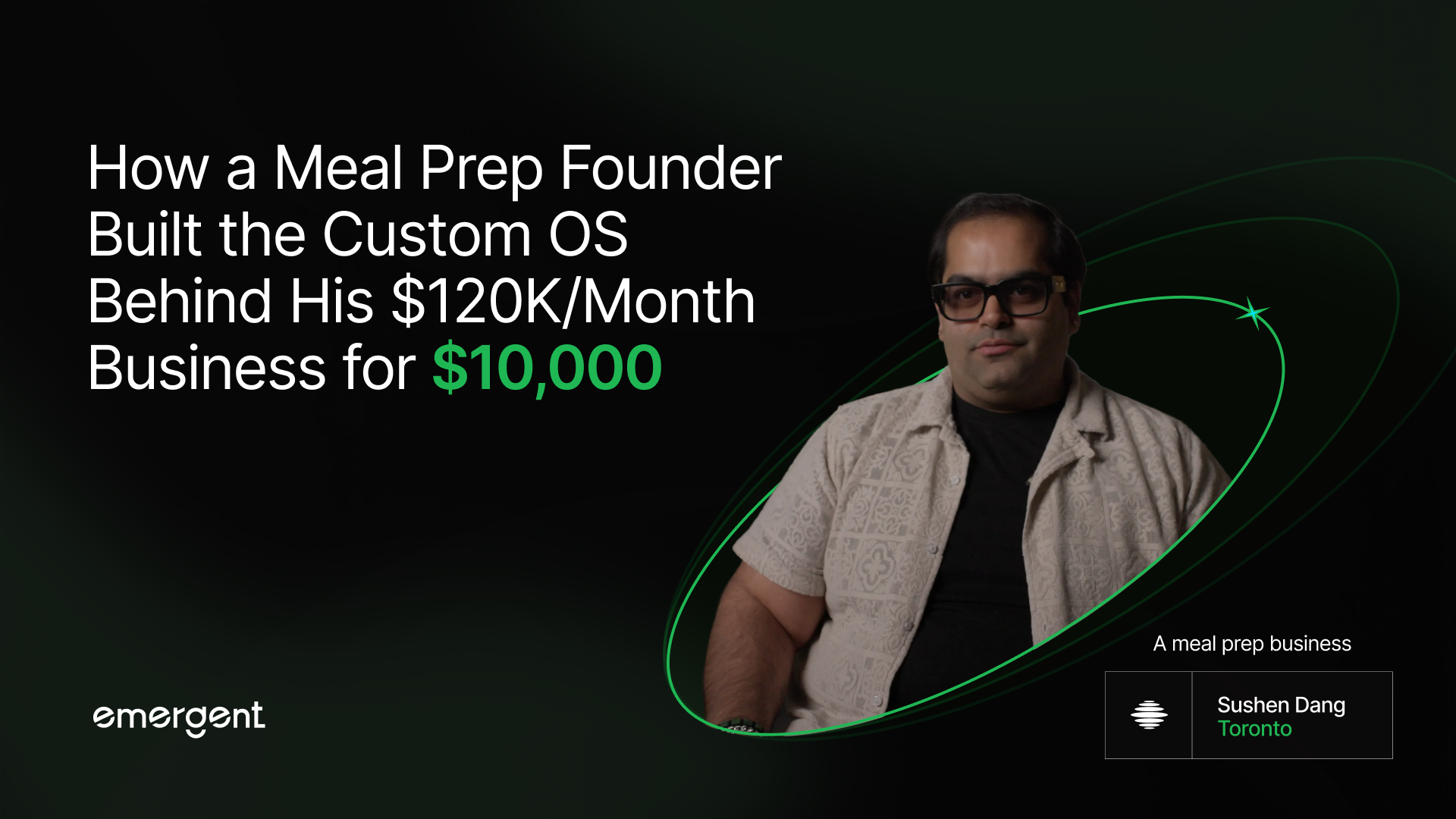
Sushen Dang is a data scientist who spent eight years in the industry before launching a meal prep business out of Toronto in 2022. He now runs two brands, Two Punjabi for You and BiteBox Meals, out of a centralized kitchen with a full team of chefs and drivers, serving hundreds of customers daily across Toronto.
Dang brought a builder's instinct to the food business. With a background in technical product management, he wanted to deliver the kind of automated, frictionless experience customers expected from platforms like Uber or Zomato. But the tools available to meal prep operators were fragmented, and custom development would have cost more than the business could justify. When he found Emergent, he decided to build the system himself. The result was Plate OS.
Challenges
A separate tool for everything, and none of them talked to each other
The meal prep industry has no single system built for its operations. Dang was running his business across a patchwork of disconnected tools: one for delivery routing (OptimoRoute), another for CRM (Dinespot), another for the website (Shopify), plus Excel spreadsheets, PDFs, and label printing software layered on top. Every operational function lived in a different product, and none of them shared data. The result was a fragmented workflow that required constant manual coordination to keep running.
Manual processes meant errors were built into the system
Without automation, Dang's team was entering orders by hand, processing customer requests through Google Forms, and managing changes in spreadsheets. The error rate hovered between 3% and 4%, a direct consequence of human input at every step. On top of that, 90% of the team's phone time was spent fielding inbound calls from customers asking to skip a meal, swap an ingredient, or change a delivery address. These were repetitive, low-value tasks that consumed the team's capacity and left almost no bandwidth for outbound sales.
Custom development at $200,000 was not an option
Dang knew exactly what system he needed. He also knew what it would cost to have it built. A professional development quote for a platform with Plate OS's complexity would run at least $200,000, by his estimate. On $1 million to $1.5 million in annual revenue, that would mean spending roughly 20% of topline on software development. "That just doesn't make sense," Dang said. Without a financially viable path to custom software, he would have been stuck with the distributed toolset, likely hiring more staff to absorb the operational load as the business scaled.
Solution
From a Shopify experiment to a multi-tenant SaaS
What started as an experiment, a custom Shopify theme, then a dashboard and CRM, grew over six months into a full multi-tenant SaaS platform. Dang built the entire system himself, without writing a single line of code. He described workflows and features in natural language, the same way he had written product specs throughout his career as a technical product manager, and Emergent translated them into working software.
The finished product, Plate OS, is an end-to-end operating system built specifically for meal prep businesses. It connects to Shopify, auto-generates daily kitchen sheets and thermal printer-ready labels, handles delivery routing with real-time driver tracking and proof of delivery, and manages subscriptions, renewals, and billing from a single system. A customer self-serve portal lets subscribers skip meals, swap ingredients, and change delivery addresses on their own, and an AI agent handles requests over SMS. The platform also supports multiple brands from one dashboard, so Dang runs both of his brands without switching between tools.
Plate OS is also multi-tenant: other meal prep companies can sign up, get their own instance, and run their operations on it. Dang's own business currently runs on it, processing 600 to 700 orders per day and generating $100,000 to $120,000 in monthly revenue.
From reading code to speaking it
Dang spent his career as a technical product manager, working alongside engineering teams and writing detailed feature specs and workflows. He could read code, debug it, and describe exactly what a system should do. What he could not do was write a single line of it. "If you ask me to write a line of code to save my life, I will be shot immediately," he said. Emergent gave him a way to turn those specs directly into working software, or as he put it, "the ability to speak code."
Dang tried other AI development tools, including Codex and GitHub Copilot, but found Emergent's user experience more intuitive. He also appreciated the portability: knowing he could export his code at any time gave him confidence to keep building on the platform. At one point, he attempted to migrate the system to AWS and quickly discovered how much operational complexity that introduced. He returned to Emergent and let it handle deployments instead.
Outcomes
20x cost reduction on the build itself
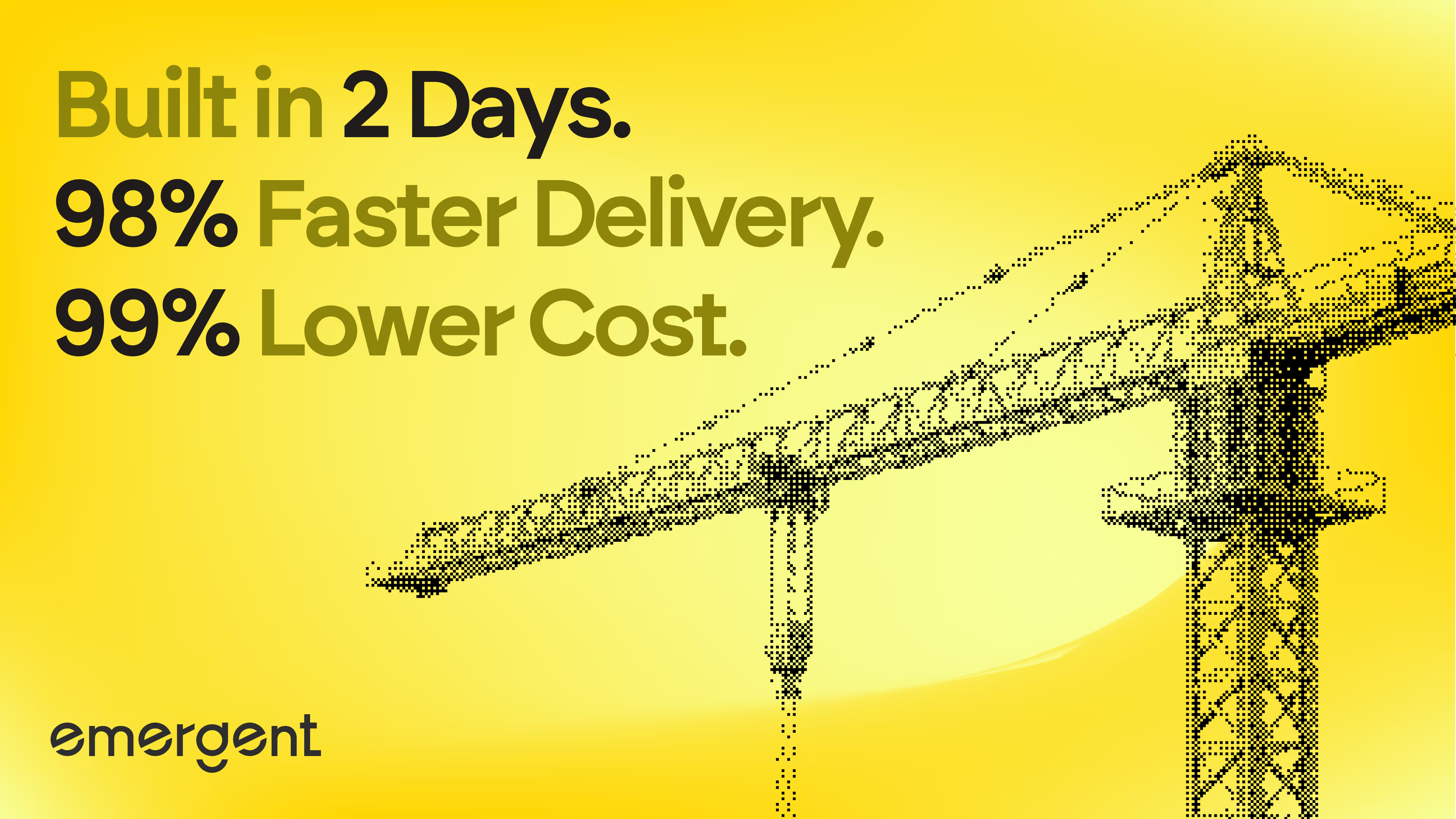
The total spend across six months of development came to roughly $10,000 in Emergent credits. Dang estimates that a traditional agency or engineering team would have charged at least $200,000 for a system of this complexity.
$2,500 in monthly savings from cancelled subscriptions
Dang eliminated several paid tools entirely: OptimoRoute for delivery management ($1,000/month), Dinespot for CRM ($800/month), and roughly $200/month in additional Shopify app subscriptions, along with savings on SMS costs and other minor tools. At $2,500 per month in savings against a $10,000 total build cost, Dang hit full ROI in four months.
60% reduction in inbound customer queries
Plate OS automates the tasks that used to consume Dang's support team: meal skips, ingredient swaps, address changes. Customers can now text an AI agent to make changes without logging into a portal. The share of phone time spent on inbound subscription queries dropped from 90% to roughly 40%, freeing the team to focus on outbound sales.
Zero percent error rate, sustained for three weeks and counting
Before Plate OS, manual order entry produced a consistent 3% to 4% error rate. With orders now fully automated, the error rate dropped to zero and stayed there. "If there is an error, it is from the customer's end, not from ours," Dang said.
A new SaaS revenue stream
Plate OS is now a product in its own right. Dang's first external customer is live on the platform and paying $1,800 per month. An enterprise deal at approximately $2,500 per month is in negotiation. With 20 to 25 additional prospects in the pipeline after less than a month of active marketing, Plate OS is on track to become a business of its own.
Full operational mobility
Dang can now run his entire business from his phone. Order processing, delivery management, customer communications, all of it runs through a single system he built and controls.
Conclusion
Dang's story is proof that you don't need a six-figure development budget or an engineering team to build production-grade software. He is a founder with deep domain expertise and the ability to describe what his business required. Emergent turned that description into a SaaS platform that runs a six-figure monthly operation, eliminated $2,500 a month in software costs, and now generates subscription revenue from other businesses. Total build cost: $10,000. Time to ROI: four months.
If you can describe what your business needs, you can build it on Emergent. Dang did it in six months, without an engineering team or a single line of code. All you need is an idea and the ability to describe it. Emergent handles the rest.
Emergent turns your idea into a full-stack web or mobile app, no coding required.
 No coding required
- Web & mobile apps
- Deploys instantly
on Emergent today



