
On June 9, 2026, Anthropic released Claude Fable 5, a model that sits in a completely new tier above every Claude model that came before it. Twelve days earlier, on May 28, Opus 4.8 shipped as the strongest generally available model in the Claude lineup.
Now both are live simultaneously, and the question everyone building on Claude is asking is straightforward: when do you use Fable 5, when do you stick with Opus 4.8, and is double the price actually worth it?
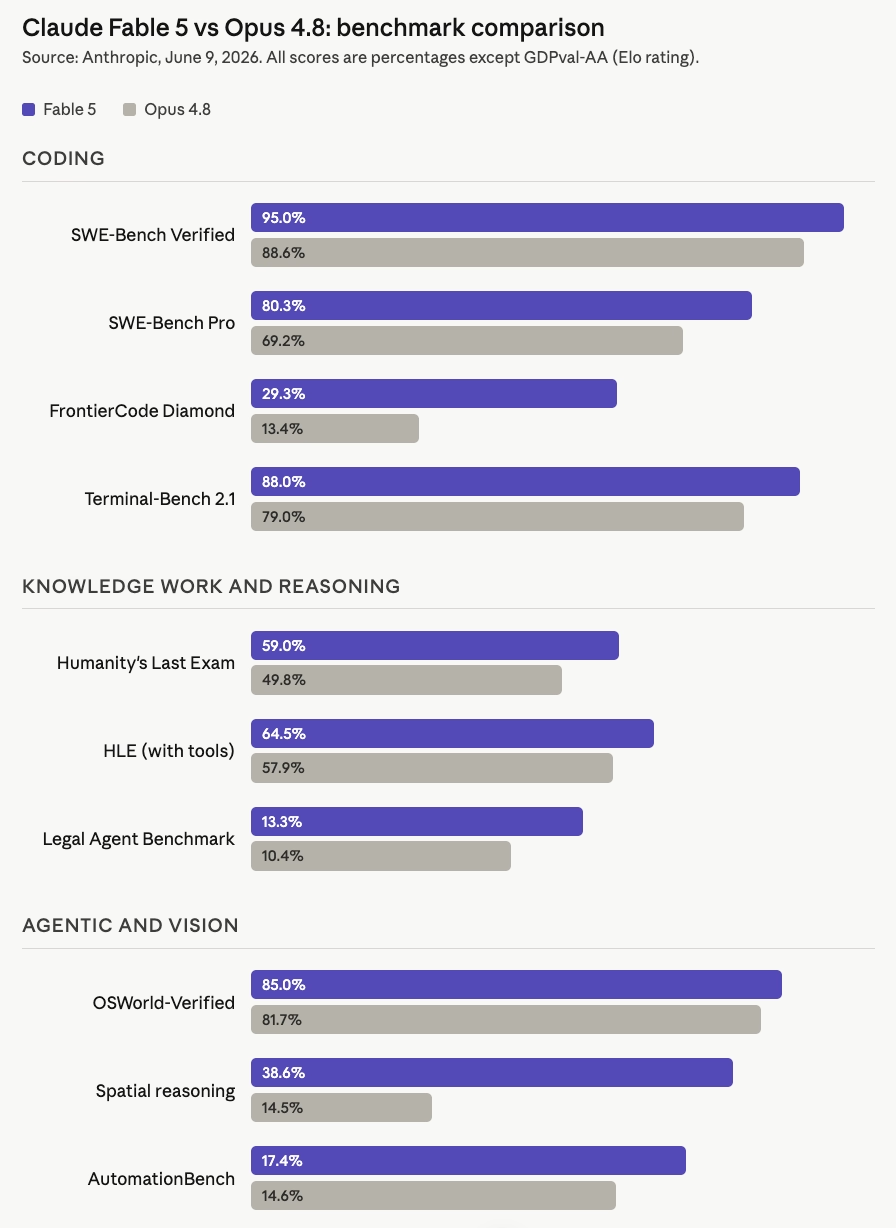
The short answer is that Fable 5 is not an incremental upgrade. It is a generational leap. On SWE-Bench Pro, the most respected benchmark for real-world software engineering, Fable 5 scores 80.3% against Opus 4.8's 69.2%. That is an 11-point gap, larger than the gap between Opus 4.8 and Google's Gemini 3.1 Pro. On FrontierCode Diamond, Fable 5 more than doubles Opus 4.8's score.
But raw capability is only half the story. Fable 5 comes with a new safeguard architecture that literally falls back to Opus 4.8 on certain queries. It requires 30-day data retention where Opus 4.8 does not. And it costs exactly twice as much per token.
This guide covers everything: benchmarks, pricing, architecture, safeguards, use cases, and a practical decision framework. All benchmark numbers are sourced from Anthropic's official announcement and the accompanying system card.
What Exactly Is a "Mythos-Class" Model?
This is the first thing to understand because it changes the frame of the entire comparison.
Anthropic's model hierarchy now has three tiers:
- Haiku for fast, lightweight tasks
- Sonnet for balanced everyday work
- Opus for complex reasoning and agentic coding
- Mythos for frontier capability across every dimension
Fable 5 is the first Mythos-class model released for general use. The name "Fable" comes from the Latin fabula ("that which is told"), a deliberate echo of the Greek mythos. Fable 5 and Claude Mythos 5 share the same underlying model weights. The difference is that Fable 5 has safety classifiers layered on top, while Mythos 5 (restricted to vetted Project Glasswing partners) has those classifiers lifted in certain domains.
Opus 4.8 is the current top of the Opus tier. It shipped 12 days before Fable 5 with improvements in honesty, self-correction, and agentic coding over Opus 4.7. It is a strong model. But it is not in the same capability tier as Fable 5.
Think of it this way: Opus 4.8 is the best sedan on the market. Fable 5 is a different category of vehicle entirely.
Claude Fable 5 vs Opus 4.8: Head-to-Head Benchmark Comparison
Every number below comes from Anthropic's published benchmark table (source: Anthropic, June 9, 2026).
Coding Benchmarks
| Benchmark | Fable 5 | Opus 4.8 | Gap | What It Tests |
|---|---|---|---|---|
| SWE-Bench Verified | 95.0% | 88.6% | +6.4 | Resolving real GitHub issues |
| SWE-Bench Pro | 80.3% | 69.2% | +11.1 | Harder real-world engineering tasks |
| FrontierCode Main | 46.3% | 27.1% | +19.2 | Production-quality coding |
| FrontierCode Diamond | 29.3% | 13.4% | +15.9 | Most difficult coding tasks |
| Terminal-Bench 2.1 | 88.0% | 79.0% | +9.0 | Terminal-based engineering |
The coding gap is the headline. An 11-point lead on SWE-Bench Pro is not a marginal improvement. For context, the gap between Opus 4.8 and GPT-5.5 on the same benchmark is about 10.6 points (69.2% vs 58.6%). Fable 5 leads Opus 4.8 by a wider margin than Opus leads its closest cross-platform competitor.
On FrontierCode Diamond, the gap is even more dramatic. This benchmark tests whether models can solve genuinely difficult coding problems while meeting production codebase standards. Fable 5 scores 29.3%, more than double Opus 4.8's 13.4%. GPT-5.5 manages just 5.7%.
What makes FrontierCode particularly telling is Anthropic's claim that Fable 5 leads even at medium effort. Most models need maximum reasoning tokens to score well on hard benchmarks. Fable 5 apparently does not. That token efficiency translates directly into cost savings on real workloads.
Knowledge Work and Reasoning
| Benchmark | Fable 5 | Opus 4.8 | Gap | What It Tests |
|---|---|---|---|---|
| GDPval-AA (Elo) | 1932 | 1890 | +42 | Knowledge work quality |
| Humanity's Last Exam (no tools) | 59.0% | 49.8% | +9.2 | Hardest academic questions |
| Humanity's Last Exam (tools) | 64.5% | 57.9% | +6.6 | Same, with tool access |
| Hebbia Finance Benchmark | Highest | Below Fable | N/A | Senior-level financial reasoning |
On the Hebbia Finance Benchmark, which tests AI at the level of seasoned financial analysts across document reasoning, chart interpretation, and problem solving, Fable 5 posted the highest score of any model. Trading firm IMC reported that Fable 5 passed their trading analysis evaluations "nearly across the board," including factual lookup, conceptual reasoning, root-cause analysis, and expected-value analysis.
For knowledge workers, consultants, analysts, and researchers, the GDPval-AA score is particularly relevant. This is Artificial Analysis's comprehensive assessment of knowledge work capability, and Fable 5 leads the entire field at 1932 Elo.
Agentic and Long-Horizon Tasks
| Benchmark | Fable 5 | Opus 4.8 | Gap | What It Tests |
|---|---|---|---|---|
| OSWorld-Verified | 85.0% | 81.7% | +3.3 | Computer use tasks |
| AutomationBench | 17.4% | 14.6% | +2.8 | Business workflow automation |
| Legal Agent Benchmark | 13.3% | 10.4% | +2.9 | End-to-end legal work |
These benchmarks are deliberately hard. The absolute numbers are low across the board because they test long-horizon, multi-step workflows where every model still has significant headroom. What matters is the relative positioning: Fable 5 leads in every category.
The real-world signal here comes from early testers. Stripe reported that Fable 5 "compressed months of engineering into days," completing a codebase-wide migration in a 50-million-line Ruby codebase in a single day that would have taken a full team over two months. Cursor CEO Michael Truell stated that Fable 5 "opened up a class of long-horizon problems that were out of reach for earlier models."
Vision and Multimodal
Fable 5 is the new state-of-the-art model for vision tasks, according to Anthropic. Specific capabilities include extracting precise numbers from detailed scientific figures and rebuilding a web app's source code from screenshots alone.
The most striking demonstration: previous Claude models struggled to play Pokemon FireRed even with complex helper harnesses and additional tools. Fable 5 completed the entire game using only raw screenshots as input, with a minimal vision-only setup and no maps, navigation aids, or extra game-state information.
For spatial reasoning specifically, Fable 5 scored 38.6% compared to Opus 4.8's 14.5%, nearly tripling the previous model's capability.
Memory and Long Context
Both models support a 1M token context window. But Fable 5 uses it fundamentally differently.
When Anthropic tested both models on Slay the Spire (a complex deck-building game), giving the models access to persistent file-based memory improved Fable 5's performance three times more than Opus 4.8. Fable 5 also reached the game's final act three times more often than Opus 4.8.
This reveals something important about how Fable 5 handles long-running tasks: it does not just process more context. It actively builds and uses working memory to improve its own outputs over time. For agentic workflows that run for hours or days, this is a qualitative difference, not just a quantitative one.
Pricing: Is 2x the Cost Worth It?
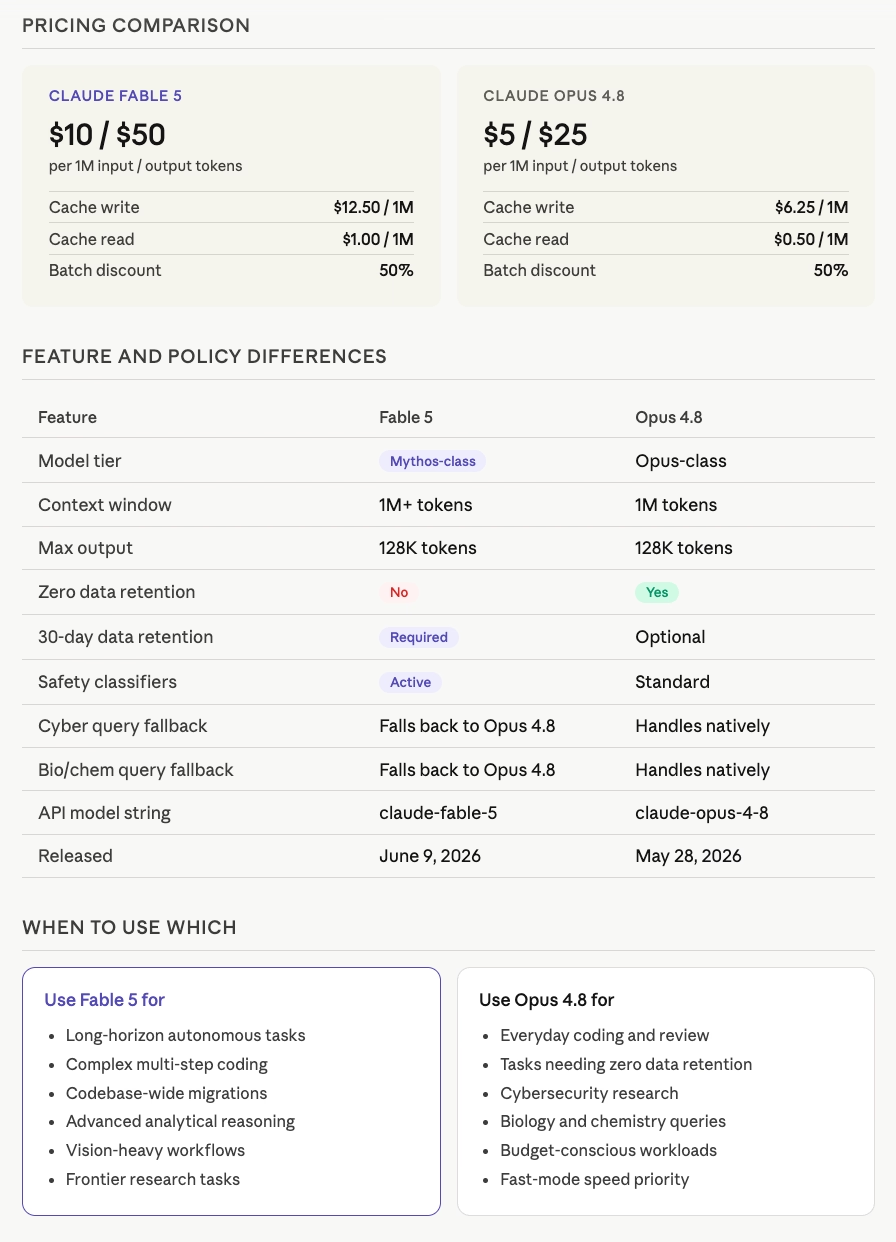
The pricing comparison is clean and easy to reason about:
| Cost Component | Fable 5 | Opus 4.8 |
|---|---|---|
| Input tokens | $10 / 1M | $5 / 1M |
| Output tokens | $50 / 1M | $25 / 1M |
| Prompt caching (write) | $12.50 / 1M | $6.25 / 1M |
| Prompt caching (read) | $1.00 / 1M | $0.50 / 1M |
| Batch processing | 50% discount | 50% discount |
Fable 5 is exactly 2x Opus 4.8 across every pricing dimension. This makes cost projection simple: whatever you spend on Opus today, double it for the same volume on Fable 5.
But the raw token math misses two critical factors:
- Fable 5 finishes tasks in fewer turns. Peter Wang (Chief Science Officer at Anaconda) reported that Fable 5 beats Opus 4.8 on spreadsheet task suites at every effort level, finishing runs 25 to 30% faster with fewer turns. Fewer turns means fewer tokens burned on conversation overhead, partially offsetting the per-token premium.
- The marginal points are not equal. Tasks that fall between Opus 4.8's ceiling and Fable 5's ceiling are not slightly better on Fable 5. They are possible on Fable 5 and impossible on Opus 4.8. For those tasks, the comparison is not "2x the price for 11 more points." It is "task completed vs task failed."
The rational cost framework:
- Opus 4.8 ($5/$25): Use for routine coding tasks, drafting, review, analysis, and anything where Opus reliably completes the job
- Fable 5 ($10/$50): Use for long-horizon engineering, complex multi-step reasoning, frontier coding problems, and tasks where Opus 4.8 demonstrably fails or requires excessive retries
The Safeguard Architecture: Where Fable 5 Becomes Opus 4.8
This is the most architecturally unique aspect of Fable 5, and most comparison articles gloss over it.
Fable 5 runs a layer of safety classifiers that detect requests in three domains:
- Cybersecurity: Offensive security, exploit development, agentic hacking
- Biology and chemistry: Bioweapons-adjacent research, dual-use life sciences queries
- Distillation: Attempts to extract Fable 5's capabilities for training competing models
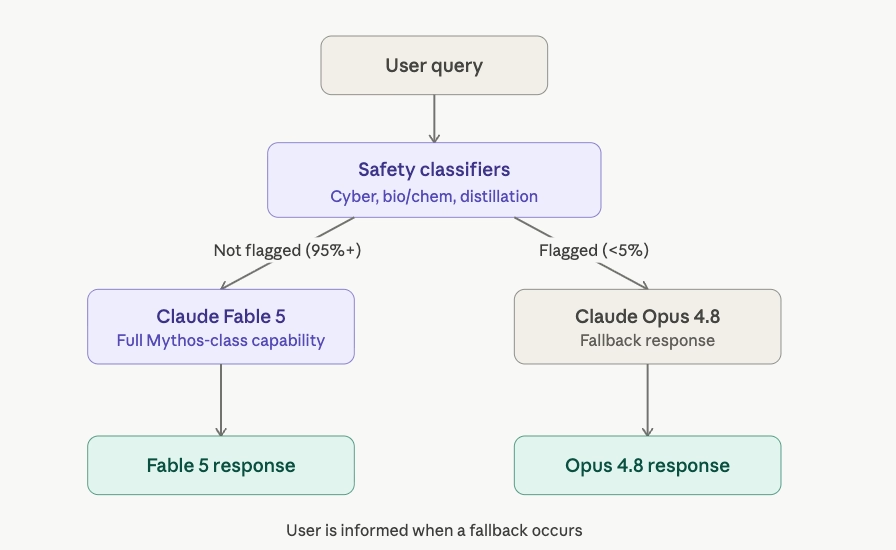
When these classifiers trigger, the request is silently routed to Claude Opus 4.8 instead. The user is informed that a fallback occurred. Anthropic reports that more than 95% of Fable 5 sessions involve no fallback at all.
What this means in practice: if your primary use case involves cybersecurity research, biological or chemical analysis, or anything that might trigger these classifiers, you are effectively using Opus 4.8 regardless of which model you select. In those domains, paying 2x for Fable 5 gets you literally the same model.
For everyone else, the safeguards are largely invisible. Anthropic has tuned them conservatively, which means some benign requests will occasionally trigger false positives. They have stated their intention to reduce these over time.
Jailbreak Resistance
Fable 5's classifiers were extensively red-teamed:
- An external bug bounty produced no universal jailbreaks in over 1,000 hours of testing
- External red-teaming organizations found no universal jailbreaks on long-form agentic tasks
- UK AISI made progress toward one within a brief initial testing window, but no complete bypass
- An internal evaluation across 400 turns of automated red-teaming showed Fable 5 significantly more resistant than previous models
For organizations where compliance and safety matter, Fable 5's classifier architecture is a genuine advantage, not just a limitation.
Data Retention: A Critical Difference for Enterprise
This is the detail that might matter most for regulated industries:
| Privacy Feature | Fable 5 | Opus 4.8 |
|---|---|---|
| Data retention | 30-day mandatory | Zero data retention (ZDR) available |
| Training data use | Not used for training | Not used for training |
| Human access logging | All access logged | Standard policies |
| Deletion guarantee | After 30 days in almost all cases | Immediate with ZDR |
Fable 5 requires 30-day retention for all traffic on both first-party and third-party surfaces. This applies to Fable 5, Mythos 5, and all future Mythos-class models. Anthropic states this data is used exclusively for safety purposes: defending against novel attacks, identifying jailbreaks, and reducing false positives.
For teams in healthcare, finance, legal, or any industry with strict data handling requirements, this is a material difference. Opus 4.8 supports zero data retention. Fable 5 does not.
If your compliance framework prohibits 30-day third-party data retention, Opus 4.8 is not just the cheaper option. It is the only option.
Real-World Performance: What Early Testers Are Saying
The benchmark numbers tell one story. The testimonials from companies with early access tell a richer one.
- Stripe (Engineering): Fable 5 compressed months of engineering into days. A codebase-wide migration in a 50-million-line Ruby codebase was completed in a single day, a task that would have taken a full team over two months by hand.
- Cursor (AI Coding): On CursorBench, Fable 5 is the state-of-the-art model. It has opened up long-horizon problems that were previously unreachable.
- Cognition/Devin (Autonomous Engineering): Fable 5 is the highest-scoring model on FrontierBench, excelling at long-horizon reasoning and generalizing to unfamiliar tools immediately.
- Hebbia (Finance): The strongest finance-first model tested, a notable step up on both general finance and reasoning.
- GitHub: Fable 5 handled complex, long-horizon coding tasks "with a level of autonomy and reliability that exceeded previous benchmarks."
- Harvey (Legal): In blind review, lawyers found Fable 5's redlines "matched or beat" their current model every time.
- Databricks: Fable 5 broke 90% on their core analytics benchmark, a 10-point jump over Opus 4.8, on complex, long-running analytical tasks.
- Anaconda: Fable 5 beats Opus 4.8 on spreadsheet task suites at every effort level, finishing runs 25 to 30% faster.
The pattern across every testimonial is consistent: the longer and more complex the task, the larger Fable 5's advantage. For short, bounded tasks, the difference is less pronounced.
Scientific Research: Where Fable 5 Goes Beyond Opus Entirely
This is the area where Fable 5 (and its Mythos 5 sibling) enters territory that Opus 4.8 simply cannot reach.
- Drug Design: Using Mythos 5, Anthropic's internal protein design experts accelerated aspects of the drug design process by approximately 10x. In one case, the model matched or beat skilled human operators at choosing binding sites, selecting and running protein design tools, and recovering from failures along the way. Nine of 14 protein targets yielded strong drug design candidates currently under investigation.
- Novel Hypotheses: Mythos 5 is Anthropic's first model to consistently produce novel, compelling scientific hypotheses. In blinded head-to-head comparisons against Opus-class models, scientists preferred Mythos's molecular biology hypotheses approximately 80% of the time. One hypothesis about a novel mechanism for an E. coli protein was independently corroborated by a separate research lab.
- Genomics Research: In over a week of largely autonomous work, Mythos 5 assembled single-cell data for millions of cells spanning 138 animal species, designed and trained a custom ML model, and outperformed a recent model published in Science despite being 100x smaller.
These capabilities are not available through Fable 5 directly (biology queries trigger the safety classifier fallback to Opus 4.8). But they demonstrate the raw capability of the underlying model, which is the same model running Fable 5 on non-restricted queries.
When to Use Fable 5 vs Opus 4.8
The decision framework is simpler than the benchmarks suggest:
Use Fable 5 When:
- The task requires sustained autonomous work over many steps or hours
- You are solving difficult coding problems that require whole-codebase understanding
- The task involves complex analytical reasoning across large documents
- You need frontier vision capabilities (screenshot-to-code, scientific figure analysis)
- You need the strongest possible performance and budget is secondary
- The task is non-sensitive (not cybersecurity, biology, or chemistry related)
Use Opus 4.8 When:
- The task is bounded and completable in a reasonable number of turns
- You need zero data retention for compliance
- Your work involves cybersecurity research, biological analysis, or chemistry (Fable 5 falls back to Opus 4.8 anyway)
- Budget efficiency matters and Opus 4.8 reliably completes the job
- You need fast mode (Opus 4.8's fast mode runs at 2.5x speed at $10/$50, the same price as Fable 5's standard mode)
The Hybrid Approach
The most cost-effective strategy for most teams is routing by task complexity:
- Start every task on Opus 4.8
- Escalate to Fable 5 only when Opus fails, loses coherence mid-task, or burns excessive tokens through retries
- Never use Fable 5 for cybersecurity or biology queries (you are paying double for the same Opus 4.8 response)
This hybrid approach captures 80% of Fable 5's value at significantly less than 2x the total cost.
API Access and Availability
| Specification | Fable 5 | Opus 4.8 |
|---|---|---|
| API model string | claude-fable-5 | claude-opus-4-8 |
| Available on claude.ai | Yes (Pro, Max, Team, Enterprise) | Yes (Pro, Max, Team, Enterprise) |
| Available on Claude Code | Yes | Yes |
| AWS Bedrock | Coming soon | Yes |
| Google Cloud Vertex AI | Coming soon | Yes |
| Microsoft Foundry | Coming soon | Yes |
| Context window | 1M+ tokens | 1M tokens |
| Max output tokens | 128K | 128K |
Important note on subscription access: Fable 5 is included on Pro, Max, Team, and seat-based Enterprise plans at no extra cost from launch through June 22. After June 23, using Fable 5 on these plans will require usage credits. Anthropic intends to restore Fable 5 as a standard part of subscription plans once capacity allows, but has not committed to a specific timeline.
Build with Fable 5 on Emergent Today
Claude Fable 5 is now live on Emergent. If you have been building on Emergent with Opus 4.8, you will notice the difference immediately on anything involving complex, multi-step generation, longer autonomous working, more coherent logic across files, fewer mid-task breakdowns.
To access it, open Emergent and select Claude Fable 5. The same credit system applies, so there is no separate pricing to worry about.
If you are new to Emergent, it is the fastest way to put Fable 5's capabilities to work without writing a single line of infrastructure code. You describe what you want to build, Fable 5 does the heavy lifting of turning your idea into a fully functioning application.
The Bottom Line
Claude Fable 5 is not a better Opus. It is a different class of model that happens to share the same interface. The 11-point gap on SWE-Bench Pro, the 2x score on FrontierCode Diamond, the ability to complete Stripe's codebase migration in a day instead of two months, and the capacity to produce novel scientific hypotheses that hold up under peer review are all evidence of a genuine capability threshold being crossed.
Opus 4.8 is not obsolete. It remains an excellent model for the majority of professional workloads, costs half as much, supports zero data retention, and serves as the literal fallback for Fable 5 on restricted queries. For most everyday tasks, the difference between the two will be invisible.
The gap becomes visible, and then undeniable, on the work that matters most: the long tasks, the hard problems, the multi-step reasoning chains that require a model to maintain coherence and improve its own thinking over sustained autonomous operation. That is where Fable 5 earns its price.

Most AI app builders stop at prototypes. Emergent creates production-ready apps you can actually launch.
- Production-ready apps
- Web & mobile apps
- Deploy in minutes