



The budget model just outran the flagship. Gemini 3.6 Flash, released July 21, 2026, beats Gemini 3.1 Pro on every coding and agentic benchmark Google has published, costs up to 58% less on output tokens, and runs roughly twice as fast. The older Pro model holds onto a narrow lead in PhD-level reasoning and nothing else.
If you're choosing between these two for an API integration, a coding agent, or an AI-powered app, the answer for most workloads is 3.6 Flash. Below, we compare benchmarks across coding, reasoning, and multimodal tasks, break down pricing at every API tier, and cover speed, migration steps, and when each model is still the right pick.
TL;DR
- Gemini 3.6 Flash wins on SWE-Bench Pro, DeepSWE, Terminal-Bench, and MLE-Bench. It sweeps every coding and agentic benchmark in Google's published comparison.
- Pricing favors Flash at every tier: $7.50 vs $12.00 per million output tokens (standard), and Flash holds flat pricing past 200K tokens where Pro jumps to $18.00.
- Speed is not close. Flash generates roughly 261 tokens per second vs 112 for Pro (Artificial Analysis, July 2026).
- Gemini 3.1 Pro still leads on GPQA Diamond (94.3% vs 92.8%) and Humanity's Last Exam (44.4% vs 38.3%), per Google's vendor-reported Pro scores and Artificial Analysis evaluations of Flash. If your workload is frontier-level science reasoning, Pro earns its premium.
- Knowledge cutoff: Flash knows 14 months more. March 2026 vs January 2025.
- Flash is GA. Pro is still in Preview five months after launch.
The quick comparison
| Category | Gemini 3.6 Flash | Gemini 3.1 Pro |
|---|---|---|
| Release date | July 21, 2026 | February 19, 2026 |
| Status | Generally available | Preview |
| Model ID | gemini-3.6-flash | gemini-3.1-pro-preview |
| Context window | 1M tokens | 1M tokens |
| Max output | 64K tokens | 64K tokens |
| Knowledge cutoff | March 2026 | January 2025 |
| Input price (≤200K) | $1.50/1M tokens | $2.00/1M tokens |
| Output price (≤200K) | $7.50/1M tokens | $12.00/1M tokens |
| Input price (>200K) | $1.50/1M tokens | $4.00/1M tokens |
| Output price (>200K) | $7.50/1M tokens | $18.00/1M tokens |
| Speed | ~261 tok/s | ~112 tok/s |
Pricing as of July 2026, sourced from Google's Gemini API pricing page. Prices reflect the Standard paid tier.
Benchmark comparison
The headline: Flash wins on coding and agentic tasks by wide margins. Pro holds a narrower edge on the hardest reasoning benchmarks. Multimodal and long-context retrieval tilt back toward Flash. Here's how the numbers break down across all three categories.
1. Coding and agentic benchmarks
Gemini 3.6 Flash leads on all four head-to-head coding and agentic benchmarks Google has published. The margins range from modest (4.5 points on SWE-Bench Pro) to enormous (37 points on DeepSWE).
| Benchmark | Gemini 3.6 Flash | Gemini 3.1 Pro | What it measures |
|---|---|---|---|
| SWE-Bench Pro | 58.7% | 54.2% | Multi-language software engineering |
| DeepSWE v1.1 | 49% | 12% | Long-horizon software engineering |
| Terminal-Bench 2.1 | 78.0% | 73.8% | Agentic terminal coding |
| MLE-Bench | 63.9% | 42.6% | Machine learning engineering |
All scores are vendor-reported by Google in its July 2026 direct comparison table.
The DeepSWE gap is the most telling. This benchmark tests long-horizon software engineering, which means the model needs to plan across multiple files, execute terminal commands, read error output, and iterate on patches without human intervention. Flash scores 49%. Pro scores 12%. That's not a marginal difference. It reflects a fundamental improvement in how Flash handles multi-step agentic workflows.
Terminal-Bench and MLE-Bench tell a similar story with smaller margins. Flash is consistently better at the kind of iterative, tool-heavy coding work that matters for AI agents in production.
A note on SWE-Bench versions. Gemini 3.1 Pro scored 80.6% on SWE-Bench Verified when it launched in February 2026. That number does not conflict with the 54.2% shown above. SWE-Bench Pro and SWE-Bench Verified are different evaluations with different task sets, different scoring criteria, and different agent harnesses. Comparing scores across benchmark variants is one of the most common errors in model comparison articles. The scores in the table above come from the same benchmark run, using the same harness, which makes them directly comparable.
2. Reasoning and knowledge benchmarks
Flash does not sweep every category. Gemini 3.1 Pro retains a meaningful lead on the hardest reasoning and knowledge benchmarks, and it would be misleading to ignore that.
| Benchmark | Gemini 3.1 Pro | Gemini 3.6 Flash | What it measures |
|---|---|---|---|
| GPQA Diamond | 94.3% | 92.8% | PhD-level science questions |
| Humanity's Last Exam (no tools) | 44.4% | 38.3% | Frontier reasoning across domains |
| Long-context reasoning (AA-LCR) | 72.7% | 69.7% | Reasoning over long documents |
GPQA Diamond (94.3%) and Humanity's Last Exam (44.4%) for Pro are from Google's February 2026 model card. The Flash scores (92.8%, 38.3%) and the AA-LCR scores come from Artificial Analysis independent evaluations. Google's 3.6 Flash announcement compared coding and agentic metrics against Pro but did not publish a direct GPQA or HLE comparison.
The GPQA Diamond gap is narrow: 1.5 percentage points. Humanity's Last Exam is wider at 6.1 points, and this is the benchmark where Pro's reasoning depth shows most clearly. If your use case involves PhD-level scientific analysis, multi-step mathematical proofs, or complex reasoning over long documents, Pro has earned the extra cost.
Two practical caveats cut against choosing Pro for its reasoning edge alone. First, its knowledge cutoff is January 2025, 14 months older than Flash's March 2026. A model that scores higher on reasoning but doesn't know about frameworks, libraries, or world events from the past year creates a different kind of accuracy problem. Second, Pro remains in Preview status. The model ID is literally gemini-3.1-pro-preview. Preview models can change behavior between API calls, and Google provides weaker stability guarantees than it does for GA models.
3. Multimodal and long-context performance
Both models accept text, images, video, audio, and PDFs. Both support a 1M-token context window. On paper, they look identical for multimodal work. In practice, Flash has a significant advantage on long-context retrieval and several multimodal benchmarks.
| Benchmark | Gemini 3.6 Flash | Gemini 3.1 Pro | What it measures |
|---|---|---|---|
| MRCR v2 (128K avg) | 91.8% | 84.9% | Needle-in-haystack retrieval at 128K |
| MRCR v2 (1M pointwise) | 54.0% | 26.3% | Needle-in-haystack retrieval at 1M |
| CharXiv Reasoning (no tools) | 85.2% | Not reported | Chart and scientific visualization reasoning |
| MMMU-Pro | 83.2% | 80.5% | Multimodal understanding and reasoning |
MRCR scores are from Google's July 2026 comparison table (8-needle variant). MMMU-Pro scores are sourced from Artificial Analysis evaluations and third-party aggregators, not from a single Google comparison table. Treat as directional rather than a controlled head-to-head.
The 1M-token MRCR result deserves attention. Flash scores 54% where Pro scores 26.3%. If you're building an application that searches through long documents, codebases, or conversation histories, Flash finds information at the full context length roughly twice as reliably as Pro.
The nuance is that finding and reasoning over long context are different skills. Pro scores slightly higher on the AA-LCR reasoning benchmark (72.7% vs 69.7%). So Flash retrieves better across long contexts, while Pro reasons slightly better once it has the relevant information. For most production use cases involving large document sets, retrieval matters more than marginal reasoning improvements.
Pricing, speed, and real-world cost
Benchmarks tell you which model is smarter. This section tells you which one is cheaper to run, and why the gap is wider than the rate card suggests.
1. API pricing
Flash costs less in every pricing mode Google offers. The gap is widest on long prompts, where Pro's tiered pricing doubles the per-token rate past 200K tokens while Flash holds flat.
| Pricing tier | Gemini 3.6 Flash | Gemini 3.1 Pro |
|---|---|---|
| Standard input (≤200K) | $1.50/1M | $2.00/1M |
| Standard output (≤200K) | $7.50/1M | $12.00/1M |
| Standard input (>200K) | $1.50/1M | $4.00/1M |
| Standard output (>200K) | $7.50/1M | $18.00/1M |
| Batch input | $0.75/1M | $1.00/1M |
| Batch output | $3.75/1M | $6.00/1M |
| Cache read (≤200K) | $0.15/1M | $0.20/1M |
| Cache storage | $1.00/1M/hr | $4.50/1M/hr |
Pricing as of July 2026, sourced from Google's Gemini API pricing page.
Output tokens are where the cost difference hits hardest, especially for agentic workloads. At standard rates, Pro's output costs 60% more per token than Flash. Once a prompt crosses 200K tokens, Pro's output price jumps to $18.00 per million, 140% more than Flash's $7.50 flat rate.
Cache storage amplifies the gap further. Storing cached context costs $4.50 per million tokens per hour on Pro versus $1.00 on Flash. For applications that cache large system prompts or document corpora, Pro's caching bill can exceed the per-request savings it was supposed to provide.
2. Speed and latency
Flash is roughly 2.3 times faster than Pro on throughput, and starts answering sooner.
| Metric | Gemini 3.6 Flash | Gemini 3.1 Pro | Source |
|---|---|---|---|
| Output speed | ~261 tok/s | ~112 tok/s | Artificial Analysis, measured at launch week |
| Time to first token | ~12.8s | ~31.2s | Artificial Analysis, measured at launch week |
These are point-in-time measurements from Artificial Analysis around July 21, 2026, and will fluctuate as Google adjusts serving infrastructure. Other sources report Flash speeds of 280-304 tok/s. TTFT includes thinking time; interactive tasks with shorter reasoning chains will see faster first-token times.
For chat applications and interactive coding tools, the TTFT difference is noticeable. A 31-second wait before Pro starts responding can feel broken in a user-facing product, while 12.8 seconds from Flash is tolerable for complex reasoning tasks.
In agentic loops, the speed difference compounds. Every tool call, file read, and error correction cycle pays the latency tax again. A coding agent that takes 12 steps to complete a task on Pro might finish in roughly half the wall-clock time on Flash, even before accounting for the possibility that Flash resolves the same task in fewer steps.
3. Token efficiency: the hidden cost multiplier
Raw pricing and benchmark scores dominate most comparison articles. What's missing is the token efficiency angle, which changes the cost math more than any rate card adjustment.
Google's own reporting says Gemini 3.6 Flash uses 17% fewer output tokens than 3.5 Flash to accomplish the same tasks. On agentic coding workloads (DeepSWE), the reduction reaches 65%. That means fewer reasoning steps, fewer tool calls, and fewer total tokens billed per completed unit of work.
For a coding agent running 100 tasks per day, the compounding effect is significant. Fewer tokens per task means lower API cost per task. Fewer tool calls per task means fewer round-trips, which means less latency per task. And fewer reasoning steps per task means the context window fills more slowly, which means the model stays inside the cheaper ≤200K pricing tier longer.
This is the dimension where Flash pulls furthest ahead of Pro in production. Per-token pricing is the sticker price. Per-task cost is what shows up on the invoice.
Which model should you use
The decision comes down to what kind of work you're running. Flash is the right default for most workloads; Pro earns its premium in a specific, narrow set of use cases.
When to pick Gemini 3.6 Flash
- Coding agents and terminal work. Flash leads on every coding benchmark and uses fewer tool calls to reach the same result. If your agent writes, tests, and iterates on code, start here.
- Agentic workflows with many steps. The combination of lower latency, lower per-token cost, and fewer tokens per task makes Flash significantly cheaper per completed task in multi-step pipelines.
- Long-document retrieval. Flash's MRCR scores at 128K and 1M tokens are substantially higher than Pro's. For search, RAG, and document Q&A over large corpora, Flash finds what you need more reliably.
- Multimodal analysis. Chart reasoning (CharXiv), visual understanding (MMMU-Pro), and general multimodal tasks all favor Flash.
- Latency-sensitive products. At 261 tok/s, Flash is fast enough for interactive chat and real-time coding assistants.
When to pick Gemini 3.1 Pro
- Frontier reasoning tasks. PhD-level science questions, complex mathematical proofs, and multi-step logical analysis where 3.1 Pro's GPQA Diamond (94.3%) and Humanity's Last Exam (44.4%) scores translate to measurably better output in your domain.
- Custom tool orchestration. Google offers a gemini-3.1-pro-preview-customtools endpoint optimized for bash and custom tool prioritization. If your agent relies on specific tool-calling patterns you've already validated on Pro, switching to Flash requires retesting.
- Long-context reasoning (not retrieval). If your application reasons over long documents rather than searching them, Pro's slight AA-LCR edge (72.7% vs 69.7%, per Artificial Analysis) might matter.
For everything else, Flash delivers better results at a lower cost. The "Pro means better" assumption that held for earlier Gemini generations does not hold for this comparison.
What about Gemini 3.5 Pro?
This comparison naturally raises the question: what happened to the bigger model? Google said at I/O 2026 in May that it expected to roll out Gemini 3.5 Pro the following month. As of July 23, 2026, it hasn't shipped. Google's Logan Kilpatrick responded to questions on X by saying it's "currently testing with partners" with no public timeline.
That context matters here. Google shipped two Flash-tier updates (3.6 Flash and 3.5 Flash-Lite) instead of the expected flagship. Both cost less than the models they replace, and 3.6 Flash now outperforms the five-month-old Pro on most benchmarks. Until 3.5 Pro arrives, 3.1 Pro is Google's best reasoning model by a shrinking margin, in a Preview state, with January 2025 knowledge.
How to migrate from Gemini 3.1 Pro to 3.6 Flash
Swapping the model ID is the minimum step. Google's migration documentation flags several API behavior changes that can break existing requests:
- Change the model target from gemini-3.1-pro-preview to gemini-3.6-flash.
- Replace thinking_budget with thinking_level if your requests use the older parameter. Google recommends thinking_level for more predictable performance.
- Remove prefilled model turns from your request payloads if present.
- Recheck structured output and function-call schemas. Flash may handle tool-calling patterns differently than Pro's customtools variant.
- Remove deprecated temperature, top_p, and top_k parameters. Gemini 3.6 Flash ignores them, and Google warns future models will reject requests that include them.
- Test stop behavior and patch size. Flash tends to produce shorter, more focused outputs. Verify that your post-processing logic handles the different output patterns.
Move one workflow at a time. Keep Pro available as a fallback until Flash matches or beats your accepted-result rate on each specific task. The safest migration path is to A/B test both models on identical prompts with identical tools, then compare completion rates, token usage, error counts, and time-to-completion.
Beyond the model comparison: skip API setup entirely
Model comparisons assume you're choosing between API keys, pricing tiers, and SDK integrations. That's the right frame if you're a developer building from the ground up. But if you're a founder, operator, or domain expert who needs AI-powered software without the infrastructure overhead, the comparison is beside the point.
Emergent turns a description into a working, deployable app with a real backend, real integrations, and real code you own. Emergent's Universal LLM Key gives you access to GPT, Claude, and Gemini through a single credential, with unified billing. No separate API accounts, no pricing tier arithmetic.
Describe what you want your app to do. Emergent's multi-agent architecture handles code generation, testing, and deployment.
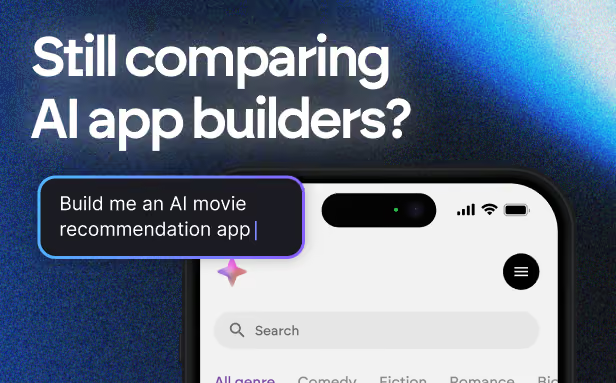
Most AI app builders stop at prototypes. Emergent creates production-ready apps you can actually launch.
- Production-ready apps
- Web & mobile apps
- Deploy in minutes







