




Anthropic retired the "4.6" suffix and shipped Claude Sonnet 5 on June 30, 2026. Same Sonnet tier, same 1M context window, same standard list price. On paper, it looks like a routine refresh.
The benchmarks tell a different story. This is the biggest generation-over-generation leap in Sonnet history. Terminal-Bench 2.1 jumps more than 13 points. Knowledge work jumps 223 Elo points, enough to actually beat Opus 4.8. On the hardest coding benchmark, Sonnet 5 gains five points and closes much of the distance to the flagship.
But there is more to this upgrade than benchmark gains. Sonnet 5 introduces a new tokenizer, three behavior changes that can break existing code, and a fundamentally different way of thinking about effort and cost. If you are running Sonnet 4.6 in production, this guide covers exactly what changed, what improved, and what you need to check before you migrate.
Claude Sonnet 4.6 vs Sonnet 5: What Actually Changed
Claude Sonnet 5 is a drop-in upgrade for Claude Sonnet 4.6 at the same standard price ($3 per million input tokens, $15 per million output tokens). It delivers major capability gains across coding, reasoning, and knowledge work.
The catches: a new tokenizer produces roughly 30% more tokens for the same text (introductory pricing offsets this through August 31, 2026), and three behavior changes mean it is not a zero-effort swap for every codebase.
The verdict for most teams: upgrade, but test your token budgets and remove a few deprecated parameters first.
Benchmark Comparison
Every number here is from Anthropic's Claude Sonnet 5 announcement and System Card. Note that some Sonnet 4.6 scores were revised due to updated grading methodology, so they may differ from the original Sonnet 4.6 launch figures.
| Benchmark | Sonnet 5 | Sonnet 4.6 | Gain | What It Measures |
|---|---|---|---|---|
| SWE-Bench Pro | 63.2% | 58.1% | +5.1 | Agentic coding, hard tasks |
| Terminal-Bench 2.1 | 80.4% | 67.0% | +13.4 | Terminal-based engineering |
| OSWorld-Verified | 81.2% | 78.5% | +2.7 | Computer use |
| Humanity's Last Exam (no tools) | 43.2% | 34.6% | +8.6 | Hardest academic questions |
| Humanity's Last Exam (with tools) | 57.4% | 46.8% | +10.6 | Same, with tools |
| GDPval-AA v2 (Elo) | 1618 | 1395 | +223 | Knowledge work quality |
Every benchmark improved. Not one regressed. The standout gains:
- Terminal-Bench 2.1 (+13.4 points): The headline for agent builders. Terminal fluency is the backbone of autonomous coding agents, and this is a structural improvement.
- Knowledge work (+223 Elo): The largest gain, and it pushes Sonnet 5 past Opus 4.8 on this benchmark. For document analysis and research synthesis, this is transformative.
- Humanity's Last Exam with tools (+10.6 points): Reasoning with tool access jumped enough that Sonnet 5 now essentially ties Opus 4.8.
Independent evaluations corroborate the direction. Cursor's internal CursorBench, run in their production harness, showed a meaningful Sonnet 5 gain over Sonnet 4.6, confirming Anthropic's published improvements are not benchmark-specific artifacts.
Want to know more? Check out our detailed breakdown of Claude Sonnet 5 benchmarks.
The Tokenizer Change
This is the most important practical difference between the two models, and the one most likely to surprise you.
Sonnet 5 uses a new tokenizer, the same one Anthropic introduced with Opus 4.7. Per Anthropic's documentation, the same input text produces approximately 30% more tokens than on Sonnet 4.6. (The announcement footnote gives a range of roughly 1.0 to 1.35x depending on content type.)
This is not an API change. Requests, responses, and streaming events keep the same shape, and no code changes are required for the tokenizer itself. But it affects anything you measure or budget in tokens:
- Token counts: Usage fields and token-counting results for the same text are higher than on Sonnet 4.6. Do not reuse counts measured against Sonnet 4.6; recount against Sonnet 5.
- Context window capacity in text terms: The context window is still 1M tokens, but each token covers less text on average, so the same window holds less text than on Sonnet 4.6.
- max_tokens budgets: An output limit tuned for Sonnet 4.6 may truncate equivalent output on Sonnet 5. Revisit limits are sized close to your expected output length.
- Per-request cost: Per-token pricing is unchanged, but because the same text produces more tokens, the cost of an equivalent request can be higher.
Anthropic explicitly set the introductory pricing so the transition from Sonnet 4.6 is roughly cost-neutral. Once standard pricing resumes on September 1, 2026, the tokenizer's cost effect becomes visible unless your workload benefits from the efficiency gains at higher effort.
Three Behavior Changes You Must Handle
Sonnet 5 is a drop-in replacement, but "drop-in" comes with three specific behavior changes that can break existing code. Per Anthropic's documentation:
1. Adaptive Thinking Is On by Default
On Sonnet 4.6, requests without a thinking field run without thinking. On Sonnet 5, the same requests run with adaptive thinking enabled by default.
Because max_tokens is a hard limit on total output (thinking plus response text), you need to revisit it for any workload that previously ran without thinking on Sonnet 4.6. To turn thinking off entirely, pass thinking: {type: "disabled"}.
2. Sampling Parameters Are Rejected
Setting temperature, top_p, or top_k to a non-default value now returns a 400 error. This is new for Sonnet-class models (the same constraint was previously introduced on Opus 4.7). Remove these parameters when migrating; the default value or omitting the parameter is accepted. Use system-prompt instructions to guide model behavior instead.
3. Manual Extended Thinking Is Removed
Manual extended thinking (thinking: {type: "enabled", budget_tokens: N}) was deprecated on Sonnet 4.6, and on Sonnet 5 it is removed and returns a 400 error, the same as on Opus 4.8 and 4.7. Use adaptive thinking with the effort parameter instead.
Aside from these three changes, code that already runs on Sonnet 4.6 needs no other changes. Tool definitions and response shapes are unchanged, and assistant message prefilling was already unsupported on Sonnet 4.6.
The New Effort Model
Sonnet 4.6 was a relatively fixed-behavior model. Sonnet 5 introduces a meaningful effort dimension that changes how you think about cost and quality.
Sonnet 5 exposes an effort parameter with levels from low through medium, high, and extra high (xhigh). Higher effort spends more tokens on reasoning, raising both quality and cost.
This is genuinely new flexibility. With Sonnet 4.6, you got roughly one behavior. With Sonnet 5, you can dial the cost-performance balance per task:
- Low to medium effort: Fast, cheap, good for straightforward tasks
- High to xhigh effort: More reasoning, higher quality, higher cost, for hard problems
Anthropic increased rate limits across Chat, Cowork, Claude Code, and the Claude Platform to accommodate the higher token usage of higher effort levels. The practical upshot: Sonnet 5 is not just a better Sonnet 4.6, it is a more configurable one.
Pricing Comparison
| Sonnet 5 (introductory) | Sonnet 5 (standard) | Sonnet 4.6 | |
|---|---|---|---|
| Input tokens | $2 / 1M | $3 / 1M | $3 / 1M |
| Output tokens | $10 / 1M | $15 / 1M | $15 / 1M |
At standard pricing, Sonnet 5 costs exactly the same per token as Sonnet 4.6: $3 input, $15 output. The introductory pricing of $2/$10 runs through August 31, 2026.
The nuance is the tokenizer. Because Sonnet 5 produces roughly 30% more tokens for the same text, an equivalent request can cost more even at the same per-token rate. Anthropic set the introductory pricing to make the transition roughly cost-neutral, which effectively gives you a two-month window to migrate before the tokenizer's cost effect fully lands.
Both models retain zero data retention support for organizations with ZDR agreements.
What Stayed the Same
Not everything changed. Sonnet 5 keeps:
- The same 1M token context window (both default and maximum)
- 128k max output tokens
- The same set of tools and platform features as Sonnet 4.6 (with one exception: Priority Tier is not available on Sonnet 5)
- The same API request and response shapes
- Zero data retention support for ZDR organizations
- The same standard per-token pricing
The claude-sonnet-5 API model ID replaces claude-sonnet-4-6. That is the core migration: update the model ID, handle the three behavior changes, and re-check your token budgets.
Should You Upgrade?
For almost every team, yes. Here is the decision by situation.
Upgrade now if:
- You want the capability gains (which are substantial across coding, reasoning, and knowledge work)
- You can handle the three behavior changes (remove sampling params, migrate off manual thinking, revisit max_tokens)
- You do knowledge work (Sonnet 5 now beats Opus 4.8 here)
- You do terminal-based engineering (the +13.4 point jump is significant)
Test carefully before upgrading if:
- Your workload has tight token budgets or max_tokens limits sized close to expected output (the tokenizer change can cause truncation)
- You depend on sampling parameters for deterministic behavior (you will need to rework this via system prompts)
- You have latency-sensitive workloads that previously ran without thinking (adaptive thinking on by default changes the token profile)
The migration checklist:
- Update the model ID from claude-sonnet-4-6 to claude-sonnet-5
- Recount your prompts with token counting under the new tokenizer
- Revisit max_tokens limits sized close to your expected output length
- Remove temperature, top_p, top_k if set to non-default values
- Migrate any budget_tokens usage to adaptive thinking with the effort parameter
- Test at your intended effort level to confirm cost and quality
Anthropic provides a dedicated migration guide with full details.
Building Products on Sonnet 5
Upgrading the model ID is a one-line change. Building and maintaining the product around the model is the harder part, and it is where most AI-powered launches stall. Between the API and a live product sits a UI, a database, authentication, payments, hosting, observability, deployment, and an iteration loop that usually requires a full engineering team.
Emergent is the platform built to close that gap. It is an AI app builder that takes a plain-language description of what you want to build and ships a real, production-ready full-stack application. Not a prototype, not a mockup. A working product with frontend, backend, database, auth, and deployment all handled in a single coordinated pass.
What makes Emergent meaningfully different from every other AI builder in 2026 is the depth of what it generates. Most no-code tools stop at the UI. Emergent reasons through how the entire system should work before writing it, then produces real code you fully own. The output syncs directly to your GitHub repository, so there is no platform lock-in. You can export it, deploy it elsewhere, or hand it off to an engineering team.
The integration story matters when a model upgrade like Sonnet 4.6 to Sonnet 5 lands. Emergent connects to the Claude API (and any other API you need) by describing what you want to integrate. No glue code, no SDK wrangling. When something breaks in production, Emergent's multi-agent framework analyzes backend logs and resolves issues without human intervention. When requirements change, you iterate by prompt rather than rebuilding.
For teams in regulated industries, Emergent is SOC 2 Type I certified with SSO/SAML, role-based access control, and audit logging built in. That combination of consumer-grade ease and enterprise-grade compliance is what makes it a different category from both traditional no-code tools and AI coding assistants.
The model upgrade is one variable. The platform that turns the model into a maintained, production product is the other. Get both right and the effort of shipping and iterating changes meaningfully.
The Bottom Line
Claude Sonnet 5 is not an incremental refresh of Sonnet 4.6. It is the biggest generation-over-generation leap in Sonnet history, with double-digit gains on terminal engineering and reasoning-with-tools, a 223-point knowledge-work jump that beats Opus 4.8, and consistent improvements across every published benchmark.
The upgrade is not entirely free, though. The new tokenizer produces roughly 30% more tokens for the same text, and three behavior changes (adaptive thinking on by default, sampling parameters rejected, manual thinking removed) mean you need to test before you swap in production. Introductory pricing through August 31, 2026 makes the transition roughly cost-neutral in the meantime.
For the overwhelming majority of teams running Sonnet 4.6, the answer is to upgrade. Just run the migration checklist first: update the model ID, recount tokens, revisit max_tokens, remove deprecated parameters, and confirm quality at your intended effort level.
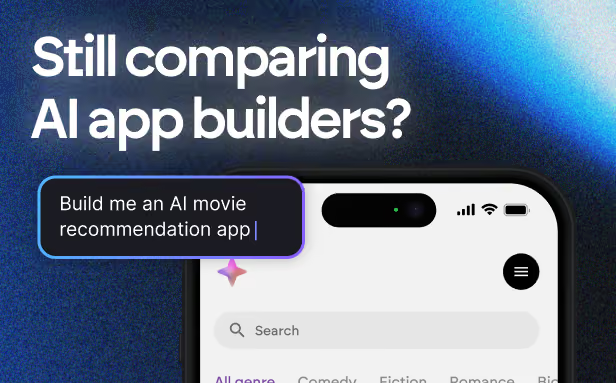
Most AI app builders stop at prototypes. Emergent creates production-ready apps you can actually launch.
- Production-ready apps
- Web & mobile apps
- Deploy in minutes







