Claude Fable 5 is the most capable publicly available AI model as of July 2026. It leads every major coding benchmark, holds a one million token context window, and sustains multi-hour autonomous work that no other model can match.
It also disappeared for 18 days.
Fable 5 launched on June 9, 2026 as Anthropic's first publicly available Mythos-class model. Three days later, the U.S. Commerce Department issued an export control directive that forced Anthropic to disable it worldwide. The model returned on July 1 with updated safety classifiers and stricter guardrails. It scores 95% on SWE-bench Verified and 80% on SWE-bench Pro, and costs $10 per million input tokens and $50 per million output tokens.
So why look for Claude Fable 5 alternatives? Two reasons. First, capability and necessity remain different questions. For most tasks on a typical workday, Fable 5's Mythos-class power goes unused. Paying frontier rates for a 200-word email draft or a data transformation script is still like renting a crane to move a couch.
Second, the ban proved that any single model can vanish overnight, regardless of how good it is. A routing strategy is no longer optional.
This article answers a practical question: which model should you actually use for which task, and what should your fallback plan look like?
What happened to Fable 5: the ban, the fix, and why alternatives still matter
On June 12, 2026, three days after Fable 5 launched, the U.S. Commerce Department ordered Anthropic to disable it for all users worldwide. The directive cited national security concerns after Amazon researchers found a prompting technique that bypassed Fable 5's safety classifiers, getting the model to produce cybersecurity information that was supposed to be restricted.
Anthropic could not filter users by nationality in real time, so it shut down both Fable 5 and Mythos 5 for everyone. The ban lasted 18 days.
On July 1, Fable 5 returned with updated safeguards. Anthropic trained a new safety classifier that blocks the reported exploit in over 99% of attempts. When a request triggers the classifier, the user is notified and the request routes to Claude Opus 4.8 automatically. The trade-off: the stricter classifier flags more benign requests during routine coding and debugging. Developers in cybersecurity-adjacent areas can expect more false positives than before the ban.
Current access terms (as of July 2026): Fable 5 is live globally across Claude.ai, the Claude Platform, Claude Code, and Claude Cowork. Included subscription access ended July 19. All usage now requires usage credits at $10/$50 per MTok. Standard Enterprise seats require credits to be explicitly enabled.
The 18-day suspension is relevant to an alternatives article because it demonstrated something the AI industry had not seen before: a commercially deployed frontier model pulled by regulatory order with roughly 90 minutes' notice. Whether or not you agree with the government's reasoning, the operational lesson is clear. Treating any single model as a hard dependency is a single point of failure.
Why people are already looking for Claude Fable 5 alternatives
Four concerns about Fable 5 drive the search for alternatives, and all four are legitimate.
1. The price math does not add up for routine work
At $10/$50 per MTok, Fable 5 costs exactly twice what Claude Opus 4.8 does. It also burns through tokens at a faster rate than any previous Claude model. If your daily workload is chat queries, short code snippets, and email drafts, you are paying frontier rates for tasks that cheaper models handle equally well.
2. Safety classifiers trip on legitimate work
Fable 5's safety classifiers automatically reroute flagged requests to Opus 4.8. Anything touching cybersecurity, biology, chemistry, or model distillation gets redirected. Before the ban, Anthropic said this fired in fewer than 5% of sessions. After the July 1 reinstatement, the classifiers are stricter. The new classifier blocks the specific exploit that triggered the ban in over 99% of cases, but it also flags more benign coding and debugging requests as false positives.
If you work in security research or biotech, you will get Opus 4.8 responses while paying Fable 5 rates more often than before.
3. Most tasks do not need long-horizon autonomy
Fable 5's real advantage shows up on tasks measured in hours and days: codebase migrations, multi-file refactors, and long-running research workflows. Anthropic itself frames the model as designed for work at that scale. A blog outline, a quick data pull, or a Slack summary do not benefit from Mythos-class power. Routing them through Fable 5 is paying a premium for capabilities you never touch.
4. The ban proved model access is not guaranteed
This is the concern that did not exist when Fable 5 first launched. The 18-day suspension showed that even the strongest model from the most safety-conscious lab can be pulled overnight by forces outside anyone's control. Teams that had hard-coded claude-fable-5 into their production stacks woke up to broken pipelines. During the outage, Opus 4.8 and Sonnet carried the load, but workloads that depended on Fable 5's reasoning depth had no equivalent substitute. A fallback strategy is now a resilience requirement, not just a cost optimization.
Claude Fable 5 alternatives: quick comparison
Ten models cover the range from direct Claude alternatives to budget API options and open-source models you can self-host. The table below sorts them by primary use case, with API pricing and the specific capability you give up relative to Fable 5.
Pricing as of July 2026. Verify against each vendor's official pricing page before committing.
Best Claude Fable 5 alternatives in 2026
1. Claude Opus 4.8: the alternative you already have
Claude Opus 4.8 is Fable 5's literal fallback model. When the safety classifiers fire, Opus 4.8 answers instead. During the 18-day ban, it was the model that kept every Claude-dependent workflow running.
Opus 4.8 launched on May 28, 2026 at $5/$25 per MTok and sits at #1 on the Artificial Analysis Intelligence Index at 61.4, making it the highest-ranked generally available model before Fable 5 entered the picture.
On SWE-bench Pro, Opus 4.8 scores 69.2%. That is 11 points behind Fable 5's 80%, which sounds like a meaningful gap until you consider that nine out of 10 daily coding tasks will not surface the difference. Opus 4.8 also uses about 35% fewer output tokens than its predecessor Opus 4.7, which means the effective cost saving is even larger than the sticker price suggests.
Emergent's internal production testing puts a finer point on the gap. Running both models on the same set of real app briefs, Opus 4.8 completed 41 features against Fable 5's 45, and the median Fable build cost roughly 1.5x what the Opus build cost (not the 2x the sticker rate suggests, because Fable's efficiency offsets part of the premium).
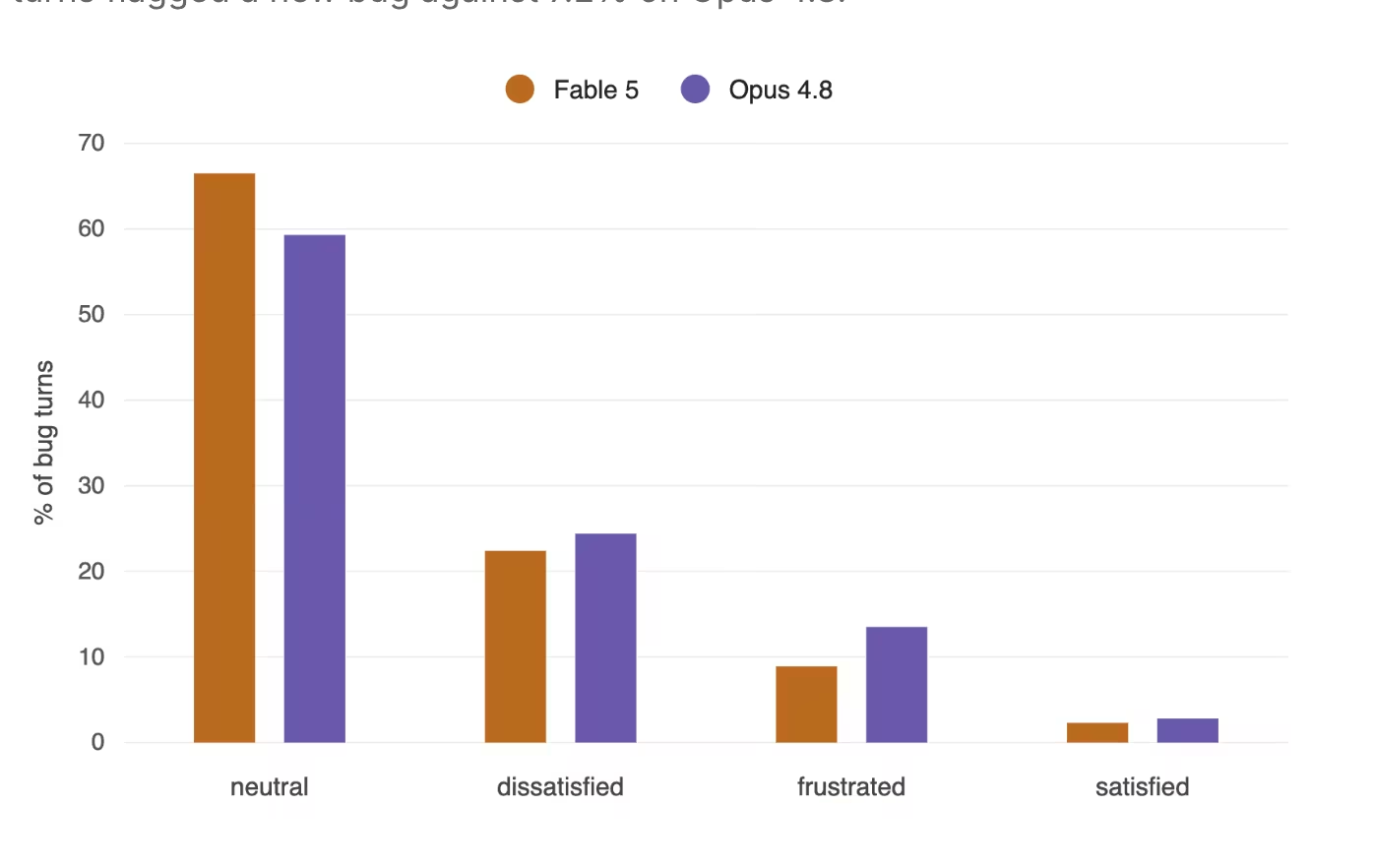
On bug rates, Fable flagged 6.6% new bugs per user turn against Opus's 7.2%. The difference is real but moderate. For most workloads, Opus gets you 91% of the way there at half the price.
If you want to go deeper on how the two models stack up, our full Fable 5 vs Opus 4.8 breakdown covers benchmarks, pricing, safeguards, and a decision framework for choosing between them.
Where it falls short
Opus 4.8 cannot sustain the multi-hour autonomous runs that define Fable 5's strength. Emergent's evals showed the gap widening specifically on long-horizon builds where the agent needs to hold the product shape across hundreds of steps. Fable delegated 23.5% of its steps to specialist sub-agents compared to Opus's 14.6%, and it self-checked with verification screenshots more frequently. If you need a model to work for a full day inside Claude Code on a codebase migration, Opus will lose the thread where Fable 5 will not.
Who this is for
Anyone who wants Claude-quality output without paying Fable 5 prices. Opus 4.8 handles the same everyday tasks at half the cost, and it lives in the same ecosystem, so switching requires zero migration.
2. GPT-5.6 (Sol, Terra, Luna): the three-tier OpenAI play
GPT-5.6 became generally available on July 9, 2026, replacing GPT-5.5 as OpenAI's flagship. The biggest change from an alternatives perspective is the three-tier structure. Sol ($5/$30 per MTok) targets the hardest reasoning and coding work. Terra ($2.50/$15) is the balanced everyday model at half Sol's price. Luna ($1/$6) handles high-volume work where cost per call is the primary constraint.
Sol is the most relevant comparison to Fable 5. It took the top spot on the Artificial Analysis Coding Agent Index with a score of 80 and scored 53.6 on Agents' Last Exam (vendor-reported by OpenAI), pulling 13.1 points ahead of Fable 5 on that specific agentic benchmark. On SWE-bench Pro, however, Fable 5 still leads Sol (80.3% vs 64.6%, both vendor-reported). The pattern is consistent: Sol is stronger on agentic orchestration tasks, Fable 5 is stronger on raw software engineering.
The three-tier ladder is Sol's real differentiator. Teams that previously ran everything through GPT-5.5 at one price can now route cheap work to Luna ($1/$6), everyday production to Terra ($2.50/$15), and reserve Sol for the hardest problems. That kind of built-in routing is something you have to architect yourself in the Claude ecosystem.
OpenAI also introduced Ultra Mode, where Sol uses sub-agents for parallel work, and Programmatic Tool Calling that lets the model write JavaScript to orchestrate tools. Both features are aimed squarely at the agentic workflow market where Fable 5 competes.
Where it falls short
Coding. The 15.4-point gap on SWE-bench Pro is meaningful for teams whose primary workload is complex software engineering. OpenAI's ecosystem is also adjusting to the three-tier split: not all third-party integrations have been updated to route across Sol, Terra, and Luna, so some tool calls still default to a single tier.
Who this is for
Teams that want frontier capability with built-in cost routing. Sol for hard problems, Terra for daily work, Luna for volume. Also the strongest option for anyone already invested in OpenAI's Codex environment or tool ecosystem.
3. Claude Sonnet 5: the new workhorse for high-volume API calls
Claude Sonnet 5 launched on June 30, 2026, and immediately replaced Sonnet 4.6 as the default model on Claude's free and Pro plans. Anthropic positions it as the most agentic Sonnet yet, able to plan, use browsers and terminals, and run autonomously at a level that previously required Opus.
The pricing is aggressive: $2/$10 per MTok through August 31, 2026 (introductory), then $3/$15 standard. At the intro rate, Sonnet 5 costs 80% less than Fable 5 on input. Even at the standard rate, it runs at 70% less.
On benchmarks, Sonnet 5 narrows the gap with Opus 4.8 more than any previous Sonnet closed on its predecessor. It scores 63.2% on SWE-bench Pro (Opus 4.8 is 69.2%, Fable 5 is 80%), and it scores 53 on the Artificial Analysis Intelligence Index at max effort (Opus 4.8 is 61.4). On everyday coding, tool use, and agentic task completion, the difference between Sonnet 5 and Opus 4.8 is often invisible.
This is the model I reach for when the task is well-defined, the volume is high, and the per-call cost matters more than squeezing out the last 5% of quality. Classification, extraction, summarization, code generation for scoped features, and chat interactions that do not require extended reasoning all run cleaner on Sonnet 5's cost curve.
Already leaning toward Sonnet for routine work? See how it holds up against Opus in our Claude Sonnet vs Opus comparison before you commit.
Where it falls short
Complex, multi-step reasoning is where the gap shows. On tasks that require sustained attention across long chains of dependencies, Sonnet 5 drops off noticeably compared to Opus 4.8 or Fable 5. It is not the right model for a codebase migration or a 50-page document analysis that requires cross-referencing across sections. Anthropic also documents a newer tokenizer and adaptive thinking by default, which means prompts tuned for Sonnet 4.6 need re-baselining.
Who this is for
Developers making thousands of API calls per day where per-call cost matters more than peak intelligence. The ideal setup for many teams is Fable 5 or Opus 4.8 for complex tasks and Sonnet 5 for everything else.
4. Gemini 3.1 Pro: the Google Workspace play
If your work lives in Google Docs, Sheets, and Gmail, Gemini 3.1 Pro is the only model on this list with native integration into that stack. It costs $2/$12 per MTok on prompts under 200K tokens ($4/$18 above), and holds the largest context window of any model here at two million tokens.
On reasoning, Gemini 3.1 Pro is genuinely strong. It scores 77.1% on ARC-AGI-2 and 94.3% on GPQA Diamond, putting it ahead of most competitors on scientific and abstract reasoning tasks. It also generates images and video, something no Claude model does. For teams that need multimodal output alongside text, Gemini is the natural choice.
Where it falls short
Coding benchmarks lag significantly. At 54.2% on SWE-bench Pro, Gemini 3.1 Pro trails Fable 5 by 26 points and Opus 4.8 by 15. Google also removed free-tier access to Pro models as of April 2026; the free tier now only covers Flash and Flash Lite.
Who this is for
Teams embedded in Google Workspace who want AI that works natively with their existing tools. Also a strong pick for research teams that value reasoning benchmarks and need image or video generation alongside text.
5. Grok 4.5: near-Opus capability at a fraction of the cost
Grok 4.5 launched on July 8, 2026 as the first model from SpaceXAI (formerly xAI, rebranded after the SpaceX merger). It costs $2/$6 per MTok, making it 5x cheaper than Fable 5 on input and over 8x cheaper on output. SpaceXAI positions it as "Opus-class, but faster, more token-efficient, and lower cost."
The headline differentiator is the Cursor integration. Grok 4.5 is the first model jointly trained by SpaceXAI and Cursor on trillions of tokens from developer and agent interactions. It ships as the default model inside Cursor on all plans, which gives it a distribution advantage no other non-OpenAI, non-Anthropic model has. On benchmarks, it scores 54 on the Artificial Analysis Intelligence Index (fourth overall, behind Fable 5, GPT-5.5, and Opus 4.8), 83.3% on Terminal-Bench 2.1, and 64.7% on SWE-bench Pro.
Where Grok 4.5 wins on economics is token efficiency. SpaceXAI's published charts show it uses 3 to 4x fewer tokens per completed task than Fable 5 or Opus 4.8. On agentic tool use, Artificial Analysis ranked it first. For teams running high-volume agent workflows where cost-per-completed-task matters more than peak benchmark scores, those efficiency gains compound fast.
Where it falls short
Honesty and hallucination. Artificial Analysis found Grok 4.5's hallucination rate more than doubled compared to Grok 4.3, jumping from 25% to 54%. That is a significant regression for any workflow where factual accuracy matters and human review is not built into the loop. The context window also dropped from Grok 4.3's 1M to 500K tokens, which matters for long-document analysis. SpaceXAI has not published a model card or safety documentation for Grok 4.5, making it harder to evaluate for regulated or high-stakes use cases.
Who this is for
Teams already in the Cursor ecosystem who want a strong coding model at a lower price point than Opus or Sol. Also worth evaluating for high-volume agentic workflows where token efficiency drives total cost down, as long as the hallucination rate is acceptable for the task and human review is in the loop. If you need the lower price of the previous generation, Grok 4.3 remains available at $1.25/$2.50 per MTok.
6. Kimi K3: the open-weight model that nears the frontier
Kimi K3 launched on July 16, 2026 as the largest open-weight model ever announced: 2.8 trillion total parameters with a Mixture-of-Experts architecture that activates 16 of 896 experts per token. It holds a 1 million token context window with native text, image, and video input.
Moonshot AI's own assessment is refreshingly honest: K3's overall performance "still trails the most powerful proprietary models, Claude Fable 5 and GPT-5.6 Sol," while "consistently outperforming other tested models." On coding, K3 scored 67.5 on DeepSWE, 88.3 on Terminal Bench 2.1, and 42.0 on SWE Marathon (the highest among all models tested in that category). Vercel's CEO noted that K3 matched Fable 5's success rate on the Next.js code generation benchmark while completing tasks faster.
The real story is not the benchmarks but the access model. Full weights are scheduled for release on July 27, 2026 under a Modified MIT license. Once published, teams can self-host a near-frontier model without per-token costs or vendor dependency. That is the architectural argument for open weights: no government letter, no pricing change, and no policy update can switch off a model running on your own hardware.
The API is live now through Moonshot's platform. Pricing is $3/$15 per MTok (with cache-hit input at $0.30 per MTok), putting it at the same tier as Claude Sonnet 5's standard rate. That is far cheaper than Fable 5, but a significant jump from the sub-dollar pricing of older Chinese frontier models like DeepSeek V4. Moonshot raised API rates compared to K2.7, signaling that near-frontier open models are no longer the bargain they used to be.
Where it falls short
The weights are not out yet. Until July 27, Kimi K3 is API-only, meaning you depend on Moonshot's infrastructure. Self-hosting 2.8T parameters requires serious hardware (Moonshot recommends 64+ accelerators). The model is also new enough that independent verification of its benchmark claims is still thin. For teams building in production today, GLM 5.2 offers a similar open-weight value proposition with weights already available.
Who this is for
Teams evaluating open-weight models at frontier scale for long-term infrastructure independence. If you can wait for the weights and have the hardware to self-host, K3 could reset what open models are capable of. If you need something running today, look at GLM 5.2 or DeepSeek V4.
7. DeepSeek V4: data sovereignty and open-source flexibility
DeepSeek V4 is available in two tiers: V4 Flash at $0.14/$0.28 per MTok and V4 Pro at $0.435/$0.87. The Flash tier is the cheapest frontier-class API available anywhere. V4 Pro also expanded its context window to one million tokens with 384K max output, and it scores 81% on SWE-bench Verified, competitive with models costing 10x more.
The real reason DeepSeek is on this list is not price. It is open-source. All DeepSeek models ship with open weights under permissive licenses, so you can self-host them on your own infrastructure. For teams where Fable 5's mandatory 30-day data retention is a dealbreaker, self-hosting DeepSeek eliminates the data residency concern entirely.
Where it falls short
If you use the hosted API instead of self-hosting, your data goes to servers in China. Multiple countries have banned or investigated DeepSeek over data privacy concerns, including Italy, South Korea, and over a dozen EU jurisdictions. Self-hosting solves the data problem but requires significant infrastructure investment.
Who this is for
Teams with strict data governance requirements who can self-host. Also developers running extremely high-volume workloads where even Grok 4.3's pricing feels expensive. If data residency is not a concern, V4 Flash is unmatched on cost per token.
8. Gemini 3.1 Flash Lite: when cost-per-call is the entire decision
Gemini 3.1 Flash Lite costs $0.25/$1.50 per MTok, 40x cheaper than Fable 5 on input. It runs at 381 tokens per second, making it one of the fastest production models available, and holds a one million token context window at that price point.
For workloads like content moderation, data extraction, classification, translation, and chatbot response generation at scale, Flash Lite delivers reliable outputs at a cost that makes million-call-per-day pipelines economically viable. Google has also added support for audio, image, and video input, giving it multimodal flexibility that most budget models lack.
Where it falls short
Flash Lite is not a frontier reasoning model. Its Intelligence Index score of 34 puts it well below the top of this list. Asking it to handle a complex architectural decision or a multi-step code refactor is asking it to do a job it was not built for.
Who this is for
Teams processing millions of API calls per month where latency and cost are the primary constraints. If you are building production pipelines for classification, extraction, or summarization, Flash Lite is the price-performance leader.
9. GLM 5.2: open-weight coding with a 1M context window
GLM 5.2 arrived on June 13, 2026 as a 744 billion parameter Mixture-of-Experts model from Zhipu AI, published on Hugging Face under a permissive MIT license. Independent benchmarks rank it the top open-weight coding model available today, and it ships with a one million token context window.
What makes GLM 5.2 immediately practical where Kimi K3 is still a promise: the weights are already out. The community has produced BF16, FP8, and 4-bit GGUF quantization formats. Day-one runtime support exists across vLLM, SGLang, and Transformers. Zhipu also ships an Anthropic-compatible API endpoint, which means tools like Claude Code can use GLM 5.2 as a drop-in by swapping the base URL and key.
On the hosted API, GLM 5.2 costs approximately $1.40/$4.40 per MTok, a fraction of Fable 5. Self-hosting eliminates per-token costs entirely but requires the hardware to run 744B parameters.
Where it falls short
Like Qwen and DeepSeek, GLM 5.2 is China-based (Zhipu AI is a Beijing company). U.S. regulated teams should evaluate data-origin and procurement rules before using the hosted API. Self-hosting on your own infrastructure resolves the data residency question but not the procurement question for some compliance frameworks. The model is also significantly smaller than Kimi K3 (744B vs 2.8T), which may matter as K3's weights become available.
Who this is for
Teams that want open-weight frontier coding performance available today, not on July 27. If you need to self-host for data sovereignty and want the strongest open coding model with weights you can download right now, GLM 5.2 is the answer. For a detailed comparison of how it stacks up against Kimi K3, see our Kimi K3 vs GLM 5.2 breakdown.
10. Llama 4 Maverick: vendor independence and zero lock-in
Llama 4 Maverick is Meta's largest open-weight model: 400 billion total parameters with 17 billion active per forward pass using a Mixture-of-Experts architecture. It is available through 8+ API providers at prices ranging from $0.15/$0.60 to $0.35/$0.85 per MTok, or you can self-host it for zero per-token cost.
The value proposition is not benchmark dominance. Maverick scores 18 on the Artificial Analysis Intelligence Index, below the frontier tier. Its real value is architectural. If you are building a product and do not want your core AI layer tied to one provider's pricing or policy decisions, an open-weight model you control is the answer. No vendor lock-in. No surprise billing changes. No mandatory data retention.
Where it falls short
On raw intelligence, Maverick is not competitive with the frontier models on this list, and the gap has widened with the arrival of Kimi K3 and GLM 5.2 as open-weight options that score significantly higher on coding and reasoning benchmarks. Its knowledge cutoff is August 2024, making it stale for anything involving recent events. Self-hosting 400 billion parameters requires serious hardware investment that most small teams cannot justify.
Who this is for
Product teams building for long-term scale who need to own their AI infrastructure. If your priority is eliminating dependency on any single provider rather than maximizing benchmark scores, Maverick is the established open-weight option with the widest deployment base. Teams with higher capability requirements should evaluate Kimi K3 or GLM 5.2.
So when should you actually use Claude Fable 5?
After walking through 10 alternatives, it is worth being direct about when none of them will do. Fable 5 earns its price on a specific class of tasks.
Emergent's internal testing clarifies where the premium pays off. Fable 5 is better understood as a judgment layer than a default worker. In production, it delegated 23.5% of its steps to specialist sub-agents (compared to Opus's 14.6%), verified its own work with screenshots more frequently, and flagged roughly 8% fewer new bugs per user turn. The value is not just a smarter answer. It is a model that plans, reviews, and decides when to inspect, keeping the next step from becoming the user's problem.
Here is what the tasks that justify Fable 5's rate look like.
1. Large-scale codebase migrations
Fable 5 can hold context across hundreds of files simultaneously and sustain that coherence over hours of autonomous work. Stripe completed a codebase-wide migration across a 50-million-line Ruby codebase in a single day, a task that would have taken a full engineering team over two months. If the job requires the model to understand the whole system before touching any part of it, Fable 5 is the only model built for that.
2. Complex knowledge work in finance or legal
On the Hebbia Finance Benchmark, Fable 5 posted the highest score of any model tested, including on document reasoning, chart interpretation, and multi-step problem solving. When the output needs to meet professional standards across a long, context-heavy document, the quality gap over cheaper models is visible.
3. Multi-day autonomous sessions in Claude Code
Fable 5 is designed for work measured in hours and days, not minutes. It actively builds and uses working memory to improve its own outputs over extended sessions, rather than just processing more context. For autonomous debugging, iterative refactors, or agent workflows that run overnight, Opus 4.8 loses the thread where Fable 5 does not.
4. Vision-heavy tasks
Fable 5 can rebuild a web app's source code from screenshots alone and extract precise data from dense scientific figures. On spatial reasoning, it scores 38.6% against Opus 4.8's 14.5%. If your task involves understanding what is on a screen, in a chart, or inside a technical diagram, and acting on it, no other generally available model is close. Automattic's Jamie Marsland tested this by giving it a screenshot and a URL, and Fable 5 built a fully editable WordPress block theme in a single shot.
5. Frontier research
Where the task requires synthesizing large volumes of literature, forming novel hypotheses, or running long autonomous research workflows, Fable 5 operates in a different tier. This is not about speed. It is about the quality of reasoning over sustained, complex, open-ended work.
6. When the ban lesson applies to you
The 18-day suspension taught a practical lesson that applies even when Fable 5 is available: no model should be your only model. The smartest use of Fable 5 is not as a default for everything but as the top tier in a routing strategy. Reserve it for the 5% of tasks where Mythos-class power changes the outcome. Route the other 95% through Opus 4.8, Sonnet 5, or GPT-5.6 Terra. That way, if Fable 5 disappears again (or if a pricing change makes it uneconomical), your workflow degrades gracefully instead of breaking.
Which Fable 5 alternative to use and when
Ten alternatives is a lot to hold in your head. This table cuts through the details. Find your primary constraint in the left column, and the right column tells you where to start.
A practical routing ladder looks like this: Sonnet 5 or GPT-5.6 Terra for everyday traffic, Opus 4.8 for complex work, and Fable 5 reserved for the long-horizon tasks where nothing else finishes the job. Add an open-weight model (GLM 5.2 or Kimi K3 once the weights ship) as a floor that no vendor action can remove.
Build with Fable 5 or any of its alternatives on Emergent
Capability and necessity are still different questions. For long-horizon coding, complex knowledge work, and multi-day autonomous sessions, Fable 5 earns its price. For everything else, Opus 4.8, GPT-5.6, Sonnet 5, Gemini, Grok, or an open-weight model will get the job done at a fraction of the cost. The ban made one additional thing clear: flexibility across models is not a nice-to-have. It is infrastructure.
The smarter question is not which model is best. It is which model is right for what you are building right now.
Whichever model you settle on, you can build with it on Emergent. Claude Fable 5, Opus 4.8, Sonnet 5, GPT-5.6 (Sol and Terra), and Gemini 3.1 Pro are all live on the platform. Emergent's Universal LLM Key gives you access to Claude, OpenAI, and Google AI models through a single credential inside your Emergent account. No separate API keys to manage, no external billing to track. You pick the model that fits the task, describe what you want to build, and Emergent's multi-agent architecture takes it from there: frontend, backend, database, auth, integrations, and deployment, all handled for you.


Every alternative has trade-offs. Emergent just builds production-ready apps from one prompt.
- Production-ready apps
- Web & mobile apps
- Deploy in minutes