Anthropic released Claude Opus 5 on July 24, 2026, and it immediately reset the price-to-performance math for frontier AI models. At $5/$25 per million tokens, it matches Opus 4.8's pricing while roughly doubling its predecessor's benchmark scores across coding and reasoning evaluations. Whether you need something cheaper, something stronger, or something you can self-host, these seven Opus 5 alternatives cover the realistic options.
Why people search for Opus 5 alternatives
Most Opus 5 alternative searches right now are not from disappointed users. The model is days old, not months. The searches come from people who read the launch coverage and want to know whether it changes a decision they had already been weighing.
That splits into three distinct questions. The first is cost: does something cheaper sit close enough on capability to make Opus 5 unnecessary? The second is capability ceiling: for teams running long agentic chains, does a pricier model like Fable 5 justify the premium? The third is lock-in. Building on a single provider's API is a commercial decision, and a new release is a natural moment to reconsider it.
Opus 5 alternatives at a glance
Pricing as of July 2026. All figures are per million tokens. Benchmark scores are vendor-reported unless labeled otherwise.
The 7 best Opus 5 alternatives
1. GPT-5.6 Sol
GPT-5.6 Sol is the most direct Opus 5 competitor. It matches Opus 5's $5 per million input tokens, though its output rate is $30 compared to Opus 5's $25. OpenAI positions Sol as the flagship of its three-tier GPT-5.6 family, which also includes Terra (balanced) and Luna (budget).
How Sol compares on capability
Sol ships with two reasoning modes that matter for agentic workflows. Base Sol handles standard requests. Sol Ultra allocates more compute at inference time and is designed for the hardest problems. On Terminal-Bench 2.1, an agentic coding evaluation, Sol Ultra scored 91.9% and base Sol scored 88.8%, according to OpenAI's preview benchmarks. Those figures are vendor-reported and have not been independently replicated on a neutral harness.
All three GPT-5.6 models share a roughly 1M-token context window and 128K max output tokens. Sol is available through ChatGPT, Codex, and the OpenAI API as of July 9, 2026.
Where the cost math changes
The $5 difference on output pricing adds up. An agent that generates 10 million output tokens per month pays $50 more on Sol than on Opus 5. For input-heavy workloads like retrieval-augmented generation, the cost difference is negligible. For output-heavy coding agents that produce long files, it compounds. The ability to drop to Terra or Luna within the same API for cheaper sub-tasks is Sol's structural advantage. Opus 5 can route down to Sonnet 5, but that requires moving across model tiers rather than staying within the same family.
2. GPT-5.6 Terra
GPT-5.6 Terra is the middle tier of OpenAI's GPT-5.6 lineup, priced at $2.50/$15 per million tokens. OpenAI says Terra is competitive with GPT-5.5 at roughly half the cost. For teams that find Opus 5's $25 output rate too expensive at volume, Terra offers a meaningful step down without leaving a frontier-capable model family.
Same API, lower ceiling
Terra shares Sol's context window (~1M tokens) and safety stack, including model-level refusals and real-time misuse classifiers. It supports the same API interface, so routing between Sol and Terra is a configuration change, not a code rewrite. The practical pattern is to send routine sub-tasks to Terra and escalate complex reasoning to Sol, an approach that works because the API model parameter is all that changes between tiers.
Where the gap shows
Terra does not have Sol Ultra's extended reasoning mode, and on the hardest agentic coding benchmarks, the gap between Terra and Sol is meaningful. For everyday coding assistance, content generation, and structured data work, that gap rarely matters. The limitation is real only when you need the absolute ceiling on every request.
3. Claude Fable 5
Claude Fable 5 is Anthropic's most capable widely released model. It sits above Opus 5 in the Claude hierarchy, not below it, and costs exactly double: $10/$50 per million tokens.
The capability gap that justifies the premium
Fable 5 is built for the tasks where Opus 5 runs out of runway. Anthropic describes it as capable of sustained autonomous operation across multi-day tasks, planning across stages, delegating to sub-agents, and checking its own work. On CursorBench 3.2, Opus 5 at max effort came within 0.5% of Fable 5's peak score (vendor-reported, Anthropic). That 0.5% gap is narrow on a benchmark and wider in practice when tasks involve sustained coherence over hours or days.
Safety classifiers and data retention
Fable 5 carries heavier safety classifiers than Opus 5. Anthropic expects Opus 5's safety classifiers to trigger about 85% less often than Fable 5's. For teams that were hitting Fable 5's guardrails on routine cybersecurity or debugging work, Opus 5's lighter classifiers may actually be the reason to stay on Opus rather than upgrade.
Two practical notes. Fable 5's training data cutoff is reported as January 2026, while Opus 5's is May 2026. Anthropic also confirms that Opus 5 does not have data retention requirements for general access, unlike Fable 5 which carries a 30-day data retention policy.
4. Claude Sonnet 5
Claude Sonnet 5 is the other direction from Fable. Released June 30, 2026, it brings near-Opus agentic performance to a substantially lower price point. The introductory rate is $2/$10 per million tokens through August 31, 2026, after which standard pricing moves to $3/$15.
Pricing and the intro window
The introductory pricing creates a time-sensitive calculation. At $2/$10, Sonnet 5 costs 60% less than Opus 5 on input and 60% less on output. At the September standard rate of $3/$15, the savings drop to 40% on input and 40% on output. Teams evaluating Sonnet 5 as an Opus 5 alternative should test during the intro window and decide before the price step takes effect.
Where Sonnet 5 holds up and where it doesn't
For teams that route by task complexity, Sonnet 5 handles the bulk of everyday work while Opus 5 or Fable 5 handles the hard tail. Sonnet 5 supports the same 1M-token context window and 128K max output as Opus 5, plus adaptive thinking that adjusts effort per request. On coding benchmarks, it narrows the capability gap with the Opus family significantly compared to Sonnet 4.6, though on the longest and most complex agentic chains the gap is still visible.
One migration note: Sonnet 5 uses a newer tokenizer than Sonnet 4.6, which means prompts tuned for the previous generation need re-baselining. Early reports suggest the tokenizer can produce significantly more tokens for the same text, partially offsetting the lower per-token price.
5. Kimi K3
Kimi K3 is the most interesting open-weight entry on this list. Moonshot AI released it on July 16, 2026, as a 2.8-trillion-parameter mixture-of-experts model with a 1M-token context window, native vision, and always-on maximum reasoning effort. The API is priced at $3/$15 per million tokens.
The open-weight case
K3's architecture uses what Moonshot calls Kimi Delta Attention, a hybrid linear attention design built specifically for long-context inference. In practice, K3 can hold an entire large repository in context without the performance degradation that plagues some models at the far end of their context window. Moonshot committed to releasing open weights under a Modified MIT license by July 27, 2026, on its Hugging Face organization page.
The verbosity catch
K3 always runs at maximum reasoning effort. There is no low or medium toggle, which means every request burns output tokens at the full $15 rate. Reports from early users indicate K3 is more verbose than competing models on equivalent tasks, which can erase the per-token price advantage against Opus 5. On paper, $3/$15 undercuts Opus 5's $5/$25. In practice, if K3 generates 1.5x the output tokens for the same task, the effective cost converges.
Benchmark context
K3 scores 57 on Artificial Analysis's Intelligence Index, one point ahead of Claude Opus 4.8 (56). On Moonshot's own coding suite, K3 edges Opus 4.8 across the board. Those are competitive figures, but they predate Opus 5's release and have not been updated against the new model.
6. Grok 4.5
Grok 4.5 is SpaceXAI's coding-focused flagship, released July 8, 2026, and priced at $2/$6 per million tokens. That output rate is the lowest of any near-frontier model on this list, and it changes the per-task economics meaningfully for output-heavy workloads.
How it stacks up on benchmarks
SpaceXAI built Grok 4.5 as a mixture-of-experts model trained jointly with Cursor on real developer sessions. Artificial Analysis scores it at 54 on its Intelligence Index, which placed it in the top five before Opus 5 launched. Post-launch, Opus 5 pushed several models down the leaderboard, and Grok 4.5 now sits below the Claude and OpenAI flagships. On SpaceXAI's own benchmark charts, Grok 4.5 places third or fourth on every evaluation shown, never first.
The context window tradeoff
The 500K context window is the clearest limitation compared to Opus 5's 1M. For workloads that need to hold an entire large codebase in context, that halved window is a hard constraint. For standard coding sessions, debugging, and agentic work that stays within 500K tokens, the constraint rarely binds.
Effort toggle and caching
Grok 4.5 supports three reasoning effort levels (low, medium, high) with high as the default, similar to Opus 5's effort toggle. Cached input costs $0.50 per million tokens, a 75% discount off the standard rate. It is available through the SpaceXAI console, Cursor on all plans, and Grok Build.
7. GLM 5.2
GLM 5.2 from Z.ai (formerly Zhipu AI) is the budget frontier option. Released June 16, 2026, it is a 744-billion-parameter mixture-of-experts model priced at $1.40/$4.40 per million tokens through Z.ai's first-party API, with third-party providers like OpenRouter offering it even cheaper.
Licensing and self-hosting
The model is fully open-weight under the MIT license with no regional or revenue restrictions. That makes it the most permissively licensed model on this list. You can self-host it commercially, fine-tune it, and deploy it without fees. For organizations with strict data residency requirements or vendor independence mandates, that licensing is the deciding factor, not the benchmarks.
Coding benchmarks: vendor vs independent
On coding, Z.ai's published table shows GLM 5.2 scoring 81.0% on Terminal-Bench 2.1 (versus 63.5 for GLM 5.1) and 62.1% on SWE-bench Pro. Those are vendor-reported figures. Independent testing from Artificial Analysis places GLM 5.2 at an Intelligence Index score of 51.1, which is competitive but below the frontier models on this list. The gap between Z.ai's published claims and independent evaluations is worth noting and tracking as more harnesses evaluate it.
Limitations to know
GLM 5.2 is text-only. It does not support image, audio, or video input. If your workflow involves visual understanding, this is a non-starter. It also supports only two reasoning modes (High and Max), with no low-effort option for quick, cheap requests.
Which Opus 5 alternative to choose (and when)
The seven alternatives above serve different needs. This section routes you to the right one based on what you are actually optimizing for.
Choose GPT-5.6 Sol if you want the closest head-to-head Opus 5 competitor with a higher reasoning ceiling. Sol Ultra's extended compute mode is designed for the problems where standard frontier models stall. The tradeoff is $5 more per million output tokens than Opus 5.
Choose GPT-5.6 Terra if you need strong performance at volume without paying frontier rates. At $2.50/$15, it costs half of Sol and roughly half of Opus 5 on output. Pair it with Sol for your hardest tasks and Terra handles everything else.
Choose Claude Fable 5 if the task genuinely demands the frontier. Multi-day autonomous agents, complex code migrations, and sustained scientific reasoning are where Fable 5 pulls ahead. For everything shorter, Opus 5 delivers near-equivalent results at half the price.
Choose Claude Sonnet 5 if most of your work is routine and the hard tasks are the exception. At introductory pricing ($2/$10 through August 31), it costs 60% less than Opus 5. Even at the standard $3/$15 rate starting September 1, the savings are significant for high-volume pipelines.
Choose Kimi K3 if open weights, native vision, and a 1M context window matter more than per-task cost efficiency. K3's always-on max reasoning and verbosity can push effective costs closer to Opus 5 than the sticker price suggests, so test on your own workload first.
Choose Grok 4.5 if output cost is the dominant factor. At $6 per million output tokens, it is less than a quarter of Opus 5's rate. The 500K context window is the constraint to check. If your tasks fit within it, the cost savings are the largest on this list.
Choose GLM 5.2 if vendor independence and self-hosting are non-negotiable requirements. MIT licensing, no revenue restrictions, and $1.40/$4.40 pricing make it the cheapest path to a model you fully control. Expect lower capability on the hardest reasoning tasks compared to the closed frontier models above.
For teams that need something even cheaper, DeepSeek V4 Pro at $0.435/$0.87 per million tokens is the floor. The capability gap to Opus 5 is wider, but for high-volume workloads where cost matters more than peak intelligence, it is worth testing.
The right Opus 5 alternative depends on what you are building
Opus 5 is a strong default for teams that want frontier-adjacent agentic coding at a fair price. The teams that spend the least while maintaining quality are the ones that route intelligently: cheap models for simple tasks, expensive models only when the task demands it.
None of these seven models is the right choice for every request. Route by workload, test on your own tasks, and revisit the decision as independent benchmarks mature over the coming weeks.
Or step back from the model comparison entirely. If the goal is a working application, the model is an implementation detail, not the decision. Emergent turns a description into production-grade software with a real backend, real integrations, and real code you own.
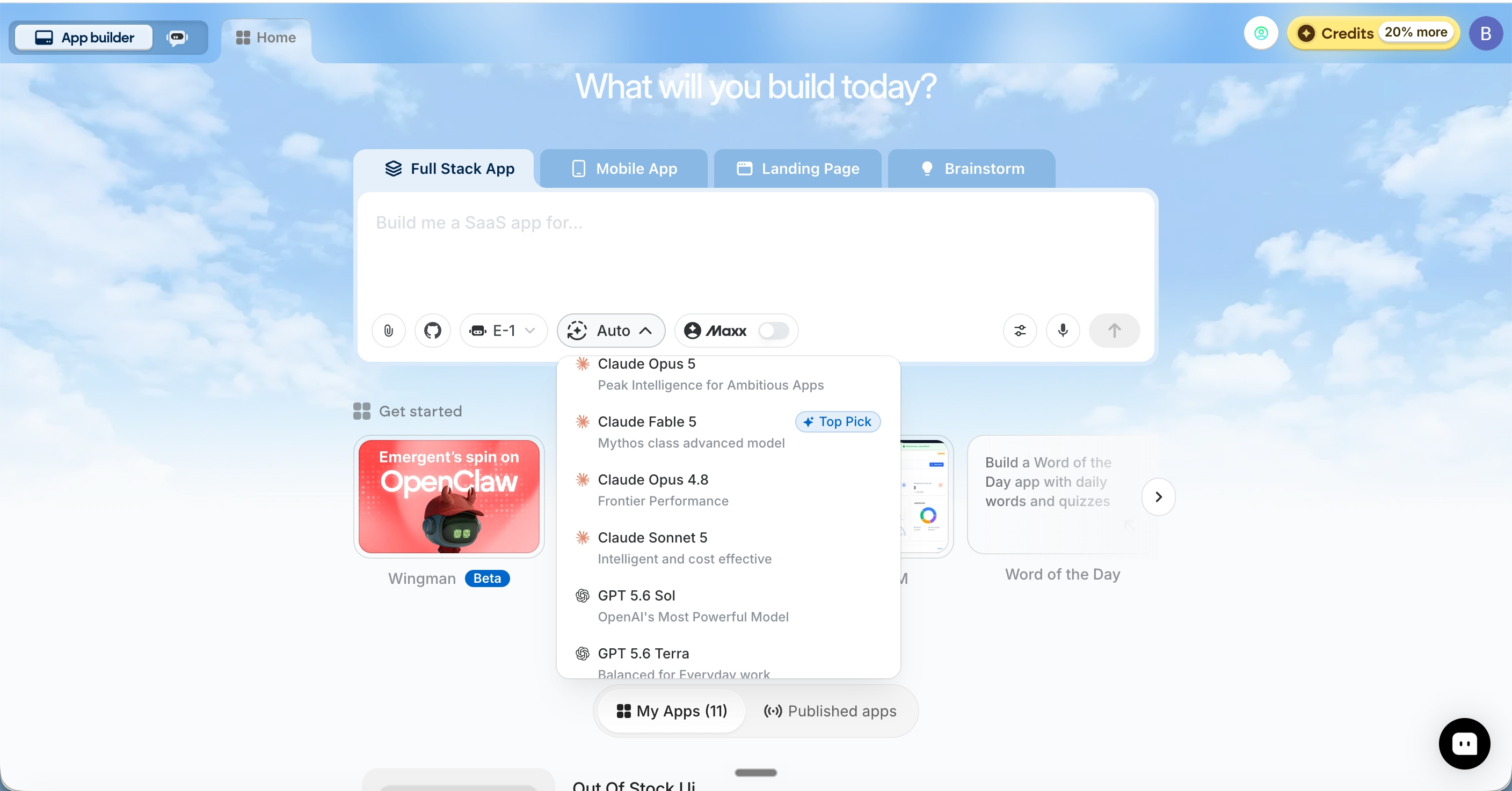
Model access comes through the Universal LLM Key, a single credential that covers GPT from OpenAI, Claude from Anthropic, and Gemini from Google. Usage draws from your Emergent Credits balance rather than three separate provider invoices. When you start a new project, you choose which model powers it. For your next project, you can pick a different one, all under the same credential and billing. Skip the model comparisons and API setup. Describe your app and let Emergent handle the rest. Start Building on Emergent.


Every alternative has trade-offs. Emergent just builds production-ready apps from one prompt.
- Production-ready apps
- Web & mobile apps
- Deploy in minutes