Claude Fable 5 costs $10 per million input tokens and $50 per million output tokens. That is double the price of Claude Opus 4.8 and the most expensive generally available model Anthropic has ever shipped.
Whether that premium is worth it depends entirely on what you are using it for. For tasks where Fable 5 finishes work that Opus 4.8 cannot complete at all, the 2x multiplier is irrelevant because the alternative is not "cheaper," it is "impossible." For routine coding, drafting, and analysis where Opus 4.8 handles the job reliably, paying double for the same outcome makes no sense.
This guide breaks down every pricing dimension: API token rates, subscription access windows, cost optimization levers, and a direct comparison against every model you are realistically choosing between.
API Pricing at a Glance
All prices below are per million tokens.
Source: Anthropic pricing page and Fable 5 Pricing
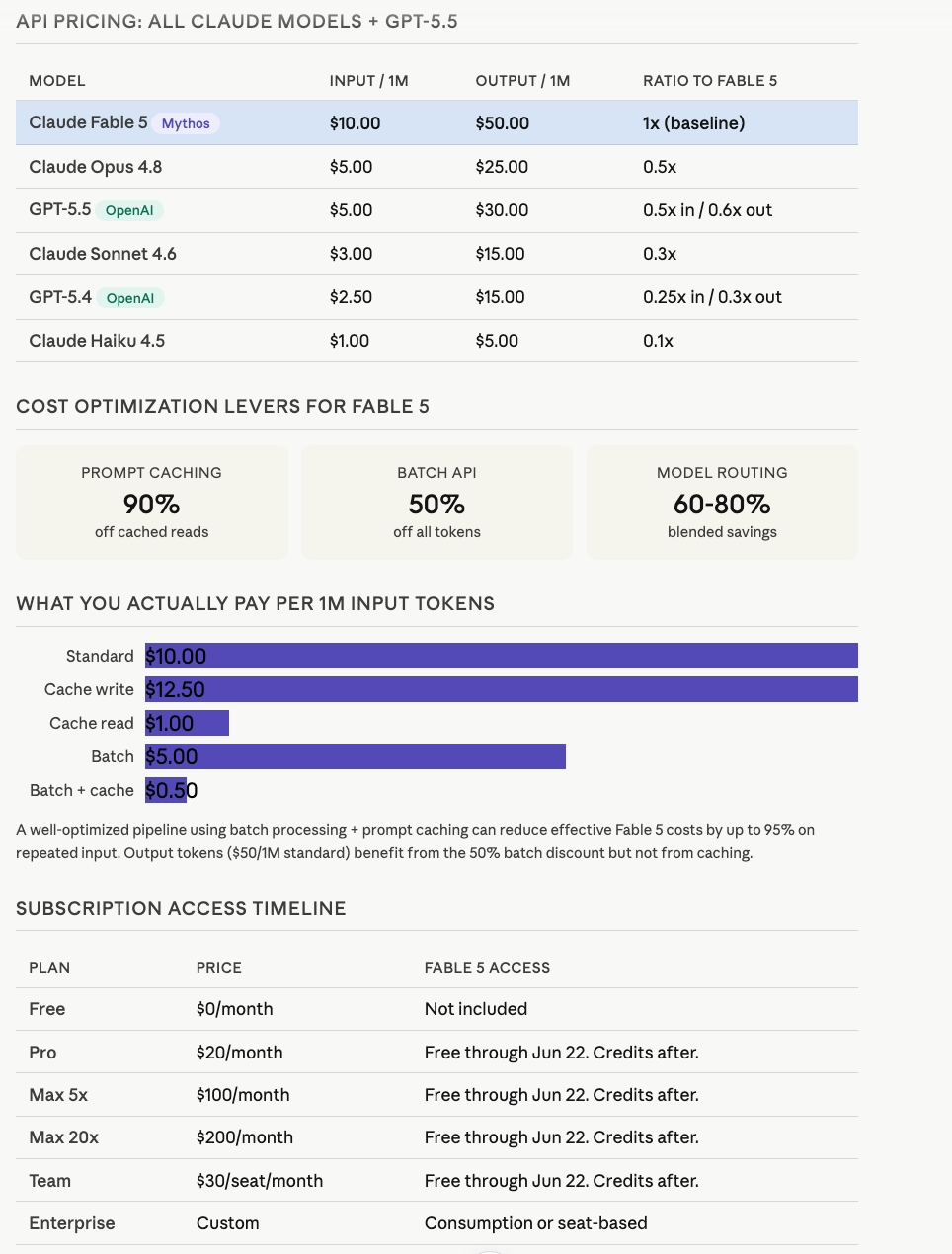
Two patterns jump out. First, output tokens cost 5x input tokens across every model in the Claude lineup. This ratio has been consistent since the Opus 4.5 generation and means that output-heavy workloads (long-form generation, code writing, detailed analysis) are disproportionately expensive. Second, every pricing dimension for Fable 5 is exactly 2x Opus 4.8. This makes migration math simple: whatever you spend on Opus today, double it for the same token volume on Fable 5.
The API model ID is claude-fable-5. It is available on the Anthropic API directly, Claude Code, AWS Bedrock, Google Cloud Vertex AI, and Microsoft Foundry.
US-only inference is available for data residency requirements at a 1.1x multiplier across all token categories, bringing effective rates to $11/$55 per million tokens.
Subscription Access: The June 22 Deadline
If you use Claude through claude.ai rather than the API, the pricing works differently and the timeline matters.
- June 9 through June 22, 2026: Fable 5 is included at no extra cost on Pro ($20/month), Max ($100 or $200/month), Team ($30/seat/month), and seat-based Enterprise plans. During this window, using Fable 5 does not count against any metered credits.
- After June 23, 2026: Fable 5 is removed from these plan inclusions. Continued use requires usage credits billed at API token rates. If you are on a Pro plan and switch to Fable 5 after this date, each conversation draws from your credit balance at $10/$50 per million tokens.
- Anthropic's stated intent is to restore Fable 5 as a standard part of subscription plans once capacity allows. There is no committed timeline for this.
On subscription plans, Fable 5 counts as roughly 2x usage compared to Opus 4.8. If you are on Max and running Fable 5 heavily, you can hit your allowance limit well before the month ends. The model picker will automatically switch you to Sonnet when that happens.
For predictable production workloads, the API is almost always cheaper than scaling subscription seats. For everyday individual use, a subscription remains simpler.
How Fable 5 Compares to the Competition on Price
The comparison everyone wants is Fable 5 against GPT-5.5, because those are the two frontier models most teams are choosing between in June 2026.
On input tokens, Fable 5 is 2x GPT-5.5. On output tokens, Fable 5 is 1.67x GPT-5.5. That means Fable 5's premium over GPT-5.5 is steeper on input-heavy workloads (long prompts with short responses) and narrower on output-heavy workloads (short prompts with long responses).
The performance delta matters for this comparison. On SWE-Bench Pro, Fable 5 scores 80.3% against GPT-5.5's 58.6%. That is a 21.7-point gap. On FrontierCode Diamond, Fable 5 scores 29.3% against GPT-5.5's 5.7%. For the hardest coding tasks, Fable 5 is not incrementally better, it is categorically different.
Anthropic itself positioned Fable 5's pricing against Claude Mythos Preview, not Opus 4.8 or GPT-5.5. The Mythos Preview, which was restricted to Project Glasswing partners, was reportedly priced significantly higher. At $10/$50, Fable 5 is described as "less than half the price of Claude Mythos Preview," making it Anthropic's play to bring frontier capability to a wider audience at a price point that serious teams can absorb.
Three Levers That Cut Your Fable 5 Bill
The headline $10/$50 rate is what you pay without any optimization. In practice, most production deployments should be significantly cheaper.
1. Prompt Caching (Up to 90% Off Input Costs)
Prompt caching is the single biggest cost lever available. When you send the same context repeatedly (system prompts, reference documents, conversation history), cached input reads cost $1 per million tokens instead of $10. That is a 90% discount on the input side.
For agentic workflows where a long system prompt and context window get replayed across dozens of turns, prompt caching can reduce total input costs by 70 to 80% in real-world usage. Claude Code enables prompt caching by default. On the raw API, you need to add the cache_control flag.
The cache write costs $12.50 per million tokens on Fable 5, which is 25% more than a standard input read. But that write cost is paid once. Every subsequent read of that cached content costs $1. If the same context is used across 5 or more turns, caching pays for itself and then some.
Still deciding where to draw the line between the two? Our Claude Fable 5 vs Opus 4.8 comparison breaks down benchmarks and a task-by-task decision framework.
2. Batch Processing (50% Off Everything)
If your workload does not need real-time responses, the Batch API cuts both input and output costs by 50%. Fable 5 batch pricing is $5/$25 per million tokens, which is identical to Opus 4.8's standard pricing.
This is the cleanest arbitrage in the pricing table: Fable 5 batch mode gives you Mythos-class capability at Opus-class prices, provided you can tolerate asynchronous processing. For analysis pipelines, document processing, code review at scale, and any workflow where latency is not a constraint, batch mode is the rational default.
3. Model Routing (Use Fable 5 Only When You Need It)
The most cost-effective architecture is not "use Fable 5 for everything" or "use the cheapest model for everything." It is routing by task complexity.
A practical routing strategy:
- Sonnet 4.6 ($3/$15) as the default for 80% of everyday tasks: drafting, summarization, translation, simple coding, conversational Q&A
- Opus 4.8 ($5/$25) for complex work that needs stronger reasoning: multi-file code generation, analysis, review, anything requiring sustained coherence
- Fable 5 ($10/$50) for frontier tasks only that Opus demonstrably fails at: long-horizon autonomous engineering, codebase-wide migrations, tasks requiring sustained autonomous operation over hundreds of steps
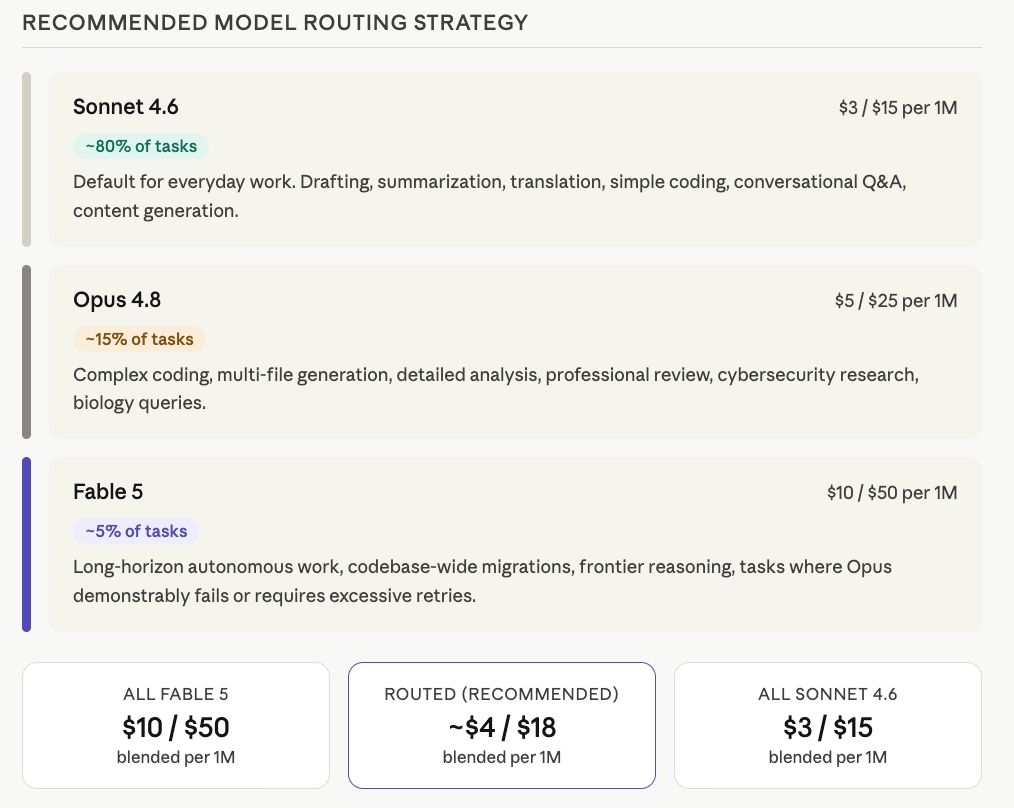
This tiered approach captures most of Fable 5's value while keeping your blended cost-per-token well below the $10/$50 headline rate.
The Hidden Cost: Token Efficiency
Raw token pricing is only half the equation. The other half is how many tokens a model burns to complete a task.
Early reports from production users consistently show Fable 5 completing tasks in fewer turns and with fewer total tokens than Opus 4.8. Peter Wang at Anaconda reported 25 to 30% fewer turns on spreadsheet task suites. Cursor found that tool calling was "meaningfully more efficient, using fewer steps for the same intelligence."
This matters for cost projections. A task that takes Opus 4.8 eight turns might take Fable 5 five turns. Even at double the per-token rate, five turns at 2x can cost less than eight turns at 1x depending on the token volume per turn.
The inverse is also true. For simple tasks where both models complete the work in one or two turns with similar token counts, Fable 5 is straightforwardly 2x the cost for no meaningful quality improvement.
The Data Retention Cost You Cannot Optimize Away
Fable 5 requires mandatory 30-day data retention for all traffic on both first-party and third-party surfaces. Opus 4.8 offers zero data retention. This is not a pricing difference, but it is a cost consideration for regulated industries.
If your compliance framework mandates zero data retention for AI interactions, Fable 5 is not an option regardless of budget. This constraint alone may keep some healthcare, legal, and financial services teams on Opus 4.8 until Anthropic updates its data retention policies for Mythos-class models.
Anthropic has stated this data is used exclusively for safety monitoring and will not be used for model training. All human access is logged, and data is deleted after 30 days in almost all cases.
Real-World Cost Scenarios
To make the pricing concrete, here are three production scenarios with approximate monthly costs.
Scenario 1: Individual Developer on Claude Code
Usage: 4 hours per day, 5 days per week, moderate token volume per session.
- Pro plan ($20/month): Fable 5 included free through June 22. After June 23, you will burn through credits faster and may need to top up or fall back to Opus 4.8.
- Max 5x ($100/month): More headroom for sustained Fable 5 use. Likely sufficient for most individual developers.
- API direct: Estimated $150 to $300/month depending on session intensity. Prompt caching reduces this to $80 to $180/month.
Recommendation: Max 5x at $100/month is the simplest option for individual developers who want regular Fable 5 access without tracking token consumption.
Scenario 2: Engineering Team Running Agentic Workflows
Usage: 10 developers, running multi-step coding agents, moderate to heavy daily usage.
- Team plan ($30/seat = $300/month): Fable 5 included free through June 22. Post-June 23, usage credits required. Team credit pool may deplete quickly with 10 users on Fable 5.
- API with routing: Sonnet 4.6 for routine work, Opus 4.8 for standard coding, Fable 5 for hard problems only. Estimated $800 to $2,000/month with prompt caching.
- API without routing (all Fable 5): Estimated $3,000 to $6,000/month. Hard to justify unless every task genuinely requires frontier capability.
Recommendation: API with routing plus prompt caching. Reserve Fable 5 for the long-horizon tasks that fail on Opus 4.8. Blended cost lands between Opus-only and Fable-only pricing.
Scenario 3: Enterprise Analysis Pipeline
Usage: Document processing, financial analysis, report generation across thousands of documents monthly.
- Batch API on Fable 5: $5/$25 per million tokens (50% off). At 500 million tokens per month, approximately $12,500/month.
- Batch API on Opus 4.8: $2.50/$12.50 per million tokens. Same volume, approximately $6,250/month.
- Hybrid (Opus batch for standard, Fable batch for complex): Estimated $8,000 to $10,000/month depending on routing split.
Recommendation: Batch mode is non-negotiable for pipeline workloads. If quality on the hardest documents justifies the premium, route those to Fable 5 batch and keep everything else on Opus 4.8 batch.
Build with Fable 5 on Emergent Today
Claude Fable 5 is now live on Emergent. If you have been building on Emergent with Opus 4.8, you will notice the difference immediately on anything involving complex, multi-step generation, longer autonomous working, more coherent logic across files, fewer mid-task breakdowns.
To access it, open Emergent and select Claude Fable 5. The same credit system applies, so there is no separate pricing to worry about.
If you are new to Emergent, it is the fastest way to put Fable 5's capabilities to work without writing a single line of infrastructure code. You describe what you want to build, Fable 5 does the heavy lifting of turning your idea into a fully functioning application.
Is Fable 5 Worth the Premium?
The answer follows a clean decision tree:
Fable 5 is worth 2x when:
- The task would fail or require excessive retries on Opus 4.8
- The work is long-horizon, autonomous, and complex (codebase migrations, multi-step research, difficult agentic workflows)
- Token efficiency gains offset the per-token premium (fewer turns = lower total cost despite higher rate)
- You need frontier vision, spatial reasoning, or advanced analytical capability
Fable 5 is not worth 2x when:
- Opus 4.8 reliably completes the task in comparable token counts
- Your workload involves cybersecurity or biology queries (Fable 5 falls back to Opus 4.8 anyway, so you are paying double for the same response)
- Budget efficiency is the primary constraint and the quality difference is invisible for your use case
- Your compliance framework requires zero data retention
If any of those apply to you, our Claude Fable 5 Alternatives guide covers 8 models that cost less and get the job done.
For most teams, the practical answer is not "Fable 5 or Opus 4.8." It is "both, routed intelligently." Start every task on the cheapest model that completes it reliably. Escalate to Fable 5 for the problems that nothing else can solve. That is where the pricing premium earns its keep.


Most AI app builders stop at prototypes. Emergent creates production-ready apps you can actually launch.
- Production-ready apps
- Web & mobile apps
- Deploy in minutes