



Claude Fable 5 is Anthropic's first publicly available Mythos-class AI model, a new tier above the Opus line in Claude's model hierarchy. Released June 9, 2026, it shares identical weights with the restricted Claude Mythos 5 but adds safety classifiers that reroute high-risk queries to Opus 4.8. It is priced at $10/$50 per million input/output tokens, supports a 1 million token context window, and is built for long-running, autonomous coding and knowledge work that previous models couldn't sustain.
Fable 5 posts the strongest benchmark scores Anthropic has published, including 95% on SWE-bench Verified and 80% on SWE-bench Pro. But the number that matters more than any benchmark is 2x: it costs exactly twice what Opus 4.8 charges. Whether that premium changes anything for your specific workload depends on what you're building and how long your tasks run. This article covers the pricing math, the safety architecture, and when Opus or Sonnet remains the smarter pick.
TL;DR
- Use Fable 5 for long-running coding migrations, autonomous debugging, multi-step research synthesis, and vision-heavy document analysis. The advantage compounds with task length.
- Stick with Opus 4.8 for general coding under 30 minutes, content work, and anything where you don't need sustained multi-hour focus. Similar quality, half the cost.
- Stick with Sonnet 4.6 for classification, routing, Q&A, and high-volume pipelines where cost dominates.
- Watch out for the safety classifiers (cybersecurity, bio/chem, distillation queries fall back to Opus 4.8) and the 30-day mandatory data retention policy.
- Pricing math: $10/$50 per million tokens, but prompt caching drops input to $1/M. A 100K-input coding session costs roughly $2.
Claude Fable 5 at a glance
The specs below are confirmed from Anthropic's product page and platform documentation as of June 2026.
Claude Fable 5 quick-reference specifications - as of June 2026
| Spec | Detail |
|---|---|
| Release date | June 9, 2026 |
| API model ID | claude-fable-5 |
| Model tier | Mythos-class (above Opus) |
| Context window | 1 million tokens |
| Max output per request | 128K tokens |
| Input pricing | $10 per million tokens |
| Output pricing | $50 per million tokens |
| Prompt caching | 90% discount on cached input ($1/M) |
| Batch pricing | $5 input / $25 output per million tokens |
| Modalities | Text and vision input, text output |
| Extended thinking | Supported |
| Safety classifiers | Active (cybersecurity, biology/chemistry, distillation) |
| Data retention | 30-day mandatory, for safety monitoring only |
| Confirmed availability | Claude API, Claude apps, Claude Code, Amazon Bedrock, Emergent, GitHub Copilot |
Where Fable 5 fits in Anthropic's model hierarchy
Understanding the hierarchy matters because it determines what you pay, what you get, and which model fits a given task.
1. The tier system: Haiku, Sonnet, Opus, Mythos
Anthropic's models now escalate through four tiers:
- Haiku (4.5): Fastest and cheapest. Built for high-volume, low-latency work like classification, routing, and simple Q&A.
- Sonnet (4.6): The production workhorse. Balances capability and cost for most application workloads.
- Opus (4.8): The previous flagship. Strong at complex reasoning, coding, and extended-context work.
- Mythos (Fable 5 / Mythos 5): The new ceiling. Designed for tasks that run for hours or days, not seconds.
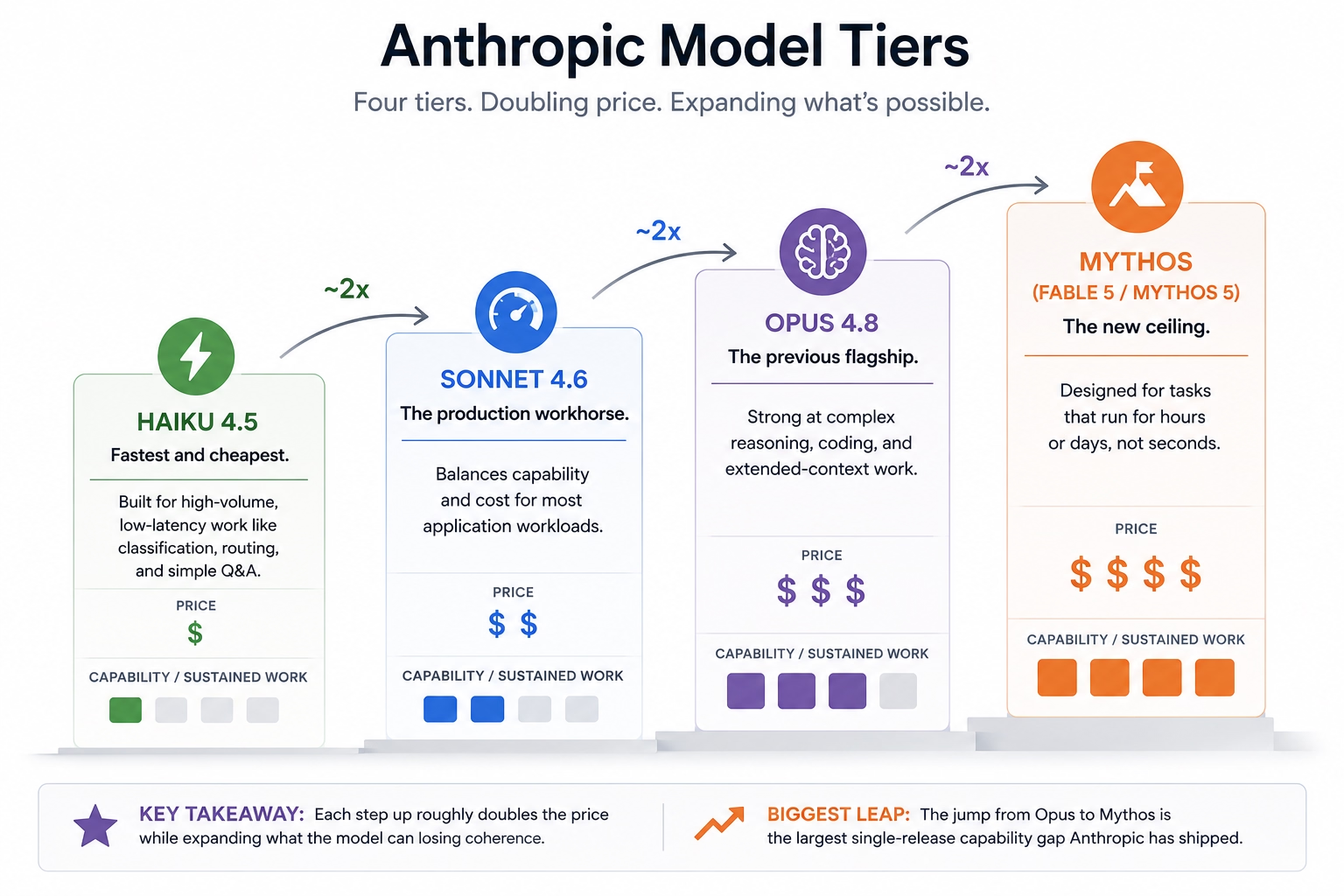
Each step up roughly doubles the price while expanding what the model can sustain without losing coherence. The jump from Opus to Mythos is the largest single-release capability gap Anthropic has shipped.
2. Fable 5 vs. Mythos 5: Same model, different guardrails
This distinction confuses almost everyone on first read, so here is the short version: Fable 5 and Mythos 5 share identical weights. They are the same model. What differs is what each is allowed to do, and who can access it.
Fable 5 is the public release. It includes safety classifiers that detect queries in cybersecurity, biology, chemistry, and model distillation, then reroute those requests to Opus 4.8 for a safe response. You still get an answer, just not from the Mythos-class model.
Mythos 5 is the unrestricted configuration, available only to vetted organizations through Project Glasswing: government cyber defenders, critical infrastructure providers, and selected biology researchers. Its cybersecurity capabilities, which include autonomously finding and chaining software vulnerabilities, are the reason Anthropic kept the model class restricted for months before this release.
For developers and teams doing standard coding, knowledge work, or business application development, the practical takeaway is simple. Fable 5 delivers Mythos-level intelligence everywhere the safeguards don't activate, and for most workloads, they won't.
Benchmark performance
The benchmark gaps are largest on agentic coding, where the tasks are long and multi-step, and narrowest on general knowledge work.
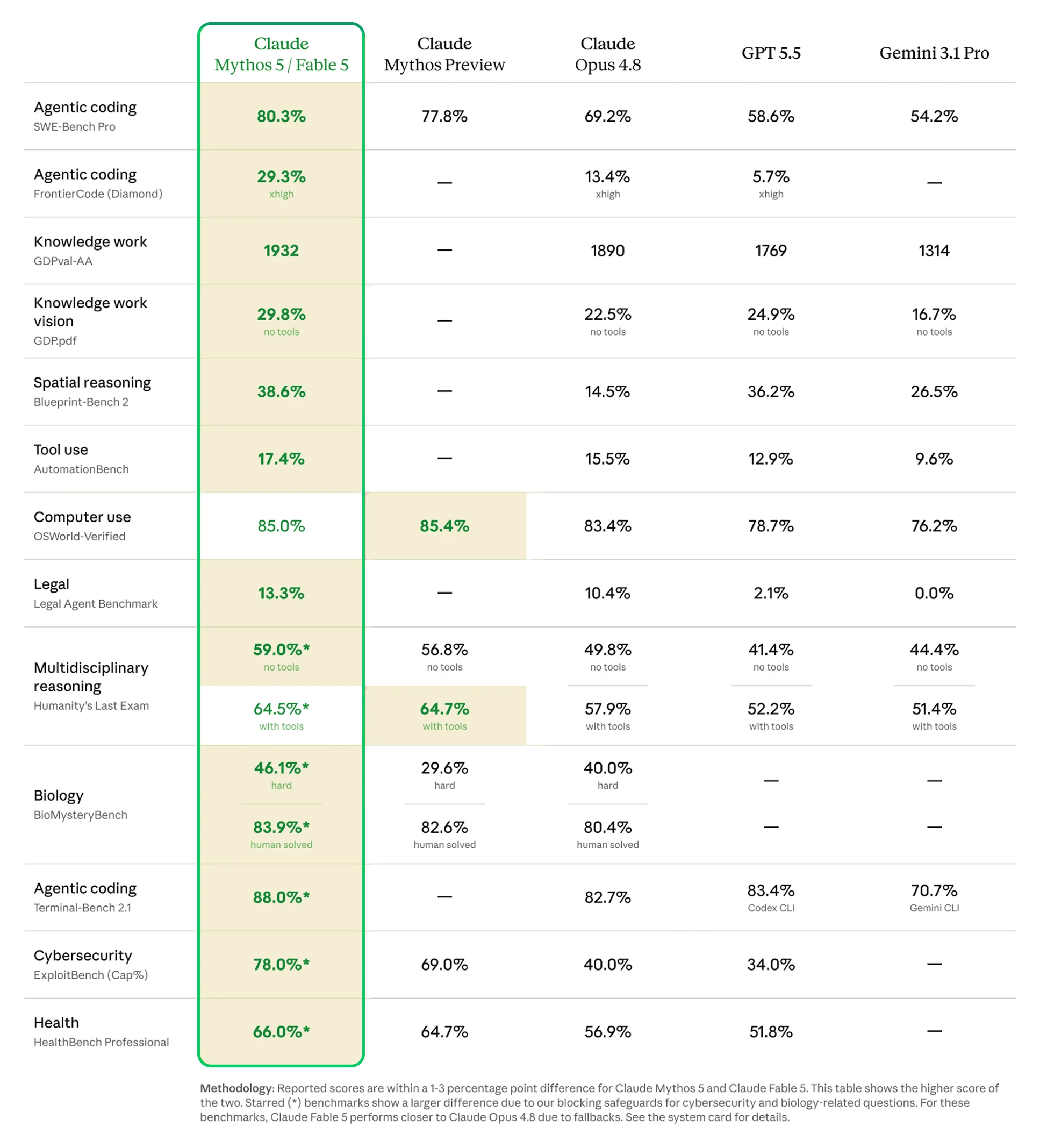
Claude Fable 5 vs. Claude Opus 4.8 benchmark comparison - Anthropic system card, June 2026
| Benchmark Category | Benchmark | Claude Mythos 5 / Fable 5 | Claude Mythos Preview | Claude Opus 4.8 | GPT-5.5 | Gemini 3.1 Pro |
|---|---|---|---|---|---|---|
| Agentic coding | SWE-Bench Pro | 80.3% | 77.8% | 69.2% | 58.6% | 54.2% |
| Agentic coding | FrontierCode (Diamond) | 29.3% (xhigh) | — | 13.4% (xhigh) | 5.7% (xhigh) | — |
| Knowledge work | GDPval-AA | 1932 | — | 1890 | 1769 | 1314 |
| Knowledge work (vision) | GDP.pdf | 29.8% (no tools) | — | 22.5% (no tools) | 24.9% (no tools) | 16.7% (no tools) |
| Spatial reasoning | Blueprint-Bench 2 | 38.6% | — | 14.5% | 36.2% | 26.5% |
| Tool use | AutomationBench | 17.4% | — | 15.5% | 12.9% | 9.6% |
| Computer use | OSWorld-Verified | 85.0% | 85.4% | 83.4% | 78.7% | 76.2% |
| Legal | Legal Agent Benchmark | 13.3% | — | 10.4% | 2.1% | 0.0% |
| Multidisciplinary reasoning (no tools) | Humanity's Last Exam | 59.0%* | 56.8% | 49.8% | 41.4% | 44.4% |
| Multidisciplinary reasoning (with tools) | Humanity's Last Exam | 64.5%* | 64.7% | 57.9% | 52.2% | 51.4% |
| Biology (hard) | BioMysteryBench | 46.1%* | 29.6% | 40.0% | — | — |
| Biology (human solved) | BioMysteryBench | 83.9%* | 82.6% | 80.4% | — | — |
| Agentic coding | Terminal-Bench 2.1 | 88.0%* | — | 82.7% | 83.4% (Codex CLI) | 70.7% (Gemini CLI) |
| Cybersecurity | ExploitBench (Cap%) | 78.0%* | 69.0% | 40.0% | 34.0% | — |
| Health | HealthBench Professional | 66.0%* | 64.7% | 56.9% | 51.8% | — |
The SWE-bench Pro result is the most meaningful number here. The benchmark tests whether a model can resolve genuinely hard software engineering issues pulled from real repositories, and an 11-point jump over Anthropic's own previous best signals a real capability gap, not benchmark tuning.
Against competing labs, early independent testing puts Fable 5 roughly 20 points ahead of GPT-5.5 on the same benchmark, though cross-lab comparisons this early should be treated as directional until more evaluations land.
Benchmarks come with caveats, and they're worth stating plainly. These evaluations measure specific tasks in controlled environments. A model that scores 80% on SWE-bench Pro will not fix 80% of your production bugs on the first try. None of these tests measure how well a model handles ambiguous requirements, recovers from mid-task changes in direction, or communicates tradeoffs, and those are the skills that matter most in real engineering work.
There's also a pattern worth noting in where the lead narrows. On short-form reasoning and general knowledge, the gap between Fable 5 and Opus 4.8 shrinks considerably. Fable 5 was optimized for long-horizon, autonomous work. The longer and harder the task, the wider its lead. The shorter the task, the less you're getting for the 2x price.
Claude Fable 5 pricing and cost math
Fable 5 costs exactly double Opus 4.8. Whether that 2x premium pays off depends entirely on what you run through it
Claude Fable 5 vs. Opus 4.8 pricing - as of June 2026
| Pricing Tier | Fable 5 | Opus 4.8 |
|---|---|---|
| Input (standard) | $10/M tokens | $5/M tokens |
| Output (standard) | $50/M tokens | $25/M tokens |
| Input (prompt caching) | $1/M tokens | $0.50/M tokens |
| Batch input | $5/M tokens | $2.50/M tokens |
| Batch output | $25/M tokens | $12.50/M tokens |
The 90% prompt caching discount matters more than it looks. If your application reuses a large system prompt or reference documents across requests, your effective input cost drops to $1 per million tokens. For agentic workflows that repeatedly load the same context, caching changes the cost equation substantially.
Here is what real sessions cost. A coding session that processes 100K input tokens and generates 20K output tokens runs about $2 on Fable 5 ($1 input plus $1 output), versus about $1 on Opus 4.8. With caching on the input, the Fable 5 session drops to roughly $1.10.
A heavier scenario: a multi-hour autonomous task processing 500K input tokens with 80% cache hits, generating 100K output tokens. On Fable 5, that's roughly $5.90. On Opus 4.8, about $3.00. The dollar gap on any single high-value task is small. The real question is whether the task needs Fable 5's sustained focus or whether Opus handles it just as well, because at scale, paying double for equivalent output adds up fast.
For a full breakdown of where that premium pays off and where Opus matches it, see our Claude Fable 5 vs Opus 4.8 head-to-head comparison covering benchmarks, safeguards, and real-world performance.
The premium is justified for large codebase migrations, multi-step research synthesis, and autonomous sessions that run for hours. It is not justified for short prompts, summarization, classification, or one-off questions, where Opus 4.8 or Sonnet 4.6 delivers comparable quality at a half or a tenth of the cost.
The safety classifier tradeoff
The safety architecture is the defining design decision of this release, and it's the part most coverage glosses over. The same capabilities that make Fable 5 exceptional at coding also make it capable of finding and exploiting software vulnerabilities at a level that kept the Mythos model class restricted for months. Fable 5 exists because Anthropic built classifiers strong enough to release the capability anyway.
The mechanism: classifiers run on every request. When a query touches a high-risk domain, the system blocks Fable 5's response and routes the request to Opus 4.8 instead. The domains that trigger the fallback:
- Offensive cybersecurity (exploit development, vulnerability chaining)
- Biology and chemistry queries that could relate to dangerous substances
- Model distillation attempts (extracting Fable 5's knowledge into another model)
- Some health-related queries
Anthropic has tuned these classifiers conservatively, which means they will sometimes catch harmless requests. A developer asking about defensive security practices might get routed to Opus 4.8 despite entirely legitimate intent. Anthropic's launch estimate is that the classifiers trigger in fewer than 5% of sessions on average, a number that will shift as the classifiers improve over time.
For most users, the practical impact is minimal. Application development, data analysis, research, and content work won't activate the classifiers. If you work in security research or the life sciences, Fable 5 will frustrate you in exactly the domains you care about, and that's by design. Those capabilities live in Mythos 5, behind Project Glasswing's vetting.
Two operational details matter for builders. First, all Mythos-class traffic carries a mandatory 30-day data retention requirement for safety monitoring. Anthropic states the data is used exclusively for safety purposes, not training, but no zero-retention configuration exists at launch. Teams with strict data governance requirements should evaluate this before adopting. Second, classifier refusals return a standard stop_reason: "refusal" in the API as an HTTP 200, and you are not billed when no output is generated, which means you can build fallback logic without paying for blocked requests.
What Fable 5 was built for: Agentic, long-running work
Fable 5 is not a better chatbot. Anthropic designed it for tasks measured in hours and days, and every headline capability reflects that priority.
The core claim is sustained autonomous execution. Previous Claude models handled long context windows, but coherence degraded on complex, multi-stage tasks. Fable 5 maintains focus across extended sessions: planning across stages, delegating to sub-agents in harnesses like Claude Code, and checking its own work before reporting back.
The most concrete evidence comes from Anthropic's own announcement. In a 50-million-line Ruby codebase, Fable 5 completed a migration in one day that would have taken an engineering team over two months. That's a deployment result, not a benchmark, and it demonstrates the specific thing this model was built to do: hold a mental model of an entire system, make changes across thousands of files, track the dependencies between those changes, and verify nothing broke.
Two supporting capabilities round out the picture. Fable 5's vision handles diagrams, nested tables, and UI mockups with higher accuracy than previous models, and it can compare its own implementation against a design spec visually. And it self-verifies by default: given a coding task, it writes test suites, runs them against its own output, and iterates before returning a result. For autonomous workflows where no human reviews intermediate steps, that behavior is the difference between a model you can delegate to and one you have to babysit.
Who should use Fable 5 (and who should not)
Fable 5 is not universally better. It is specifically better at long, complex, autonomous work, and choosing between it, Opus 4.8, and Sonnet 4.6 comes down to task length, complexity, and budget.
| Use Case | Recommended Model | Why |
|---|---|---|
| Large codebase migrations | Fable 5 | Sustained multi-hour focus without coherence loss |
| Multi-step research synthesis | Fable 5 | Plans across stages, self-verifies, handles 1M context |
| Autonomous debugging sessions | Fable 5 | Writes and runs its own tests without supervision |
| Vision-heavy document analysis | Fable 5 | Stronger diagram, table, and design-spec comprehension |
| General coding tasks under 30 minutes | Opus 4.8 | Nearly equivalent quality at half the cost |
| Content writing and editing | Opus 4.8 or Sonnet 4.6 | Fable 5's advantages don't surface for writing |
| Classification and routing | Sonnet 4.6 or Haiku 4.5 | Fable 5 is dramatically overpriced for these |
| Quick Q&A and summarization | Sonnet 4.6 | Fast, affordable, accurate enough for short-form work |
| High-volume production pipelines | Sonnet 4.6 | Cost dominates at scale |
| Offensive cybersecurity research | Mythos 5 (Glasswing only) | Fable 5's classifiers block this domain |
Fable 5 is overkill if your average session runs under 15 minutes, your prompts stay under 10K tokens, or your tasks don't require multi-step autonomous reasoning. In those cases, Opus 4.8 delivers most of the quality at half the price, and Sonnet covers the rest for far less.
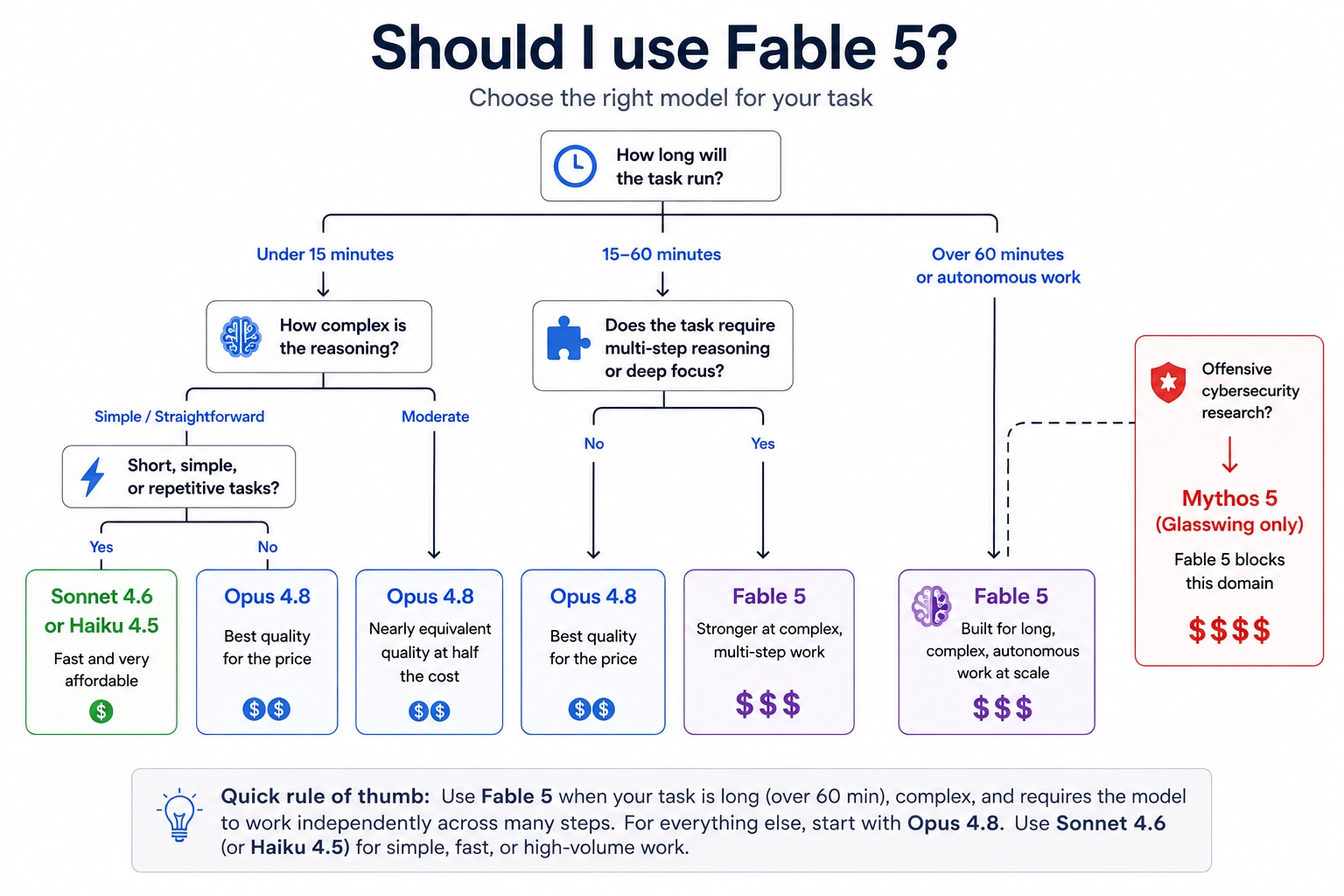
The premium earns itself when you push the model to work independently on hard problems over extended periods. The advantage compounds with task length and difficulty.
A practical adoption path: keep your workloads on Opus 4.8 and escalate individual tasks to Fable 5 only when Opus hits its limits. Most coding and knowledge work won't need the upgrade. The tasks that do will make the cost difference feel trivial against the engineering time saved.
How to access Claude Fable 5
Fable 5 is available immediately, with no waitlist for API access.
Claude API. Use the model ID claude-fable-5. If you already build with the Anthropic SDK, switching is a one-line change. Extended thinking is supported, and classifier refusals return stop_reason: "refusal" as an HTTP 200.
Claude Code. Fable 5 is a selectable model option in Anthropic's coding agent.
Amazon Bedrock. Confirmed by AWS, with availability through both Bedrock and the Claude Platform on AWS.
GitHub Copilot. Confirmed by GitHub's changelog. Note that the admin policy covering the 30-day data retention requirement is off by default, so organization admins must enable it before Fable 5 works in Copilot.
Emergent. Fable 5 is available on Emergent with no waitlist for building full-stack apps with AI.
On subscriptions, Fable 5 is included on Pro, Max, Team, and seat-based Enterprise plans through June 22, 2026, after which it requires usage credits at API rates until Anthropic restores subscription access.
Build with Claude models on Emergent
Claude Fable 5 is a genuine step up from Opus, but not for every task. The model earns its 2x premium on work that runs long and runs hard: multi-hour coding migrations, autonomous debugging sessions that span thousands of files, research synthesis that needs a million tokens of context without losing the thread. For everything shorter or simpler, Opus 4.8 at half the price or Sonnet 4.6 at a tenth of it will do the job. The safety classifiers are a real constraint for security and life-sciences work, but they won't touch most development workflows. And the 30-day data retention policy is worth factoring into your compliance review before you adopt. The practical move is to keep Opus as your default, escalate to Fable 5 when a task genuinely demands it, and measure per-task cost rather than per-token cost when deciding whether the upgrade paid off.
If you want Claude's capabilities in a working application without managing API infrastructure, Emergent supports Claude models, including Fable 5, Opus, and Sonnet, through its Universal Key. Describe what you want to build in plain English, and Emergent's multi-agent system handles the backend, database, and deployment. You own the code your app ships with.
Start Building Today.

Most AI app builders stop at prototypes. Emergent creates production-ready apps you can actually launch.
- Production-ready apps
- Web & mobile apps
- Deploy in minutes







