I spent a week digging into Claude Code Review, Anthropic's automated pull request reviewer, across the docs, the plugin, and write-ups from engineers who ran it on production code. It's one of the most accurate AI reviewers out there, but the pricing is unusual, so here's who should use it and who should skip it.
Claude Code Review: Quick Verdict (TL;DR)
- Claude Code Review is a great option for engineering teams that ship a lot of code and keep missing bugs in review. It runs several AI agents over each pull request, double-checks its own findings to cut the noise, and flags logic bugs instead of style nitpicks.
- The catch is the price. It bills per review at roughly $15 to $25 per pull request, needs a Team or Enterprise plan, and the managed version only works on GitHub.
- Solo builders and non-technical founders who haven't built the app yet don't really need it.
What Is Claude Code Review?
Claude Code Review is an automated code reviewer that reads your GitHub pull requests and leaves comments on the exact lines where it finds problems.
A pull request, or PR, is the set of code changes a developer proposes before it's merged into the main project. It's the natural place to catch mistakes before they ship.
It's built into Claude Code, Anthropic's coding tool that runs in the terminal (the text window where developers type commands). The feature launched as a research preview for Team and Enterprise plans, per Anthropic's documentation.
Instead of one model skimming the changes, a team of specialized agents reads each change against your whole codebase, with every agent hunting a different class of bug.
Claude Code Review Features
The feature set is small on purpose. Anthropic's product team has said they kept the reviewer focused on logic errors rather than formatting, because developers stop trusting a tool that floods them with nitpicks. Here are the parts that matter and where each one has limits.
- Multi-agent review with a verification pass: Several agents read each change in parallel, each hunting a different bug type. A separate step then checks every finding against the actual code before it posts, which cuts the noise. Bigger PRs cost more and take longer.
- Severity tags that never block your merge: Every finding is labeled by how serious it is and posted as a summary plus inline comments. The review never approves or blocks the PR, so your workflow stays intact. To gate merges on findings, you wire that up yourself.
- Custom rules through CLAUDE.md and REVIEW.md: You tune what gets flagged with a plain-text instructions file in your repository. CLAUDE.md sets shared project rules, and REVIEW.md sets review-only priorities. Without either, you get the default correctness profile, and a good file means more relevant findings.
- A local review command in the terminal: No GitHub app needed. Running /code-review in any Claude Code session checks your current changes and can post comments or apply fixes. The plugin behind it runs four agents and posts only high-confidence findings, above 80 out of 100.
How to Set Up Claude Code Review
Setting it up is an admin job that takes about 10 minutes. Here's the flow:
- Check that you have admin access: You need to be an admin of your Claude organization to install GitHub apps.
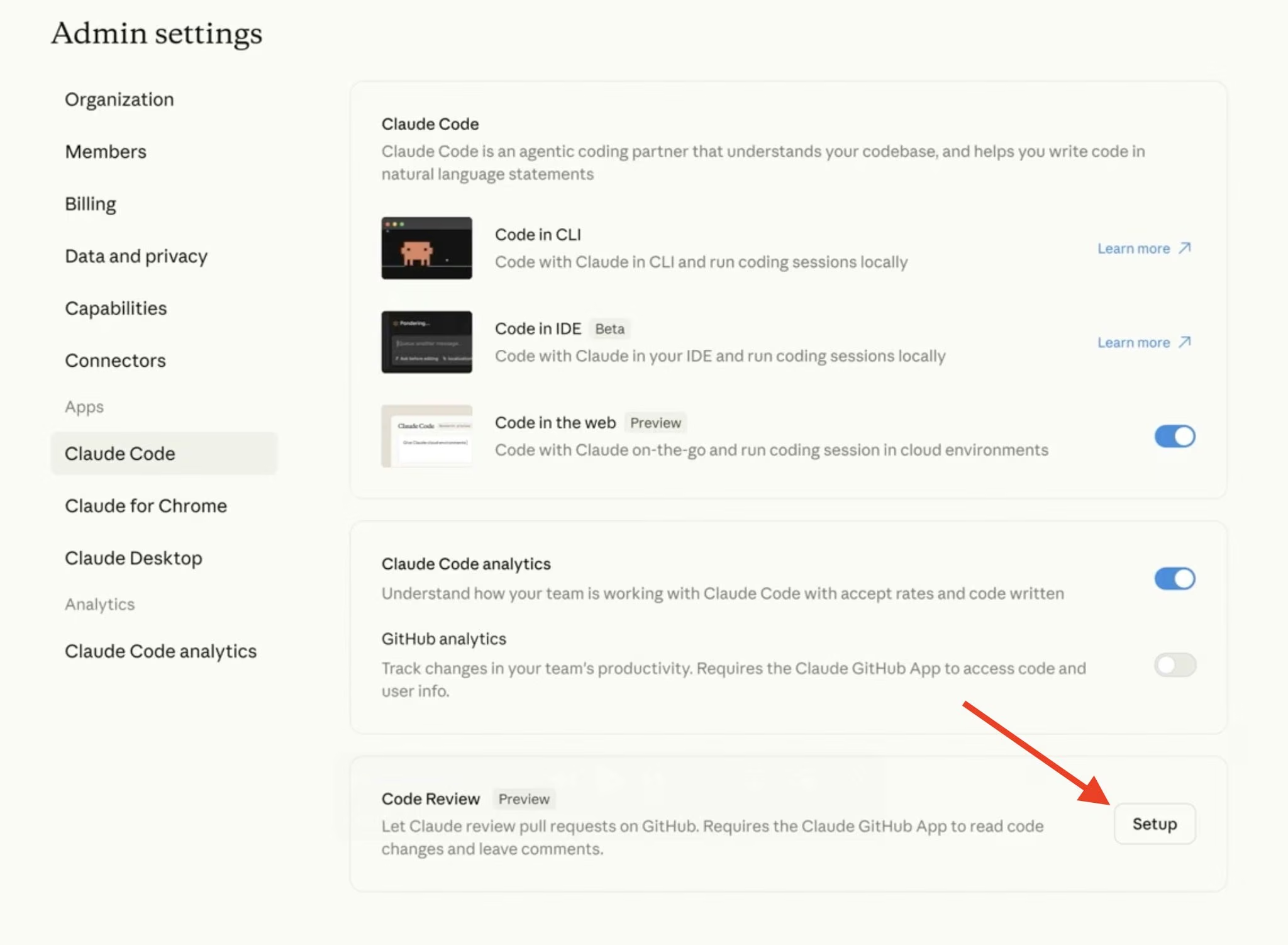
- Open the setup screen: Go to Admin Settings, find Code Review under the Claude Code tab, and click Setup.
- Install the GitHub app: Follow the prompts. The app asks for read-and-write access to your repository contents, issues, and pull requests.
- Pick your repositories: Choose which repos to turn on. If one is missing, confirm you gave the Claude GitHub app access to it during install. You can add more later.
- Test it: Open the Claude Code dashboard and push a change that breaks something, then open a PR.
When your change is ready, clicking Create PR saves it and opens a pull request on GitHub.
Claude then sends its agents to review the change, run tests, and suggest fixes. In one test, it flags a serious security hole in GET /api/sessions/:id, the endpoint the app uses to load a session. The endpoint isn't checking whether the person asking is allowed to see that data.
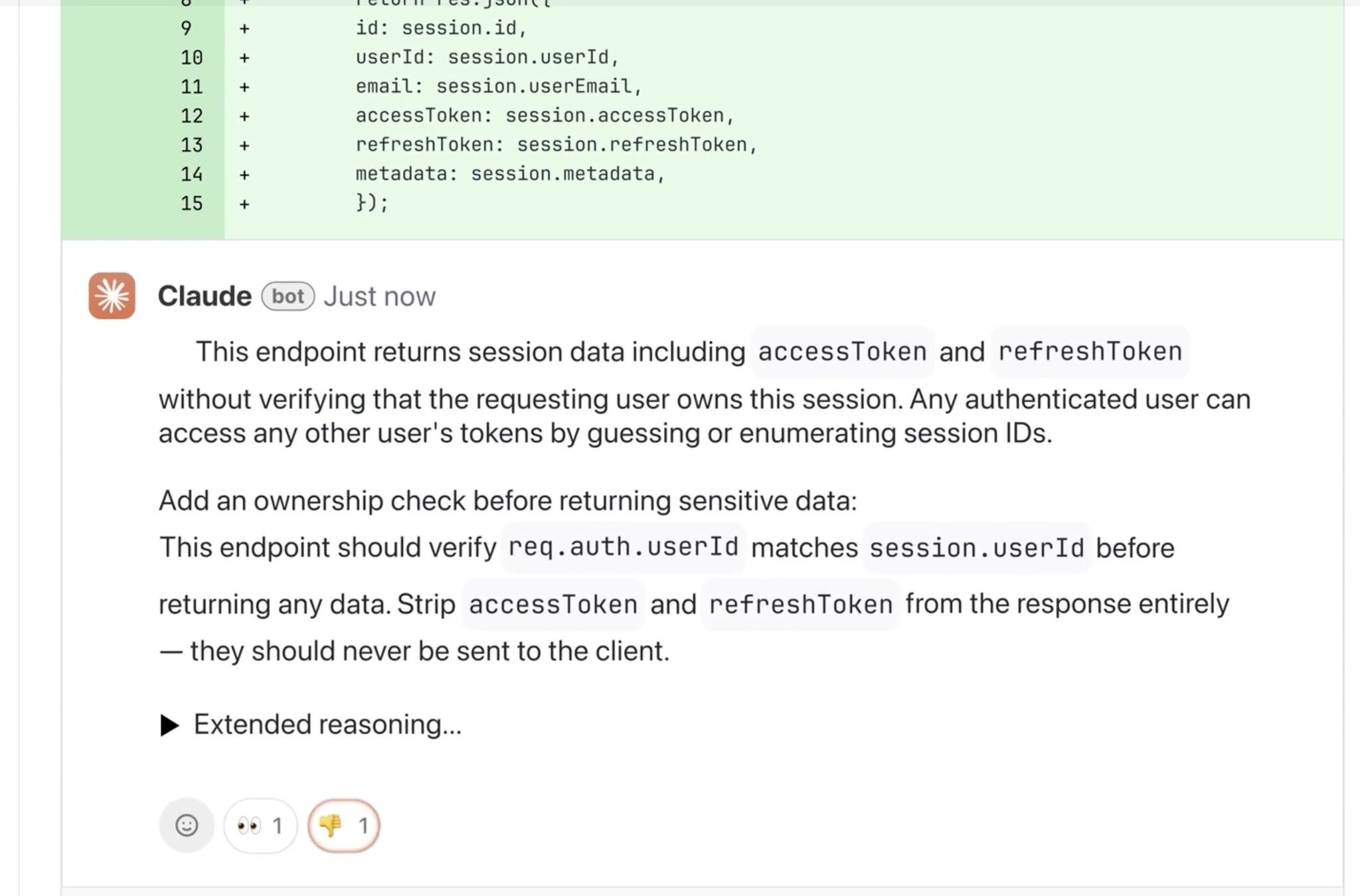
The review breaks the finding down like this:
- Impact: Any user could pull another user's sessions, which is a full account takeover. The review marked it a critical-severity finding.
- Fix: Add an ownership check so the app confirms the requester owns the session, and strip access tokens (the keys that prove who's logged in) out of the data it sends back.
From there, you can accept the fix and merge with confidence. Human reviewers stay in charge. Claude acts as the safety net underneath them and catches logic bugs, subtle regressions, and security holes that are easy to miss by hand.
Important Things to Know Before You Enable Claude Code Review
Before you turn it on, a few things are worth keeping in mind.
- Reviews can run automatically: Once an admin enables Code Review, it can review every new PR on its own, with nothing for developers to set up.
- Human approval is still required: Claude only surfaces findings and suggestions. The final merge decision stays with a person.
- Pricing is usage-based: Reviews are billed on token usage and usually cost about $15 to $25 each, depending on the size and complexity of the PR.
- Review depth scales with PR size: Larger, more complex PRs get a deeper review with more agents, while small changes get a lighter pass.
- Reviews take about 20 minutes on average: The system favors thorough analysis over speed, so results aren't instant.
- Findings are sorted by severity: “Important” is a bug to fix before merging, “Nit” is a minor issue worth addressing, and “Pre-existing” is a bug that was already in the codebase before this PR.
- Admins control cost and scope: You can set monthly spend caps, turn reviews on for chosen repositories only, and track activity in the analytics dashboard.
Claude Code Review: What Real Users Are Saying
Reactions split along a predictable line: engineers love how accurate it is, but worry about the cost. Anthropic's own numbers are striking, G2 reviewers back up the quality, and skeptics on Hacker News and r/ClaudeCode are still weighing whether to trust it on their own code.
Pros
- Catches bugs humans miss: Anthropic runs it on nearly every internal PR, and substantive review comments jumped from 16% to 54% of PRs after rollout, according to its launch post. One case caught a one-line change that would have broken an entire login system before it was merged.
- Low false-positive rate: In Anthropic's internal numbers, engineers marked fewer than 1% of findings as wrong, and PRs over 1,000 lines got flagged 84% of the time. As AI engineer Zen van Riel notes in his analysis of those numbers, a reviewer this accurate gets read instead of ignored.
- Speeds up work on unfamiliar code: Using the Claude Code CLI, SpecterOps senior consultant Andrew Luke traces how data moves through code he's never seen, calling it a big help on an unfamiliar language or framework, in his write-up. It works best with good context up front.
- The verification step sets it apart: Independent analysis credits the built-in step, where the system tries to disprove its own findings, as a genuine advance over reviewers that dump every concern into the PR, per CodeAnt AI.
- G2 reviewers praise its codebase awareness: On G2, a verified reviewer says Claude Code "understands the full context of what you're building," reading the whole project and catching conflicts between components, which is what lets its reviews flag more than a quick skim would.
Cons
- The per-review price adds up: At $15 to $25 per PR, a team running 10 PRs a day could spend several thousand dollars a month, so set a spend cap before the first review, as one three-week test pointed out.
- The managed version is GitHub-only: It rules itself out for teams on GitLab or Bitbucket, though Anthropic offers separate self-hosted integrations. CodeAnt AI calls this a genuine constraint for shops with mixed version control.
- It can still get things wrong: Andrew Luke says asking Claude Code to surface vulnerabilities directly gave him a long list of mostly false positives, so he uses it to support his review rather than replace it. He also caught it stating a wrong fact about a database.
- Flat-rate rivals look cheaper on paper: Tools like CodeRabbit offer unlimited reviews for a flat per-developer monthly fee, so paying per review only pays off if Claude catches bugs the cheaper tools miss.
- Some users say the tool has slipped: a Hacker News thread asking whether Claude Code is getting worse drew broad agreement, with commenters reporting buggier output and inconsistent sessions since a recent large-context update. That decline matters for a tool you trust to catch bugs.
Overall, engineers respect the accuracy and the restraint, but many weigh the per-PR cost against flat-rate options.
My Personal Take on Claude Code Review
What impressed me most was the restraint. Most AI reviewers fail by talking too much, and a PR buried under 40 style comments gets ignored the same way an overstuffed inbox does. Going after logic bugs first, then verifying each one before posting, is the right call.
The severity tags and the choice never to block a merge also show a tool that respects how teams already work. The local /code-review command is the part most people can try today, and it's a smart habit before you open a PR.
My one reservation is the one the practitioners raise. The accuracy holds up, but you pay per review, and the bill grows with the size of your PRs and how often you push. Like any AI reviewer, it's a strong second pair of eyes, and a person still approves the merge.
Is Claude Code Review Right for You?
Claude Code Review is right for you if you review code on GitHub at volume and keep letting bugs slip through. It's the wrong tool if you're not shipping code at all. Here's how it breaks down.
Who will love it:
- Teams drowning in review load: If PRs get skimmed instead of read because everyone is stretched, a trustworthy reviewer on every change closes a gap that fatigue keeps opening.
- GitHub teams on a Team or Enterprise plan: The setup is a 10-minute admin task, and the tool slots into the review workflow you already have.
- Security-minded reviewers in unfamiliar code: As the SpecterOps workflow shows, it shines at tracing how data moves through a codebase you didn't write.
Who should avoid it:
- Solo developers watching costs: Per-review billing is hard to justify for one person, and a flat-rate tool or the local /code-review command will serve you better.
- Teams on GitLab or Bitbucket: The managed service is GitHub-only, so you'd be looking at the self-hosted integrations instead.
- Non-technical founders without a codebase yet: If you have no pull request workflow to plug into, a code reviewer isn't the tool you're missing. You need a way to build and ship the software first.
A Better Fit for Non-Developers: Emergent
If you landed here because you want to build an app and weren't sure whether Claude Code Review fits into that, here's the straight answer: it doesn't. Code Review is for teams already writing and shipping code. If you're a non-technical founder or operator, the tool you need is an app builder.
Emergent is an AI app-building platform that turns a plain-English description into working, deployable software, with the full app, including its data, sign-in, and payments, built for you.
You describe the app you want, and a team of agents plans it, designs the screens, writes the code, and runs its own tests. Unlike Claude Code Review, which assumes you already have a codebase, Emergent is one of the vibe coding tools built for people who don't write code at all.
A few things make it a fit for non-developers:
- Start from a description: There's no terminal, pull request, or review pipeline to set up. You explain what the app should do, and Emergent builds it.
- It ships software you can launch: The multi-agent system builds the working app behind the scenes, so it can take payments and serve customers once it goes live, rather than stalling at a demo.
- It connects to tools you already use: Emergent integrates with GitHub, Figma, and Notion, so your code, designs, and docs stay in sync.
- You own what it makes: Your code, data, and deployment stay yours to export and self-host, with no lock-in.
There's a free tier to test the idea before you commit. Try building your first app on Emergent and see how far a single description gets you.
My Final Verdict
For an engineering team on GitHub that keeps shipping bugs past review, Claude Code Review earns its price because the accuracy holds up and the noise stays low. Solo developers counting dollars will do better with a flat-rate reviewer.
And if you're not writing code at all, what you need is an app builder, since a reviewer was never the missing piece. Code Review is excellent at its one job. If that job is reviewing GitHub PRs at volume, it's worth the price, and if you're still building the app, start with a builder instead.

Most AI app builders stop at prototypes. Emergent creates production-ready apps you can actually launch.
- Production-ready apps
- Web & mobile apps
- Deploy in minutes