Alternatives and Competitors
•
Best n8n Alternatives for Workflow Automation in 2026
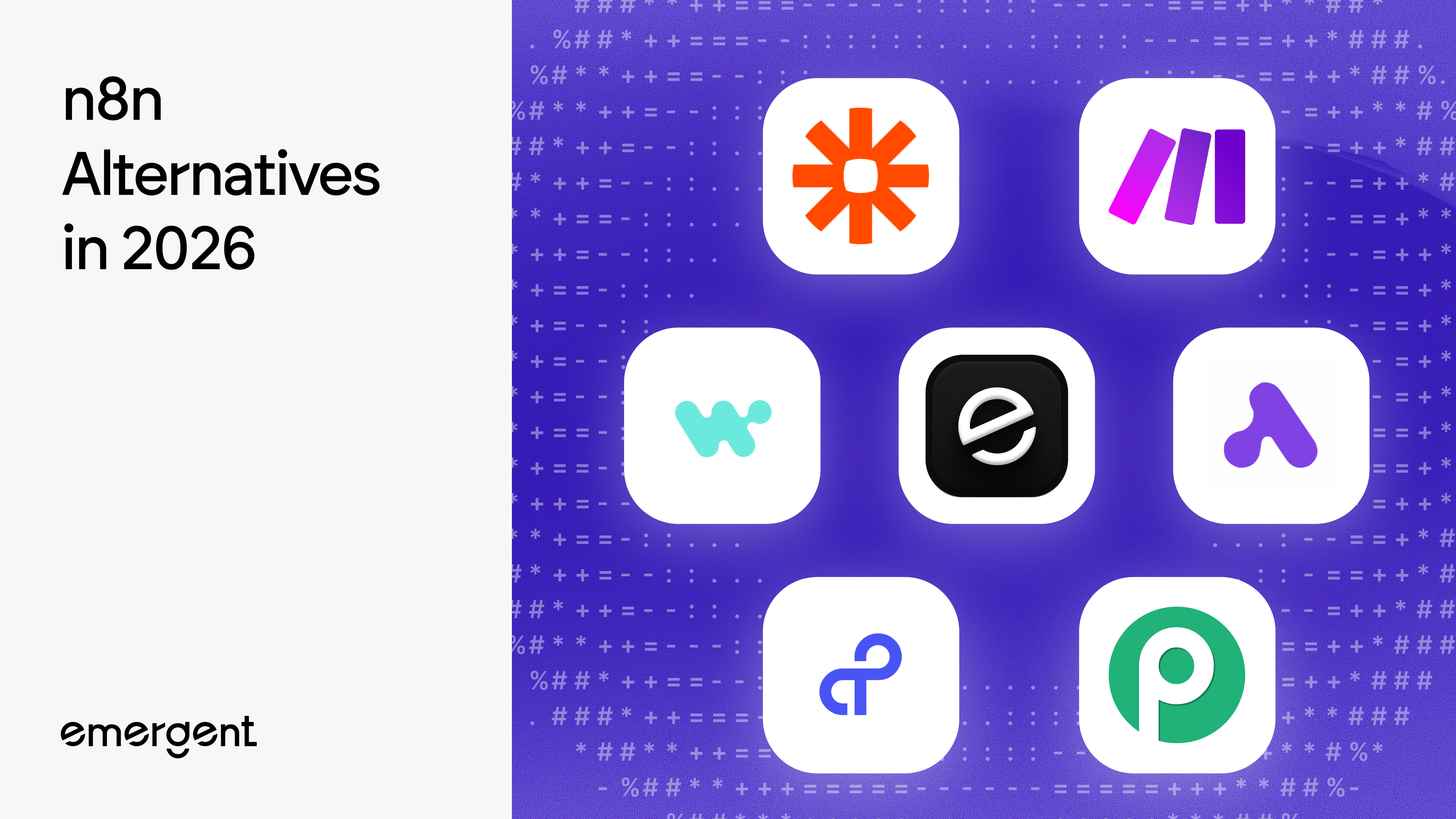
Looking for a better alternative to n8n? Compare the 7 best n8n competitors in 2026, ranked by automation depth, hosting model, scalability, and AI-native orchestration.
Written By :

Aishwarya Srivastava
Workflow automation has gone from a "nice to have" to the operational backbone of modern businesses. Whether you're a solo founder stitching together APIs, an ops team eliminating manual handoffs, or an enterprise architect enforcing compliance at scale, the right automation platform can be the difference between scaling and stalling.
The numbers reflect this shift: the global workflow automation market is valued at over $26 billion in 2026 and is expected to reach $80+ billion by 2035. Around 60% of businesses have already implemented automation in at least one workflow, and 80% plan to maintain or increase their automation investment. McKinsey research suggests AI and automation together could inject $2.6–$4.4 trillion into global GDP annually, and automate tasks that currently occupy 60–70% of today's workforce.
n8n has earned its place in the conversation. It's powerful, open-source, developer-friendly, and flexible enough to handle everything from simple app connections to complex AI agent workflows. But it's not the perfect fit for everyone, and in 2026, the alternatives have never been stronger.
This guide covers the 11 best n8n alternatives in 2026, who they're for, what they do best, and how to choose the right one for your situation.
TL;DR
n8n is a powerful open-source workflow automation platform, but it comes with challenges like a steep learning curve, self-hosting overhead, stateless architecture, and limited enterprise support
These limitations have led many teams to explore alternative automation tools
Beginner-friendly no-code options like Zapier and Make are ideal for ease of use and quick setup
AI-native platforms like Emergent cater to teams looking for automation driven by natural language and intelligent agents
Developer-first tools like Pipedream and open-source self-hosted options like Activepieces and Windmill offer more control, flexibility, and customization depending on technical needs and budget
What is n8n?
n8n (pronounced "nodemation") is a fair-code licensed workflow automation platform that allows teams to connect applications, APIs, and databases through a visual node-based editor, while also giving developers the freedom to write JavaScript or Python at any point in the workflow.
Founded in Berlin in 2019 by Jan Oberhauser, it has grown to over 400 native integrations, 1,300+ core nodes, and roughly 5,800 community-built nodes. It supports both self-hosting (free) and a managed cloud offering, and has become a go-to platform for technical teams building AI-powered, data-sensitive, or highly customized automations. In August 2025, n8n reached a valuation of $2.3 billion, up from $350 million just four months prior, and surpassed $40M in annual revenue, with clients including Vodafone and Delivery Hero.
Types of n8n Alternatives
Not all automation tools are built alike. Understanding the categories helps you shortlist the right tool faster:
SaaS No-Code Platforms
Tools like Zapier, Make, and Pabbly Connect are fully cloud-hosted, designed for non-technical users, and prioritize ease of setup and broad integration libraries over deep customization.
AI-Native Agent Builders
Platforms like Emergent.sh go beyond traditional automation by using AI agents that can autonomously plan, build, and execute complex workflows from plain-language instructions. These are built for the agentic AI era, not just connecting point A to point B.
Developer-First Platforms
Tools like Pipedream and Temporal give engineers code-level control, serverless execution environments, and workflow durability without the overhead of self-hosting n8n.
Open-Source / Self-Hosted Tools
Activepieces, Windmill, and Apache Airflow allow teams to retain full data ownership, avoid vendor lock-in, and run automation on their own infrastructure, similar to n8n's self-hosted model, but with varying tradeoffs in ease of use and feature depth.
What Are the Gaps and Challenges in n8n?
Before evaluating alternatives, it's worth understanding where n8n falls short, because the gaps in n8n often point directly to what you need from a replacement.
Steep learning curve
n8n requires comfort with APIs, JSON, and sometimes code to build anything beyond simple automations. New users consistently report needing two to eight weeks before building workflows confidently, a significant investment for teams that need automation running now.
Self-hosting overhead
While the Community Edition is free, self-hosting is not truly "free" once you factor in infrastructure provisioning, maintenance, updates, and uptime management. One analysis estimated the real cost of a small self-hosted n8n deployment at $200–$500 per month, and in enterprise settings, this can reach six figures annually.
Stateless architecture
n8n does not natively support persistent memory across workflow executions. Once a workflow ends, context is wiped. This makes it unsuitable for workflows requiring long-term context, multi-session AI agents, or durable state tracking without external databases.
Complex workflows become unwieldy
Workflows with 100+ nodes resemble a "spider web", difficult to read, debug, and maintain. Version upgrades can break existing complex workflows, requiring manual intervention on deprecated nodes.
Limited enterprise support
n8n lacks the dedicated enterprise-grade customer support, compliance assurances, and SLAs that large organizations need for automating mission-critical operations.
Not truly no-code
While n8n has a visual builder, most real-world automation tasks still require understanding APIs, expressions, and logic, which effectively excludes non-technical business users.
Fair-code license restrictions
n8n's license restricts commercial use of the tool in SaaS products, limiting teams who want to build and sell automation-powered software.
The Need for n8n Alternatives
The automation landscape in 2026 has fundamentally split into two. One camp still needs reliable, rule-based workflow automation for connecting SaaS tools. The other is building sophisticated AI agents that can reason, plan, remember context, and adapt to unexpected situations.
n8n sits awkwardly between these camps. It's powerful enough for technical developers but too complex for business users. It has AI nodes but lacks true agentic capabilities. It's open-source but carries real operational overhead. 92% of companies plan to increase AI investments over the next three years, and many of them are finding that n8n's architecture, built before modern agentic AI frameworks matured, isn't keeping pace.
As a result, teams on both ends of the spectrum are looking elsewhere, and they have excellent options to choose from.
What Are the Best n8n Alternatives in 2026?
Here's a high-level comparison of the top 11 n8n alternatives:
Tool | Best For | Type | Hosting | Ease of Use | Integrations | Pricing | Key Strength |
Non-technical builders, AI apps | AI-Native Builder | Cloud | ⭐⭐⭐⭐⭐ | API-native + custom | From $0 (Free credits) | Build full apps via conversation | |
Simple automations, non-technical users | SaaS No-Code | Cloud | ⭐⭐⭐⭐⭐ | 8,000+ | From $19.99/mo | Widest integration library | |
Visual complex workflows | SaaS No-Code | Cloud | ⭐⭐⭐⭐ | 2,000+ | From $9/mo | Visual data routing | |
Developer-first event automation | Developer-First | Cloud | ⭐⭐⭐ | 2,700+ | From $0 (Free tier) | Code-first serverless execution | |
Enterprise-grade automation | Enterprise iPaaS | Cloud | ⭐⭐⭐ | 1,200+ | Custom (enterprise) | Enterprise compliance + AI | |
Budget-conscious teams | SaaS No-Code | Cloud | ⭐⭐⭐⭐ | 2,000+ | From $16/mo or $349 lifetime | Lifetime deal, free internal tasks | |
Open-source Zapier alternative | Open-Source | Self-hosted / Cloud | ⭐⭐⭐⭐ | 400+ | Free (self-hosted); $8/mo cloud | Easiest open-source n8n swap | |
Code-first developer teams | Open-Source | Self-hosted / Cloud | ⭐⭐⭐ | Script-based | Free (self-hosted); $10/mo cloud | Scripts + workflow orchestration | |
Data engineering pipelines | Open-Source | Self-hosted | ⭐⭐ | Python-native | Free (self-hosted) | Mature DAG orchestration | |
Mission-critical durable workflows | Developer-First | Self-hosted / Cloud | ⭐⭐ | SDK-based | From $25/mo cloud | Workflow durability guarantee | |
Microsoft 365 organizations | SaaS | Cloud | ⭐⭐⭐⭐ | 1,000+ | Included in M365 / $15/user standalone | Deep Microsoft ecosystem integration |
11 Best n8n Alternatives in 2026
Emergent
Emergent (emergent.sh) is an AI-native platform that fundamentally reimagines what automation and app-building look like. Rather than asking you to drag nodes across a canvas or write integration code, Emergent lets you describe what you want in plain language, and autonomous AI agents handle the architecture, development, testing, and deployment.
Type of Tool
AI-Native App Builder / No-Code Automation Platform
Best For
Personas: Non-technical founders, product teams, business operators, startup builders, and enterprises looking to enable every department to ship working software without depending entirely on engineering.
Use Cases: Building internal tools, automating business workflows, creating customer-facing apps, generating MVPs, deploying AI agents for lead qualification, report generation, onboarding automation, and any scenario where the idea-to-product gap is the core bottleneck.
Basic Features
Conversational app building — Describe your app or workflow in natural language; Emergent's AI agents generate a complete, functional application
Full-stack generation — Produces real backend logic, databases, authentication, APIs, and frontend UI — not just prototypes or mockups
Built-in integrations — Native connections to Google Sheets, Airtable, Notion, Slack, and Stripe out of the box
Automatic debugging — AI agents analyze logs and resolve errors autonomously, without requiring manual intervention
Mobile app support — Build production-ready iOS and Android apps alongside web applications
Responsive design — Every build is automatically responsive across desktop, tablet, and mobile
GitHub integration — Save and fork projects directly to GitHub for version control and collaboration
Advanced Features
Multi-agent framework — Multiple specialized AI agents collaborate to handle architecture, logic, UI, and deployment simultaneously
AI agent deployment — Deploy AI agents as teammates that automate complex, context-aware tasks like lead qualification and report generation at scale
1M token context window (Pro plan) — Handles large, complex projects without losing context mid-build
Custom agent creation — Build and configure your own AI agents with custom system prompts and behaviors
Enterprise-grade security — ISO 27001 and SOC 2 certified, with SSO, role-based access control, and audit logs built in
Shared workspaces — Teams can build simultaneously with pooled credits and role-based permissions
Payment processing — Stripe integration included by default, enabling monetization without additional setup
Premium integrations (Pro plan) — Access to advanced integrations and priority support with faster machine performance
How Emergent Fills the n8n Gaps and Solves Your Problems?
n8n requires technical expertise to set up, self-host, maintain, and scale. It lacks persistent memory for AI agents, requires manual node management for complex workflows, and excludes non-technical users entirely. Emergent addresses every one of these pain points:
No self-hosting overhead
Emergent is fully managed, no servers to provision, no infrastructure to maintain, no updates to worry about. Everything from hosting to scaling is handled out of the box.
True conversational automation
Where n8n asks you to drag, connect, and configure nodes, Emergent asks you to describe what you want. This opens automation to every team member, not just developers.
AI-native by design
Emergent doesn't bolt AI onto a workflow builder, it was built from the ground up around autonomous AI agents. Every build benefits from agents that plan, reason, iterate, and deploy independently.
Production-ready, not prototypes
Unlike n8n workflows that often require significant developer refinement before production use, Emergent's output is deployable from day one, complete with real backend, databases, and integrations.
Enterprise security without enterprise complexity
ISO 27001 and SOC 2 certification, SSO, RBAC, and audit logs are included, no enterprise tier required to access the security features your team needs.
If you've ever watched a brilliant product idea die waiting for engineering bandwidth, Emergent was built specifically to eliminate that bottleneck. Start building your first app today at emergent.sh, your idea deserves to ship.
Trusted Source Reviews
Platform | Rating | Notes |
✅ Backed | $50M ARR in 7 months; one of the fastest-growing YC startups | |
⭐ 3.8/5 | Praised for speed; some user feedback on credit usage transparency | |
⭐⭐⭐⭐ | Consistently cited for AI quality and ease of app generation |
Zapier
Zapier is the most widely used no-code automation platform in the world. It pioneered the trigger-and-action model that most people now think of when they hear "workflow automation," and it remains the gold standard for breadth of integrations and ease of entry. Founded in 2011, Zapier now connects 8,000+ apps, roughly 7x more integrations than n8n, and is used by millions of businesses globally.
Type of Tool
SaaS No-Code Automation Platform
Best For
Personas: Non-technical business users, marketers, sales teams, small business owners, and anyone who needs automation running in minutes without touching a line of code.
Use Cases: Connecting popular SaaS tools (CRM to email, form submissions to spreadsheets, Slack notifications from project management tools), automating repetitive data entry tasks, and handling linear trigger-action workflows across mainstream apps.
Basic Features
Trigger-and-action workflow builder ("Zaps") with guided setup
8,000+ pre-built app integrations, the widest library in the category
Multi-step Zaps with filters, delays, and conditional paths
Templates library with thousands of pre-built workflows
Real-time and scheduled triggers
Team collaboration features on higher plans
Advanced Features
AI Copilot for creating Zaps from plain language descriptions
Zapier Agents for autonomous AI teammates with access to 30,000+ Zapier actions and MCP server support
Custom code steps (Python/JavaScript) on Professional plans and above
Paths (conditional branching) for more complex logic
Zapier Tables and Interfaces for lightweight data storage and user-facing forms
Sub-Zaps for reusable workflow components
Enterprise SSO and admin controls on Enterprise plans
How Zapier Fills the n8n Gaps and Solves Your Problems?
Zapier is the antithesis of n8n's complexity. Where n8n demands technical fluency, Zapier provides guided setup in minutes. Where n8n requires infrastructure management, Zapier is entirely managed. The key tradeoff is cost at scale, at 10,000 tasks/month, Zapier costs roughly $300/month versus n8n Cloud Pro at a fraction of that, often 3–10x more expensive. But for teams where ease of use matters more than cost efficiency at volume, Zapier's premium is the price of accessibility.
Trusted Source Reviews
Platform | Rating | Notes |
⭐ 4.5/5 | Praised for ease of use and integration breadth; 1,830+ reviews | |
⭐ 4.7/5 | High marks for reliability and onboarding | |
⭐ 1.4/5 | Lower scores driven primarily by billing and support complaints at scale |
Make (formerly Integromat)
Make is the visual workflow automation platform that sits between Zapier's simplicity and n8n's complexity. It offers a canvas-based builder where data flows visually between modules, making it easy to understand how your automation works at a glance, while supporting significantly more advanced logic than Zapier. Paid plans start at just $9/month for 10,000 operations, making it one of the most cost-effective options for mid-volume automation.
Type of Tool
SaaS No-Code / Low-Code Visual Automation Platform
Best For
Personas: Operations teams, marketing ops, freelancers, and agencies that need more than basic trigger-action flows but don't want to write code.
Use Cases: Multi-step data transformation workflows, conditional routing, CRM syncing, marketing automation, ecommerce order processing, and any scenario that requires seeing your data flow as it moves between apps.
Basic Features
Visual scenario builder with real-time data flow visualization
2,000+ app integrations
Routers, filters, and conditional branches built into the visual canvas
Flexible scheduling (as frequently as every minute on paid plans)
Error handling and retry logic
Advanced Features
Iterator and aggregator modules for handling arrays and complex data structures
HTTP/webhook modules for custom API connections
Data stores for lightweight in-workflow data storage
Scenario history and version control
Team workspaces and user roles
AI-assisted scenario building
Webhooks and instant triggers
How Make Fills the n8n Gaps and Solves Your Problems?
Make removes n8n's self-hosting complexity entirely while offering a visual building experience that's more intuitive than n8n's node canvas for most users. A team spending $299/month on Zapier could often accomplish the same work on Make for $59/month, making Make the natural middle ground between accessibility and cost efficiency. The main limitation compared to n8n is the absence of self-hosting and code-level customization at every step — but for teams that don't need those capabilities, Make offers substantially more power than Zapier at a significantly lower price.
Trusted Source Reviews
Platform | Rating | Notes |
⭐ 4.7/5 | Consistently praised for visual builder and value | |
⭐ 4.8/5 | Users highlight flexibility and advanced logic | |
⭐ 3.9/5 | Positive overall; some note learning curve for complex scenarios |
Pipedream
Pipedream is the automation platform built for developers who want code-level control without managing infrastructure. It bridges the gap between no-code triggers and full custom logic, every workflow step can be a pre-built action or custom code in JavaScript, Python, Go, or Bash, running in a managed serverless environment.
Pipedream's free tier covers 10,000 invocations per month, making it one of the most generous starting points for developer teams.
Type of Tool
Developer-First Serverless Automation Platform
Best For
Personas: Software engineers, full-stack developers, and technically skilled ops teams who are comfortable writing code but don't want the overhead of self-hosting.
Use Cases: Event-driven integrations, API glue code, webhook processing, lightweight backend services, developer tooling automation, and any workflow that benefits from code flexibility without infrastructure management.
Basic Features
Workflow builder with pre-built triggers, actions, and custom code steps
2,700+ integrated apps with 10,000+ pre-built tools and managed OAuth
Serverless execution. No provisioning or scaling required
Real-time logs and step-level debugging
Free tier: 10,000 invocations/month
Node.js, Python, Go, and Bash support in custom steps
Advanced Features
npm and PyPI package support in code steps
Event history and replay for debugging
Data stores for cross-workflow state management
Scheduled and cron-based triggers
Pipedream Connect for embedding automation into your own products
SQL and AI-assisted workflow building tools
Custom components published to the community marketplace
How Pipedream Fills the n8n Gaps and Solves Your Problems
Pipedream is the closest managed alternative to n8n for developers. It offers the same code-first flexibility, and then some, with broader language support, while eliminating infrastructure overhead entirely. The auth management system handles OAuth token refreshes automatically, a genuine pain point in n8n's self-hosted setup. Paid plans start at $29/month, significantly less than the real-world $200–$500/month cost of running a self-hosted n8n instance at scale. For developer teams tired of managing n8n infrastructure, Pipedream is often the most direct upgrade path.
Trusted Source Reviews
Platform | Rating | Notes |
⭐ 4.6/5 | Developers praise serverless execution and auth management | |
⭐⭐⭐⭐ | Strong community following among developer-builders | |
⭐ 4.5/5 | Noted as powerful but less friendly for non-technical users |
Workato
Workato is enterprise-grade integration and automation at its most mature. It's not a tool for startups or solo builders. It's a platform built for organizations where automation failures have real financial or compliance consequences, and where IT needs full visibility, governance, and control over every workflow. Workato is recognized as an 8x Gartner Magic Quadrant Leader for iPaaS and 3x Furthest in Vision. It is trusted by enterprises including Adobe, Cisco, Vodafone, and Atlassian.
Type of Tool
Enterprise iPaaS (Integration Platform as a Service)
Best For
Personas: Enterprise IT architects, automation Center of Excellence teams, and operations leaders in financial services, healthcare, and large-scale e-commerce.
Use Cases: Cross-department process automation, ERP and CRM integration, compliance-driven data workflows, IT service management, HR automation, and any scenario where governance, audit trails, and enterprise SLAs are non-negotiable.
Basic Features
Visual "recipe" builder with triggers, actions, and conditional logic
1,200+ pre-built connectors across cloud and on-premise apps
Real-time sync and conditional routing
Workbot for triggering automations via Slack or Microsoft Teams
Error handling and retry logic with fallback workflows
API management layer built in
Advanced Features
RecipeIQ and Workato Genie — AI-assisted recipe building and optimization
Enterprise MCP (Model Context Protocol) for AI agent integration
RBAC, SSO, audit logs, and enterprise governance controls
On-premise connectivity via secure agents
Multi-region deployment options
High-volume parallel processing without timeouts
How Workato Fills the n8n Gaps and Solves Your Problems
Workato directly addresses n8n's most significant enterprise gap: the absence of dedicated support, compliance guarantees, and governance at scale. Where n8n leaves enterprise teams managing their own infrastructure and piecing together security configurations, Workato provides a fully managed, enterprise-certified platform with the SLAs, controls, and compliance frameworks large organizations require. The tradeoff is cost. Workato is priced for enterprise budgets and isn't suited for smaller teams.
Trusted Source Reviews
Platform | Rating | Notes |
⭐ 4.7/5 | Top-rated for enterprise automation and reliability | |
⭐ 4.5/5 | 8x Magic Quadrant Leader for iPaaS | |
⭐ 3.6/5 | Lower scores reflect pricing opacity and complexity for smaller teams |
Pabbly Connect
Pabbly Connect is the automation platform that wins on value. Its standout feature is that triggers and internal steps- filters, routers, formatters, are completely free and don't count against your task quota. Only action steps consume tasks, which means your automation budget stretches significantly further than on Zapier or Make. For teams willing to commit long-term, Pabbly offers a one-time $349 lifetime deal that no major competitor comes close to matching. Over 14,000 businesses currently rely on the platform, which holds SOC 2 Type 2 and ISO 27001:2022 certification.
Type of Tool
SaaS No-Code Automation Platform
Best For
Personas: Budget-conscious small businesses, solopreneurs, freelancers, and teams that need solid automation without per-task billing anxiety.
Use Cases: Email marketing automation, CRM data syncing, e-commerce order workflows, lead routing, scheduling, and any repetitive task automation where cost predictability matters more than bleeding-edge features.
Basic Features
Trigger-action workflow builder with 2,000+ app integrations
Multi-step workflows with filters, routers, and delays
Free internal tasks so that triggers and filters don't consume your task quota
AI Assistant for workflow building
SOC 2 Type 2 and ISO 27001:2022 certified
Advanced Features
MCP server support for AI agent integration
JavaScript and Python code modules for custom logic
Iterator support for handling arrays and loops
Shared folders for team collaboration
Monthly plans from $16/month for 10,000 tasks
How Pabbly Connect Fills the n8n Gaps and Solves Your Problems?
Pabbly's core strength is removing the cost anxiety that plagues most per-task automation tools. n8n solves this differently (self-hosted = unlimited executions), but at the cost of infrastructure complexity that can run $200–$500/month in real-world operational costs. Pabbly gives small teams a predictable, affordable alternative without DevOps knowledge or server management. The lifetime deal is genuinely unmatched in the category — for teams confident in their automation needs, it's a one-time investment that pays for itself almost immediately.
Trusted Source Reviews
Platform | Rating | Notes |
⭐ 4.4/5 | Praised for the pricing model and free internal tasks | |
⭐ 4.5/5 | Users highlight lifetime deal value | |
⭐ 3.7/5 | Generally positive; some note integration limitations vs. Zapier |
Best n8n Open-Source Alternatives in 2026
Open-source automation tools give teams complete control over their data, infrastructure, and workflow logic without subscription fees or vendor lock-in. Large enterprises currently account for 71% of workflow automation revenue, but SMBs are on track for a 10.19% CAGR through 2031, fueled in large part by open-source tools that bring enterprise-grade automation within budget. The tradeoff is always the same: you trade managed convenience for control and cost-efficiency.
Activepieces
Activepieces is the open-source automation platform that most closely mirrors n8n's philosophy, visual, self-hostable, extensible, while being significantly easier to learn and deploy. It's MIT-licensed (completely free and open for everyone), and its Docker-based self-hosting setup gets you running in minutes, not hours. Cloud plans start at just $8/month, with the Community Edition free and unlimited for self-hosted use.
Best For
Personas: Startups, small teams, and non-technical operators who want the cost advantages of open-source without n8n's learning curve.
Use Cases: CRM and marketing automation, lead routing, data syncing across business tools, AI agent workflows, and any self-hosted automation scenario where simplicity and data ownership both matter.
Basic Features
Visual drag-and-drop workflow builder with branching, triggers, and conditions
400+ growing integration library ("Pieces" ecosystem)
AI Copilot for building flows and writing code snippets using natural language
Fully self-hostable via Docker with minimal configuration
Free Community Edition with no workflow limits
Cloud plans from $8/month
Advanced Features
~400 MCP servers makes it the largest open-source MCP toolkit for AI agents
Custom code steps in Node.js and TypeScript
AI-native design with deep support for AI agent flows
Community-contributed pieces marketplace
Enterprise-grade security features on self-hosted deployments
Flat-rate cloud pricing regardless of flow count
How Activepieces Fills the n8n Gaps and Solves Your Problems
Activepieces is the most direct n8n replacement for teams who love open-source but struggle with n8n's complexity. The interface is cleaner, the self-hosting setup more streamlined, and its AI-first design, including the world's largest open-source MCP toolkit, makes it better suited for AI-native automation than n8n out of the box. Users who've tried Make, Latenode, and Pabbly consistently report Activepieces as the closest match to Zapier's ease of use in the open-source world, while costing far less at scale.
Trusted Source Reviews
Platform | Rating | Notes |
⭐ 4.5/5 | Users cite ease of use vs. n8n and strong pricing value | |
⭐⭐⭐⭐ | Growing community; praised as the best open-source n8n alternative | |
⭐⭐⭐⭐⭐ | Active development; strong contributor engagement |
Windmill
Windmill is an open-source developer platform that approaches automation from a scripts-first perspective. Rather than starting with a visual canvas, Windmill starts with code, TypeScript, Python, Go, SQL, or Bash, and provides a UI, scheduling, permissions, and audit logs layer on top of those scripts. Windmill is used by 3,000+ organizations and can be self-hosted in approximately 3 minutes via Docker or Kubernetes. Cloud plans start at $10/month.
Best For
Personas: Software engineering teams, DevOps engineers, and technical operations professionals who want to treat automation as code with proper version control and CI/CD integration.
Use Cases: Internal tools, database-triggered automations, developer workflow orchestration, scheduled jobs, multi-language script pipelines, and engineering teams who want Git-based automation management.
Basic Features
Script-first workflow building in TypeScript, Python, Go, SQL, and Bash
Visual workflow orchestration layer for composing scripts into flows
Self-hostable in ~3 minutes via Docker or Kubernetes
Free open-source; cloud plans from $10/month
Used by 3,000+ organizations globally
Advanced Features
Built-in approval flows for human-in-the-loop automation steps
Git-based versioning treats automation as part of your codebase
Role-based access control and audit logs
Shared variable and resource management across scripts
AI flow chat interface describes a workflow in natural language, Windmill generates the flow
Scheduled jobs with cron-like precision
Multi-language support in the same workflow
How Windmill Fills the n8n Gaps and Solves Your Problems
Windmill solves n8n's "brittle visual workflow" problem in a fundamentally different way. Windmill's code-first approach means those same 100 nodes become a few hundred lines of clean, testable, version-controlled code. For engineering teams, this is a more maintainable and scalable approach that also supports CI/CD integration, something n8n's visual workflows simply can't offer.
Trusted Source Reviews
Platform | Rating | Notes |
⭐ 4.6/5 | Developers praise Git integration and code-first approach | |
⭐⭐⭐⭐⭐ | Active open-source community; rapid feature development | |
⭐⭐⭐⭐ | Frequently mentioned as the best developer-friendly n8n alternative |
Apache Airflow
Apache Airflow is the industry-standard workflow orchestration platform for data engineering teams. Originally developed at Airbnb and now maintained by the Apache Software Foundation, it uses Python-native DAG (Directed Acyclic Graph) definitions to design, schedule, and monitor complex data pipelines. With 35,000+ GitHub stars, it's one of the most widely adopted workflow orchestration tools in existence — a testament to its maturity and enterprise reliability.
Best For
Personas: Data engineers, ML engineers, and technical teams orchestrating ETL pipelines, data transformation workflows, and machine learning training runs.
Use Cases: ETL pipeline orchestration, dbt run triggering, Spark job management, data quality checks, ML model training pipelines, and any complex scheduled data workflow requiring Python-native control and enterprise scheduling.
Basic Features
Python-native DAG definitions for workflow design
Modern web UI for workflow monitoring and management
Plugin-based operator system for AWS, GCP, Azure, and third-party services
Robust scheduling with dependency management between tasks
Distributed execution with Celery and Kubernetes executors
An extensive community of operators and plugins
Advanced Features
Dynamic DAG generation from code for parameterized workflows
XCom for cross-task data sharing
Branching operators for conditional workflow paths
SLA alerts and task-level monitoring
Integration with major data platforms (Snowflake, BigQuery, Databricks)
Airflow 2.x task groups and improved UI for large DAGs
How Apache Airflow Fills the n8n Gaps and Solves Your Problems
Airflow directly addresses n8n's biggest weakness for data teams: it was built explicitly for complex, scheduled data pipeline orchestration. Where n8n can have performance issues with datasets exceeding 100,000 rows and workflows that grow unwieldy at scale, Airflow handles thousands of tasks per day reliably with proper scheduling, monitoring, and failure handling.
The tradeoff is that Airflow is exclusively a developer tool. There's no visual building experience for non-technical users, and the learning curve is steep even for engineers new to DAG-based thinking.
Trusted Source Reviews
Platform | Rating | Notes |
⭐ 4.4/5 | Praised for scheduling and reliability by data engineering teams | |
⭐⭐⭐⭐⭐ | 35,000+ stars; one of the most starred workflow tools on GitHub | |
Gartner | ⭐⭐⭐⭐ | Recognized as a mature, production-grade workflow orchestration |
Temporal
Temporal is a workflow orchestration platform built around one core promise: your workflows will complete, no matter what happens to the underlying infrastructure. It introduces durable execution (the ability for long-running workflows to survive server crashes), network failures, and deployment restarts, picking up exactly where they left off. Temporal Cloud starts at $25/month with consumption-based pricing, and the open-source server is free to self-host.
Best For
Personas: Backend engineers and platform teams at companies in fintech, e-commerce, logistics, and any domain where a failed workflow has serious financial or operational consequences.
Use Cases: Multi-day approval processes, payment processing workflows, order fulfillment orchestration, any workflow requiring reliable state persistence across sessions, and scenarios where n8n's stateless architecture is simply inadequate.
Basic Features
Durable workflow execution that survives infrastructure failures
SDKs available in Go, Java, Python, TypeScript, and PHP
Temporal Cloud for fully managed deployment
Open-source server for self-hosting
Workflow history and visibility into every execution state
Timer and signal support for waiting indefinitely on external events
Advanced Features
Activities for reliable execution of individual workflow steps
Child workflows and workflow composition patterns
Temporal Schedules for cron-like and calendar-driven triggers
Visibility APIs for querying workflow state in real time
Worker performance tuning for high-throughput scenarios
Multi-cluster deployment for global availability
Search attributes for filtering workflows by custom metadata
How Temporal Fills the n8n Gaps and Solves Your Problems
Temporal solves the gap that n8n can't close: stateful, durable, long-running workflow execution with guaranteed completion. n8n is fundamentally stateless, when a workflow ends, context is lost.
Temporal workflows can wait days or weeks for external events, survive crashes, and resume without losing progress. For engineering teams building workflows where failure is not an option, payment processing, multi-step approvals, order fulfillment. Temporal is the infrastructure-grade answer that n8n was never designed to provide.
Trusted Source Reviews
Platform | Rating | Notes |
⭐ 4.5/5 | Engineers praise durable execution and reliability guarantees | |
⭐⭐⭐⭐⭐ | Strong open-source community; rapid enterprise adoption | |
Gartner | ⭐⭐⭐⭐ | Recognized in workflow orchestration and process automation |
Microsoft Power Automate
Microsoft Power Automate is the automation platform included in Microsoft 365, which means if your organization already runs on Teams, SharePoint, Outlook, and Dynamics, you may already have a license for it. It combines cloud-based workflow automation (cloud flows), desktop automation via RPA (desktop flows), and AI-powered workflow suggestions via Microsoft Copilot. Forrester documented a 248% three-year ROI for a composite enterprise deploying Power Automate, one of the highest documented ROI figures for any enterprise software category.
Best For
Personas: IT administrators, operations teams, and business users in organizations standardized on Microsoft 365.
Use Cases: Microsoft Teams notifications, SharePoint document workflows, Outlook-based approvals, Dynamics CRM automations, desktop RPA for legacy application interaction, and any scenario where the majority of tools in the workflow are Microsoft products.
Basic Features
Cloud flows for app-to-app automation across 1,000+ connectors
Desktop flows for RPA, automating legacy apps and desktop interactions
AI Copilot for creating and modifying workflows in natural language
Pre-built templates for common Microsoft 365 scenarios
Process and task mining for discovering automation opportunities
Included with most Microsoft 365 Business plans
Advanced Features
AI Builder for document processing, object detection, and prediction models
Process advisor for discovering automation ROI across your organization
Business process flows for guided multi-stage approvals
Power Platform integration with Power Apps and Power BI
Premium connectors for Salesforce, Dynamics 365, and more
Enterprise governance via Microsoft's DLP and compliance policies
How Microsoft Power Automate Fills the n8n Gaps and Solves Your Problems
Power Automate's primary advantage over n8n is zero-friction access for Microsoft shops. If your team lives in Teams, Outlook, and SharePoint, Power Automate connects those tools without configuration or infrastructure management. It also adds desktop RPA capabilities that n8n simply doesn't offer, automating interactions with legacy desktop applications that have no API. Standalone plans start at $15/user/month, and for organizations already on Microsoft 365, it's often included at no additional cost. The downside: outside the Microsoft ecosystem, connector quality drops significantly, and the UI is noticeably clunkier than Zapier or Make for non-Microsoft workflows.
Trusted Source Reviews
Platform | Rating | Notes |
⭐ 4.5/5 | Strong ratings from Microsoft 365 users | |
⭐ 4.4/5 | Recognized leader in RPA and low-code automation | |
⭐ 4.4/5 | Praised for M365 integration; mixed reviews for non-Microsoft workflows |
How to Choose Your n8n Alternative?
With eleven strong options on the table, choosing the right one comes down to five questions:
How technical is your team?
If you have developers who are comfortable with code and APIs, Pipedream, Windmill, Temporal, or Airflow give you maximum power. If your team is primarily non-technical business users, Zapier, Make, Pabbly, or Power Automate will get you to automation faster. If you want to skip the builder entirely and just describe what you want, Emergent is in a category of its own.
Do you need self-hosting?
If data sovereignty, compliance, or cost at scale are priorities, Activepieces, Windmill, or Apache Airflow give you complete infrastructure control for free. If you're happy with managed cloud, every other option on this list works.
How complex are your workflows?
Simple trigger-action automations: Zapier, Pabbly. Visual multi-step workflows with conditional logic: Make. Complex data pipelines: Apache Airflow. Mission-critical long-running workflows: Temporal. AI-powered workflows described in plain language: Emergent.
What's your enterprise footprint?
Microsoft 365 shop: Power Automate. Large enterprise requiring compliance SLAs and governance: Workato. Everything else: evaluate based on the other criteria.
What's your budget?
Best lifetime deal: Pabbly Connect ($349 one-time). Free open-source: Activepieces, Windmill, Airflow. Best free developer tier: Pipedream (10,000 invocations/month). Best value for non-technical teams: Make (from $9/month).
Conclusion
n8n remains a genuinely powerful tool, but it was built for a specific profile of user: technically skilled, comfortable with self-hosting, and willing to invest time in a steep learning curve. In 2026, that profile represents a shrinking fraction of the teams that need workflow automation. With 75% of executives saying automation now delivers a decisive competitive edge, and 65% of organizations expanding their automation initiatives, the pressure to automate faster and smarter has never been higher.
For everyone else, the alternatives are stronger than they've ever been. Whether you're a non-technical founder who needs to ship a product yesterday (Emergent), a developer who wants code control without infrastructure headaches (Pipedream), an ops team that needs visual workflows at a fair price (Make), or a data engineering team building production pipelines (Apache Airflow), there is a purpose-built tool that fits your situation better than n8n.
The most important thing is to match the tool to your team, not the other way around.
FAQs
1. Is there a free alternative to n8n?
Yes, several. Activepieces and Windmill are fully free when self-hosted, with no workflow or execution limits on their Community Editions. Pipedream offers a generous free tier of 10,000 invocations per month. Emergent provides free credits to get started. Apache Airflow is free and open-source, though it requires significant technical setup.