If you are comparing Rocket.new and Base44, you are likely exploring AI-first app builders that promise faster product creation without traditional coding complexity.
Both platforms position themselves around AI-driven generation, structured workflows, and reducing developer friction. But their approach to architecture, control, and scalability differs in meaningful ways.
This comparison will break it down clearly so you can decide which fits your workflow in 2026.
Quick Comparison Table
| Parameter | Rocket.new | Base44 |
|---|---|---|
| Development Approach | AI-powered rapid app generation platform with prompt-first workflows. ⭐️⭐️⭐️⭐️ | AI-native structured app builder with guided product flows. ⭐️⭐️⭐️⭐️ |
| Primary Use Case | Quickly generate functional web apps and MVPs from prompts | Build structured applications with AI-guided logic and workflows |
| Coding Required | Partial. AI scaffolds most logic; refinement often needed. ⭐️⭐️⭐️⭐️ | Partial. AI handles scaffolding; architecture guided within system. ⭐️⭐️⭐️⭐️ |
| Full Stack from Prompts | Designed to generate runnable full-stack applications. ⭐️⭐️⭐️⭐️ | Generates structured full-stack foundations. ⭐️⭐️⭐️⭐️ |
| Hosting & Deployment | Built-in preview and managed deployment options. ⭐️⭐️⭐️⭐️ | Deployment options depend on tier and ecosystem structure. ⭐️⭐️⭐️⭐️ |
| Scalability | Scales within managed hosting limits depending on plan. ⭐️⭐️⭐️⭐️ | Structured for evolving applications but within ecosystem limits. ⭐️⭐️⭐️⭐️ |
| Collaboration | Basic collaboration features depending on plan. ⭐️⭐️⭐️ | Structured team workflows available in higher tiers. ⭐️⭐️⭐️⭐️ |
| Code Ownership | Exportable project files depending on plan. ⭐️⭐️⭐️⭐️ | Exportable code with plan-based limits. ⭐️⭐️⭐️⭐️ |
| Best For | Indie hackers and rapid MVP builders | Founders and AI-first product teams |
Rocket.new vs Base44: Key Features Comparison in Detail
We will move chronologically, starting from first interaction to long-term scalability. This makes the comparison practical and easy to evaluate.
1. Ease of Setup & Getting Started
The first friction point is onboarding. How quickly can you move from idea to working environment?
Rocket.new
Rocket.new is designed for speed. You start with a prompt, describe the application, and the system generates a working project structure.
There is minimal configuration. The interface prioritizes fast generation and preview. This makes it attractive for users who want immediate visible output.
Base44
Base44 also begins with a prompt-based workflow, but it emphasizes structured logic and guided product framing.
Instead of only generating UI and endpoints, it attempts to guide how the product is structured internally. Setup is still fast, but slightly more opinionated.
If Base44 feels too constrained for your workflow, our Base44 Alternatives guide covers the tools builders are switching to.
Our Recommendation:
If instant generation is your priority, Rocket.new feels faster. If you prefer guided structure from the beginning, Base44 provides more framing.
2. AI Workflow Depth
Speed is one thing. Depth is another.
Rocket.new
Rocket.new is optimized for generating functional apps quickly. It performs well at scaffolding UI, endpoints, and basic data flows.
However, deeper architectural reasoning or multi-stage product planning may require manual refinement.
Base44
Base44 focuses more on structured AI-guided product logic. It encourages thinking in terms of flows, architecture, and structured app systems.
Its AI is positioned not only to generate but also to guide product evolution.
Our Recommendation:
For raw generation speed, Rocket.new is efficient. For guided structure and system thinking, Base44 provides more depth.
3. Development Flexibility & Customization
As projects grow, customization becomes critical.
Rocket.new
Rocket.new abstracts infrastructure to simplify building. This lowers friction but can limit low-level customization depending on platform capabilities.
It works well for MVPs and early validation projects.
Base44
Base44 maintains structured control while allowing customization within its framework. It is more opinionated but also encourages system-level thinking.
The trade-off is slightly more learning curve in exchange for structured growth.
Our Recommendation:
For flexibility inside a structured AI system, Base44 has an edge. For lightweight rapid builds, Rocket.new keeps things simple.
4. Deployment & Production Readiness
Shipping matters more than generation.
Rocket.new
Rocket.new includes preview and deployment workflows within its ecosystem. This allows users to quickly test or publish applications.
It is well-suited for MVP launches and early-stage validation.
Base44
Base44 is built with deployment intent but emphasizes structured application design first.
Depending on plan tier, deployment capabilities vary. Its focus is slightly more on building structured systems rather than just pushing live quickly.
Our Recommendation:
If speed-to-live matters most, Rocket.new wins. If you care about product architecture before scaling, Base44 may be better.
5. Scalability & Long-Term Growth
The final test is sustainability.
Rocket.new
Rocket.new scales within managed hosting limits. It is strong for early-stage apps and validation.
For complex enterprise systems, migration to traditional stacks may eventually be required.
Base44
Base44 positions itself around evolving applications. Its structured workflows support product growth more intentionally.
However, scaling still depends on ecosystem constraints and export flexibility.
Our Recommendation:
For long-term structured product growth, Base44 has a stronger positioning. For rapid MVP cycles, Rocket.new excels.
6. Multi-File Architecture & Codebase Evolution
As applications scale, managing multi-file structure becomes critical.
Rocket.new
Rocket.new generates structured project files automatically and allows edits within its environment. It is optimized for fast iteration and regeneration cycles.
However, deep architectural refactoring across large codebases may require manual oversight. The system prioritizes speed over complex system redesign.
Base44
Base44 emphasizes structured logic from the beginning. It attempts to organize features, flows, and architecture more intentionally during generation.
This can make long-term code evolution smoother, especially when adding new modules or restructuring features.
Our Recommendation:
For evolving structured applications, Base44 provides more architectural stability. Rocket.new is better suited for rapid iteration cycles.
7. Context Handling & Prompt Memory
Handling context over time affects productivity.
Rocket.new
Rocket.new maintains project-level awareness during iteration but is primarily focused on active generation sessions.
Long, complex planning discussions or deep system reasoning may not always persist seamlessly across iterations.
Base44
Base44 is designed to support structured, guided flows that maintain logical continuity. Its workflow encourages thinking in terms of system design rather than isolated prompts.
This can help reduce architectural drift during product growth.
Our Recommendation:
For maintaining structured continuity in evolving apps, Base44 has an edge. For fast prompt-to-output cycles, Rocket.new remains efficient.
8. Integration & API Connectivity
Modern apps require third-party integrations.
Rocket.new
Rocket.new supports connecting APIs and backend logic within generated apps. The abstraction simplifies integration setup.
However, fine-grained infrastructure-level customization may be limited by platform constraints.
Base44
Base44 integrates APIs within a more structured framework. Its guided workflows help define where integrations fit into system architecture.
This reduces ad-hoc integration patterns that can complicate scaling later.
Our Recommendation:
If integration structure matters for long-term scaling, Base44 is stronger. If you want quick connectivity without deep architectural planning, Rocket.new is simpler.
9. Customization Depth & Low-Level Control
As projects mature, control becomes more important.
Rocket.new
Rocket.new abstracts much of the backend infrastructure. While this speeds development, it may limit deep system-level customization.
Advanced performance tuning or infrastructure-specific configuration may require export or migration.
Base44
Base44 balances abstraction with structured customization. It encourages modular growth while maintaining guided architecture.
This allows more controlled scaling within its ecosystem.
Our Recommendation:
For deeper customization within a guided AI system, Base44 offers more stability. Rocket.new prioritizes simplicity over granular control.
10. Product Thinking vs Execution Speed
Finally, there is a philosophical difference.
Rocket.new
Rocket.new optimizes for execution speed. It helps you move from idea to working interface quickly.
It is ideal for rapid experimentation and iterative MVP cycles.
Base44
Base44 optimizes for structured product thinking. It guides users through building systems rather than just screens.
This positioning aligns more closely with long-term product development.
Our Recommendation:
If you want to ship fast, Rocket.new is compelling. If you want to build thoughtfully and scale deliberately, Base44 may be better aligned.
Review Comparisons
Unlike larger developer platforms, Rocket.new and Base44 do not yet have extensive coverage across traditional SaaS review aggregators. Their feedback is more concentrated in early adopter communities and builder ecosystems.
Star Ratings Overview
| Platform | G2 Rating | Capterra Rating | Product Hunt |
|---|---|---|---|
| Rocket.new | (~3.5 / 5 from individual verified reviews) ⭐⭐⭐☆ | — | (community traction reported) ⭐⭐⭐⭐ |
| Base44 | (verified G2 reviews trending positive) ⭐⭐⭐⭐☆ | (4.0 / 5) ⭐⭐⭐⭐ | (4.4 / 5 from ~31 Product Hunt reviews) ⭐⭐⭐⭐ |
Review Summary Analysis
Rocket.new
Community feedback highlights Rocket.new’s speed and prompt-to-app generation capability. Users appreciate how quickly they can move from idea to working preview.
Common concerns include long-term maintainability, deeper customization limits, and reliance on platform-managed infrastructure. Early adopters often position it as an MVP accelerator rather than a full engineering replacement.
Overall Sentiment: Strong for rapid execution. Mixed opinions for large-scale production use.
Base44
Base44 receives attention for its structured AI-guided workflow. Builders who value system thinking and product framing tend to respond positively.
Some feedback reflects questions around scalability, ecosystem constraints, and clarity of pricing tiers. Since it is still evolving, long-term enterprise case studies are limited.
Overall Sentiment: Base44 is appreciated for its structured building approach and is still maturing in broader market visibility. For a deeper look at what builders are saying, our Base44 reviews breakdown covers real user feedback across platforms.
What Users Are Saying?
Below are recent Reddit discussions relevant to Rocket.new vs Base44, formatted in our locked structure.
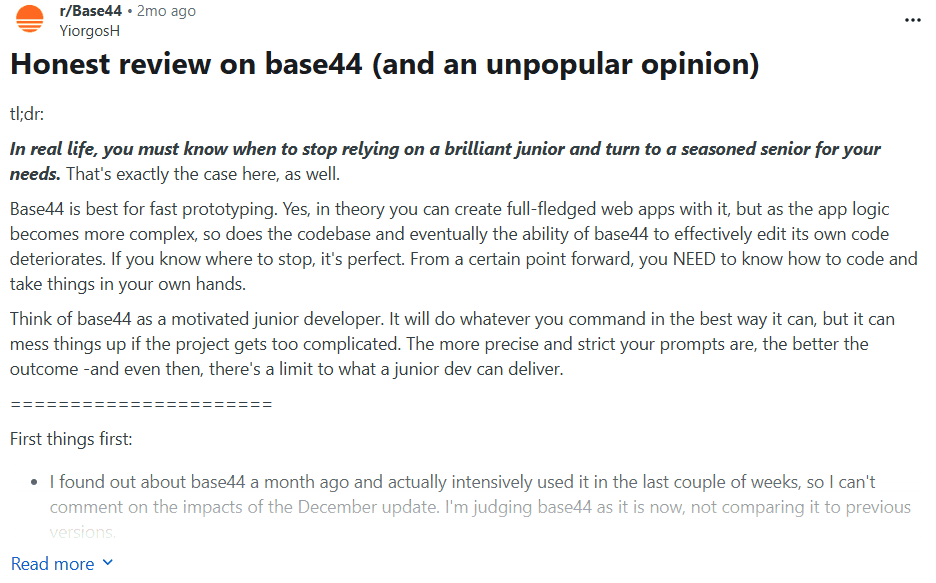
r/Base44 – Honest Review on Base44
In this thread, a user shares a detailed opinion about using Base44, discussing both strengths and frustrations.
The post highlights appreciation for structured AI-guided building and reduced coding friction. However, the user also questions scalability limits, ecosystem dependency, and whether the platform can support more complex, production-grade applications long term.
Source: r/Base44
Reddit
Insight: Base44 is appreciated for structured app generation, but users remain cautious about long-term scaling and platform dependency.
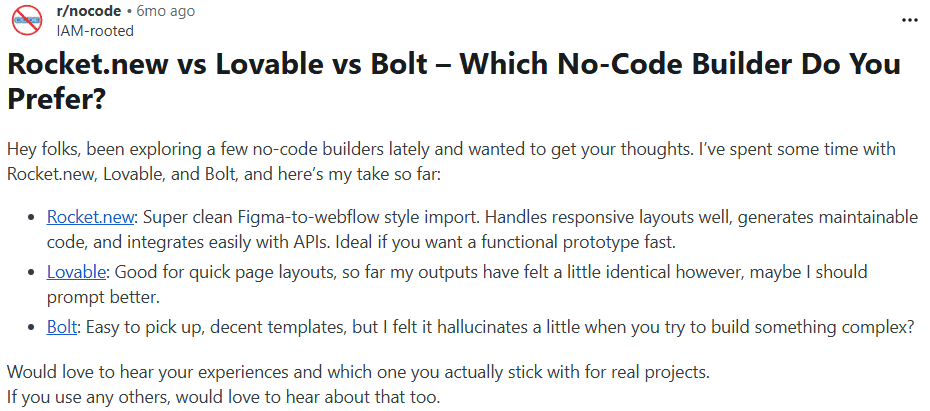
r/nocode – Rocket.new vs Lovable vs Bolt
This discussion compares Rocket.new with other no-code and AI app builders.
Rocket.new is often mentioned for its fast prompt-to-app generation. Users evaluating multiple tools discuss trade-offs around speed, customization limits, and stability. The conversation suggests Rocket.new is strong for experimentation, but long-term robustness varies depending on project complexity.
Source: r/nocode
Reddit
Insight: Rocket.new is viewed as a rapid builder within the no-code AI space, especially for MVP experimentation.
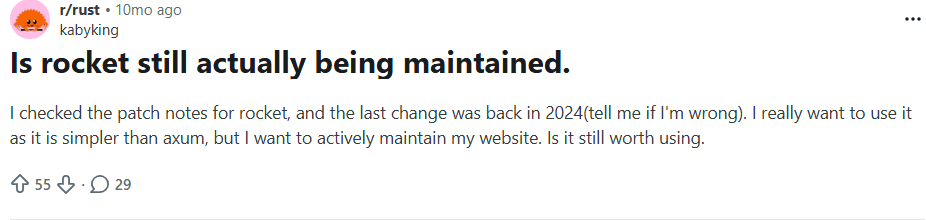
r/rust – Is Rocket Still Being Maintained?
This thread refers to Rocket (the Rust web framework), not Rocket.new the AI builder.
Users discuss maintenance activity, updates, and ecosystem health of the Rust framework. It is important to distinguish this from Rocket.new, which is an AI-powered builder platform and unrelated to the Rust framework.
Source: r/rust
Reddit
Insight: When researching Rocket.new, ensure clarity between the AI builder and the Rust web framework named Rocket to avoid confusion.
Pricing Comparison
Below is a structured comparison of publicly available pricing models. Exact pricing may vary based on billing cycle and updates.
| Plan Tier | Rocket.new | Base44 |
|---|---|---|
| Free Plan | Free tier with limited AI generation tokens and project scope | Free tier with limited AI credits and basic app generation |
| Entry Paid Plan | Pro tier around ~$20–$30 / month depending on billing cycle, includes higher token limits and private projects | Starter tier around ~$16–$20 / month depending on billing cycle, includes expanded message credits |
| Mid Tier Plan | Team plans ~$30+ / user / month with collaboration and higher usage limits | Builder tier ~$40 / month with increased AI credits and integration allowances |
| Advanced Tier | Enterprise plans with custom pricing for higher token allocation and support | Pro tier ~$80 / month with significantly higher credit limits |
| Top Tier / Enterprise | Custom enterprise pricing with SLAs and volume-based usage | Elite tier ~$160 / month for highest credit allocation and priority support |
| Billing Model | Token-based usage per month tied to subscription | Message and integration credit-based monthly allocation |
Pricing Insight
- Rocket.new revolves around AI token consumption. Heavy iteration increases usage cost.
- Base44 uses a message and integration credit structure. Pricing scales with how many AI interactions and integrations you require.
For rapid MVP cycles, both remain accessible at lower tiers. For heavy production usage, careful monitoring of credit consumption becomes essential.
If you’re considering Rocket.new for your next project, understanding Rocket.new pricing can help you choose the right plan for your workload.
Introducing Emergent
When comparing Rocket.new and Base44, you are evaluating two AI-first app builders focused on accelerating product creation.
Emergent positions itself differently.
Instead of optimizing only for speed or only for guided structure, Emergent focuses on structured AI-native product building with production intent. It aims to reduce architectural chaos while still allowing rapid iteration.
Here is how it compares on differentiated dimensions that go beyond the quick comparison table:
| Parameter | Emergent | Rocket.new | Base44 |
|---|---|---|---|
| AI Depth & Structured Reasoning | Combines AI generation with structured architectural guidance for scalable systems. ⭐️⭐️⭐️⭐️⭐️ | Strong at prompt-based generation but less focused on system-level reasoning. ⭐️⭐️⭐️⭐️ | Emphasizes structured app logic with guided flows. ⭐️⭐️⭐️⭐️ |
| Architecture Stability | Designed to reduce long-term architectural drift through guided system flows. ⭐️⭐️⭐️⭐️⭐️ | Optimized for rapid output; deeper restructuring may require manual oversight. ⭐️⭐️⭐️⭐️ | Structured thinking from start improves long-term clarity. ⭐️⭐️⭐️⭐️ |
| Product Lifecycle Awareness | Focused on idea → build → deploy → scale within guided workflows. ⭐️⭐️⭐️⭐️⭐️ | Primarily optimized for idea → MVP speed. ⭐️⭐️⭐️⭐️ | Balanced between MVP generation and structured growth. ⭐️⭐️⭐️⭐️ |
| Long-Term Scalability Framing | Designed for evolving systems and modular expansion. ⭐️⭐️⭐️⭐️⭐️ | Scales within platform-managed limits. ⭐️⭐️⭐️⭐️ | Supports structured scaling within ecosystem limits. ⭐️⭐️⭐️⭐️ |
| Intelligence vs Execution Balance | Balances AI reasoning with structured execution. ⭐️⭐️⭐️⭐️⭐️ | Execution-first builder with AI assistance. ⭐️⭐️⭐️⭐️ | Structured execution with AI-guided scaffolding. ⭐️⭐️⭐️⭐️ |
Positioning Insight:
If Rocket.new is optimized for execution speed and Base44 for structured AI flows, Emergent positions itself as a structured AI product system that blends reasoning, architecture, and deployment readiness.
How to Choose the Best AI Builder?
Choosing between Rocket.new, Base44, and Emergent depends on how you prefer to build and scale.
Do You Prioritize Speed or Structure?
If your goal is rapid MVP validation and experimentation, Rocket.new is optimized for speed.
If you prefer guided product architecture from the start, Base44 provides more structure.
If you want speed without sacrificing long-term system clarity, Emergent bridges both.
Are You Building for Validation or Long-Term Growth?
Rocket.new works well for early testing and quick iterations.
Base44 supports structured growth but within its ecosystem boundaries.
Emergent focuses on sustainable product development with architectural foresight.
How Important Is Architectural Clarity?
Rocket.new emphasizes output velocity.
Base44 emphasizes structured flows.
Emergent emphasizes long-term modular architecture and scalable system design.
Do You Expect to Scale Complexity Over Time?
For lightweight apps, Rocket.new is sufficient.
For structured medium-complexity products, Base44 performs well.
For evolving AI-native systems that may grow in complexity, Emergent offers stronger framing.
What Type of Builder Are You?
Indie hacker testing ideas quickly → Rocket.new
AI-first founder seeking guided flows → Base44
Product-focused team building scalable AI systems → Emergent
Conclusion
When comparing Rocket.new vs Base44, the difference is not about which tool is more “AI-powered.” Both rely heavily on AI. The difference is how they approach product building.
Rocket.new is built for velocity. It helps you move from idea to working app quickly. If your priority is testing ideas, shipping MVPs fast, and iterating without worrying too much about long-term architecture, it performs well.
Base44 leans more toward structured product building. It focuses on guided workflows, clearer system organization, and architectural framing from the beginning. If you care about building in a more deliberate and organized way, Base44 may feel more stable over time.
In simple terms:
- Choose Rocket.new if you value speed and rapid experimentation.
- Choose Base44 if you value structure and guided product clarity.
If you are thinking beyond MVP and want a system that balances AI reasoning, architecture, and scalable execution, platforms like Emergent aim to sit between speed and structure.
The right choice depends on whether you are optimizing for immediate output or long-term product evolution.
Most AI app builders stop at prototypes. Emergent creates production-ready apps you can actually launch.
- Production-ready apps
- Web & mobile apps
- Deploy in minutes