


GPT-5.6 Sol and Terra Are Now Available on Emergent

OpenAI's GPT-5.6 family launched publicly today after two weeks behind a government review gate. The models are now live across ChatGPT and the API, and starting today, GPT-5.6 Sol and GPT-5.6 Terra are available to all Emergent users.
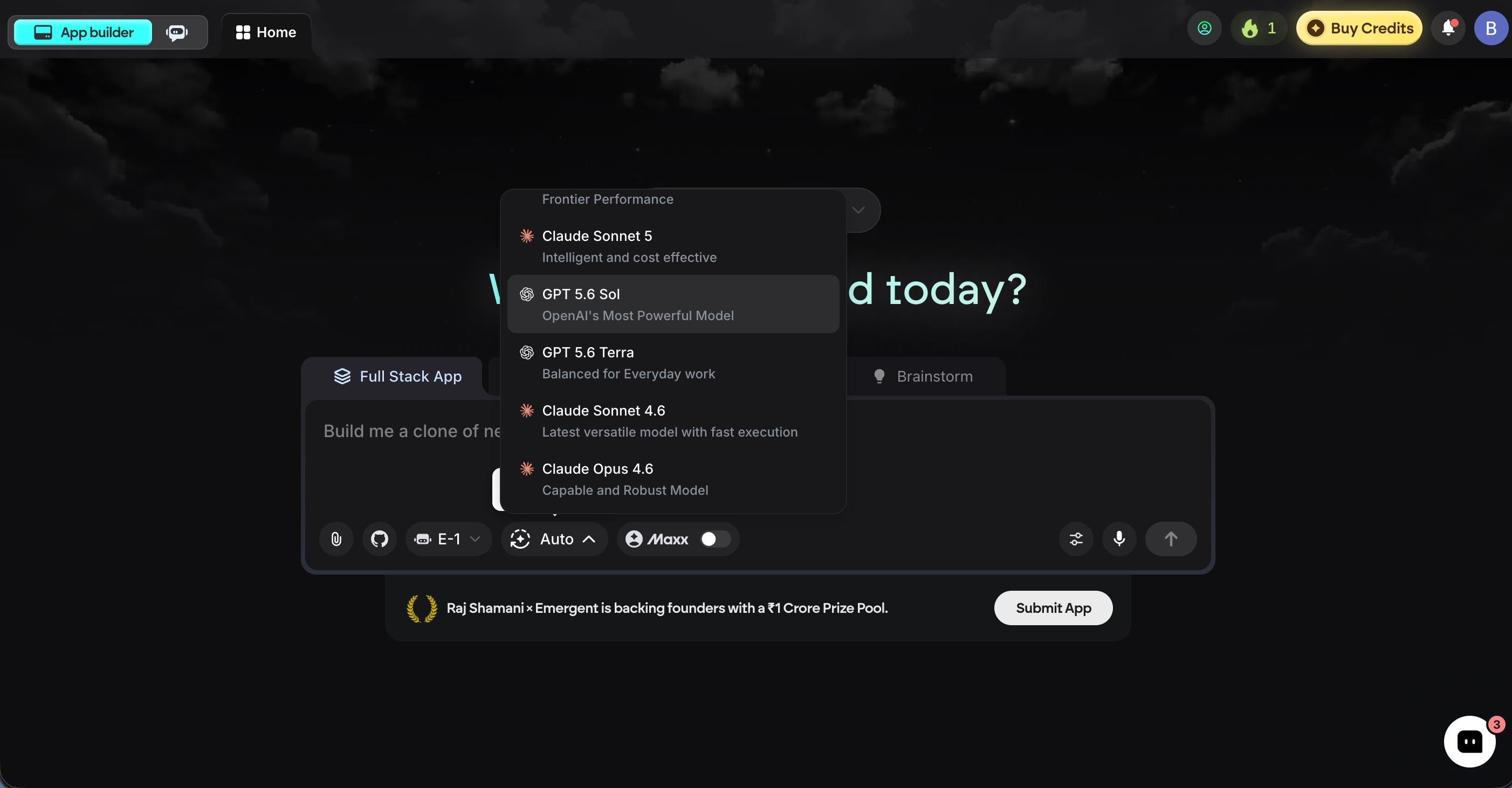
That means if you're building on Emergent, you can use OpenAI's most capable models right now. No separate OpenAI account. No API key management. No code. Just describe what you want to build and tell the agent which model to use.
What GPT-5.6 Sol and Terra Bring to the Table
GPT-5.6 is not one model. It's a family of three tiers. Emergent is launching with the top two: Sol and Terra.
GPT-5.6 Sol is OpenAI's most powerful model. It scored 88.8% on Terminal-Bench 2.1, a benchmark that tests real command-line coding workflows, outperforming every competing model tested.
On Agents' Last Exam, which evaluates long-running professional workflows across 55 fields, Sol scored 53.6%, beating Claude Fable 5 (40.5%) by over 13 points, according to OpenAI's published results. On the Artificial Analysis Intelligence Index, Sol with max reasoning comes within one point of Fable 5 while completing tasks in 61% less time at roughly half the estimated cost.
Sol also introduces two new capabilities: max reasoning effort, which gives the model extended time to think through harder problems, and Ultra mode, which deploys subagents to split complex work and run it in parallel. (Availability of specific Sol features like Ultra mode may depend on how the model is integrated within your app.)
Beyond raw intelligence, the generation brings practical upgrades for builders. OpenAI calls it "a step change in design judgment." Front-end rendering is notably stronger, producing cleaner and more polished UI code out of the box. Stronger computer-use capabilities let GPT-5.6 inspect and refine the rendered result, not just generate the underlying code, catching visual and functional issues before handing the work back. Visual understanding gets a significant upgrade too, making the models well-suited for apps that need to analyze or interpret images and documents.
Knowledge work output also gets a lift. Sol produces more polished presentations, documents, and spreadsheets, following complex reference formats more faithfully and handling equations, financial models, typography, and layout with greater precision. It can create fully editable presentations from scratch, translating a prompt and source material into a coherent visual narrative. For freelancers and small teams that rely on professional-quality deliverables, this is a practical upgrade that shows up in everyday work.
GPT-5.6 Terra is the everyday workhorse. OpenAI positions it as competitive with GPT-5.5 at roughly half the cost, but the benchmarks tell a stronger story. On Agents' Last Exam, Terra (50.4%) outperforms Claude Fable 5 (40.5%) at roughly one-sixteenth the estimated cost, according to OpenAI.
On the Artificial Analysis Coding Agent Index, Terra (77.4) edges Fable 5 (77.2) in about one-third of the time with half the output tokens. That token efficiency matters directly on Emergent: fewer tokens per task means lower credit spend per app you build and run. For most production workloads on Emergent, from customer-facing apps and content tools to internal dashboards, Terra delivers strong performance without the premium price tag.
When to Use Sol vs. Terra
Picking between the two comes down to what your app needs to do.
Use Sol when your app involves complex reasoning, multi-step problem-solving, or tasks where output quality is the top priority. Think: AI consultants that analyze business data, coding assistants that debug intricate issues, or tools that need to synthesize information from multiple sources into structured recommendations. Sol's stronger front-end rendering also makes it the better choice when your app's UI quality needs to be polished from the first build. Sol is the strongest model OpenAI has shipped, and it shows in tasks that demand depth.
Use Terra when you're building for production volume and your tasks don't require the ceiling of Sol's reasoning. Customer chatbots, content generators, form processors, summarization tools, and classification pipelines all work well on Terra at roughly half Sol's cost. For most apps built on Emergent, Terra is likely the right default.
Why This Matters for Builders
Every time a stronger model becomes available, the ceiling for what you can build without writing code goes up. GPT-5.6 Sol and Terra represent a meaningful step in that direction.
Sol's reasoning capabilities mean the AI features inside your app can handle harder problems. Customer-facing tools can give smarter answers. Internal automation can tackle workflows that previously needed human judgment. And Terra ensures you can ship these capabilities at production scale without burning through your budget.
Start Building with GPT-5.6
GPT-5.6 Sol and Terra are live on Emergent today for all users. If you're already on the platform, the new models are ready to use. If you're new, you can sign up and start building in minutes.
The models are here. The platform handles the rest. Start building on Emergent with GPT-5.6.
Stay tuned to Emergent News for more on AI tools, launches, and what they mean for builders.


on Emergent today




