


Google Stitch: The Free AI Tool That Lets You Design Apps with Words

You have an idea for an app. You can picture the layout, the flow, the feel of it. But between you and a working prototype sits a wall: learning Figma, hiring a designer, or spending days wrestling with templates that never quite match your vision.
Google just took a sledgehammer to that wall. And the entire design software industry felt the impact.
What Is Google Stitch?
On March 18, Google Labs released a major update to Stitch, its AI-powered design platform. Originally launched at Google I/O in May 2025, Stitch was reportedly built from the acquired startup Galileo AI. It has now been rebuilt from the ground up into what Google calls an "AI-native software design canvas."
In plain terms: you describe what you want your app or website to look like, and Stitch builds it. No wireframes. No design background. No code.
Josh Woodward, VP of Google Labs and the Gemini app, framed the tool's purpose in the official announcement, calling AI "a creativity multiplier, helping people explore many ideas quickly".
The tool runs on Google's Gemini AI models and is currently free to use through Google Labs. Users get 350 generations per month in Standard Mode (powered by Gemini 2.5 Flash) and 50 per month in Experimental Mode (using the more advanced Gemini 2.5 Pro).
Read More: 7 Powerful Gemini Alternatives to Look for
How Vibe Design Works in Practice?
Google is calling the new workflow "vibe design." The name sounds like a buzzword, but the workflow it describes is genuinely useful.
As the official Google blog post explains, rather than beginning with a wireframe, users can start by explaining the business objective they're hoping to achieve, what they want their users to feel, or even examples of what's currently inspiring them.
You might prompt Stitch: "I want a landing page for an AI writing assistant with a hero section, three feature cards, social proof, and a two-tier pricing table." Or you could go broader: "Something premium and minimalist, like Stripe's site, designed to get sign-ups fast." Stitch generates multiple design directions from that input. You pick the one that fits, then refine with follow-up prompts or voice commands.
But vibe design is only one piece of the overhaul. The March 2026 update shipped five major changes that together make Stitch feel less like a generation tool and more like a full design environment.
What's New in the March 2026 Update?
AI-Native Infinite Canvas
The redesigned canvas accepts images, text, and code as context within a single workspace. You can drag in a screenshot of a competitor's page or paste a rough sketch, and Stitch will use it as a reference. This gives your ideas room to grow from early concepts to working prototypes without switching tools.
Design Agent
A new AI agent tracks your full project history and can reason across everything you've built so far. It offers critiques, generates variations, and helps you explore multiple design directions at once. Think of it as a collaborator that remembers every iteration you've tried.
Agent Manager
When you're testing three different homepage concepts at the same time, things get messy fast. The Agent Manager keeps your parallel explorations organized, tracking progress across multiple ideas so you can experiment without losing prior work.
Voice-Driven Design
You can now speak directly to the canvas. The AI agent listens, asks clarifying questions, gives real-time design critiques, and makes live updates. Say "show me this in a dark theme" or "give me three different menu layouts," and the interface responds instantly. This is particularly useful during early exploration when typing precise prompts feels too restrictive.
DESIGN.md
This is an agent-friendly markdown file that captures your design rules in a portable format. Users can extract a design system from any URL, or use DESIGN.md to export or import design rules to or from other design and coding tools. For teams working across multiple projects, this feature helps maintain visual consistency without manual effort.
One-Click Export and Developer Handoff
Every design generates clean HTML and CSS code that you can copy directly. Stitch also supports one-click export to Figma with editable layers and Auto Layout, plus integration with Google's AI Studio, Antigravity coding tool, and MCP servers. This bridges the gap between design and development, so the handoff to your coding workflow is seamless.
How Google Stitch Sent Figma's Stock Tumbling 8%?
The market reaction was swift and significant. Shares of Figma dropped 8% on Wednesday, followed by a decline of more than 4% on Thursday. The stock is down about 35% this year.
The concern is not that Stitch will replace Figma overnight. Professional design teams are not going to abandon years of component libraries and design systems. But the worry is about what happens at the edges.
Solo founders, small teams, and early-stage projects that might have been future Figma customers could now start (and possibly finish) their design work in Stitch, for free. Figma's Organization plan costs $55 per seat per month, billed annually. For a 20-person team, that adds up to roughly $13,200 per year. Stitch costs nothing.
Figma reported $1.06 billion in revenue for 2025, up 41% year over year, with net dollar retention at 136%. But net losses widened to $1.25 billion, up from $732 million in 2024. The stock is now trading roughly 80% below its post-IPO high of $142.92.
Google's entry into core design territory made that fragility visible.
Futurum Group analyst Bradley Shimmin provided a grounded take on the competitive picture. He noted that at its core, Stitch generates TypeScript for apps or HTML and CSS for web pages, making it fundamentally another coding agent. But he acknowledged Google's strength in handling multimodal inputs like images, audio, and text, which speeds up the design process considerably.
What Industry Experts Are Saying
The response from the design and tech community has been divided but revealing.
Designer Hewar Saber, who has a sizable following on social media, captured one side of the reaction with a widely shared post calling the new Stitch update "scary" for designers. That post resonated because it touched on a real anxiety about the shifting nature of design work.
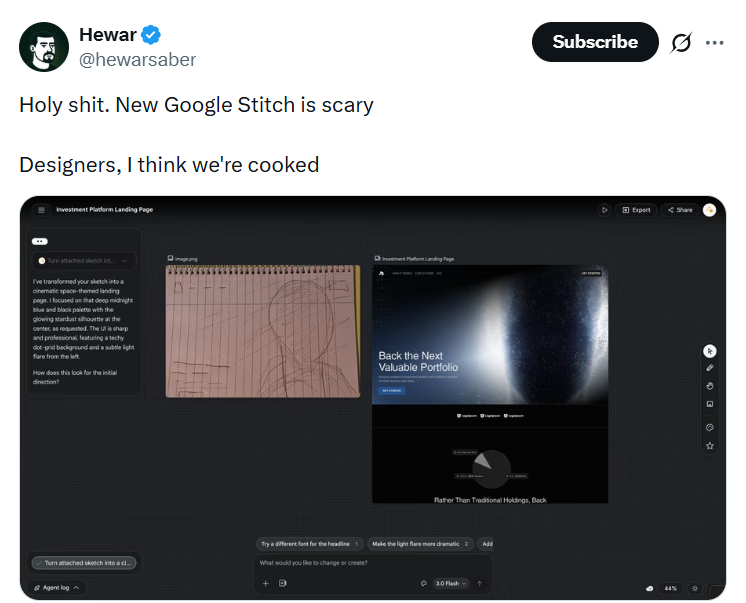
But as tech commentator Glen Rhodes argued in his analysis of the launch, the fears may be misplaced. He noted that what Stitch is replacing is not design thinking itself, but rather the translation layer between a rough idea and a visual output.
Designers who think in systems and push back on bad product decisions have more leverage now, not less, because they can generate ten directions in the time it used to take to produce one.
Shimmin also offered a caution worth noting for anyone planning to rely on AI-driven design at scale. He emphasized the need for deterministic elements like brand standards and design requirements to guide AI output, warning that without those controls, teams take a bigger risk than they probably need to.
What's Still Missing?
Stitch is powerful, but it has clear limits that builders should understand before diving in.
There is no design system management. Users cannot define and enforce a component library, design tokens, or brand guidelines across projects. Stitch is currently a single-user tool with no real-time multiplayer editing or team workspaces. Accessibility compliance (WCAG) is inconsistent and often needs manual review.
The tool excels at what one NxCode analysis called the "zero-to-one phase," getting from a blank page to a solid first draft fast. But the "one-to-100 phase," refining designs into production-ready, accessible, brand-consistent design systems, is where traditional tools still have the advantage.
Google also has not committed to Stitch's long-term availability. It remains a Google Labs experiment with no announced pricing or enterprise roadmap as of March 2026. For builders who remember Google Wave, Google+, or Stadia, that caveat is worth noting.
What This Means for Builders?
If you have ever stalled on a project because you could not get the design right, or could not afford a designer, Stitch changes your options. It will not replace a seasoned design team. But it can replace the blank canvas that keeps many solo builders stuck.
The ability to go from a plain-language description to a polished, code-ready UI in minutes is exactly the kind of unlock that non-technical creators need. The tool is free, backed by Google's infrastructure, and integrated with a growing AI development ecosystem.
As Google's own blog puts it, whether you're a professional designer looking to explore dozens of variations or a founder manifesting your first software idea, Stitch aims to close the gap from idea to reality in minutes rather than days.
For solo creators and small teams working on tight budgets, this is worth testing today.
Try It Yourself
Google Stitch is available now through Google Labs. All you need is a Google account.
For non-technical founders and solo creators, this is a meaningful shift. The design phase of building a product has traditionally been one of the biggest bottlenecks, either because of cost, skill gaps, or both. Stitch lowers that barrier to a text prompt and a few minutes of your time. That alone makes it worth experimenting with, whether you're validating an app idea, mocking up a landing page, or pitching investors.
But design is only half the equation. A polished UI still needs to become a working product. If Stitch handles your design, Emergent handles the rest. You can take your concept from a visual prototype to a fully built, functional product without writing a single line of code. Design it with Stitch. Build it with Emergent. Try Emergent today

on Emergent today




