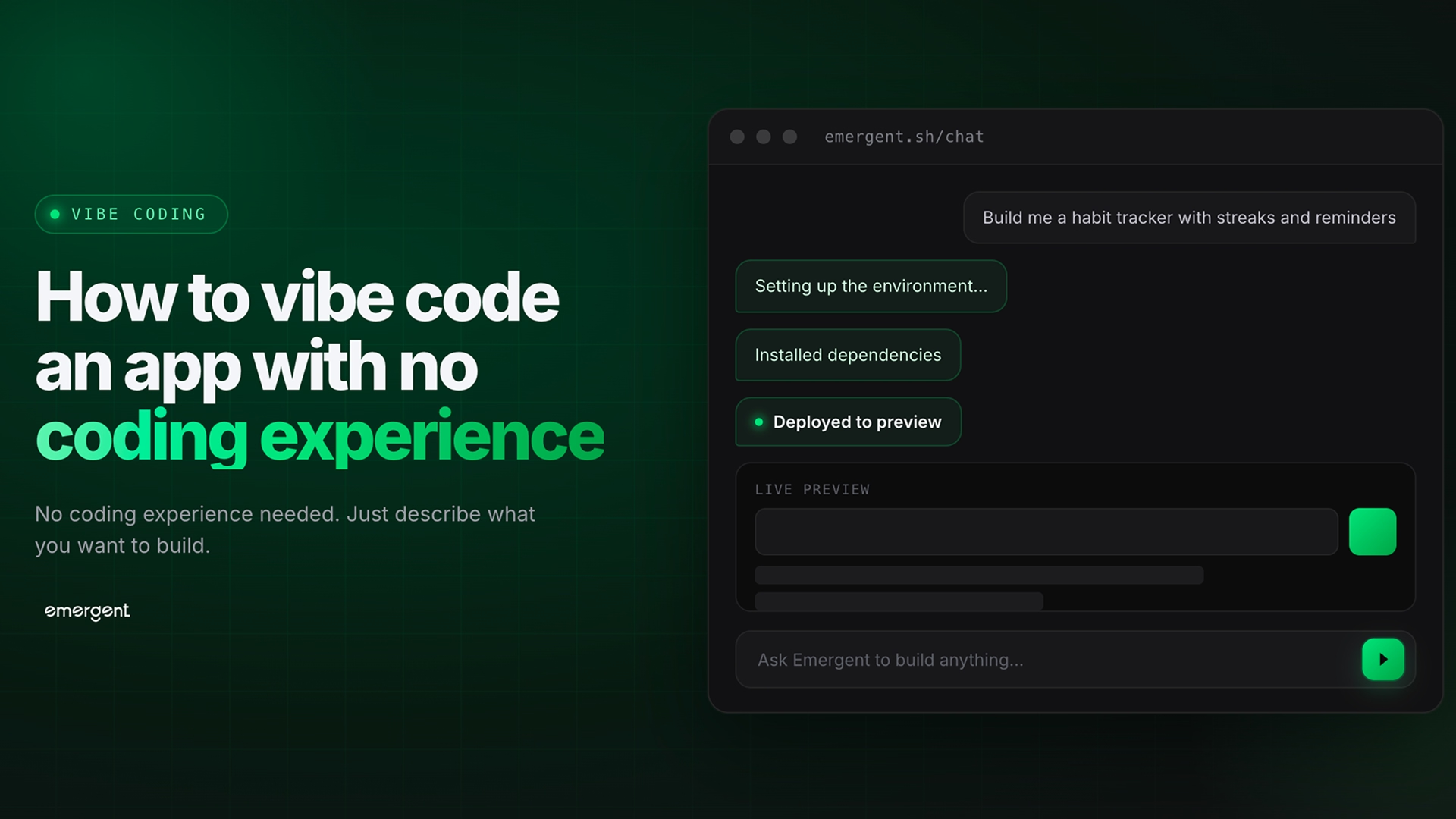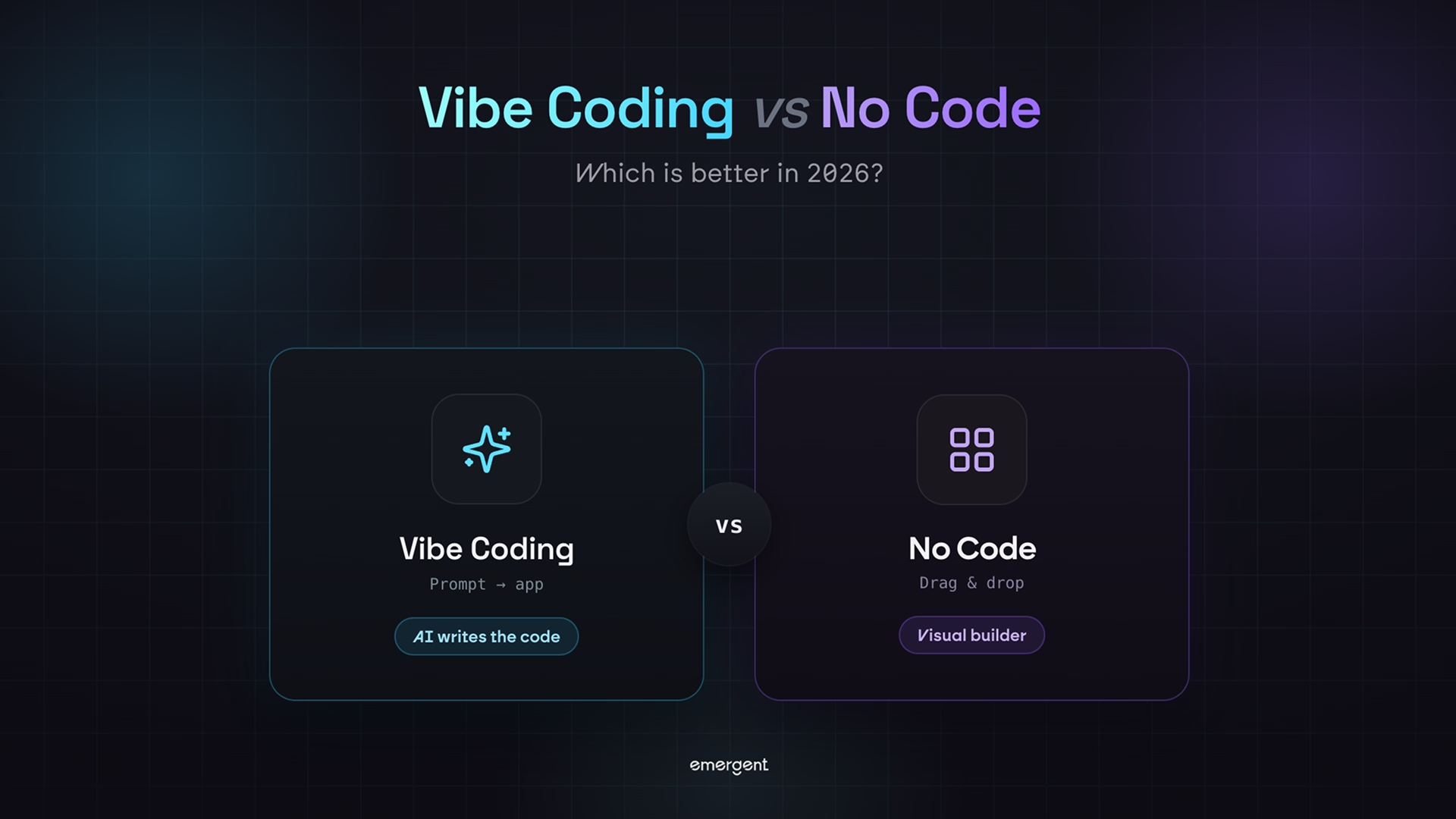
In 2026, Gartner forecasts that over 75 percent of new enterprise applications will be built using low-code or no-code development platforms, reflecting the rapid adoption of visual and model-driven technologies for faster, more accessible software creation. App building has shifted from a purely engineering-led activity to a strategic capability that startups, enterprises, and product teams actively choose based on speed, control, scalability, and long-term maintainability.
App building platforms today span a wide spectrum, from traditional IDEs used by professional engineers to AI-powered and no code systems that translate product intent directly into working software. Choosing the wrong platform can lock teams into slow iteration cycles, fragile architectures, or limited scalability. Choosing the right one determines how fast ideas move from concept to production, how safely systems evolve, and how well applications hold up under real-world usage.
What is an app building platform?
An app building platform is a software environment that enables teams to design, develop, test, and deploy applications for mobile, web, or cross-platform use. Depending on the platform, this may involve writing native code, assembling visual components, configuring logic flows, or generating applications from high-level intent using AI-assisted systems.
Modern app building platforms are used not only by engineers, but also by founders, product managers, and operations teams. The strongest platforms provide a balance between development velocity, architectural control, and production reliability, allowing applications to grow in complexity without requiring complete rewrites.
Top 5 App Building Platforms That Actually Work in 2026
Here are the 5 best app building platforms you should look out for in 2026:
- Emergent
- Android Studio
- Xcode
- FlutterFlow
- Softr
Suggested Read: Best AI Website Builder
What are the key features of app building platforms?
Control over application architecture and system logic
A serious app building platform must allow teams to define how data flows, how business logic executes, and how components interact over time. Platforms that hide architecture completely may accelerate early development but often limit scalability and maintainability. Long-term success depends on how clearly system logic can be structured and evolved.
Speed of development and iteration under real constraints
Development speed is not just about initial build time, but about how quickly teams can respond to feedback, bugs, and changing requirements. Strong platforms reduce friction across the entire lifecycle, from prototyping to production updates. Speed must be sustainable, not just fast on day one.
Support for production-grade performance and reliability
Applications must perform consistently under real user load, network variability, and device constraints. App building platforms should support performance optimization, error handling, and stability as first-class concerns. Reliability is what separates experimental apps from real products.
Flexibility across platforms, devices, and use cases
Modern products rarely live on a single platform. App builders must support mobile, web, or cross-platform deployment without forcing teams into rigid tradeoffs. Flexibility protects teams from future platform shifts and expansion needs.
Ability to scale teams, features, and complexity
As applications grow, more people, features, and integrations are added. Strong platforms support collaboration, versioning, and system evolution without exponential complexity. Scalability applies to both the software and the team building it.
What are the benefits of using app building platforms?
Faster time to market with reduced development overhead
App building platforms eliminate repetitive setup and boilerplate work that traditionally slows development. Teams can focus on product logic and user experience rather than infrastructure. Faster launches enable earlier validation and iteration.
Better alignment between product intent and implementation
Platforms that reduce translation layers between idea and execution minimize misinterpretation. Whether through visual builders or AI-driven generation, clearer alignment reduces costly rework. Intent-driven development improves product quality.
Lower long-term maintenance burden
Well-structured platforms encourage reusable components, centralized logic, and predictable updates. This reduces technical debt accumulation over time. Maintenance becomes manageable rather than overwhelming.
Improved collaboration between technical and non-technical teams
Modern app builders allow product, design, and engineering teams to work within shared systems. Clear visibility into app logic improves decision-making. Collaboration accelerates delivery without sacrificing quality.
Greater adaptability as products and markets evolve
Markets change, requirements shift, and new technologies emerge. App building platforms that support evolution allow teams to adapt without starting over. Adaptability is a strategic advantage in competitive environments.
5 Best App Building Platforms
App building platforms in 2026 range from traditional native development environments to AI-powered and no code systems. Some prioritize absolute control and performance, while others emphasize speed and accessibility. The platforms below stand out because they represent the strongest options across this spectrum, depending on how much control, speed, and scalability a team requires.
1. Emergent
Emergent is one of the best, full-stack, AI-powered vibe coding and no code platforms for building serious applications without forcing teams to choose between speed and architectural depth. In 2026, Emergent is increasingly adopted by startups, product-led companies, and enterprise innovation teams that want to move from idea to deployed application while still retaining control over logic, data, integrations, and long-term scalability.
Unlike traditional app builders that start from screens or templates, Emergent starts from intent and system design. Builders describe what the application should do, how users interact with it, how data flows, and how the business logic behaves. Emergent then generates a cohesive application system that includes frontend UI, backend logic, data models, authentication, integrations, and deployment, all aligned to that original intent.
Key Features of Emergent as an App Building Platform
Intent-driven generation of complete application systems
Emergent allows teams to express product requirements in natural language, including workflows, permissions, edge cases, and business rules. The platform converts this intent into a working application architecture rather than isolated screens or components. This dramatically reduces the gap between product thinking and technical execution, which is where many apps fail or drift.
Unified frontend, backend, and logic generation
Instead of stitching together separate tools for UI, APIs, databases, and authentication, Emergent generates them as a single coordinated system. Frontend components, backend services, and logic layers are aware of each other by design. This reduces integration fragility and prevents inconsistencies that emerge as applications grow.
Structured modeling of data, workflows, and permissions
Emergent treats data models, workflows, and access control as first-class entities. Builders can define relationships, constraints, and role-based behavior explicitly. This structure supports complex real-world applications such as marketplaces, SaaS products, internal tools, and operational systems without requiring custom rewrites later.
Built-in support for authentication, roles, and security
User authentication, authorization, and role-based access are generated as part of the core system rather than bolted on later. Security considerations are embedded into the application logic from the start. This is critical for apps that handle sensitive data or multi-user workflows.
Integration-ready architecture for external services
Emergent applications are designed to integrate with external APIs, databases, and third-party services without breaking internal logic. Integrations are treated as structured extensions of the system. This allows apps to evolve operationally without destabilizing core functionality.
Production-ready deployment and scalability by default
Apps built with Emergent are designed for real usage, not just demos. Deployment, hosting, and scaling are handled as defaults rather than optional upgrades. This allows teams to launch confidently and scale without re-platforming when usage grows.
Unique Features of Emergent Compared to Other App Building Platforms
Vibe coding that captures system behavior, not just UI
Emergent’s vibe coding approach allows builders to express how an app should behave under different conditions, not just how it should look. Logic around failure handling, user flows, and edge cases can be expressed conversationally. This preserves intent across the entire system.
Separation of business logic from presentation
Emergent cleanly separates core business logic from UI presentation. Teams can redesign interfaces or launch new frontends without rewriting backend logic. This separation protects long-term maintainability and reduces technical debt.
Designed for evolving products, not fixed templates
Emergent does not lock teams into rigid templates or predefined feature sets. As requirements change, the system can be extended or adjusted without architectural resets. This flexibility is critical for products that are expected to evolve over years.
Suitable for both technical and non-technical builders
Product managers and founders can express intent clearly, while engineers can inspect, refine, and extend generated systems. This shared ground improves collaboration and reduces misalignment. Emergent acts as a bridge rather than a replacement for engineering discipline.
Handles complexity without exponential overhead
As features, users, and integrations increase, Emergent maintains structural clarity. Complexity grows linearly rather than exponentially. This is one of the most important differentiators for long-lived applications.
Focused on correctness and coherence over shortcuts
Emergent prioritizes generating correct, coherent systems rather than quick visual demos. This reduces the risk of hidden failures later. The platform is optimized for apps that must work reliably in production.
Advantages of Emergent as an App Building Platform
- Full-stack system generation from high-level intent.
- Strong architectural foundations for complex apps.
- Reduced integration and maintenance overhead.
- Built-in security and role management.
- Scales well as products and teams grow.
- Suitable for production-critical applications.
Limitations of Emergent as an App Building Platform
- Requires thoughtful definition of product intent.
- More powerful than simple drag-and-drop builders.
- Less suited for throwaway prototypes or static sites.
Pricing and Plans of Emergent
| Plan | Pricing | Key Highlights |
|---|---|---|
| Free | $0/month |
|
| Standard | $20/month |
|
| Pro | $200/month |
|
| Team | $300/month |
|
| Enterprise | Custom |
|
Read More About: Emergent Pricing and Plans
2. Android Studio
Android Studio is the official integrated development environment for building native Android applications, and in 2026 it remains the most powerful and flexible option for teams that require absolute control over Android performance, system behavior, and low-level platform capabilities. It is primarily used by professional engineering teams, Android-first companies, and organizations building applications where reliability, performance, and OS-level integration are non-negotiable.
As an app building platform, Android Studio represents the maximum-control end of the spectrum. Unlike AI or no code platforms, it does not abstract complexity away. Instead, it exposes the full Android SDK, tooling, and ecosystem, allowing teams to architect applications exactly as they choose. This power comes with cost, in time, expertise, and ongoing maintenance responsibility.
Key Features of Android Studio as an App Building Platform
Full access to native Android APIs and system capabilities
Android Studio provides unrestricted access to the Android SDK, platform APIs, hardware features, and OS-level services. This enables apps to leverage advanced capabilities such as background services, sensors, Bluetooth, system permissions, and performance optimizations. For apps that must integrate deeply with the Android operating system, this level of access is essential and cannot be replicated by higher-level builders.
Complete architectural control over application structure
Teams using Android Studio define their own app architecture, including data layers, domain logic, UI composition, and state management. This allows the implementation of clean architectures such as MVVM, MVI, or custom patterns tailored to the product. Architectural control ensures long-term maintainability but requires disciplined engineering practices.
Native performance and memory management
Apps built in Android Studio compile to native Android code, delivering maximum performance and responsiveness. Developers can optimize memory usage, threading, and rendering behavior directly. This is critical for high-performance apps such as real-time systems, media-heavy applications, or apps operating under constrained device conditions.
Advanced debugging, profiling, and testing tools
Android Studio includes powerful tools for debugging, performance profiling, memory analysis, and automated testing. Developers can inspect runtime behavior, track performance regressions, and simulate different devices and OS versions. These tools are essential for maintaining reliability as apps scale.
Direct integration with Android build and release pipelines
Android Studio integrates tightly with Gradle, CI systems, and Google Play distribution workflows. This allows teams to control build variants, release channels, and deployment strategies precisely. Release management becomes a structured engineering process rather than a platform abstraction.
Long-term compatibility with the Android ecosystem
Because Android Studio evolves alongside the Android platform itself, apps built with it remain compatible with new OS versions and device capabilities. Teams are not dependent on third-party platform roadmaps. This reduces long-term platform risk.
Unique Features of Android Studio Compared to Other App Building Platforms
Absolute control with zero abstraction layers
Android Studio exposes the raw building blocks of Android app development. There are no hidden constraints or platform-imposed limitations. This makes it uniquely suited for apps that cannot compromise on behavior or performance.
Industry-standard tooling for professional Android development
Android Studio is the reference environment for Android engineering worldwide. Skills, patterns, and tooling learned here transfer directly across companies and projects. This makes hiring and knowledge sharing easier for engineering-led teams.
Freedom to design any UX or interaction model
Developers can implement any UI pattern, animation, or interaction supported by the Android framework. There are no template constraints or component limitations. UX innovation is bounded only by engineering skill and time.
Strong suitability for regulated or security-sensitive apps
Apps requiring strict compliance, custom security models, or deep OS integration benefit from Android Studio’s transparency. Teams can implement and audit every layer of the application. This is often required in finance, healthcare, or enterprise contexts.
Full ownership of code and intellectual property
All code written in Android Studio belongs entirely to the team. There is no platform lock-in beyond the Android OS itself. This ownership is critical for companies with long-term product roadmaps.
Steep learning curve with proportional long-term payoff
Android Studio demands strong engineering expertise and ongoing maintenance effort. However, for teams that invest in it, the payoff is unmatched flexibility, performance, and control. The cost scales with ambition.
Advantages of Android Studio as an App Building Platform
- Maximum control over Android app behavior.
- Native performance and OS-level integration.
- Powerful debugging and profiling tools.
- No platform-imposed feature ceilings.
- Full code ownership and transparency.
- Long-term compatibility with Android ecosystem.
Limitations of Android Studio as an App Building Platform
- Requires experienced Android engineers.
- Slower initial development compared to no code platforms.
- Higher ongoing maintenance overhead.
- Android-only, no cross-platform support.
- Longer iteration cycles for non-technical teams.
- Less accessible for rapid experimentation.
Pricing and Plans of Android Studio
| Plan | Pricing | Key Highlights |
|---|---|---|
| Free | $0 per month |
|
| Gemini Code Assist Standard | From $19 per month |
|
| Gemini Code Assist Enterprise | From $45 per month |
|
3. Xcode
Xcode is Apple’s official integrated development environment for building native iOS, iPadOS, macOS, watchOS, and visionOS applications, and in 2026 it remains the definitive platform for teams that need deep integration with Apple’s ecosystem. It is primarily used by professional engineering teams, Apple-first startups, and enterprises building applications where performance, platform fidelity, and long-term OS compatibility are critical.
As an app building platform, Xcode represents maximum native control within the Apple ecosystem. Like Android Studio, it does not abstract complexity away. Instead, it exposes Apple’s frameworks, tooling, and SDKs directly, allowing teams to design applications that fully leverage Apple hardware, OS features, and human interface guidelines. This power comes with high demands on engineering expertise and process discipline.
Key Features of Xcode as an App Building Platform
Full access to Apple’s native SDKs and platform frameworks
Xcode provides direct access to Apple frameworks such as UIKit, SwiftUI, Core Data, Core Animation, HealthKit, and ARKit. This enables apps to integrate deeply with device capabilities, system services, and Apple’s design paradigms. For applications that must feel truly native and leverage platform-specific features, this level of access is essential.
Complete control over application architecture and lifecycle
Developers using Xcode define their own architectural patterns, state management, data persistence strategies, and lifecycle handling. This allows teams to implement clean, testable architectures that scale with product complexity. Architectural freedom supports long-lived applications but requires strong engineering rigor to avoid fragmentation.
Native performance optimized for Apple hardware
Apps built with Xcode compile directly to native binaries optimized for Apple silicon and iOS devices. Developers can fine-tune performance, animations, memory usage, and rendering pipelines. This results in smooth, responsive experiences that are difficult to match with higher-level abstraction platforms.
Advanced debugging, profiling, and testing capabilities
Xcode includes Instruments for performance profiling, memory leak detection, and energy usage analysis. Developers can simulate devices, OS versions, and edge cases precisely. These tools are critical for maintaining stability and performance across Apple’s rapidly evolving hardware lineup.
Tight integration with Apple’s build, signing, and distribution workflows
Xcode manages code signing, provisioning profiles, TestFlight distribution, and App Store submissions. This tight integration ensures compliance with Apple’s requirements but also introduces procedural complexity. Mastery of these workflows is essential for reliable releases.
Long-term alignment with Apple’s platform evolution
Because Xcode evolves alongside Apple’s operating systems, apps built with it remain compatible with new OS versions and hardware features. Teams are not dependent on third-party platform roadmaps. This reduces long-term risk for Apple-first products.
Unique Features of Xcode Compared to Other App Building Platforms
Deep alignment with Apple’s human interface and design philosophy
Xcode encourages adherence to Apple’s design guidelines through native frameworks and tooling. This alignment produces apps that feel coherent and intuitive within the Apple ecosystem. Consistency with platform norms improves user trust and adoption.
Exclusive access to Apple-only capabilities
Certain features such as advanced HealthKit integrations, system-level privacy controls, and Apple-specific hardware features are only fully accessible through Xcode. For apps targeting Apple’s premium user base, this exclusivity matters.
Strong suitability for performance-critical and polished consumer apps
High-end consumer apps, creative tools, and enterprise-grade Apple apps benefit from Xcode’s performance and polish potential. Teams can control every detail of interaction and presentation. This is difficult to replicate with cross-platform abstractions.
High barrier to entry with professional-grade payoff
Xcode has a steep learning curve, especially around Swift, SwiftUI, and Apple’s tooling ecosystem. However, teams that invest gain unmatched control and quality within Apple platforms. The payoff scales with expertise.
Full ownership of source code and intellectual property
All code written in Xcode is owned entirely by the team. There is no vendor lock-in beyond Apple’s OS. This ownership is critical for long-term product strategies.
Platform-specific focus limits cross-platform reuse
While Xcode excels within Apple’s ecosystem, code reuse across Android or web platforms is limited. Teams must plan for parallel development if cross-platform coverage is required. This tradeoff is fundamental to native Apple development.
Advantages of Xcode as an App Building Platform
- Maximum control over Apple-native applications.
- Best-in-class performance and polish on iOS and macOS.
- Access to Apple-exclusive frameworks and features.
- Powerful debugging and profiling tools.
- Long-term compatibility with Apple platforms.
- Full code ownership.
Limitations of Xcode as an App Building Platform
- Requires skilled Apple-platform engineers.
- Slower initial development for non-technical teams.
- High procedural complexity around signing and releases.
- Limited cross-platform reuse.
- Higher maintenance cost over time.
- Not suitable for rapid no code experimentation.
Pricing and Plans of Xcode
| Plan | Pricing | Key Highlights |
|---|---|---|
| Xcode | $0 |
|
| Apple Developer Program | $99 per year |
|
| Xcode Cloud Free Tier | Included with Developer Program |
|
| Xcode Cloud 100 Hours | ~$49.99 per month |
|
| Xcode Cloud 250 Hours | ~$99.99 per month |
|
| Xcode Cloud 1,000 Hours | ~$399.99 per month |
|
| Xcode Cloud 10,000 Hours | ~$3,999.99 per month |
|
4. FlutterFlow
FlutterFlow is a visual, cross-platform app building platform built on top of Google’s Flutter framework, designed to help teams create mobile and web applications without writing all code manually. In 2026, FlutterFlow is widely used by startups, product teams, and solo builders who want faster iteration than native IDEs provide, while still retaining more control and extensibility than typical no code tools.
As an app building platform, FlutterFlow sits between full native development and high-level no code systems. It abstracts UI construction, navigation, and common logic visually, while still allowing access to Flutter code when needed. This hybrid positioning makes it attractive for teams that want speed without fully surrendering architectural control.
Key Features of FlutterFlow as an App Building Platform
Visual UI builder backed by Flutter’s rendering engine
FlutterFlow provides a drag-and-drop interface for constructing screens, layouts, and navigation using Flutter widgets. These visual components compile down to Flutter’s high-performance rendering engine, enabling smooth animations and consistent behavior across platforms. This approach accelerates UI development while preserving a native-like feel.
Cross-platform deployment from a single codebase
Apps built in FlutterFlow can be deployed to iOS, Android, and web from the same project. This significantly reduces development effort for teams targeting multiple platforms. Cross-platform consistency improves maintainability, though platform-specific customization may still require additional work.
Visual logic workflows for common application behavior
FlutterFlow allows builders to define actions, conditional logic, API calls, and navigation flows visually. This removes the need to write boilerplate code for common behaviors. As logic grows more complex, maintaining clarity in visual workflows becomes increasingly important.
Integration with backend services and APIs
FlutterFlow supports integration with REST APIs, Firebase, and external backend services. Data fetching, authentication, and persistence can be configured without building everything from scratch. Backend flexibility enables a wide range of application types, from SaaS dashboards to consumer apps.
Code export and extensibility for advanced use cases
Unlike many no code platforms, FlutterFlow allows teams to export generated Flutter code. Developers can extend, refactor, or integrate this code into larger systems. Code access reduces vendor lock-in and enables advanced customization when visual tools reach their limits.
Rapid prototyping with production-adjacent foundations
FlutterFlow enables teams to prototype quickly while staying close to production-ready architecture. Prototypes can often evolve into real products without a full rewrite. This continuity is a key advantage over throwaway prototyping tools.
Unique Features of FlutterFlow Compared to Other App Building Platforms
Hybrid no code and developer-friendly approach
FlutterFlow balances accessibility for non-engineers with extensibility for developers. Visual builders handle the majority of work, while code access remains available. This hybrid model supports collaboration across technical skill levels.
Strong alignment with the Flutter ecosystem
Because FlutterFlow builds on Flutter, teams benefit from Google’s ecosystem, community packages, and long-term framework investment. Skills and code can transfer beyond the platform. This alignment reduces long-term platform risk.
Faster iteration than native IDEs with more control than no code tools
FlutterFlow significantly shortens development cycles compared to Android Studio or Xcode. At the same time, it avoids the rigidity of purely template-driven platforms. This middle ground suits many modern product teams.
Visual development that still respects app structure
Unlike some no code tools that obscure architecture, FlutterFlow exposes screens, components, and data relationships explicitly. Builders must still think structurally. This encourages better long-term design discipline.
Suitable for MVPs that may need to scale
FlutterFlow works well for MVPs that are expected to grow into full products. The ability to export and extend code supports scaling. However, scaling still requires engineering investment.
Tradeoffs between visual convenience and complex logic clarity
As applications grow, visual logic can become dense and harder to reason about. Teams must manage complexity deliberately. Understanding this tradeoff is critical to long-term success with FlutterFlow.
Advantages of FlutterFlow as an App Building Platform
- Rapid cross-platform development from one project.
- Visual UI and logic accelerate iteration.
- Access to real Flutter code reduces lock-in.
- Good balance between speed and control.
- Strong ecosystem support.
- Suitable for evolving MVPs.
Limitations of FlutterFlow as an App Building Platform
- Visual logic can become complex at scale.
- Performance tuning may require manual code work.
- Platform-specific customization is limited visually.
- Requires Flutter knowledge for advanced cases.
- Less control than native IDEs.
- Still demands architectural discipline.
Pricing and Plans of FlutterFlow
| Plan | Pricing | Key Highlights |
|---|---|---|
| Free | $0 per month |
|
| Basic | $39/month |
|
| Growth | $80 per month first seat |
|
| Business | $150 per month first seat |
|
5. Softr
Softr is a high-level no code app building platform focused on turning structured data into functional web and lightweight application experiences with minimal technical overhead. In 2026, Softr is primarily used by startups, internal teams, operations groups, and non-technical builders who need to ship tools, portals, and simple apps quickly without managing infrastructure, codebases, or complex application architecture.
As an app building platform, Softr represents the speed-and-accessibility end of the spectrum. It deliberately abstracts away most engineering concerns in favor of rapid assembly using prebuilt blocks, data sources, and permissions. This makes it powerful for certain categories of apps and fundamentally unsuitable for others.
Key Features of Softr as an App Building Platform
Block-based app construction tied directly to data sources
Softr allows users to build applications by assembling prebuilt blocks such as lists, forms, dashboards, and detail views. These blocks are directly connected to data sources like Airtable, Google Sheets, and databases. This tight coupling between UI and data enables extremely fast app creation for CRUD-style applications.
Native support for internal tools, portals, and dashboards
Softr excels at building internal tools, customer portals, partner dashboards, and simple SaaS frontends. Authentication, permissions, and role-based access can be configured without code. This makes it particularly valuable for operational and business-facing use cases.
Built-in authentication and access control
User authentication and access rules are handled natively within the platform. Builders can restrict views, actions, and data based on roles or conditions. This eliminates a major source of complexity for non-technical teams building multi-user apps.
Rapid deployment with managed hosting and infrastructure
Apps built with Softr are deployed automatically with hosting, scaling, and maintenance handled by the platform. Builders do not need to manage servers, deployments, or updates. This dramatically lowers operational burden and time to launch.
Visual customization within predefined constraints
Softr offers visual styling options that allow apps to match basic brand requirements. However, customization is constrained by the block system. This tradeoff prioritizes consistency and speed over deep UI flexibility.
Integrations with automation and business tooling
Softr integrates with automation platforms, APIs, and business tools to extend functionality. This allows apps to participate in broader workflows. Integrations expand capability without introducing code complexity.
Unique Features of Softr Compared to Other App Building Platforms
Extreme speed to value for data-driven applications
Softr can turn an existing dataset into a usable app in hours rather than weeks. This speed is unmatched by lower-level platforms. It is ideal when the primary goal is access and workflow, not bespoke behavior.
Designed for non-engineers as first-class builders
Softr assumes little to no technical background. Concepts like databases, APIs, and authentication are simplified. This enables business teams to build and iterate independently.
Strong alignment with modern no code ecosystems
Softr fits naturally into stacks built around Airtable, Zapier, Make, and similar tools. It acts as a presentation and interaction layer on top of existing systems. This composability is central to its value.
Clear ceiling on complexity and customization
Softr intentionally limits what can be customized to maintain simplicity and reliability. This makes the platform predictable. It also means it cannot support complex application logic or highly interactive experiences.
Low maintenance and operational risk
Because Softr manages infrastructure and updates centrally, apps remain stable with minimal effort. This is valuable for teams without engineering resources. Operational simplicity is a core differentiator.
Best suited for apps where correctness beats sophistication
Softr shines when apps need to work reliably and clearly rather than impress with technical depth. For many internal and business-facing tools, this is exactly the right tradeoff.
Advantages of Softr as an App Building Platform
- Extremely fast app creation from existing data.
- No infrastructure or deployment management.
- Built-in authentication and permissions.
- Accessible to non-technical teams.
- Strong fit for internal tools and portals.
- Low ongoing maintenance effort.
Limitations of Softr as an App Building Platform
- Limited control over application architecture.
- Not suitable for complex logic or workflows.
- UI customization constrained by blocks.
- Web-focused, not native mobile apps.
- Performance tuning is not exposed.
- Hard ceiling on long-term scalability.
Pricing and Plans of Softr
| Plan | Pricing | Key Highlights |
|---|---|---|
| Free | $0 per month |
|
| Basic | $59 per month |
|
| Professional | $167 per month |
|
| Business | $323 per month |
|
| Enterprise | Custom pricing |
|
How to choose the best app building platform?
Decide whether speed or architectural control is your primary constraint
Every app team eventually pays for whichever dimension they deprioritize. If you are figuring out how to create a business app, that tradeoff starts at platform selection. Platforms optimized for speed abstract architecture aggressively, which accelerates early delivery but can cap long-term flexibility. Platforms optimized for control require more upfront effort but preserve freedom as requirements evolve. The correct choice depends on whether your app is an experiment or a long-lived system expected to grow in scope, users, and complexity.
Evaluate how the platform handles business logic as it grows
Simple apps tolerate simple logic, but real products accumulate rules, permissions, edge cases, and workflows. You should examine whether logic is modeled explicitly, scattered across visual actions, or hidden behind templates. Platforms that lack clear logic structures tend to become brittle as features increase, forcing rewrites or workarounds that slow teams down later.
Assess production readiness, not just build convenience
Many platforms look impressive during demos but struggle under real usage. Production readiness includes performance under load, error handling, security primitives, deployment reliability, and rollback capability. Choosing a platform that treats production as an afterthought often leads to painful migrations once traction appears.
Consider who will build and maintain the app over time
An app outlives its initial builders. You should consider whether future team members, engineers or non-technical operators, can understand and extend the system. Platforms that encode logic implicitly or visually without structure can become difficult to reason about, increasing long-term maintenance risk.
Match the platform’s evolution path to your product roadmap
Some platforms are excellent for getting started but plateau quickly. Others require more investment early but scale smoothly. You should choose a platform whose strengths align with where your product is going, not just where it starts. Misalignment here is one of the most common causes of re-platforming.
Also read our guide on application development tools before committing to a platform.
Why is Emergent the best app building platform?
Treats applications as coherent systems, not collections of screens
Emergent starts from system intent rather than UI assembly. It models how data, logic, users, and workflows interact across the entire application. This coherence prevents the fragmentation that often appears when apps are built incrementally using disconnected tools or templates.
Converts high-level product intent directly into executable architecture
Emergent allows teams to express what the app should do and how it should behave in natural language, then generates a structured system that reflects that intent. This eliminates the translation gap between product thinking and implementation. Fewer misunderstandings lead to fewer rebuilds and more stable products.
Balances speed with long-term architectural integrity
Emergent accelerates development without hiding critical structure. Teams move quickly while still retaining visibility into logic, data models, and permissions. This balance is rare and essential for products that must ship fast without sacrificing future flexibility.
Handles complexity growth without exponential overhead
As features, users, and integrations grow, Emergent maintains structural clarity rather than compounding complexity. Logic remains centralized and understandable. This allows teams to scale functionality without slowing development velocity dramatically.
Suitable for serious, production-grade applications from day one
Emergent is designed for real users, real data, and real operational constraints. Security, deployment, and scalability are built in rather than layered on later. This makes it appropriate for startups and enterprises that expect their apps to matter.
Conclusion
App building platforms in 2026 span a wide range of philosophies and tradeoffs. Android Studio and Xcode offer maximum native control at the cost of speed and accessibility. FlutterFlow provides a pragmatic middle ground between visual development and real code. Softr optimizes for speed and simplicity but enforces a clear ceiling on complexity.
Emergent stands apart by reframing app building as a system design problem rather than a UI or code problem. Its intent-driven, full-stack approach allows teams to move fast while preserving architectural coherence. For teams building applications that are meant to grow, evolve, and endure, Emergent offers the strongest foundation among modern app building platforms.

Most builders stop at a prototype. Emergent ships real web and mobile apps, with accounts, databases, and payments included.
- Production-ready apps
- Web & mobile apps
- Deploy in minutes