Not too long ago, building a website meant hiring a developer, spending weeks going back and forth on designs, and then watching your budget disappear faster than you expected. Or, if you were brave enough to DIY, you spent entire weekends watching tutorials just to get a half-decent homepage live. Things look very different now.
AI has quietly changed what it means to "build" something. You describe what you want, and the tool builds it. No code, no design degree, no 47 browser tabs open at once.
This guide walks you through exactly how to build a website with AI, step by step, in plain language. Whether you are launching a small business, a portfolio, a blog, or an online store, this is your starting point.
Step 1: Define your website idea and goals for AI input
Before you open any tool, get clear on what you are actually building. This sounds obvious, but it is the step most people skip, and it is the one that determines how good your AI output is going to be.
AI tools are only as good as the instructions you give them. A vague prompt like "make me a website" produces a vague, generic result. A specific prompt like "I need a website for my freelance photography business in Austin, targeting couples planning weddings, with a portfolio section, a contact form, and a booking inquiry page" gives the AI something real to work with.
Before you start, write down the answers to these three questions:
- What type of website do you need? A portfolio, a business site, a blog, an online store, a booking page, something else?
- Who is your audience? Think about who will actually land on this site. Are they potential clients, readers, customers, or employers?
- What do you want visitors to do? Book a call, buy a product, read your content, fill out a form?
Having these answers ready makes every step that follows faster and more focused. The AI will use this context to generate structure, content, and design choices that actually make sense for your situation instead of producing something that looks like it could belong to anyone.
Step 2: Choose an AI website builder or tool
Once you know what you are building, you need to pick the right tool. This is where a lot of people get stuck because there are many options out there, and they are not all built for the same purpose.
It helps to understand the two broad categories before you start comparing specific platforms: single-function AI tools and end-to-end builders.
Single-function AI tools
The first type is the single-function AI tool. These assist with one specific part of the process, like generating copy, suggesting design layouts, or producing images, but they do not build a complete website on their own. They are useful if you already have a site and want AI help with a particular task, or if you are a developer who wants to slot AI assistance into an existing workflow.
End-to-end AI website builders
The second type is the end-to-end AI website builder. These tools handle everything: structure, design, content, hosting, and publishing, all from one place. You describe your site, the AI builds a working draft, and you refine and publish without ever leaving the platform. This is the right starting point for most people who are not developers, because there is no assembly required.
For the purposes of this guide, the focus is on end-to-end builders, since that is what most people actually need when starting from scratch.
Within this category, there are a few tools worth knowing about. Below are the tools you should consider.
Emergent
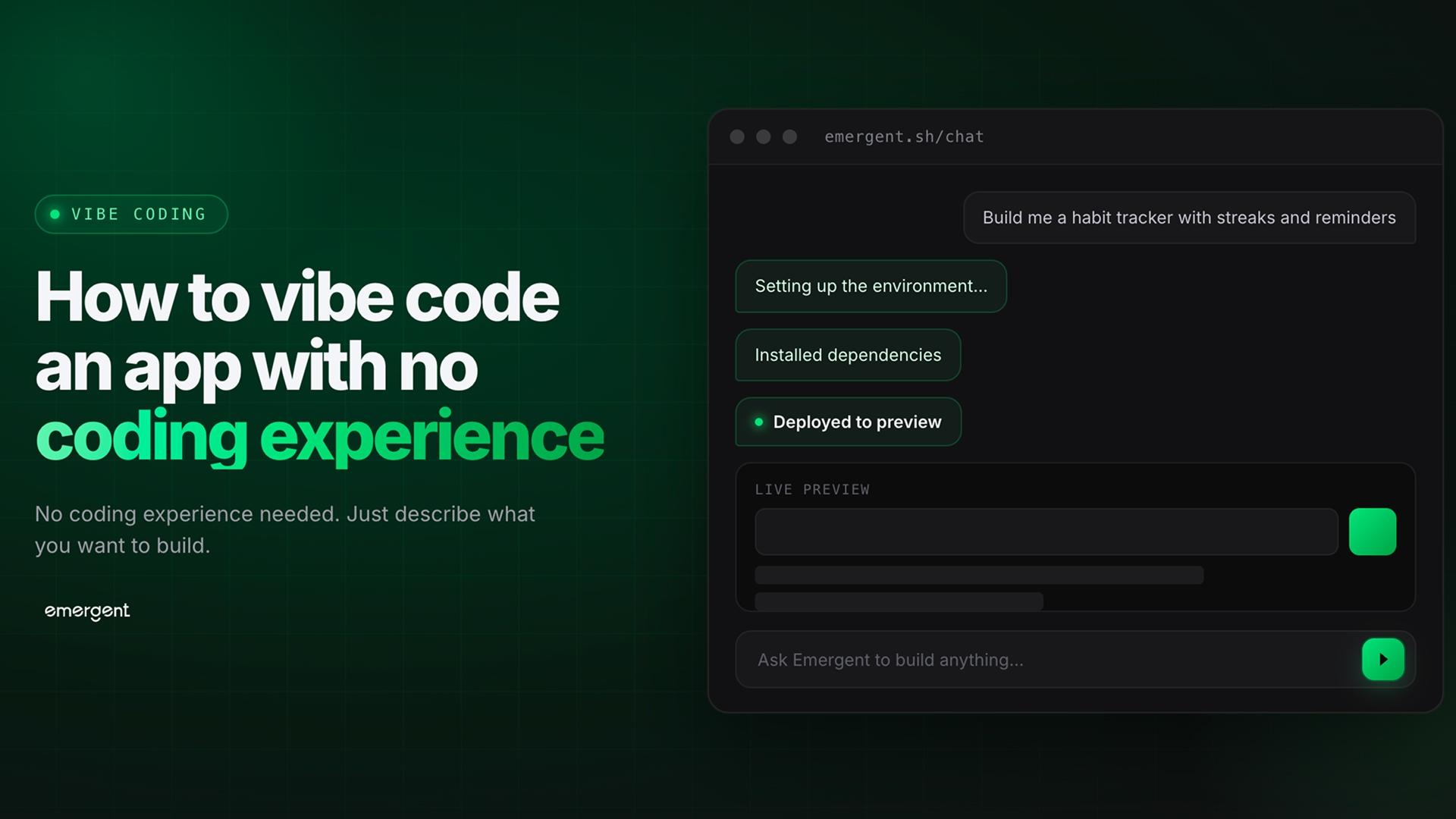
Emergent is a conversational AI platform that lets you build production-ready websites and applications by describing what you want in plain English. Instead of filling in a template, you chat with AI agents that handle the design, code, and deployment end-to-end. It is particularly well-suited for people who want something more custom or functional than a standard templated site allows.
Read More: Best 6 AI Agent Builders Worth Considering
Wix
Wix is one of the more established names in this space, and its AI builder lets you answer a few questions about your business before generating a starting layout that you can then edit using its drag-and-drop tools.
Hostinger
Hostinger takes a similar prompt-based approach and is one of the more budget-friendly options, with hosting and a domain included in the same package.
Squarespace
Squarespace has its Blueprint AI builder, which walks you through a five-step guided process before producing a design that leans toward the polished and editorial end of the spectrum.
When making your choice, the main question to ask is whether you need the platform to handle hosting and your domain as well, or whether you just need help with design and content. If you want everything managed in one place, go with a full end-to-end platform. If you already have hosting sorted, a more focused tool might be enough.
Step 3: Generate your website structure using AI
With your tool chosen, the next step is to let AI do the architectural work. Website structure means the overall layout of your site: which pages you need, how they connect, and what sections live on each page.
Traditionally, this is where a lot of time gets lost. People sit down to build a site and realize they are not sure if they need a separate "Services" page or whether it should just live on the homepage. Should there be a blog? Where does the testimonials section go?
AI removes this guesswork. When you give it a clear description of your website (which you wrote out in Step 1), it will generate a recommended structure for you. Most tools will propose pages like Home, About, Services or Products, Blog, and Contact, and then suggest what content sections belong on each one.
Your job at this stage is not to build anything yet. It is to look at what the AI has proposed and decide whether it makes sense for your specific situation.
Use this checklist to review what it generates:
- Does the site have a homepage that clearly explains what you do and who you do it for?
- Is there an About page if your business relies on trust or personal connection?
- Are your services or products each given enough space, or are they crammed onto one page when they deserve their own?
- Is there a clear way for visitors to contact you or take the next step?
- If content marketing is part of your plan, is a blog included?
- Are there any pages the AI has suggested that you simply do not need?
Add a page if something is missing. Remove one if it is not relevant. Think of the AI-generated structure as a smart first draft, not a finished plan. Getting it right early saves a lot of time later because you are not retrofitting pages into a design that was not built for them.
Step 4: Create website content with AI assistance
The structure tells visitors where to go. Content is what they actually read when they get there. This is often the part people dread most, and it is where AI can genuinely save you hours.
AI can generate headings, section descriptions, calls to action, product descriptions, about page copy, and more. You feed it context about your business or brand, and it produces draft content for each page. On most AI website builders, this happens automatically as part of the site generation process. You end up with a working draft of your full site, not just empty placeholder text.
Here is the important part: do not publish the AI-generated content as-is.
Read through everything it has written. Replace anything that sounds generic with language that is specific to your business. Add details only you would know: your backstory, your approach, what makes you different, specific results or examples. Change any phrasing that does not sound like you.
For example, if you are a startup founder selling home help robots, the AI might generate a headline like "Smart home automation for modern living." That is fine as a starting point, but it could describe a hundred different products. What it cannot write for you is something like -
"We built Maya after realizing that 60 percent of our beta users were elderly people living alone who just needed help carrying groceries and remembering medications."
That detail is yours, and it is the kind of thing that makes someone stop scrolling.
Here is how to make an AI-generated website stand out in terms of content:
Find your USP
Start by identifying the one thing about your product or business that nobody else can honestly claim. Not "great customer service" or "high quality" - those are table stakes. Think about your origin story, a specific problem you solve that others ignore, or a result your customers consistently get that competitors cannot match.
Connect it to what your user actually needs
A USP that lives in your head does not help anyone. The next step is translating it into something your visitor cares about. Ask yourself: what does my customer lose by not having this? What does their life or business look like with it? That gap is where your content should live.
Humanize your offering
People buy from people, even when they are buying software or robots. Add the human element: who built this and why, what problem you personally experienced that led to this product, or what your customers say in their own words. AI cannot invent this for you, but it can shape it once you provide the raw material.
Feed it back into your AI tool
Once you have your USP, the user connection, and the human angle worked out, go back to your AI tool and give it all of that as direct input. Do not just ask it to "write homepage copy." Tell it exactly what makes you different, who you are writing for, and what tone you want. The more specific your input, the more usable the output.
AI gets you 70 to 80 percent of the way there, very fast. The remaining 20 to 30 percent is what turns a generic-sounding site into one that actually connects with people. That part is yours to do, and this process is how you do it.
Step 5: Apply AI-generated design and layouts
Once the content is drafted, AI handles the visual layout. This is where things start to look like a real website.
AI-generated layouts handle the decisions that would otherwise require a design eye. These decisions include:
- How much whitespace to use
- Where to place images relative to text
- How to structure a section so it is easy to scan
- How to make the whole thing look good on both desktop and mobile screens
You do not need to know what "above the fold" means or understand responsive design principles. The AI has already built those considerations into the layout it generates.
It also ensures things like:
- Sections stack correctly on mobile
- Images scale
- Buttons are placed where they are most likely to get clicked
What you should do at this stage is look at each page and evaluate whether the visual flow makes sense. Does the homepage tell a clear story as you scroll? Does the most important information appear early? Does each section lead naturally into the next? If something feels off, most AI website builders let you rearrange, add, or remove sections without touching any code.
Step 6: Customize branding and visual elements
A layout generated by AI will look clean and functional. But out of the box, it will also look like a layout generated by AI, which means it could belong to anyone. This step is about making it yours.
Branding customization typically involves a few key areas:
Colors
Most tools let you update the color palette across the entire site with a single change. Choose colors that match your brand or that feel right for the type of business you are running. A legal firm and a children's tutoring company should not have the same color scheme. If you are not sure where to start, Coolors is a free palette generator that lets you browse and lock in color combinations that work well together. Adobe Color is another solid option that also shows you how colors relate to each other in terms of contrast and harmony.
Fonts
Typography sets the tone of your site more than most people realize. Pick font pairings that match the feel of your brand, whether that is clean and professional, warm and approachable, or bold and creative. Google Fonts has a free library of hundreds of typefaces and lets you preview pairings before committing. If you want curated suggestions, Fontpair specifically focuses on combinations that work well together and organizes them by mood and style.
Images
Replace any AI-generated or stock images with real photos where possible. Real photos of your actual product, space, team, or work are significantly more effective than generic stock imagery. If you do need stock photos, Unsplash and Pexels both offer high-quality, royalty-free images that tend to look less obviously "stock" than the default options most site builders pull from.
Logo
If you have a logo, upload it. If you do not, several AI tools include a logo generator to produce a basic version for you to start with. Looka and Canva are both beginner-friendly options that can get you something usable quickly, even if you plan to invest in a more polished logo later.
None of this requires design experience. Most modern AI website builders give you simple controls for all of these elements. The goal is not to redesign the site from scratch but to add enough of your specific identity that the site no longer looks like it could belong to any business.
Step 7: Add functional features using AI tools
A website that just displays information is a starting point. Most businesses need it to do more than that: collect leads, take bookings, accept payments, run a blog, or let visitors ask questions.
The good news is that most AI website builders have these features built in, and adding them is closer to switching something on than building it yourself.
Common features you might want to add:
Contact forms
These are usually included by default. Make sure yours asks for the information you actually need, not just a name and email.
Booking or appointment scheduling
If you run a service-based business, look for a built-in booking feature or a simple integration with tools like Calendly. Some AI builders include this natively.
Payment processing
For online stores or paid bookings, most platforms support payment connections through Stripe or PayPal. You link your account and the platform handles the checkout flow.
Blog
If content marketing is part of your plan, enable the blog feature. Several AI website builders can generate blog post drafts or outlines to help you get started.
Live chat or chatbots
Some platforms offer AI-powered chat widgets that can answer basic visitor questions automatically.
The key principle here is to use what is already built in before looking for third-party add-ons. Adding too many external tools early on creates maintenance headaches later. Start simple, see what your visitors actually need, and add complexity from there.
Step 8: Optimize content and pages for search visibility
A well-designed website that no one can find does not do much for your business. Search engine optimization (SEO) is what helps your site show up when people search for what you offer. The basics are not complicated, and AI can handle most of them.
Here is what to focus on at this stage:
Page titles
Every page on your site needs a unique title that describes what is on that page and includes a relevant keyword. AI tools can suggest these based on your content.
Meta descriptions
This is the short summary that appears under your page title in search results. It does not directly affect rankings but it does affect whether people click. Keep it concise and specific.
Headings
Make sure your main heading on each page includes the primary topic of that page. If you are a plumber in Chicago, your homepage heading should probably mention both your service and your location.
Image alt text
Every image should have a short description. AI tools can generate these automatically, but check them to make sure they are accurate.
Page speed
Most AI website builders produce well-optimized sites by default. Make sure your images are not unnecessarily large, as oversized images are one of the most common reasons websites load slowly.
SEO does not produce overnight results. But setting it up correctly from the start means your site is in a much stronger position as time goes on.
Step 9: Test user experience and refine with AI feedback
Before you publish, take the time to use your website the way a visitor would. This is one of the most valuable steps in the process, and it is easy to skip when you have been staring at the same pages for hours.
1. Start with mobile
Pull up your website on your phone and scroll through every page:
- Does it load quickly?
- Is the text readable without zooming?
- Can you tap buttons without them being too small?
- Can you find the main thing you want visitors to do?
2. Then test on desktop
Check that images are not too large or too small, that text is not stretching across the full screen width in a way that is hard to read, and that navigation works as expected.
3. Analyse your site
Some AI website builders include built-in tools that analyze your site and flag issues with layout, readability, or missing SEO elements. If yours has this, run it and work through any suggestions that make sense.
4. Get feedback
Consider asking someone who has not seen the site before to spend two minutes on it and tell you what they think the site is about and what they would do next. Fresh eyes catch things you have become blind to.
5. Refine
Refine before you publish. Small improvements at this stage save you from a poor first impression once the site is live.
Step 10: Publish and manage your website from one platform
You have built something real. Now it is time to make it live.
Most AI website builders simplify the publishing process significantly. Instead of dealing with separate hosting accounts, FTP uploads, SSL certificates, and DNS configuration, everything is handled from one dashboard. You connect a domain (or purchase one through the platform), choose your plan, and hit publish.
If you do not already have a domain name, most platforms make it easy to search for and register one directly. Aim for something short, memorable, and closely related to your business name or what you do.
After publishing, the same platform is where you will manage your site going forward. Update content, add pages, check basic analytics, and run any features like your blog or booking system all from the same place you built the site. This matters because the simplest websites to maintain are the ones that do not require you to juggle multiple tools.
Check in on your site regularly, especially in the first few weeks after launch. See how visitors are engaging with it, what pages they are spending time on, and where they are dropping off. Use that information to make small improvements over time.
Doing all of this with an AI website builder
Reading through those ten steps, it is easy to see how much is actually involved in getting a website from idea to live. Each step is manageable on its own, but doing them across multiple tools adds friction, hand-offs, and more than a few "why isn't this working" moments.
This is where an AI website builder that handles the full workflow makes a real difference. Instead of switching between a design tool, a content tool, a hosting platform, and an SEO plugin, you work from a single environment that connects all of these steps.
Emergent is a good example of how this works in practice. It is built around the idea that you should be able to describe what you want and have AI agents handle the design, code, and deployment from that description alone. You are not filling in templates; you are having a conversation with the platform, and it builds accordingly. That is a meaningfully different experience from traditional website builders, and it is especially well suited for people who want something more tailored than a standard template allows.
Whether you use Emergent or another platform that works end-to-end, the principle is the same: a unified workflow reduces the number of places where things can go wrong, and it makes managing your site after launch far simpler.
Ready to try it yourself? Start Building on Emergent.

Describe what you want and Emergent builds it. A real, production-ready app you can launch the same day.
- One prompt to build
- Zero code required
- Deploy in minutes