Blaze.tech has emerged as a compelling no-code and low-code option for teams looking to build web applications quickly without deep engineering resources. It combines drag-and-drop visual development with integrations and deployment capabilities, making it appealing for internal tools, MVPs, and cross-platform applications. However, as the low-code ecosystem has expanded, many builders have begun to evaluate alternatives that offer different balances of flexibility, scalability, governance, and long-term ownership. Market expectations have shifted toward platforms that can support not just rapid prototyping but also robust operations and evolving product requirements.
For many organizations, the decision to explore alternatives arises when Blaze.tech starts to feel constraining. As apps grow complex, needs around automation, integration, workflow orchestration, and user-role management become more pressing. Choosing the right alternative early can save significant time and cost, especially when internal tools become central to operations or customer-facing products. This guide helps you compare five credible Blaze.tech alternatives in 2026 so you can align your choice with your team’s technical maturity and long-term growth path.
Constraints to Consider with Blaze.tech Before Choosing an Alternative
1. No Clear Code Export or Self-Ownership Path
Blaze.tech is designed as a fully managed platform where applications live and run inside its ecosystem. There is currently no documented way to export applications as standalone codebases or migrate logic externally.
2. Abstraction Over Depth for Advanced Custom Logic
Blaze.tech prioritizes speed and abstraction, which simplifies development for many use cases. However, this abstraction also limits how deeply teams can customize logic, UI behavior, or edge-case workflows.
3. Enterprise-First Positioning Limits Accessibility for Small Teams
Blaze.tech’s positioning and pricing model are clearly oriented toward teams and organizations rather than individual builders or hobbyists. While this aligns well with enterprise needs, it can be a barrier for startups or solo founders who want to experiment cheaply before committing.
Top Blaze.tech Alternatives and Competitors in 2026
- Emergent
- Softr
- Tooljet
- Bubble
- Retool
- Glide
1. Emergent
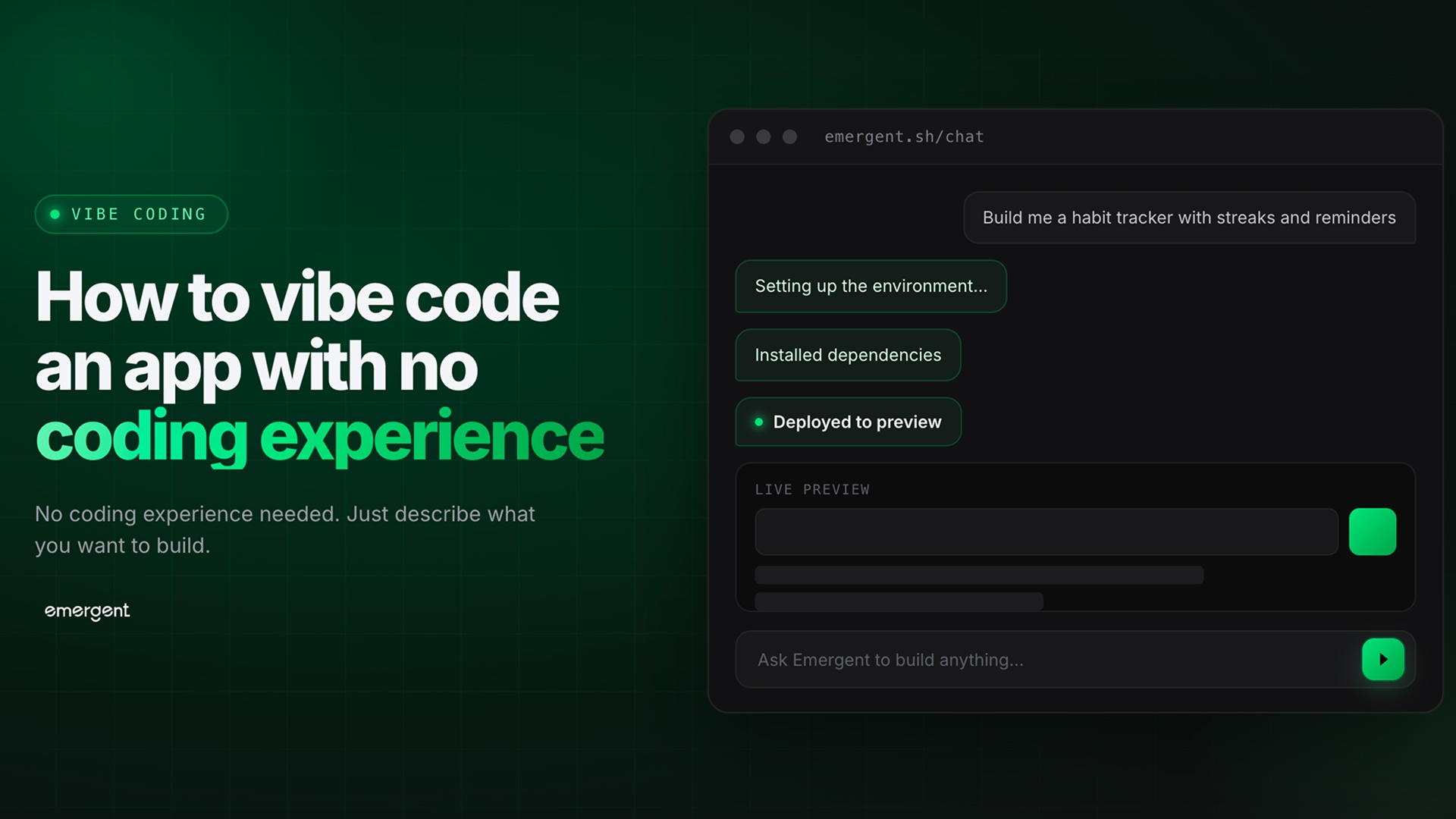
Emergent is one of the best, full-stack, AI-powered vibe coding and no code platforms for building web and mobile applications. Instead of assembling apps through visual widgets alone, teams describe workflows and system behavior in natural language. Emergent then generates the frontend, backend, data logic, and deployment as one cohesive system. Compared to Blaze.tech, which focuses on rapid visual building, Emergent emphasizes system-level structure from day one. This reduces rework as apps evolve. Teams typically choose Emergent when internal tools or products are expected to grow in complexity. It is positioned for long-term ownership rather than short-term builds.
Key Features of Emergent
1. Natural language system building
Emergent allows builders to define app behavior and workflows using plain English. The platform translates intent into structured logic and application flow. This removes the need to manually wire screens and conditions. Blaze.tech users often find this approach reduces configuration overhead. As requirements change, updates happen through conversation rather than rebuilding components.
2. Full-stack generation by default
Frontend UI, backend services, authentication, and data handling are created together. There is no need to bolt on external services just to reach production readiness. Blaze.tech users often manage integrations separately. Emergent treats the app as a complete system from the start, which scales more cleanly.
3. Clean separation of logic and interface
Emergent keeps business logic independent from presentation. This prevents changes in UI from breaking workflows. Blaze.tech apps can become tightly coupled as complexity grows. Emergent avoids this pattern early, making iteration safer over time.
4. Built-in automation and orchestration
Complex workflows and multi-step automations are handled natively. These workflows remain readable and manageable as they expand. Blaze.tech users often rely on simpler automation patterns. Emergent supports deeper operational logic without fragility.
5. Integrated testing and deployment
Testing is part of the build loop, not an afterthought. Teams can validate behavior before publishing changes. Deployment happens inside the platform without external pipelines. This improves reliability once apps are in active use.
Who Should Use Emergent?
1. Teams building mission-critical internal tools
Emergent fits tools that operations rely on daily. Reliability and scalability matter more than speed alone. It supports growth without architectural resets.
2. Founders planning beyond MVPs
Teams moving from prototype to production benefit from Emergent’s system-first design. Early discipline reduces future migration risk. This suits long-term roadmaps.
3. Organizations with complex workflows
Approval chains, automations, and integrations live in one platform. External dependencies are reduced. This simplifies maintenance as systems grow.
4. Teams prioritizing outcomes over UI wiring
Emergent rewards clarity of intent rather than manual configuration. Builders focus on what the app should do, not how widgets connect. This suits mature teams.
Advantages vs Limitations
| Advantages | Limitations |
|---|---|
| Full-stack apps without fragmented tooling | More capability than very simple apps require |
| Natural language driven workflows | Requires clear thinking to guide outcomes |
| Designed for production-grade systems | Less suited for throwaway prototypes |
| Clean separation of logic and UI | |
| Built-in automation and deployment | |
| Long-term ownership and flexibility |
Pricing
| Plan | Pricing | Key Highlights |
|---|---|---|
| Free | $0/month |
|
| Standard | $20/month |
|
| Pro | $200/month |
|
| Team | $300/month |
|
| Enterprise | Custom |
|
Read More About: Emergent Pricing and Plans
2. Softr
Softr is a no-code platform focused on building user-facing web apps and portals on top of existing data sources. Instead of acting as a full backend system, Softr works as a presentation and access layer connected to tools like Airtable, Google Sheets, and databases. Compared to Blaze.tech, Softr puts more emphasis on clean interfaces and role-based access rather than deep workflow orchestration. This makes it easy to launch client portals, dashboards, and internal tools without moving data into a new system. Teams often choose Softr when speed and usability matter more than complex backend logic. It is positioned as a front-end builder rather than a full application engine.
Key Features of Softr
1. Frontend-first app and portal building
Softr is designed around creating clean, responsive web interfaces quickly. Screens are built using pre-configured blocks for lists, forms, and dashboards. This removes much of the layout work found in other builders. Blaze.tech users often find Softr faster for presentation-heavy apps. Backend logic remains intentionally lightweight.
2. Native connections to external data sources
Softr connects directly to Airtable, Google Sheets, and databases without requiring data migration. This keeps existing workflows intact. Changes in the data source reflect immediately in the app. Blaze.tech users who prefer not to re-platform data often see this as a major advantage.
3. Built-in authentication and access control
The platform includes login, permissions, and role-based visibility out of the box. This supports client portals and internal dashboards with minimal setup. Compared to Blaze.tech, Softr simplifies access management for common use cases. Advanced authorization logic is limited by design.
4. Reusable blocks for common workflows
Softr provides blocks for search, filtering, forms, and navigation that work across apps. These blocks reduce repetitive configuration. They are optimized for consistency rather than customization. This suits teams prioritizing speed over bespoke behavior.
5. Fast deployment and iteration
Apps can be published quickly without complex configuration. Updates are straightforward and low risk. This shortens feedback loops for teams iterating on user experience. Blaze.tech users often appreciate this simplicity when launching portals quickly.
Who Should Use Softr?
1. Teams building client or partner portals
Softr fits portals where users log in to view or manage data. Interface clarity matters more than backend depth. This is a common Blaze.tech alternative scenario.
2. Non-technical teams
Business users can build and update apps without engineering support. The learning curve is low. This reduces dependency on developers.
3. Companies with established data systems
Teams already using Airtable or spreadsheets can layer Softr on top. This avoids rebuilding data models. Softr acts as an access layer rather than a system of record.
4. Projects prioritizing speed and presentation
When visual polish and fast launch matter most, Softr performs well. As logic grows complex, other platforms may fit better.
Advantages vs Limitations
| Advantages | Limitations |
|---|---|
| Fast setup for web apps and portals | Limited backend logic and automation |
| Clean, responsive UI out of the box | Heavy reliance on external data sources |
| Direct integration with existing data sources | Customization capped by block system |
| Built-in authentication and roles | Not ideal for complex workflows |
| Low learning curve | Scaling depends on underlying data tools |
| Strong fit for client-facing dashboards | Web-only focus |
Pricing
| Plan | Pricing | Key Highlights |
|---|---|---|
| Free | $0 per month |
|
| Basic | $59 per month |
|
| Professional | $167 per month |
|
| Business | $323 per month |
|
| Enterprise | Custom |
|
3. ToolJet
ToolJet is an open-source low-code platform designed for organizations that want enterprise grade compliance along with greater control over their infrastructure and application lifecycle. Unlike purely cloud-based no-code tools, it offers self-hosted deployments and integrates directly with databases, APIs, and enterprise systems. Compared to Blaze.tech, ToolJet feels far more engineering-focused while also offering visual development for business users. ToolJet lets you fluidly move between AI, no-code, and low-code right in the same tab unlike standard no-code tools that hit the limits once things get complex.. This makes it particularly useful for engineering, operations, and compliance teams in mid-large enterprises, building internal applications that require customization, auditability, and secure data handling. ToolJet is ideal for organizations that need full infrastructure control, predictable scaling costs, and deep customization for internal tools and workflow automation.
Organizations typically evaluate ToolJet when they:
- Need to deploy internal tools on private infrastructure
- Require deeper customization than template-driven builders
- Want to reduce dependency on proprietary SaaS platforms
- Need predictable costs as internal tool usage scales
- Want business users to be actively involved in the engineering process
Key Features
1. Self-Hosted and Cloud Deployment Options
Supports Docker and Kubernetes deployments, enabling teams to run applications in private cloud or on-prem environments. Unlike retool, ToolJet offers self hosting in all its plans without charging you on per end user model.
2. Database and API Integrations
With 80+ integrations, ToolJet connects directly to most SQL and NoSQL databases, REST APIs, LLMs, SaaS tools, and third party services. ToolJet supports a smooth migration experience by letting you develop your enterprise apps on your existing stack.
3. Workflow and Dashboard Builder
ToolJet provides a visual interface for building internal tools such as admin panels, reporting dashboards. You can even build complex, AI-powered automation workflows by simply connecting a few nodes on the intuitive workflow builder.
4. Open Architecture and Code Extensibility
Developers can extend applications using JavaScript or Python, enabling customization beyond standard drag-and-drop builders. The built-in Custom Component also allows you to create
5. Role-Based Access Control and Audit Logging
ToolJet lets you manage access with precision using predefined roles, custom groups, and granular permissions across apps, data sources, and workflows. Built-in audit logs automatically track user activity with details such as who performed an action, when it occurred, and from where, helping teams meet governance, security, and compliance requirements with greater visibility and control.
6. Predictable Scaling Costs
ToolJet runs on builder-based licensing models that can reduce long-term costs compared with user+builder based pricing structures commonly followed in SaaS tools.
Who Should Use ToolJet?
1. Teams building internal operational tools
ToolJet fits dashboards, admin panels, and workflow automation systems used in day-to-day operations. These tools prioritize reliability, data access, and system integration. Blaze.tech users often evaluate ToolJet when workflows become more complex or infrastructure control becomes necessary.
2. Organizations requiring deployment flexibility
Enterprises with private infrastructure or compliance requirements benefit from the ability to deploy applications in controlled environments. ToolJet supports both cloud and self-hosted setups without requiring a complete platform migration.
3. Engineering and operations teams
ToolJet works well for teams comfortable integrating systems and managing infrastructure. Developers can extend applications with custom logic while still benefiting from a visual builder interface.
4. Businesses managing growing internal usage
Organizations building tools for multiple departments often prioritize predictable scaling costs and infrastructure independence. ToolJet supports expanding usage without tightly coupling growth to per-user licensing models.
Advantages vs Limitations
| Advantages | Limitations |
|---|---|
| Flexible deployment across cloud and self-hosted environments | Requires technical setup for self-hosted deployments |
| Enterprise-grade features | Advanced UI customization may require developer involvement |
| Direct integration with 80+ databases and APIs | Mobile optimization features are still evolving |
| Open architecture reduces vendor lock-in risk | |
| Strong support for operational dashboards and workflows | |
| JavaScript and Python scripting with custom component support | |
| Predictable scaling as internal usage grows | |
| Larger enterprise ecosystem than legacy platforms |
Pricing (Cloud)
| Plan | Pricing | Key Highlights |
|---|---|---|
| Free | $0 per builder per month |
|
| Starter | $19 per builder per month |
|
| Pro | $79 per builder per month |
|
| Team | $199 per builder per month |
|
| Enterprise | Custom |
|
Pricing (Self-Hosting)
| Plan | Pricing | Key Highlights |
|---|---|---|
| Free | $0 per builder per month |
|
| Pro | $79 per builder per month |
|
| Team | $199 per builder per month |
|
| Enterprise | Custom |
|
4. Bubble
Bubble is a full no-code platform designed to build complex, database-driven web applications. It allows teams to design interfaces visually while defining detailed workflows, business logic, and data relationships behind the scenes. Compared to Blaze.tech, which emphasizes rapid visual building, Bubble provides far more control over how applications behave as they scale. Apps are structured around workflows that trigger actions across pages, users, and data states. This makes Bubble powerful, but also more demanding to learn. Teams usually adopt Bubble when internal tools evolve into customer-facing products or when workflow complexity outgrows simpler builders. It is positioned as a high-capability platform for serious web applications.
Key Features of Bubble
1. Visual builder with workflow-driven logic
Bubble combines drag-and-drop UI design with configurable workflows that control app behavior. Logic is defined step by step, allowing precise control over actions, conditions, and outcomes. Blaze.tech users often find this a major upgrade in flexibility. The trade-off is higher setup and maintenance effort.
2. Native relational database
Bubble includes a built-in database designed for relational data at scale. Data types, fields, and relationships can be fully customized. This supports more advanced use cases than simple form-based tools. Blaze.tech users often migrate here when data modeling becomes a bottleneck.
3. Extensive plugin ecosystem
Bubble offers a large marketplace of plugins for payments, APIs, analytics, and third-party services. This reduces the need to build everything from scratch. Flexibility is high, but plugin quality varies. Teams need to manage dependencies carefully.
4. Scalable hosting and performance controls
Bubble manages hosting and scaling within the platform. Apps can handle growing user bases with proper optimization. Blaze.tech users often value this when apps move beyond internal use. Performance tuning requires planning but is possible.
5. Custom workflows for business processes
Workflows can span multiple pages and user roles, supporting real operational logic. This enables complex approvals, onboarding flows, and automations. Blaze.tech users often hit limits here. Bubble is built to handle this depth.
Who Should Use Bubble?
1. Teams building complex web applications
Bubble fits products that require rich workflows and data relationships. These apps go beyond internal dashboards. Control matters more than simplicity.
2. Organizations extending internal tools to customers
When internal apps become customer-facing, Bubble provides the flexibility to support users, payments, and permissions. This transition is smoother than with simpler platforms.
3. Builders willing to invest in learning
Bubble has a steep learning curve. Teams that commit gain significant power. Casual users may find it overwhelming.
4. Web-first product teams
Bubble is optimized for web applications. Mobile support exists but is secondary. Teams focused on web experiences fit best.
Advantages vs Limitations
| Advantages | Limitations |
|---|---|
| Deep control over workflows and logic | Steep learning curve |
| Powerful built-in database | Web-first orientation |
| Large plugin ecosystem | Performance requires careful optimization |
| Suitable for complex web apps | Plugin dependency risks |
| Scales beyond simple internal tools | UI building can be time-consuming |
| Strong community and learning resources | Not ideal for quick, simple builds |
Pricing
| Plan | Pricing | Key Highlights |
|---|---|---|
| Free | $0 per month |
|
| Starter | $69 per month |
|
| Growth | $249 per month |
|
| Team | $649 per month |
|
| Enterprise | Custom |
|
5. Retool
Retool is a low-code platform purpose-built for creating internal tools on top of existing databases and APIs. Instead of trying to be a general app builder, Retool focuses on speed, reliability, and control for operational workflows. Apps are assembled using components that connect directly to live data sources, with logic handled through queries and scripts. Compared to Blaze.tech, Retool feels far more engineering-oriented and less visual-first. This makes it extremely powerful for internal dashboards, admin panels, and support tools, but less suitable for public-facing apps. Retool is positioned for teams that want internal tools to behave like real software without building everything from scratch.
Key Features of Retool
1. Direct database and API connectivity
Retool connects natively to databases, REST APIs, and internal services without intermediate layers. Queries run against live data rather than synced copies. Blaze.tech users often rely on abstractions for similar tasks. Retool’s direct access improves reliability and performance for operational tools.
2. Component-based internal app building
The platform provides a library of components such as tables, forms, charts, and inputs optimized for internal use. These components are designed to handle real data volumes. Compared to Blaze.tech’s more general UI blocks, Retool prioritizes function over aesthetics. Custom styling is secondary.
3. Scriptable logic and workflows
Retool allows logic to be written in JavaScript where needed. This supports advanced conditions, transformations, and automations. Blaze.tech users may find this more technical, but also more flexible. It suits teams that want precise control over behavior.
4. Environment management and versioning
Apps can be deployed across environments like development and production. Version history and rollbacks are supported. This introduces software-grade discipline into internal tooling. Blaze.tech offers simpler deployment flows by comparison.
5. Security and access controls
Retool includes granular permissions, role-based access, and enterprise security features. This is critical for tools handling sensitive data. Compared to Blaze.tech, Retool offers deeper governance for internal systems.
Who Should Use Retool?
1. Teams building internal admin tools
Retool fits dashboards, support tools, and operational systems. These apps prioritize reliability over design. Blaze.tech users often switch when tools become mission-critical.
2. Organizations with existing data infrastructure
Companies with databases and APIs benefit from Retool’s direct connectivity. There is no need to reshape data. This suits mature tech stacks.
3. Engineering-led or technical teams
Retool assumes some comfort with code. Teams with developers unlock the most value. Non-technical users may find it less approachable.
4. Businesses requiring strong security controls
Retool supports enterprise-grade security needs. This matters in regulated environments. Blaze.tech users often look here for governance.
Advantages vs Limitations
| Advantages | Limitations |
|---|---|
| Direct access to live databases and APIs | Not designed for public-facing apps |
| Built for reliable internal tools | Requires technical knowledge |
| Strong scripting and logic control | UI customization is limited |
| Environment management and versioning | Less suitable for non-technical builders |
| Enterprise-grade security | Mobile support is secondary |
| High performance for operational use | Higher cost at scale |
Pricing (Cloud)
| Plan | Pricing | Key Highlights |
|---|---|---|
| Free | $0 per standard user per month, $0 per end user per month |
|
| Team | $12 per standard user per month, $7 per end user per month |
|
| Business | $65 per standard user per month, $18 per end user per month |
|
| Enterprise | Custom |
|
Pricing (Self-Host)
| Plan | Pricing | Key Highlights |
|---|---|---|
| Free | $0 per standard user per month, $0 per end user per month |
|
| Team | $12 per standard user per month, $7 per end user per month |
|
| Business | $65 per standard user per month, $18 per end user per month |
|
| Enterprise | Custom |
|
6. Glide
Glide is a no-code app builder that turns structured data into functional web and mobile apps. It is built around a data-first model where tables define screens, logic, and user behavior. Compared to Blaze.tech, Glide simplifies app creation by reducing UI and workflow complexity in favor of clear data relationships. This makes it easy to launch internal tools, dashboards, and lightweight client apps quickly. Glide is often chosen when speed and clarity matter more than deep customization. It is positioned as a fast path to usable apps without managing application architecture directly.
Key Features of Glide
1. Data-first application model
Glide apps are driven by tables, with logic and screens generated from rows and relationships. This keeps behavior predictable and easy to follow early on. Blaze.tech users often find this reduces setup friction. As workflows grow more complex, flexibility becomes more limited.
2. Prebuilt UI components
The platform offers ready-made components for lists, forms, charts, and actions. These components cover common use cases without custom development. Compared to Blaze.tech, Glide prioritizes consistency over bespoke design. This speeds up delivery but caps customization.
3. Simple conditional logic
Logic is configured through visibility rules and conditions tied to data values. This makes basic workflows easy to implement. Blaze.tech users may miss deeper workflow control. Glide favors simplicity over expressive logic depth.
4. Built-in authentication and roles
Glide includes native login and role-based access control. This supports internal tools and basic portals with minimal setup. Compared to Blaze.tech, access control is easier to configure for common scenarios. Advanced permission models are limited.
5. Instant publishing and updates
Apps can be published and updated instantly without app store pipelines. This shortens feedback loops significantly. Glide emphasizes iteration speed over native flexibility. It works best for web-first deployments.
Who Should Use Glide?
1. Teams building internal dashboards
Glide fits tools that surface data for operations or reporting. These apps benefit from speed and simplicity. Blaze.tech users often switch for faster iteration.
2. Non-technical teams
Business users can build and maintain apps without learning frameworks. Changes are easy to make. This reduces reliance on developers.
3. Startups validating workflows
Glide supports testing ideas quickly. It works well before requirements solidify. As products mature, limits appear.
4. Organizations avoiding native deployment
Teams that do not want to manage app store builds prefer Glide’s web-first approach. This simplifies maintenance.
Advantages vs Limitations
| Advantages | Limitations |
|---|---|
| Very fast setup using structured data | Limited flexibility for complex workflows |
| Clean and predictable UI components | UI customization is constrained |
| Built-in authentication and roles | Scaling introduces pricing and structure limits |
| Easy maintenance for small teams | Less suited for native mobile experiences |
| No framework or state management required | Logic can become hard to manage at scale |
| Strong fit for internal tools | Not ideal for highly custom products |
Pricing
| Plan | Pricing | Key Highlights |
|---|---|---|
| Free | $0 per month |
|
| Explorer | Starting at $25 per month (billed monthly) |
|
| Maker | Starting at $60 per month (billed monthly) |
|
How to Choose the Right Blaze.tech Alternative?
1. Clarify Whether You Are Building Internal Tools or Full Applications
Blaze.tech can work well for quick builds, but not every alternative serves the same purpose. Some platforms are optimized for internal dashboards and admin tools, while others are designed for full customer-facing products. If your app is expected to move beyond internal use, choosing a platform built for production applications becomes important early. This decision often determines whether you will need to migrate later.
2. Evaluate Workflow Complexity and Automation Needs
Simple apps rarely stay simple. As approvals, integrations, and multi-step logic enter the picture, platforms differ sharply in how well they scale behavior. UI-first builders tend to struggle as logic grows. System-first platforms handle complexity more predictably. Buyers should assess how much automation their tools will need over time.
3. Consider Your Team’s Technical Comfort
Some alternatives trade simplicity for control. Platforms like Retool and Bubble expose more technical concepts, while others prioritize ease of use. The right platform should stretch your team without overwhelming it. Misalignment here often leads to stalled adoption or heavy reliance on a few power users.
4. Match the Platform to Your Deployment Needs
Blaze.tech users often reassess when deployment requirements expand. Web-only tools, native mobile apps, and internal deployments each carry different constraints. Some platforms simplify publishing, while others require more setup in exchange for control. Understanding how and where your app will be used helps narrow choices quickly.
5. Think About Long-Term Ownership and Scalability
Speed at launch is valuable, but long-term ownership matters more. Lock-in, pricing escalation, and architectural limits often surface after adoption. Platforms that support clean scaling and ownership reduce this risk. Buyers should optimize for durability, not just initial speed.
Conclusion
Blaze.tech remains a viable option for rapid app creation, but many teams begin exploring alternatives as their needs mature. The platforms covered here represent different paths forward, from system-first application builders to specialized internal tooling platforms. There is no single best replacement, only better alignment with how your apps are expected to evolve. Choosing the right Blaze.tech alternative is ultimately about removing future constraints before they become operational blockers.

Every alternative has trade-offs. Emergent just builds production-ready apps from one prompt.
- Production-ready apps
- Web & mobile apps
- Deploy in minutes