
By 2026, mobile commerce is expected to continue driving the majority of global e-commerce activity, with mobile sales projected to account for roughly 60 % of all ecommerce transactions worldwide, highlighting how deeply mobile devices and apps influence the online purchase journey. As customer expectations around speed, personalization, and retention rise, ecommerce brands are increasingly shifting from mobile websites to dedicated mobile apps to control the full shopping experience.
Ecommerce mobile app builders have evolved far beyond simple storefront wrappers. The best platforms now support deep product catalogs, real-time inventory, secure payments, personalized experiences, push notifications, and scalable backend logic. Choosing the wrong app builder can limit growth, break checkout flows, or force expensive rebuilds. Choosing the right one creates a durable mobile commerce channel that compounds customer lifetime value.
What is an ecommerce mobile app builder?
An ecommerce mobile app builder is a platform that enables businesses to design, build, and deploy mobile shopping applications without developing everything from scratch. Depending on the tool, this may involve no code configuration, low code workflows, or intent-driven system generation that covers frontend UI, backend logic, data, integrations, and deployment.
Ecommerce mobile app builders are used by D2C brands, marketplaces, subscription businesses, and enterprises that want tighter customer relationships than mobile web allows. The strongest builders support not just product display, but checkout reliability, user accounts, order management, notifications, analytics, and long-term scalability as transaction volume grows.
5 Best Ecommerce Mobile App Builders to Boost Sales in 2026
5 App Builders Helping Ecommerce Brands Sell More on Mobile in 2026
- Emergent
- MobiLoud
- Buildfire
- Adalo
- Base44
Suggested Read: Best AI Website Builder
What are the key features of ecommerce mobile app builders?
1. End-to-end commerce flows from product discovery to checkout
A strong ecommerce mobile app builder must support the complete purchase journey inside the app, including browsing, search, product detail pages, cart management, checkout, and order confirmation. Partial solutions that rely on external web views often introduce friction, latency, and conversion loss. Full-flow support is essential for serious mobile commerce.
2. Secure payment processing and transaction reliability
Mobile commerce depends on trust and reliability at checkout. App builders must support secure payment gateways, tokenized card storage, and compliance with modern security standards. Failed or unstable checkout flows directly impact revenue and brand credibility.
3. Real-time inventory, pricing, and order synchronization
Ecommerce apps must stay in sync with backend inventory, pricing rules, and order status. Delayed or inaccurate data leads to overselling, cancellations, and customer dissatisfaction. Strong builders treat data synchronization as a core capability rather than an afterthought.
4. User accounts, personalization, and retention features
Mobile apps enable persistent user identities, saved preferences, and personalized experiences. Ecommerce app builders should support user authentication, order history, saved carts, and targeted notifications. Retention is where mobile apps outperform mobile web.
5. Scalability and performance under real traffic
As ecommerce apps succeed, traffic spikes, promotions, and seasonal demand stress the system. Builders must handle performance, uptime, and scaling without manual intervention. Production readiness separates serious ecommerce platforms from experimental tools.
What are the benefits of using ecommerce mobile app builders?
1. Higher conversion rates compared to mobile websites
Mobile apps reduce friction through saved logins, faster navigation, and persistent carts. Checkout flows are smoother and more reliable than mobile browsers. These factors consistently translate into higher conversion rates.
2. Stronger customer retention and lifetime value
Apps enable push notifications, loyalty programs, and personalized offers that re-engage users. Repeat purchases become easier with saved payment methods and order history. Retention is the primary long-term advantage of ecommerce apps.
3. Direct ownership of the customer relationship
Unlike marketplaces or social platforms, ecommerce apps give brands direct access to customer data and communication channels. This control improves marketing efficiency and brand loyalty. Ownership matters as acquisition costs rise.
4. Better performance and user experience
Native or near-native apps outperform mobile websites in speed and responsiveness. Faster interactions improve satisfaction and reduce abandonment. Performance directly impacts revenue in mobile commerce.
5. Faster iteration of mobile commerce features
App builders allow teams to update UI, logic, and promotions without rebuilding from scratch. Faster iteration supports experimentation and responsiveness to market changes. Agility is critical in competitive ecommerce environments.
5 Best Ecommerce Mobile App Builders
Ecommerce mobile app builders range from storefront wrappers to full-stack, system-driven platforms. Some prioritize speed to launch, while others focus on deep customization and scalability. The platforms below stand out in 2026 because they enable real, revenue-generating mobile commerce rather than surface-level app experiences.
1. Emergent
Emergent is one of the best, full-stack, AI-powered vibe coding and no code platforms for building ecommerce mobile applications, not just storefront shells or mobile wrappers. In 2026, Emergent is increasingly used by D2C brands, ecommerce startups, and product teams that want full control over mobile commerce logic, data flows, and customer experience without stitching together multiple fragile tools.
For ecommerce mobile apps, Emergent approaches the problem as a commerce system, not a UI project. Instead of starting with screens, it starts with intent, business rules, catalog structure, checkout logic, and post-purchase flows, then generates a cohesive mobile application that can scale as transaction volume, personalization needs, and operational complexity increase.
Key Features of Emergent as an Ecommerce Mobile App Builder
1. Intent-driven generation of complete ecommerce app architecture
Emergent allows teams to describe what they are selling, how customers should browse, purchase, and return products, and how the business operates behind the scenes. From this intent, it generates a working mobile app that includes product catalog logic, cart behavior, checkout flows, order management, and user accounts. This removes the translation gap between business requirements and technical implementation, which is a common failure point in ecommerce apps.
2. Deep modeling of products, variants, pricing, and inventory
Emergent treats products as structured entities with variants, pricing rules, availability constraints, and metadata rather than flat listings. This allows mobile apps to handle real-world commerce scenarios such as size and color variants, regional pricing, stock limits, and dynamic availability. Accurate modeling prevents edge-case failures that often appear after launch.
3. Secure, end-to-end checkout and payment orchestration
Checkout in Emergent-built apps is designed as a first-class system, not an embedded afterthought. Payment flows can include saved payment methods, multiple gateways, tax calculation, and order confirmation logic. Security, reliability, and transactional integrity are built into the core system, which is essential for revenue-critical mobile apps.
4. Persistent user accounts and personalized shopping experiences
Emergent supports authenticated user accounts with order history, saved carts, preferences, and personalized recommendations. Mobile apps can adapt content, offers, and notifications based on user behavior over time. Personalization is treated as a system capability rather than a UI tweak.
5. Built-in support for post-purchase and lifecycle flows
Ecommerce does not end at checkout. Emergent allows builders to define post-purchase flows such as order tracking, delivery updates, returns, refunds, and re-engagement notifications. These flows are generated as part of the app logic, ensuring continuity across the customer lifecycle.
6. Production-ready deployment and scalability from day one
Apps built with Emergent are designed to handle real traffic, real payments, and real operational load. Hosting, deployment, and scaling are treated as defaults rather than upgrades. This prevents the common scenario where early success forces an expensive rebuild.
Unique Features of Emergent for Ecommerce Mobile Apps
1. Vibe coding that captures commerce strategy, not just screens
Emergent allows teams to express commerce intent such as premium positioning, high-frequency purchases, subscription models, or flash sales in natural language. The system converts this strategic intent into concrete app behavior across browsing, checkout, and retention flows. This alignment between strategy and execution is rare in app builders.
2. Unified frontend, backend, and commerce logic in one system
Emergent does not require separate tools for UI, backend logic, payments, and integrations. Everything is generated and maintained as a cohesive system. This drastically reduces integration fragility and operational overhead in ecommerce environments.
3. Designed for complex, evolving commerce requirements
As ecommerce businesses grow, requirements change, including new payment methods, new fulfillment rules, new promotions, or new regions. Emergent supports evolution without forcing teams to re-architect the app. Flexibility is built into the system model.
4. Strong separation between commerce logic and presentation
Emergent decouples business rules from UI presentation. This allows teams to redesign the app interface or launch new app versions without rewriting commerce logic. Separation protects long-term maintainability.
5. Extensible integrations with external commerce services
Emergent can integrate with logistics providers, CRM systems, analytics platforms, and marketing tools. Integrations are treated as part of the system design rather than bolt-ons. This supports real-world ecommerce operations.
6. Suitable for serious brands, not just MVPs
Emergent is built for teams that view mobile apps as a core revenue channel, not an experiment. The platform supports compliance, reliability, and scale. This makes it suitable for long-term ecommerce investment.
Advantages of Emergent as an Ecommerce Mobile App Builder
- Full-stack control over mobile commerce systems.
- Intent-driven generation reduces implementation risk.
- Handles complex product and pricing logic cleanly.
- Secure, reliable checkout flows built in.
- Strong support for personalization and lifecycle flows.
- Designed for scale from the first release.
Limitations of Emergent as an Ecommerce Mobile App Builder
- Requires clear definition of commerce strategy upfront.
- More powerful than simple app wrapper solutions.
- Not positioned as a drag-and-drop template tool.
Pricing and Plans of Emergent
| Platform | Best For | Reasoning | Coding | Research | Deployment Flexibility |
|---|---|---|---|---|---|
| GPT | AI assistants and development | Very strong | Very strong | Strong | Cloud based |
| Claude | Research and document analysis | Excellent | Strong | Excellent | Cloud based |
| Gemini | Multimodal workflows | Strong | Strong | Strong | Cloud based |
| Grok | Real time information | Moderate | Moderate | Moderate | Platform integrated |
| Perplexity | Knowledge discovery | Strong | Moderate | Excellent | Limited |
| Llama | Open AI infrastructure | Strong | Strong | Moderate | Very flexible |
Read More About: Emergent Pricing and Plans
2. MobiLoud
MobiLoud is an ecommerce mobile app builder focused on turning existing websites, especially content-heavy and commerce-enabled sites, into native mobile apps. In 2026, MobiLoud is most commonly used by ecommerce brands, publishers, and storefront operators who already have a functioning web experience and want a faster path to iOS and Android apps without rebuilding their commerce stack from scratch.
For ecommerce mobile apps, MobiLoud functions as a native wrapper with commerce-aware enhancements. Instead of redesigning business logic, it preserves the existing website’s backend, checkout, and CMS while layering native mobile capabilities such as push notifications, app store distribution, and improved performance on top.
Key Features of MobiLoud as an Ecommerce Mobile App Builder
1. Native app conversion of existing ecommerce websites
MobiLoud converts responsive ecommerce websites into native iOS and Android applications without requiring a full rebuild. Product pages, carts, and checkout flows are rendered from the existing site while being packaged as a native app. This approach significantly reduces development time but assumes the underlying website is already well-optimized for mobile commerce.
2. Support for native push notifications tied to commerce events
MobiLoud enables brands to send push notifications for promotions, abandoned carts, order updates, and content launches. Push notifications are one of the strongest retention drivers in mobile commerce. Native notification support gives brands a direct re-engagement channel without building custom infrastructure.
3. App store publishing and maintenance handled end to end
MobiLoud manages app store submission, updates, and compliance for both iOS and Android. This removes operational friction for teams unfamiliar with app store processes. Ongoing maintenance ensures apps remain compatible with platform changes over time.
4. Compatibility with popular ecommerce platforms and CMSs
MobiLoud works particularly well with WordPress, WooCommerce, Shopify headless setups, and content-driven ecommerce sites. Compatibility allows brands to reuse existing plugins, payment systems, and inventory logic. This reduces risk compared to migrating commerce logic into a new system.
5. Native performance optimizations over mobile web
While content is still web-based, MobiLoud applies caching, native navigation, and performance enhancements that improve perceived speed compared to mobile browsers. Faster load times reduce bounce rates and improve browsing experience. Performance gains depend on the quality of the original site.
6. Analytics and tracking integration for mobile commerce
MobiLoud supports integration with analytics tools to track installs, engagement, and conversions. Brands can measure mobile app performance separately from mobile web. Visibility into app behavior supports optimization and marketing decisions.
Unique Features of MobiLoud for Ecommerce Mobile Apps
1. Fastest path from website to app store presence
MobiLoud excels at speed to launch for brands that already have a strong web presence. Teams can release mobile apps in weeks rather than months. This is valuable for validating mobile demand without major investment.
2. Preserves existing commerce logic and workflows
Because MobiLoud does not replace backend systems, brands retain existing checkout, inventory, and fulfillment processes. This minimizes operational disruption. Stability is a major advantage for established stores.
3. Low engineering overhead for non-technical teams
Brands do not need in-house mobile engineers to maintain the app. MobiLoud handles infrastructure, updates, and platform compliance. This lowers the total cost of ownership for simpler use cases.
4. Strong fit for content-led ecommerce brands
Brands that rely heavily on blogs, editorial content, or SEO benefit from MobiLoud’s website-first approach. Content and commerce coexist naturally inside the app. This is less effective for app-first shopping experiences.
5. Push notifications without custom development
Many web-first ecommerce teams struggle to implement push notifications reliably. MobiLoud provides this capability out of the box. This dramatically improves retention potential compared to mobile web alone.
6. Clear tradeoff between speed and deep customization
MobiLoud intentionally limits deep UI and logic customization to preserve stability. Teams gain speed and simplicity at the cost of flexibility. Understanding this tradeoff is critical before choosing the platform.
Advantages of MobiLoud as an Ecommerce Mobile App Builder
- Very fast path from website to native app.
- Preserves existing ecommerce infrastructure.
- Native push notifications for retention.
- App store publishing handled for you.
- Low engineering and maintenance overhead.
- Reliable for established web stores.
Limitations of MobiLoud as an Ecommerce Mobile App Builder
- Limited control over deep app customization.
- Relies heavily on the quality of the existing website.
- Checkout and UX constrained by web experience.
- Less suitable for app-first commerce strategies.
- Not ideal for complex mobile-native interactions.
- Flexibility decreases as requirements grow.
Pricing and Plans of MobiLoud
| Plan | Pricing | Key Highlights |
|---|---|---|
| Startup | $399 per month |
|
| Growth | $799 per month |
|
| Corporate | From $1,499 per month |
|
3. Buildfire
Buildfire is a mobile app builder positioned for brands that want a configurable, plugin-driven ecommerce app without building a custom commerce backend from scratch. In 2026, Buildfire is commonly used by small to mid-sized ecommerce businesses, franchises, and content-driven brands that want native mobile apps with commerce features layered through modules rather than deeply custom logic.
For ecommerce mobile apps, Buildfire operates as a feature-assembly platform. Instead of modeling commerce as a unified system, it provides plugins for products, carts, payments, notifications, and content, which are configured and combined into an app. This approach favors speed and accessibility over architectural depth.
Key Features of Buildfire as an Ecommerce Mobile App Builder
1. Plugin-based ecommerce functionality for fast assembly
Buildfire offers prebuilt plugins for product listings, digital goods, payments, carts, and basic order handling. These plugins allow brands to assemble an ecommerce app quickly without custom development. However, because logic lives inside discrete plugins, complex commerce rules can become fragmented as requirements grow.
2. Native mobile apps with configurable UI components
Apps built with Buildfire are native iOS and Android applications rather than web wrappers. UI components such as product grids, menus, and navigation can be configured visually. This improves performance and app-store credibility compared to purely web-based solutions.
3. Built-in support for push notifications and promotions
Buildfire includes native push notifications that can be triggered for promotions, announcements, or content updates. Push is a core driver of ecommerce app retention. Notification logic is configurable but not deeply personalized without additional tooling.
4. Support for digital products and basic subscriptions
Buildfire works well for digital goods, memberships, and simple subscription models. Payment handling is straightforward for common use cases. More complex pricing logic or fulfillment workflows require workarounds or external systems.
5. Content and commerce combined in one app
Buildfire allows brands to mix ecommerce features with content such as blogs, videos, and community feeds. This is useful for brands that sell through education or engagement. Content and commerce coexist, but they are not deeply integrated at the logic level.
6. Managed hosting and app store deployment
Buildfire handles hosting, app store submission, and ongoing platform updates. This reduces operational burden for non-technical teams. Control over infrastructure-level decisions is limited by design.
Unique Features of Buildfire for Ecommerce Mobile Apps
1. Low barrier to entry for non-technical teams
Buildfire is designed so marketing teams and business owners can build apps without engineering support. Configuration replaces development in most cases. This accessibility is a major reason teams choose Buildfire.
2. Marketplace of plugins for extending functionality
Additional features can be added through Buildfire’s plugin marketplace. This allows incremental expansion of app capabilities. Plugin quality and long-term support vary, which can affect stability.
3. Predictable costs and scope for simpler commerce needs
Because features are predefined, teams can estimate cost and effort upfront. This predictability is attractive for budget-conscious brands. Flexibility is traded for certainty.
4. Strong fit for content-led selling strategies
Brands that rely on content, community, or education to drive sales benefit from Buildfire’s mixed content-commerce approach. This is less effective for high-volume transactional commerce.
5. Faster launch cycles compared to custom builds
Apps can often be launched in weeks rather than months. This speed enables quicker validation of mobile app strategies. Long-term optimization may require platform compromises.
6. Clear ceiling on customization and scalability
Buildfire intentionally limits deep customization to preserve platform simplicity. As ecommerce complexity increases, teams may encounter constraints. Understanding this ceiling is critical before committing.
Advantages of Buildfire as an Ecommerce Mobile App Builder
- Native mobile apps without custom development.
- Fast setup through plugin-based features.
- Built-in push notifications for engagement.
- Suitable for digital goods and simple subscriptions.
- Low technical maintenance burden.
- Predictable launch timelines.
Limitations of Buildfire as an Ecommerce Mobile App Builder
- Fragmented logic as commerce complexity grows.
- Limited control over checkout and pricing rules.
- Plugin ecosystem quality varies.
- Not ideal for complex inventory or fulfillment.
- The customization ceiling reaches quickly.
- Less suitable for large-scale transactional commerce.
Pricing and Plans of Buildfire
| Plan | Pricing | Key Highlights |
|---|---|---|
| Standard | $209 per month |
|
| Growth | $389 per month |
|
| Scale | $549 per month |
|
| Professional Services | Custom pricing |
|
4. Adalo
Adalo is a no code app builder that enables teams to create custom ecommerce mobile applications by visually defining screens, data models, and workflows without writing traditional code. In 2026, Adalo is most commonly used by startups, small ecommerce brands, and internal teams that want more control than website wrappers offer, but without the complexity of fully custom mobile development.
For ecommerce mobile apps, Adalo functions as a logic-capable app builder rather than a commerce-first platform. It provides the primitives needed to build product catalogs, carts, and checkout flows, but the responsibility for designing reliable commerce logic, performance, and edge cases rests heavily on the builder.
Key Features of Adalo as an Ecommerce Mobile App Builder
1. Visual screen-based construction of ecommerce user flows
Adalo allows builders to visually design every screen involved in the ecommerce journey, including product discovery, product detail pages, carts, and checkout flows. Navigation, conditional rendering, and user interactions are defined without code. This gives teams fine-grained control over user experience, but also increases the risk of inconsistencies if flows are not designed carefully.
2. Custom data models for products, carts, and orders
Builders can define collections for products, variants, users, carts, and orders using Adalo’s database system. Relationships between these collections power ecommerce logic such as cart totals and order history. Data modeling flexibility enables custom use cases, but poorly designed schemas can lead to performance and maintenance issues as the app scales.
3. Action-based workflows for commerce logic
Adalo uses action sequences to define what happens when users add items to carts, place orders, or complete payments. These workflows allow conditional logic and data updates. As ecommerce complexity grows, workflows can become difficult to reason about and debug without strong discipline.
4. Integration with third-party payment providers
Adalo supports integrations with external payment services, often through web views or custom actions. This enables basic checkout functionality for digital or physical products. Payment reliability and UX quality depend on the integration approach chosen.
5. Native iOS and Android app generation
Apps built with Adalo are true native applications distributed through app stores. This improves performance and credibility compared to purely web-based apps. App store deployment is supported but still requires careful testing for commerce reliability.
6. Custom components and external API integrations
Adalo supports custom components and external APIs for extending ecommerce functionality. This allows integration with inventory systems, fulfillment services, or analytics platforms. External dependencies increase power but also operational complexity.
Unique Features of Adalo for Ecommerce Mobile Apps
1. High degree of UI and flow customization without code
Adalo allows builders to design highly customized ecommerce experiences visually. This flexibility is valuable for brands that want differentiated mobile UX. Customization comes at the cost of increased design responsibility.
2. Balance between no code accessibility and logic control
Adalo sits between simple app wrappers and full custom development. Builders can implement non-trivial logic while remaining in a visual environment. This balance appeals to teams willing to think structurally.
3. Rapid prototyping of custom commerce ideas
Teams can quickly test unique ecommerce flows, subscription concepts, or niche marketplaces. Fast iteration supports experimentation. Production hardening requires additional rigor.
4. Suitable for niche and experimental ecommerce apps
Adalo works well for specialized ecommerce use cases that do not fit standard templates. Custom schemas support differentiation. High-volume transactional commerce may stretch the platform.
5. Community ecosystem and reusable components
The Adalo community provides templates and components that accelerate development. Reuse reduces build time. Quality and maintainability vary across community assets.
6. Clear ownership of app logic and structure
Unlike template-driven platforms, Adalo makes builders explicitly responsible for how ecommerce logic is assembled. This transparency helps teams understand their system. It also exposes them to architectural risk.
Advantages of Adalo as an Ecommerce Mobile App Builder
- Strong visual control over ecommerce UX.
- Custom data modeling for flexible commerce logic.
- Native iOS and Android app output.
- Good fit for niche and experimental apps.
- No traditional coding required.
- Supports external integrations.
Limitations of Adalo as an Ecommerce Mobile App Builder
- Commerce logic complexity grows quickly.
- Performance tuning requires experience.
- Payment flows often rely on web views.
- Debugging workflows can be challenging.
- Not optimized for high-scale commerce.
- Requires disciplined system design.
Pricing and Plans of Adalo
| Plan | Pricing | Key Highlights |
|---|---|---|
| Free | $0/month |
|
| Starter | $45/month |
|
| Professional | $65/month |
|
| Team | $200/month |
|
| Business | $250/month |
|
5. Base44
Base44 is an ecommerce mobile app builder positioned around structured commerce backends with customizable mobile frontends, targeting brands that need stronger data control than template-driven tools but do not want to build a full mobile stack from scratch. In 2026, Base44 is most commonly used by mid-sized ecommerce brands, B2B commerce teams, and catalog-heavy businesses that care deeply about data consistency, pricing rules, and operational reliability across channels.
For ecommerce mobile apps, Base44 functions as a backend-first commerce system with mobile delivery capabilities. Instead of starting with screens or templates, it emphasizes catalog structure, pricing logic, inventory control, and API-driven delivery to mobile apps. This orientation makes it suitable for serious commerce operations, but it demands upfront clarity and discipline.
Key Features of Base44 as an Ecommerce Mobile App Builder
1. Backend-centric modeling of products, catalogs, and pricing rules
Base44 allows teams to model products, variants, bundles, pricing tiers, and availability rules as structured backend entities before exposing them to the mobile app. This approach ensures pricing consistency and prevents frontend-driven logic drift. Strong backend modeling is critical for brands with complex catalogs or regional pricing.
2. API-driven mobile app integration for commerce data
Commerce data in Base44 is exposed to mobile apps through APIs rather than hardcoded UI logic. This separation allows mobile interfaces to evolve independently of backend rules. API-driven delivery improves maintainability and reduces the risk of checkout inconsistencies.
3. Support for complex pricing, discounts, and access rules
Base44 supports rule-based pricing, discounts, and customer-specific access logic. This is particularly useful for B2B ecommerce, wholesale models, or membership-based pricing. Many simpler app builders struggle to represent these scenarios reliably.
4. Inventory synchronization and order lifecycle management
The platform handles inventory state, order creation, status updates, and lifecycle transitions centrally. Mobile apps consume this state rather than managing it locally. Centralized order logic improves accuracy under real transaction load.
5. Secure authentication and account-based commerce flows
Base44 supports authenticated user accounts tied to pricing eligibility, order history, and permissions. This enables personalized commerce experiences and gated access. Security and access control are treated as first-class concerns.
6. Mobile-ready delivery with performance optimization
Base44’s mobile delivery layer is designed to serve structured commerce data efficiently to mobile apps. Performance considerations such as caching and payload optimization are built into the system. This supports smoother browsing and checkout experiences.
Unique Features of Base44 for Ecommerce Mobile Apps
1. Strong fit for backend-heavy and B2B ecommerce models
Base44 excels in scenarios where commerce rules are complex and cannot be simplified into templates. B2B pricing, negotiated rates, and role-based access are well supported. This differentiates it from consumer-first builders.
2. Clear separation between commerce logic and UI
By enforcing a backend-first architecture, Base44 prevents business rules from leaking into UI configuration. This separation protects long-term maintainability. Teams can redesign mobile experiences without rewriting commerce logic.
3. Designed for operational correctness over visual speed
Base44 prioritizes correctness, consistency, and reliability over rapid UI experimentation. This aligns with businesses where errors are costly. The tradeoff is slower initial setup compared to visual builders.
4. Scalable foundation for multi-channel commerce
The same backend can serve mobile apps, web storefronts, and internal tools. This multi-channel capability reduces duplication and inconsistency. Mobile apps become one surface of a unified commerce system.
5. Better control over data ownership and integrity
Base44 gives teams clear ownership over their commerce data models. Data is not trapped inside opaque UI builders. This is valuable for long-term businesses with evolving requirements.
6. Higher learning curve with long-term payoff
The platform requires teams to think structurally about commerce upfront. This learning curve can slow early progress. Over time, the payoff is stability and scalability.
Advantages of Base44 as an Ecommerce Mobile App Builder
- Strong backend modeling for complex commerce.
- API-driven architecture improves maintainability.
- Suitable for B2B and rule-heavy pricing models.
- Centralized inventory and order management.
- Clear separation of logic and presentation.
- Scales across multiple channels.
Limitations of Base44 as an Ecommerce Mobile App Builder
- Higher upfront complexity and setup effort.
- Slower to prototype compared to visual builders.
- Requires backend and data modeling expertise.
- Less suitable for simple D2C MVPs.
- UI flexibility depends on frontend implementation.
- Not optimized for drag-and-drop workflows.
Pricing and Plans of Base44
| Plan | Pricing | Key Highlights |
|---|---|---|
| Free | $0 per month |
|
| Starter | $20 per month |
|
| Builder | $50 per month |
|
| Pro | $100 per month |
|
| Elite | $200 per month |
|
How to choose the best ecommerce mobile app builder?
1. Decide whether your mobile app is a wrapper or a core revenue system
Many ecommerce teams underestimate this decision. If the mobile app is merely an extension of an existing website, wrapper-style builders can work temporarily. However, if the app is expected to drive retention, repeat purchases, personalization, and long-term revenue, it must be treated as a first-class commerce system with its own logic, performance guarantees, and lifecycle flows.
2. Evaluate how deeply the platform models commerce logic, not just UI
Ecommerce is defined by rules, pricing logic, inventory constraints, tax handling, payment reliability, and post-purchase workflows. Builders that focus primarily on screens and navigation often collapse under real transaction load. A strong platform models commerce behavior explicitly and consistently across every user interaction.
3. Assess checkout reliability and failure handling under real conditions
Checkout is where most ecommerce apps fail silently. You must evaluate how the builder handles payment retries, partial failures, network instability, and edge cases like inventory conflicts. Platforms that treat checkout as a plugin or web view often introduce hidden fragility that only appears at scale.
4. Consider how personalization and retention are implemented structurally
Mobile commerce success depends heavily on repeat behavior. Builders should support persistent user accounts, saved preferences, order history, and targeted push notifications as system-level features. If personalization is bolted on rather than foundational, retention efforts become inconsistent and hard to scale.
5. Look at how the platform supports growth and operational change
Ecommerce systems evolve continuously, with new payment methods, new regions, new pricing strategies, and new fulfillment partners. The best app builders support change without forcing rewrites. Platforms with rigid templates or tightly coupled logic often block growth rather than enable it.
Why is Emergent the best ecommerce mobile app builder?
1. Treats ecommerce apps as complete transactional systems, not UI projects
Emergent models ecommerce as a system of intent, rules, and flows rather than a collection of screens. Product catalogs, carts, checkout logic, and post-purchase behavior are generated as a unified architecture. This system-first approach prevents the fragmentation and brittleness common in UI-led builders.
2. Converts business intent directly into executable commerce logic
Teams can express how they sell, such as subscriptions, bundles, flash sales, or premium positioning, in natural language. Emergent translates this intent into concrete mobile app behavior across browsing, checkout, and retention. This eliminates the translation loss that typically occurs between strategy and implementation.
3. Handles real-world commerce complexity without brittle integrations
Emergent unifies frontend, backend, payments, authentication, and integrations into a single generated system. This reduces dependency chains and integration failure points. Commerce logic remains consistent even as features are added, traffic increases, or workflows evolve.
4. Builds mobile apps that are production-ready from day one
Apps built with Emergent are designed for real transactions, real users, and real operational load. Performance, scalability, and security are treated as defaults rather than upgrades. This prevents costly rebuilds when early success turns into sustained demand.
5. Enables long-term ownership, adaptability, and evolution
Emergent separates commerce logic from presentation, allowing mobile apps to evolve visually without destabilizing the backend. New features, markets, or business models can be introduced without rewriting the system. This adaptability makes Emergent suitable for serious, long-term ecommerce investment.
Conclusion
Ecommerce mobile app builders in 2026 span a wide spectrum, from fast website wrappers like MobiLoud, to plugin-driven platforms like Buildfire, to logic-capable builders like Adalo, and backend-first systems like Base44. Each serves a specific type of business and maturity level, but most struggle when mobile apps move from experiments to core revenue channels.
For teams that view mobile commerce as a strategic asset rather than a side project, Emergent stands apart. Its intent-driven, full-stack approach aligns business strategy, commerce logic, and mobile execution into a single system. That alignment is what allows ecommerce apps to scale reliably, retain customers, and compound value over time.
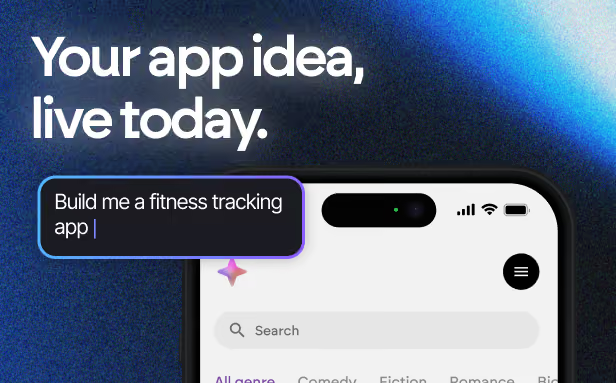
Most builders stop at a prototype. Emergent ships real web and mobile apps, with accounts, databases, and payments included.
- Production-ready apps
- Web & mobile apps
- Deploy in minutes