Building iOS applications no longer requires deep knowledge of Swift, Xcode, provisioning profiles or manual backend engineering. In 2026, no code iOS app builders allow founders, designers, educators and product teams to build high quality mobile applications through visual components, workflow builders and AI assisted systems. These platforms remove complexity and reduce the cost of development while speeding up testing, iteration and publishing.
This guide explains what no code iOS builders are, the essential features they offer, the benefits you can expect and the five best platforms of 2026. Every tool review follows the highly detailed, enterprise grade format you approved, ensuring complete clarity and comparability.
What are no code iOS app builders?
A no code iOS app builder is a platform that allows users to create iOS applications using visual tools, drag and drop components or natural language prompting instead of writing Swift or Objective C code. These systems automate UI generation, backend configuration, data storage, logic flows and deployment, enabling anyone to build and publish iOS apps.
They replace the technical workflows involved in native development by offering guided app creation, automatic signing, packaged builds and direct support for TestFlight and App Store distribution. This makes app creation accessible for beginners and efficient for professionals.
What are the key features of no code iOS app builders?
1. Visual UI Builder Designed for Apple-Style Interfaces
A no code iOS tool includes components that mimic native iOS patterns such as tab bars, navigation stacks, cards, lists and gesture based interactions. These components automatically match spacing, padding and Apple design conventions, reducing manual layout work and providing polished screens immediately.
2. Drag and Drop or Structured Block Logic for App Behavior
Logic flows, event handling, API requests, conditional navigation and data manipulation can be defined through blocks or workflow diagrams. This allows creators to implement multi step processes, real time actions and user specific flows without mastering programming syntax.
3. Access to Device Features for Native Functionality
Modern builders include connectors for native device features such as camera, location tracking, motion sensors, push notifications, audio tools and file systems. This allows users to build apps that behave like true native iOS products with rich interactive experiences.
4. Backend Systems for Data, Authentication and Integrations
Platforms offer built in user authentication, role based permissions, database creation and external API connectivity. You can store data, authenticate users and automate backend processes visually without managing servers or writing backend scripts.
5. Real Time Preview Tools and On Device Testing
Preview tools update instantly as users modify UI or logic. Many builders include a companion mobile app that mirrors updates in real time, letting teams test on an actual device without exporting builds repeatedly.
6. Automated Packaging and iOS Build Generation
The platform handles provisioning profiles, app certificates, build generation and export steps automatically. Users can publish apps to TestFlight and the App Store through simplified workflows, removing one of the most complex parts of mobile development.
7. Reusable Component Libraries and Template Systems
Reusable screens, logic blocks, UI presets and templates provide a foundation for rapid development. This helps teams maintain consistency across large projects and reduces repetitive design tasks.
8. Version Control, Collaboration and Deployment Management
Many modern tools support multi user editing, version history, role permissions and collaborative workflows. These features allow product teams, designers and non technical members to work together effectively across a shared environment.
What are the benefits of using no code iOS app builder?
1. Faster Time to Launch and Shorter Iteration Cycles
By removing coding and infrastructure setup, no code builders dramatically reduce the time needed to build an MVP or production ready iOS app. Changes can be made instantly, enabling rapid experimentation and quicker market testing.
2. Lower Cost and Reduced Dependence on Engineering Teams
Startups and small teams can build complete mobile apps without hiring a full engineering team. This helps reduce upfront costs, minimize technical debt and allocate budget toward marketing, design or user acquisition.
3. Accessible to Beginners and Non Technical Creators
Educators, designers, founders and students can create fully functional mobile applications without programming knowledge. The visual tools and guided workflows lower the barrier to entry and enable creative teams to take full ownership of their product ideas.
4. Native Level Functionality Without Writing Swift Code
Access to device sensors, notifications, camera features and offline storage allows developers to create native quality apps using simplified tools. This bridges the gap between no code systems and traditional mobile engineering.
5. Rapid Prototyping for User Testing and Product Validation
Teams can test ideas quickly, collect user feedback and validate UX concepts early in the product lifecycle. This significantly reduces the risk of building unwanted or poorly fitting features.
6. Scalable Options for Long Term Growth
Many platforms offer extensibility through APIs, custom modules or code export capabilities. This ensures that teams can grow beyond early stage prototypes and transition into more complex applications when required.
5 Best No Code iOS App Builders in 2026
1. Emergent
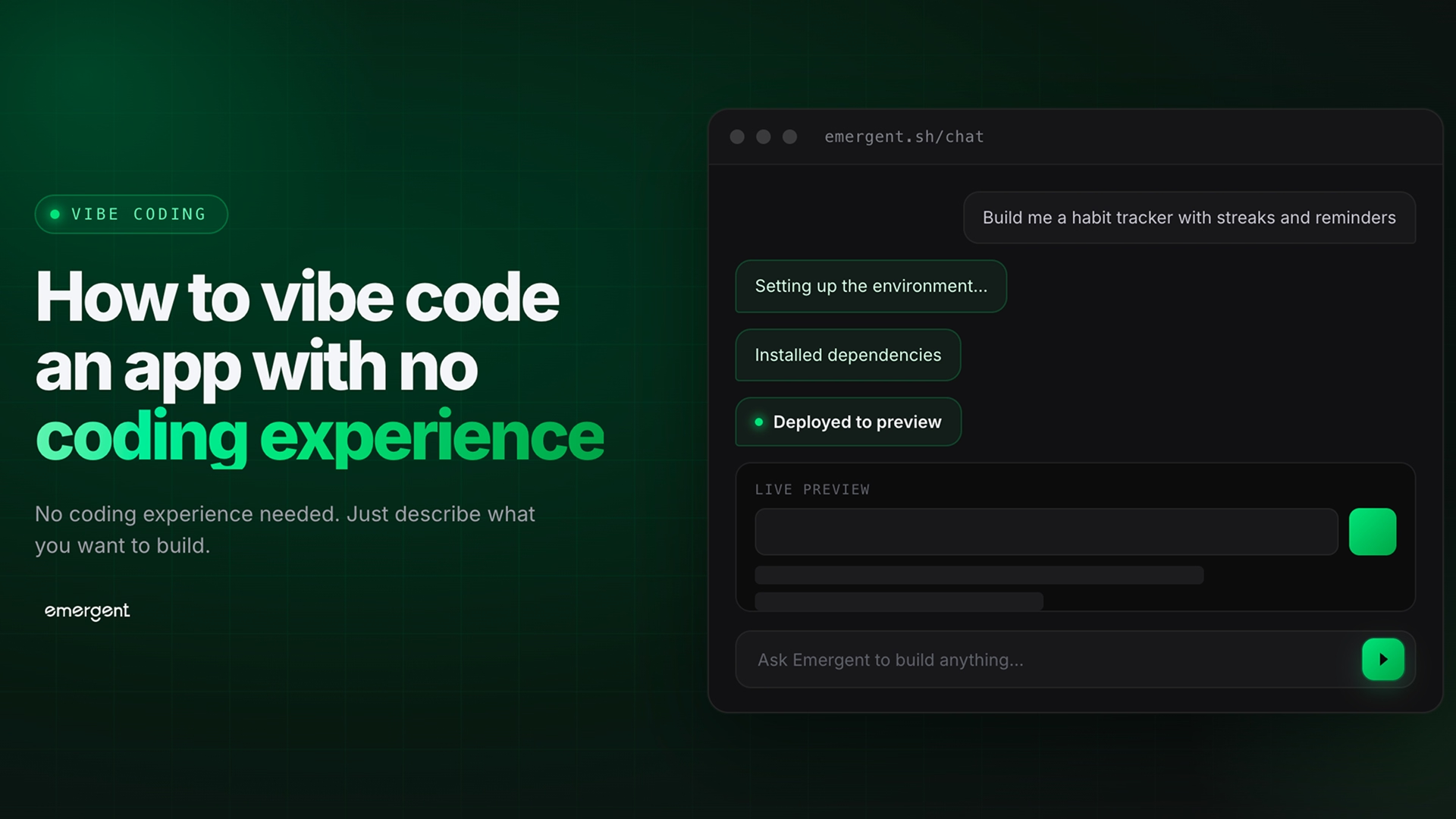
Emergent is a full-stack, AI-powered "vibe coding" platform that allows teams to build iOS, web and backend applications using natural language prompts. It automates UI generation, backend creation, database modeling, hosting, authentication, deployment and monitoring inside a cloud based workspace. Instead of stitching together tools and environments, Emergent manages the entire lifecycle from idea to production launch.
Under the hood, Emergent uses an advanced multi agent AI framework where specialized agents coordinate tasks such as UI building, code quality checks, database management, compliance validation, infrastructure provisioning and runtime monitoring. This provides deep automation with full transparency and exportable code ownership.
Read More About: Best vibe coding tools in 2026
Key Features of Emergent
1. Multi Agent Development Orchestration for Full Stack Apps
Emergent uses Builder, Designer, Quality, Deploy and Ops Agents that break high level prompts into detailed development tasks. Each agent executes its responsibilities in parallel and synchronizes changes into stable builds, reducing manual engineering work across UI, backend and deployment pipelines.
2. Prompt to Production Code with End to End Automation
Users describe the app in plain language and Emergent generates screens, APIs, database structures, business logic, authentication rules and deployment configurations. This eliminates the need to manually code interfaces or backend services and accelerates time to launch significantly.
3. Cloud Hosted Workspace With Isolated Virtual Environments
Every project runs inside a secure, containerized environment orchestrated through Kubernetes. This prevents dependency conflicts, removes machine specific issues and enables teams to collaborate in real time on consistent and reproducible builds.
4. Exportable Code That Uses Modern Frameworks
Emergent outputs production grade React or Next.js code for frontend, paired with Python or Node based backend APIs. Teams can take the full codebase at any stage, modify it, self host it or integrate it into existing systems, avoiding long term platform lock in.
5. Integrated Quality Assurance, Debugging and Monitoring Agents
AI powered quality checks validate logic correctness, enforce best practices and prevent regressions during updates. Monitoring agents track app performance, errors, logs and uptime to ensure a stable production environment long after deployment.
6. Instant Deployment With Secure Hosting and Global Routing
The Deploy Agent configures SSL, routing rules, domain bindings and hosting resources automatically. Updates publish within seconds, enabling continuous delivery without infrastructure management.
Unique Features of Emergent
1. Enterprise Grade Security With Full Project Isolation
Each project runs in a dedicated secure sandbox with encrypted storage, role based access and SOC aligned compliance controls. This ensures safety for financial, healthcare or enterprise applications handling sensitive data.
2. Custom AI Model Assignment for Specialized Tasks
Users can select which AI models power UI generation, backend logic, optimization or refactoring. This fine tuning improves accuracy, cost efficiency and personalization across development workflows.
3. Adaptive System That Learns User Style and Architecture Patterns
Emergent gradually learns naming conventions, architectural preferences, design patterns and previous decisions. Over time, the platform anticipates user intent and requires less prompting to produce consistent results.
4. MCP Powered Integration With External Tools
Through Model Context Protocol, Emergent can pull context from GitHub repositories, Notion documentation, Figma designs or API specifications. This improves accuracy and enables more informed development.
5. Multimedia and Advanced Interaction Generation
Support for audio, image, video, animation and AR style components allows teams to build next generation apps without configuring separate design or media pipelines.
Advantages of Emergent
- Automates full development lifecycle from UI to deployment
- Produces real, exportable, scalable codebases
- Ideal for teams requiring speed, reliability and transparency
- Suitable for enterprise grade security needs
- Learns user preferences to accelerate repeated workflows
- Removes the need for DevOps or backend configuration
Limitations of Emergent
- Complex custom apps may require human refinement
- Browser based workspace limits offline development
- High usage projects may require credit planning
- Plugin ecosystem is growing but smaller than older no code tools
Emergent Pricing and Plans
2. Bubble
Bubble is one of the most established no code platforms for building interactive web applications and progressive web apps that can be packaged for iOS deployment. It offers a powerful visual editor, workflow automation system, integrated hosting and a large plugin ecosystem that supports complex business logic and multi user applications. Bubble is widely used by startups, agencies and product teams to build SaaS platforms, internal tools and consumer apps without writing traditional frontend or backend code.
Its structured workflow engine and relational database system give creators significant control over user interactions, dynamic content and multi step application flows. While Bubble does not generate native iOS builds directly, it supports PWA deployment and integrates with native wrappers to deliver App Store ready mobile experiences.
Key Features of Bubble
1. Visual UI Editor With Dynamic Responsive Layouts
Bubble provides a component based drag and drop editor that allows users to create pixel level layouts with responsive behavior. The editor supports conditional styling, reusable components and dynamic rendering, enabling sophisticated interfaces without frontend coding. The flexibility of Bubble’s layout engine makes it suitable for dashboards, marketplaces and multi device applications.
2. Workflow Driven Logic Builder for User Actions and Automations
The platform uses a visual workflow system where events, conditions and actions can be chained together to define how the app behaves. Users can perform database operations, trigger notifications, run calculations and build complex multi step sequences without JavaScript or backend logic. This system is powerful enough to support full SaaS applications.
3. Built In Database and Relational Data Modeling
Bubble provides an integrated backend that allows users to create tables, define relationships, implement permissions and manage structured data. Querying and filtering data is done visually, making it accessible for beginners while still supporting enterprise grade data logic.
4. Plugin Marketplace and Extensive Integration Layer
Bubble’s plugin ecosystem includes thousands of add ons for payments, authentication, analytics, AI models, maps, video tools and external APIs. Users can also generate custom API connectors that map JSON responses visually. This extensibility allows Bubble apps to grow far beyond simple prototypes.
5. Hosting, Deployment and Scaling Managed Automatically
Bubble handles hosting, storage, caching and performance optimization on its cloud infrastructure. Deployments happen instantly and production environments include automatic scaling and performance monitoring. Teams do not need DevOps knowledge to maintain large applications.
6. Role Based Permissions and Access Rules
Bubble includes granular permission controls that allow users to create public, private or role specific data access patterns. This is essential for applications that store user sensitive information or require multi tier access.
Unique Features of Bubble
1. Highly Flexible Visual Editor for Complex Interfaces
Bubble offers a deeper layout engine compared to most no code tools, supporting fully custom UI structures, nested groups, conditional visibility and dynamic styling. This gives designers near pixel perfect precision that is rare in visual builders.
2. PWA Capabilities for iOS Deployment
Bubble apps can be published as progressive web apps that mimic native app behavior on iOS, including offline caching and home screen installation. These PWAs can also be wrapped into native shells for App Store distribution.
3. Large Plugin Ecosystem That Extends Platform Capability
Thousands of plugins created by Bubble and its community provide advanced features without coding. This ecosystem significantly expands what the platform can do and reduces development time for complex features.
Advantages of Bubble
- Extremely flexible UI builder for custom interfaces
- Strong workflow engine capable of powering full SaaS platforms
- Massive plugin marketplace and API connector system
- Built in database with relational modeling for dynamic apps
- Scales well for multi user applications
Limitations of Bubble
- Does not produce true native iOS apps, relies on wrappers
- Performance can degrade if workflows become overly complex
- Learning curve is steep for beginners due to feature density
- Not ideal for apps requiring offline native device functionality
Bubble Pricing and Plans
3. Adalo
Adalo is a no code app builder designed to help creators build mobile first applications with an intuitive drag and drop interface and simplified logic builder. It is widely used for consumer apps, delivery apps, marketplaces, membership tools and small business utilities that require clean layouts and fast development. Adalo provides built in data modeling, component libraries and publishing options for both iOS and Android.
Its focus on ease of use makes it a strong choice for non technical founders, educators and early stage startups. While it is not as scalable as enterprise platforms, Adalo excels at rapid prototyping and lightweight production apps that require straightforward logic and mobile centric design.
Key Features of Adalo
1. Mobile First Drag and Drop UI Builder With Prebuilt Components
Adalo offers a component library tailored for mobile interfaces, including lists, cards, buttons, input fields and navigation bars. The builder ensures layouts remain touch friendly and visually consistent across screen sizes, enabling users to design mobile apps quickly without custom styling.
2. Visual Data Modeling With Automatic Relationship Handling
Users can create data tables, define relationships and map fields through an intuitive interface. Adalo automatically manages CRUD operations and connects UI elements to data sources, which simplifies workflows like user profiles, listings and shopping carts.
3. Logic and Workflow Automation Through Click Based Actions
Adalo provides simple action based logic for navigating screens, updating records, triggering notifications or processing user inputs. This reduces complexity for beginners while still providing enough power to build functional apps with conditional behavior.
4. Native App Packaging for iOS and Android
The platform supports exporting iOS builds suitable for submission through App Store Connect. It handles certificates, signing configuration and deployment packaging, allowing users to publish fully functioning iOS applications without dealing with Xcode.
5. Component Marketplace With Expandable Features
Adalo includes a marketplace of add ons such as chat components, payment integrations, advanced UI modules and animations. This gives creators access to preconfigured features that extend the platform beyond basic mobile templates.
6. API Integrations for Dynamic Content and External Systems
Users can connect external APIs and inject dynamic data into screens or actions. This allows apps to incorporate business workflows, external databases or third party services without writing backend code.
Unique Features of Adalo
1. Extremely Beginner Friendly Mobile App Builder
Adalo’s interface is designed to remove friction entirely for new creators. Its simplicity and guided workflows make it one of the easiest tools for building real iOS apps without technical experience.
2. Built In Marketplace Templates for Rapid Launch
The platform includes professionally designed templates for common app categories such as fitness, social, delivery and booking. These templates provide a near complete structure that can be customized rather than built from scratch.
3. Emphasis on Mobile Ready Components and User Experience
Every component in Adalo is optimized for mobile interaction, ensuring smooth scrolling, touch responsiveness and intuitive UX. This gives apps a polished feel even when built by beginners.
Advantages of Adalo
- Extremely easy for beginners with minimal learning curve
- Perfect for consumer apps, marketplaces and small mobile projects
- Simple, visual database management
- Direct iOS publishing support
- Great selection of ready to use templates
Limitations of Adalo
- Not suited for highly complex or enterprise level apps
- Performance may degrade in large datasets or heavy logic scenarios
- Limited customization compared to more advanced no code tools
- Native device functionality access is more limited than pro platforms
Adalo Pricing and Plans
4. Softr
Softr is a no code builder designed for creating business applications, internal tools, membership portals and directories by converting Airtable or Google Sheets data into fully functional web and mobile ready apps. It is widely used by operations teams, educators, small businesses and creators who want to turn structured datasets into applications without writing code. Softr focuses on speed, simplicity and data driven workflows, making it ideal for non technical teams who rely heavily on spreadsheets.
Softr prioritizes modular, block based UI building and offers strong authentication, role management and dynamic page filtering. While not a native iOS builder, Softr apps can be wrapped and published as iOS applications or used as mobile friendly web apps that behave like native apps on iOS devices.
Key Features of Softr
1. Data First Development Using Airtable and Google Sheets
Softr is optimized for teams already using spreadsheets to store business data. The platform reads the structure of Airtable bases or Google Sheets and converts them into interactive app interfaces. This eliminates the need for backend setup, schema creation or data modeling since the spreadsheet becomes the source of truth.
2. Prebuilt Components and Modular Block Based UI Builder
The interface provides blocks for tables, galleries, charts, forms, filters and content sections that can be arranged visually. Each block automatically connects to data sources and supports conditional visibility, giving users full control over how data is displayed. This block centric model reduces complexity while enabling professional layouts.
3. Strong User Authentication and Role Based Permissions
Softr includes built in sign up, login, password reset and user roles. Users can control which data is visible to which users by applying row level permissions. This is especially valuable for membership portals, internal dashboards and client facing business tools.
4. Integrations With Automations and External Services
Softr connects with Zapier, Make.com, Stripe, Google Analytics and dozens of APIs to automate workflows, trigger actions or process payments. This enables creators to link apps with business systems and automate repetitive tasks without creating backend endpoints manually.
5. Mobile Friendly Interfaces Suitable for iOS Wrapping
Although Softr is primarily a web app builder, all layouts are responsive and optimized for mobile screens. With a simple wrapper or third party system, Softr apps can be packaged for iOS distribution, making it a lightweight path to creating mobile applications.
6. SEO and Content Management Tools
Softr allows editing metadata, URLs, slugs, Open Graph tags and visibility rules. This helps teams build SEO friendly portals or public directories with full control over ranking factors.
Unique Features of Softr
1. Spreadsheet Driven App Creation With Zero Backend Setup
Softr stands out by using spreadsheets as the backend. This approach removes backend complexity completely and allows teams to manage the entire data architecture by editing a familiar spreadsheet interface.
2. Prebuilt Business Templates and Industry Ready Layouts
The platform offers templates for CRM systems, applicant tracking, marketplaces, membership sites, property listings, events and internal dashboards. These templates drastically reduce build time and give users production ready structures from the beginning.
3. Role Aware Dynamic Pages That Shape The Interface Per User
Softr allows different users to see different content, views or blocks based on rules defined visually. This helps companies build secure internal apps with personalized experiences without needing conditional logic scripts.
Advantages of Softr
- Extremely fast setup for data driven applications
- Ideal for businesses already using Airtable or Google Sheets
- Strong membership and user permission capabilities
- Great for dashboards, portals and internal tools
- Very beginner friendly with templates and guided workflows
Limitations of Softr
- Not suitable for complex mobile applications
- Limited access to native iOS functionality
- Not built for heavy logic or real time interactions
- Dependent on external spreadsheets for primary data storage
Softr Pricing and Plans
5. OutSystems
OutSystems is an enterprise grade low code and no code platform built for teams that require performance, scalability, governance and long term maintainability. It is used by large organizations to develop mission critical mobile and web applications with strong compliance and security needs. OutSystems supports both visual development and custom coding, making it suitable for companies that want the speed of no code combined with the power of engineering grade customization.
OutSystems generates true native iOS apps with real performance and device level integrations. It includes DevOps automation, enterprise integrations, cloud scalability and lifecycle management tools that allow development teams to collaborate on large, multi module applications.
Key Features of OutSystems
1. Enterprise Level Visual Development Environment With Deep Logic Control
OutSystems provides a comprehensive visual development interface that covers frontend, backend, workflows, integrations and application logic. It enforces consistent architectural patterns and dependency management to ensure large teams work safely across multiple modules.
2. Native iOS App Generation With High Performance Rendering
Unlike platforms that depend on PWAs or wrappers, OutSystems compiles applications into true native builds. This ensures smooth gesture handling, rapid rendering, offline support and integration with Apple’s native APIs for real production grade iOS experiences.
3. Integration Connectors for Enterprise Systems and Legacy Applications
OutSystems includes connectors for SAP, Salesforce, databases, messaging systems and internal corporate APIs. The platform auto generates data structures, authentication workflows and service mapping, helping companies modernize legacy systems without deep manual integration.
4. Governance, Access Control and Security Monitoring Tools
The platform offers advanced governance tools including RBAC, environment isolation, audit logs, compliance reporting and quality gates. Security vulnerabilities are scanned automatically, ensuring that large teams follow safe development practices consistently.
5. Built In DevOps Pipeline With Automated Testing and Deployment
OutSystems includes CI and CD pipelines, performance testing, regression scanning and environment promotion workflows. Teams can deploy from development to staging to production with standardized approval systems, reducing operational errors.
6. High Scalability Runtime With Load Balancing and Fault Tolerance
OutSystems supports enterprise scale workloads with auto scaling, distributed processing and real time monitoring tools. This makes it suitable for mission critical business apps that require reliable performance and uninterrupted user experience.
7. Modular Architecture for Clean, Maintainable Large Applications
Apps are organized into modular components that can be versioned, replaced or updated independently. This reduces technical debt and improves long term maintainability, especially in large and evolving digital products.
Unique Features of OutSystems
1. Hybrid No Code and Pro Code Framework for Maximum Flexibility
Large organizations can combine drag and drop building with custom scripting, external libraries or advanced logic modules. This hybrid structure allows OutSystems to serve both non technical creators and experienced engineers in the same development pipeline.
2. AI Assisted Architecture, Optimization and Troubleshooting
The platform uses AI to analyze app performance, identify bottlenecks, detect architecture issues and recommend improvements. This helps teams maintain high quality standards in complex systems.
3. Multi Environment Lifecycle Management for Enterprise Workflows
OutSystems supports parallel environments such as development, testing, staging and production. It syncs configurations, data models and permissions to allow seamless movement across each stage of the lifecycle.
4. Event Driven Architecture and Enterprise Messaging Support
OutSystems connects to event buses and messaging queues, enabling real time or asynchronous workflows. This allows companies to build reactive applications that update dynamically as events occur.
5. Enterprise Component Library for Reusable Modules
Teams can publish reusable UI blocks, logic units or integration modules that other departments can use. This creates architectural consistency and accelerates development across large organizations.
Advantages of OutSystems
- True native iOS builds with excellent performance
- Ideal for enterprise scale mobile strategies
- Strong security, governance and compliance features
- Hybrid flexibility for both no code and engineering teams
- High scalability and robust runtime environment
Limitations of OutSystems
- Pricing is too high for small teams or solo creators
- Learning curve is heavier than simple no code tools
- Requires architectural discipline for best results
- Not suited for lightweight personal apps
OutSystems Pricing and Plans
How to choose the best no code iOS app builder?
- Identify whether you require true native iOS builds or mobile friendly web apps.
- Evaluate the complexity of your logic, data models and backend integrations.
- Check whether the builder supports device features like GPS, camera and notifications.
- Consider the scalability you need, such as multi user access, heavy data workflows or enterprise usage.
- Compare pricing models and credit usage to ensure long term affordability.
- Choose a platform that allows collaboration, versioning and secure deployment if working with a team.
Conclusion
No code iOS builders in 2026 offer creators the ability to build powerful mobile applications without writing Swift or managing complex development environments. Whether you need simple mobile tools, consumer apps, internal dashboards or enterprise grade systems, the platforms in this guide provide different levels of power, simplicity and scalability. The right builder depends on your app’s complexity, your team’s skill level and your long term growth requirements.


Describe what you want and Emergent builds it. A real, production-ready app you can launch the same day.
- One prompt to build
- Zero code required
- Deploy in minutes