AI coding tools are evolving fast, but not all of them solve the same problem. Claude Code is built around Anthropic’s Claude models, giving developers a powerful coding assistant focused on reasoning, long context understanding, and structured code generation. It operates primarily as an AI coding companion rather than a hosted development environment.
Replit, on the other hand, is a browser-based cloud IDE where you can code, run, and deploy applications directly from your browser. It includes Replit Agent for AI-assisted coding, built-in runtimes, collaboration features, and one-click deployments.
So this comparison is not just about “which AI is better.” It’s about workflow. Do you want a powerful AI coding assistant inside your stack, or an all-in-one cloud development environment with built-in hosting?
Claude Code enhances how you write code.
Replit changes where and how you build and ship.
Claude Code vs Replit: Quick Comparison Table
Before we go deep into features, here’s a fast positioning overview to help you see where each platform stands.
| Parameter | Claude Code | Replit |
|---|---|---|
| Development Approach | AI coding assistant powered by Claude models⭐️⭐️⭐️⭐️ | Cloud IDE with AI Agent and deployment⭐️⭐️⭐️⭐️⭐️ |
| Primary Use Case | Code generation, reasoning, refactoring | Build, run, and deploy apps in browser |
| Coding Required | Yes, developer-led workflow⭐️⭐️⭐️⭐️⭐️ | Yes, but AI can scaffold⭐️⭐️⭐️⭐️ |
| Full Stack from Prompts | Partial, generates code but no hosting | Partial, AI assists but manual logic needed |
| Hosting & Deployment | Not included | Built-in one-click deployment⭐️⭐️⭐️⭐️⭐️ |
| Collaboration | Depends on your repo workflow | Real-time collaboration in browser⭐️⭐️⭐️⭐️⭐️ |
| Code Ownership | Fully yours (works with your repos)⭐️⭐️⭐️⭐️⭐️ | Fully yours, exportable⭐️⭐️⭐️⭐️ |
| Best For | Devs wanting smarter AI coding | Learners, indie devs, quick hosted apps |
Claude Code vs Replit: Key Features Comparison in Detail
Development Environment & Workflow
This feature looks at where and how you actually build. Are you coding inside a hosted browser IDE, or using an AI assistant inside your own setup?
Claude Code
Claude Code works as an advanced AI coding assistant powered by Anthropic’s Claude models. It does not provide a full IDE or hosting environment. Instead, it integrates into your development workflow and helps you write, refactor, and reason about code.
You continue working in your own editor, repository, and infrastructure. Claude Code enhances your thinking, helps debug logic, and supports structured multi-file changes, but it does not replace your development environment.
Read More About: 6 Best Claude Alternatives
Replit
Replit is a full browser-based development environment. You write code, run it, and deploy it without installing anything locally. It includes runtimes, package management, secrets handling, and deployment inside the same interface.
You can start from scratch, collaborate in real time, and publish apps with a single click. For developers who want everything in one place, Replit changes the entire workflow.
Our Recommendation:
If you want an all-in-one coding and deployment environment, Replit fits better. If you want to enhance your existing setup with strong AI reasoning, Claude Code makes more sense.
AI Reasoning & Code Quality
Not all AI tools reason the same way. Some are optimized for speed, while others focus on deeper understanding and structured output.
Claude Code
Claude Code is built on Anthropic’s Claude models, known for strong reasoning and long context handling. It performs well with complex logic, multi-step instructions, and large code explanations.
It is particularly strong when analyzing architecture, refactoring existing systems, or generating well-structured code blocks. Developers who prioritize thoughtful, structured output often appreciate its reasoning capabilities.
Replit
Replit includes Replit Agent, which assists inside the IDE. It helps scaffold projects, write functions, and explain code. It works best for iterative development inside small to medium-sized projects.
While capable, its strength is more about accelerating everyday coding tasks rather than deep architectural reasoning across very large codebases.
Our Recommendation:
For deeper reasoning and complex logic generation, Claude Code stands out. For everyday coding acceleration inside a live IDE, Replit works well.
Full-Stack Capabilities
This feature evaluates whether the platform builds complete applications or mainly assists with code.
Claude Code
Claude Code generates backend logic, frontend components, APIs, and database schemas when prompted. However, it does not provision hosting, databases, or deployment automatically.
You still configure infrastructure, connect services, and deploy manually using your existing tools. Claude Code enhances generation, but infrastructure remains your responsibility.
Replit
Replit allows you to build full-stack applications inside the browser. It supports multiple languages, simple database setups, and built-in deployment.
You can write backend logic, create APIs, manage environment variables, and deploy directly from the interface. It handles the runtime and hosting layer for you.
Our Recommendation:
If you want built-in hosting and deployment, Replit is stronger. If you prefer controlling your own infrastructure, Claude Code fits better.
Collaboration & Team Workflow
Modern development is rarely solo. This feature looks at how easily teams can work together, review code, and manage shared projects.
Claude Code
Claude Code enhances individual developer productivity rather than acting as a collaboration platform. It does not include built-in real-time collaboration, shared workspaces, or team dashboards.
Teams still rely on GitHub, GitLab, or internal CI/CD systems for collaboration. Claude Code operates inside that ecosystem as an assistant rather than a collaboration layer.
Replit
Replit supports real-time collaborative coding directly in the browser. Multiple users can edit the same project simultaneously, similar to a shared document.
It also offers team plans with access controls, workspace sharing, and centralized management. This makes it especially useful for classrooms, startups, and distributed teams working quickly.
Our Recommendation:
If collaboration inside the IDE matters, Replit is clearly stronger. Claude Code is better suited for individuals or teams already structured around Git-based workflows.
Deployment & Hosting
Shipping code is just as important as writing it. This feature compares how each platform handles deployment.
Claude Code
Claude Code does not provide hosting or deployment infrastructure. After generating or modifying code, you deploy through your own pipelines, cloud provider, or hosting service.
This gives you flexibility and full control, but also means more responsibility. It fits teams with established DevOps practices.
Replit
Replit provides one-click deployment from inside the platform. Apps can go live with a public URL and SSL automatically configured.
You can manage environment variables, redeploy quickly, and iterate without leaving the browser. For small to moderate apps, this is very convenient.
Our Recommendation:
If you want instant hosting without setup, Replit is easier. If you already have deployment pipelines, Claude Code integrates smoothly into that structure.
Code Ownership & Portability
Vendor lock-in is an important consideration. This feature looks at how portable your projects are.
Claude Code
Claude Code works inside your own repositories. All generated code lives in your project files and version control.
There is no platform-level hosting dependency. You retain complete ownership, infrastructure control, and portability.
Replit
Replit projects can be downloaded or connected to GitHub, but they are developed inside Replit’s hosted environment.
While code export is possible, runtime and deployment workflows are closely tied to Replit’s infrastructure unless migrated manually.
Our Recommendation:
For maximum portability and infrastructure independence, Claude Code has an edge. Replit is more convenient but more platform-centered.
Learning Curve & Accessibility
Ease of use matters, especially for beginners or non-traditional developers.
Claude Code
Claude Code assumes you already have a development setup and understand Git, environments, and deployment basics.
It excels for experienced developers who want an AI partner for complex thinking and structured coding tasks.
Replit
Replit is beginner-friendly. You can start coding immediately in the browser without installing anything.
It is widely used for education, hackathons, and rapid experimentation. The integrated environment lowers barriers significantly.
Read More About: 7 Best Replit Alternatives
Our Recommendation:
For beginners or rapid onboarding, Replit is easier. For experienced developers seeking deeper AI reasoning inside their own workflow, Claude Code fits better.
Replit vs Claude Code: Review Comparisons
Before we break down what users are saying, here’s a snapshot of how both platforms are rated across major review platforms.
| Platform | G2 | Capterra | Product Hunt |
|---|---|---|---|
| Replit | ⭐ 4.5 / 5 | ⭐ 4.6 / 5 | ⭐ 4.7 / 5 |
| Claude (Anthropic) | ⭐ 4.7 / 5 | ⭐ 4.6 / 5 | ⭐ 4.8 / 5 |
Replit Reviews from Trusted Platforms
From G2
Users frequently praise:
- Zero setup browser-based IDE
- Easy collaboration with teammates
- Built-in hosting and quick deployments
Common concerns mentioned on G2 include performance limits for heavier workloads and constraints on lower-tier plans.
From Capterra
Reviewers highlight:
- Accessibility for beginners
- Clean interface
- Useful for prototypes and educational use
Some feedback notes that larger production systems may outgrow the platform’s default resource limits.
From Product Hunt
The community appreciates:
- Fast onboarding
- Developer-friendly experience
- Practical deployment workflow
Overall, review sentiment positions Replit as excellent for rapid builds, learning, and small-to-mid scale apps.
Want the full picture? Read our in-depth Replit reviews breakdown.
Claude Code Reviews from Trusted Platforms
From G2
Users commonly highlight:
- Strong reasoning capabilities
- High-quality debugging assistance
- Clear code explanations
Developers often mention that Claude feels “thoughtful” and structured when solving complex coding problems.
From Capterra
Reviewers appreciate:
- Natural conversational responses
- Accurate code generation
- Strong documentation-style output
Criticism typically revolves around usage limits and the fact that Claude is not a full IDE or hosting environment.
From Product Hunt
The community consistently praises:
- Advanced reasoning
- Long-form structured answers
- Help with architecture and refactoring
However, it is viewed as an AI assistant rather than a full development platform.
Review Summary
- Replit is rated highly for usability, collaboration, and deployment convenience.
- Claude Code is rated highly for intelligence, reasoning depth, and code quality.
Want the full picture? Read our in-depth Claude Code review breakdown
Replit vs Claude Code: What Users Are Saying
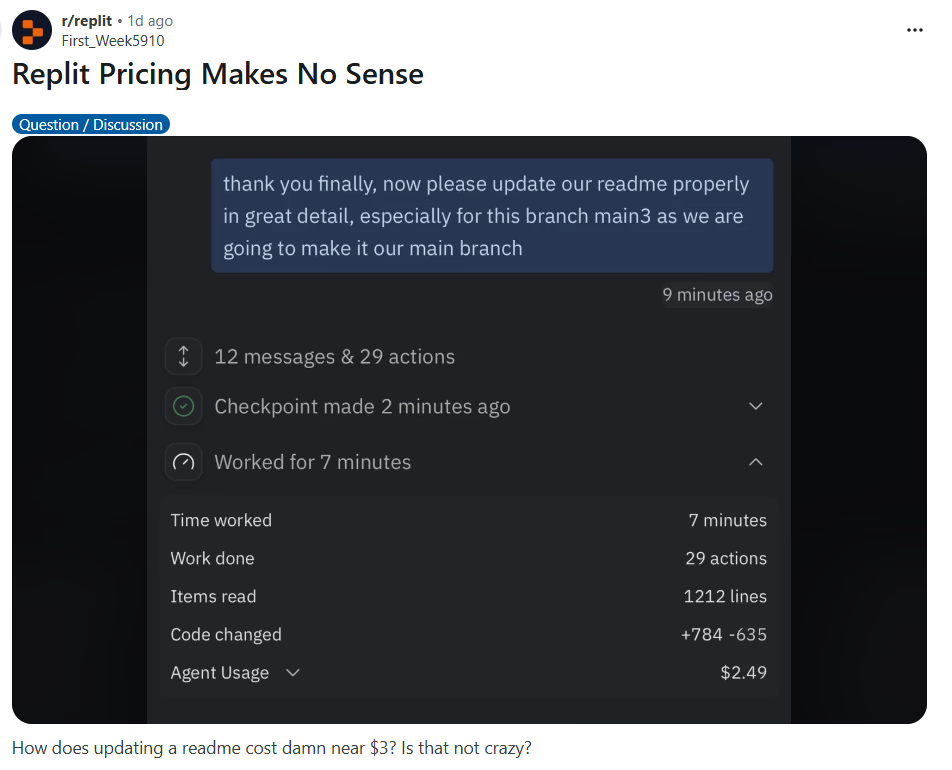
Pricing Concerns Around Replit
What the discussion highlights:
- Users expressed confusion around Replit’s pricing tiers and credit usage.
- Some felt that usage limits and pricing structure were not immediately intuitive.
- There were debates around whether the value justifies the cost compared to running tools locally.
- The thread reflects cost sensitivity among hobbyists and solo developers.
Source: r/replit
Reddit
Takeaway:
Replit’s convenience and hosting come at a cost. Developers comparing it with tools like Claude Code often factor in whether browser-based infrastructure is worth recurring subscription pricing.
Running Claude Code CLI Inside Replit
What the discussion highlights:
- A user shared a tutorial on running Claude Code CLI agents inside Replit.
- This shows developers combining both tools rather than treating them as direct substitutes.
- It highlights Replit’s flexibility as a cloud environment while using Claude’s AI reasoning power.
- Users discussed setup steps, CLI workflows, and environment configuration.
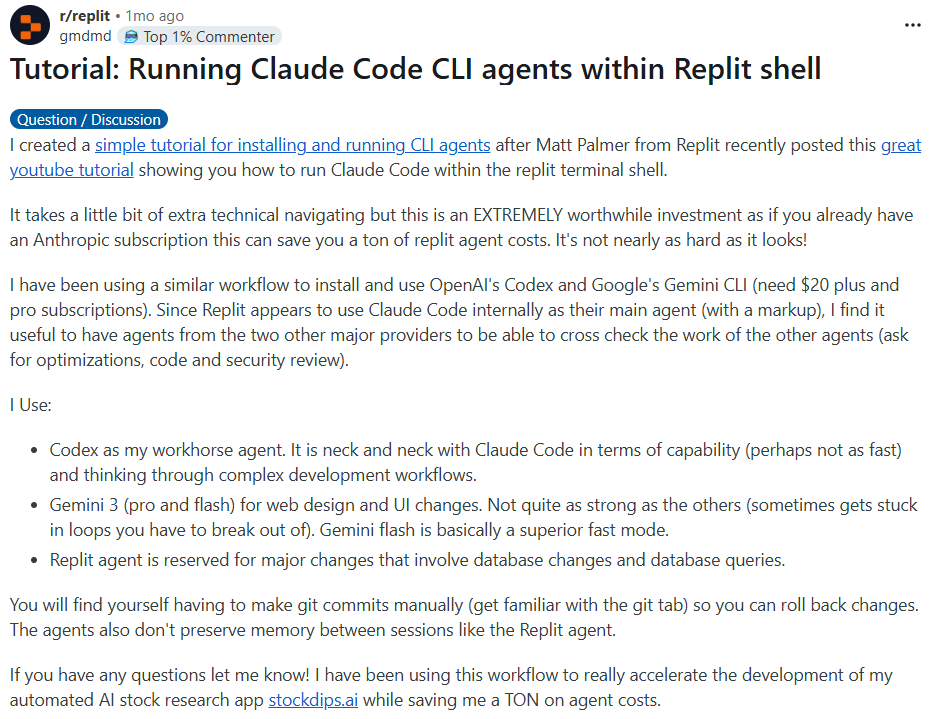
Source: r/replit
Reddit
Takeaway:
Replit can act as the runtime environment, while Claude Code provides advanced AI assistance. This hybrid usage pattern suggests the tools serve complementary roles for some users.
What Makes Replit Better Than Claude Code?
What the discussion highlights:
- Users compared browser-based development versus AI coding assistants.
- Replit was praised for zero setup, collaboration, and instant deployment.
- Claude Code was seen as stronger in reasoning and code intelligence.
- The thread framed the comparison as workflow preference rather than feature superiority.
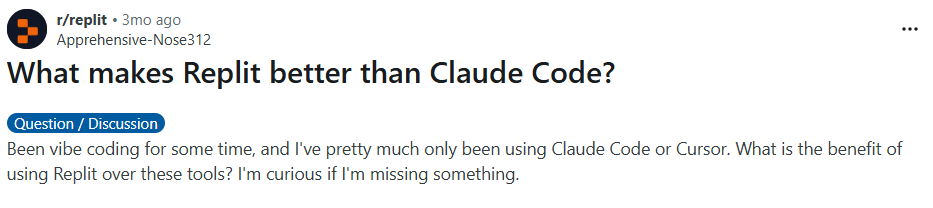
Source: r/replit
Reddit
Takeaway:
Replit appeals to developers who value simplicity and hosting integration. Claude Code appeals to those prioritizing advanced AI reasoning within their existing development stack.
Replit vs Claude Code: Pricing Comparison
Pricing Overview Table
| Plan Tier | Replit | Claude (Anthropic) |
|---|---|---|
| Free Plan | Free tier with limited resources, public projects, and capped compute usage | Free tier with limited daily message usage |
| Core / Pro (Individual) | Core – $20/month (includes private repls, higher compute limits, deployments, Replit Agent access) | Claude Pro – $20/month (higher usage limits, priority access, faster responses) |
| Higher Individual Tier | No separate higher solo tier publicly listed beyond Core | No additional solo tier publicly listed beyond Pro |
| Team Plan | Teams – ~$40 per user/month (collaboration controls, private projects, usage management) | Claude Team – Custom pricing (collaboration, admin controls, higher usage limits) |
| Enterprise Plan | Custom enterprise pricing | Custom enterprise pricing |
Introducing Emergent as a Best Option for Replit and Claude Code
If you compare Replit and Claude Code closely, one focuses on where you build, and the other focuses on how well the AI thinks. What neither fully solves is the gap between idea and a production ready system that includes UI, backend logic, database, integrations, and deployment in one place.
Emergent is positioned differently. Instead of acting only as a code editor or only as an AI assistant, it converts natural language into a working full stack application. That means UI, backend logic, database schemas, APIs, integrations, hosting, and deployment are generated together in a coordinated way. Teams retain full code ownership with GitHub sync and push and pull from VS Code.
Emergent vs Replit vs Claude Code: Positioning Snapshot
| Parameter | Replit | Claude Code | Emergent |
|---|---|---|---|
| Development Scope | Cloud IDE with runtime + deployment ⭐⭐⭐⭐☆ | AI coding assistant inside workflow ⭐⭐⭐☆☆ | Full-stack system generation from prompt ⭐⭐⭐⭐⭐ |
| Primary Strength | Zero setup coding + hosting ⭐⭐⭐⭐☆ | Deep reasoning + contextual code help ⭐⭐⭐⭐☆ | End-to-end app creation ⭐⭐⭐⭐⭐ |
| Full Stack Coverage | Partial (code + hosting) ⭐⭐⭐☆☆ | No (assistant only) ⭐⭐☆☆☆ | Complete (UI, backend, DB, deploy) ⭐⭐⭐⭐⭐ |
| Built-in Deployment | Yes ⭐⭐⭐⭐☆ | No ⭐☆☆☆☆ | Yes ⭐⭐⭐⭐⭐ |
| Database Provisioning | Basic managed DB options ⭐⭐⭐☆☆ | Not available ⭐☆☆☆☆ | Auto generated from prompts ⭐⭐⭐⭐⭐ |
| Code Ownership | Yes ⭐⭐⭐⭐☆ | Yes ⭐⭐⭐⭐☆ | Yes ⭐⭐⭐⭐⭐ |
| Best For | Prototypes, learning, small hosted apps ⭐⭐⭐⭐☆ | Developers needing strong AI reasoning ⭐⭐⭐☆☆ | MVPs + scalable production systems ⭐⭐⭐⭐⭐ |
Conclusion
When comparing Claude Code vs Replit, the right choice depends on how you build and what you need to ship.
Choose Replit if you want a browser-based development environment where you can code, run, and deploy without installing anything locally. It is especially strong for learning, hackathons, internal tools, and lightweight production apps that benefit from one-click deployment and collaborative cloud workspaces.
Choose Claude Code if you already work inside an established development setup and want deep AI reasoning to help with debugging, refactoring, documentation, and complex logic. It enhances professional workflows rather than replacing them.
If your goal is not just writing code but generating and deploying full applications from natural language across UI, backend, database, and integrations, then a system-level platform like Emergent may be worth evaluating alongside these tools.
Ultimately, the decision comes down to workflow preference:
- Browser IDE with integrated hosting → Replit
- AI assistant inside your coding environment → Claude Code
- Full system generation from prompts → Platform-level builders
infrastruct

Most AI app builders stop at prototypes. Emergent creates production-ready apps you can actually launch.
- Production-ready apps
- Web & mobile apps
- Deploy in minutes