


India AI Impact Summit 2026: The 6-Day Highlights That Defined India’s AI Moment

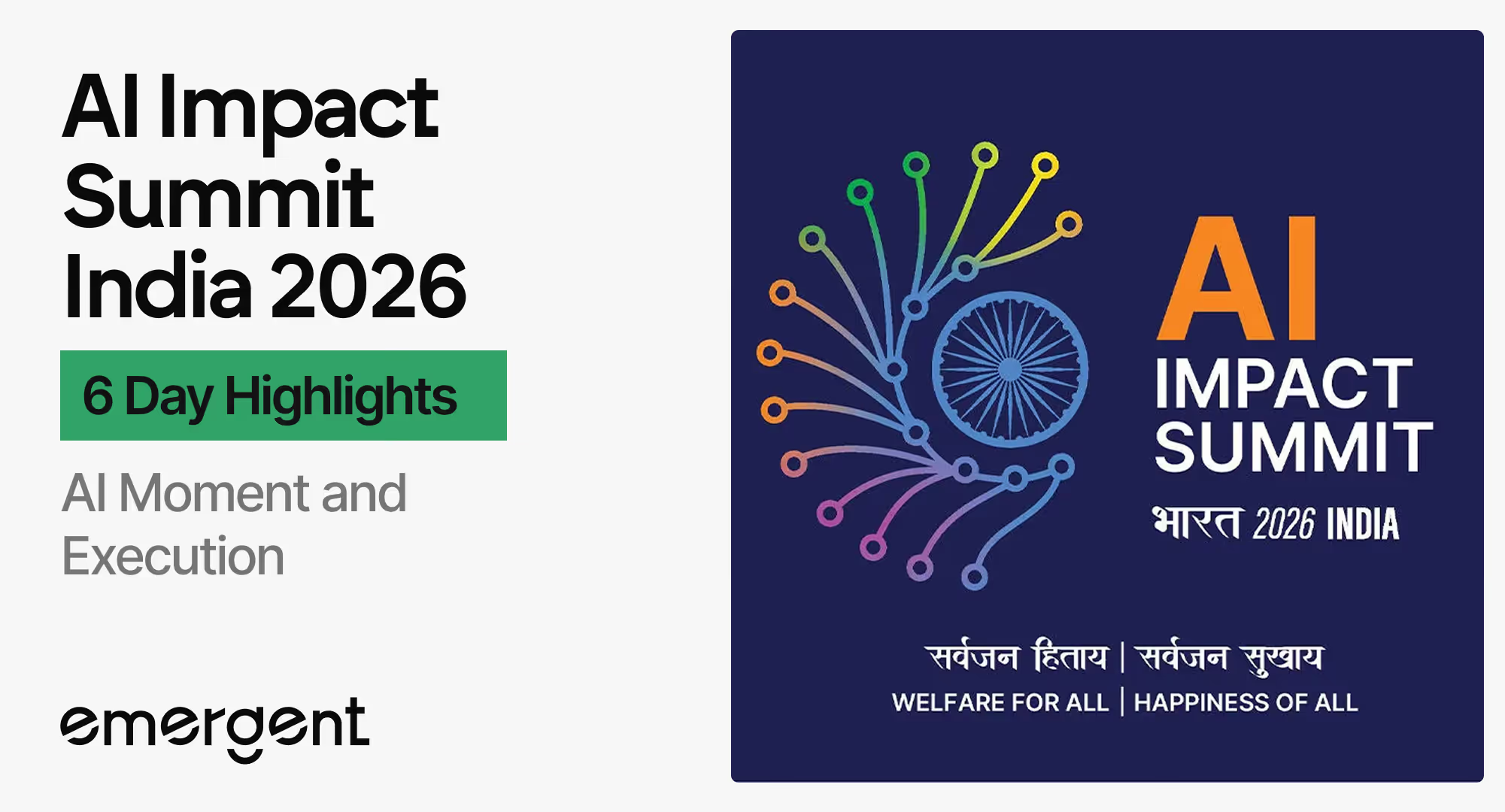
From 16 to 20 February 2026, the India AI Impact Summit 2026 took place at Bharat Mandapam, bringing together delegations from over 100 countries, more than 500 sessions, and over 800 exhibitors at the parallel India AI Impact Expo.
The summit formally concluded on 20 February. The Expo continued through 21 February following a confirmed one-day extension due to strong turnout.
Across six days of activity, several developments stood out as materially significant.
Here are the defining highlights:
1. Tata Group and OpenAI Announce 100MW to 1GW AI Data Center Partnership
The most consequential announcement of the week came on Day 4.
Tata Group, including Tata Consultancy Services, announced a strategic partnership with OpenAI to establish India’s first large-scale AI-optimized data center.
Confirmed details:
- Initial capacity of 100 megawatts
- Planned expansion to 1 gigawatt
- Intended to support AI training and inference workloads
Natarajan Chandrasekaran described AI as the “infrastructure of intelligence,” comparing its impact to electricity and the internet.
This was not symbolic positioning. It was a capital-backed infrastructure commitment that materially shifts India toward sovereign AI compute capacity.
2. Global AI CEOs Participate in Policy Dialogue
The summit brought together leaders from frontier AI labs including:
- Sam Altman
- Sundar Pichai
- Dario Amodei
Their participation moved the conversation beyond product demos into governance alignment, infrastructure scaling, and cross-border regulatory coordination.
Unlike purely technical conferences, the emphasis here was on collaboration between governments and AI model developers.
3. AI Framed as National Infrastructure
Prime Minister Narendra Modi opened the summit with a focus on AI as central to economic growth and digital public infrastructure.
Repeated themes across five days included:
- Responsible AI deployment
- Regulatory alignment
- Sovereign compute capacity
- Enterprise AI integration
- Workforce transformation
The summit consistently treated AI not as a vertical industry, but as macroeconomic infrastructure.
4. Agentic AI Moves From Concept to Enterprise Strategy
Beyond generative AI discussions, several enterprise sessions focused on “Agentic AI,” referring to systems capable of autonomous decision-making and workflow execution.
TCS highlighted:
- Movement beyond chatbot deployments
- Integration of AI into core business processes
- Enterprise-scale automation frameworks
This signaled a shift from AI as interface to AI as operational layer.
5. Skilling at National Scale
TCS publicly reported:
- 100,000+ employees upskilled in advanced AI capabilities
- 1,500 app prototypes built during the Tata YUVAi hackathon
- AI Sakhi demonstrations enabling non-technical participants to build AI-driven products
These are measurable outcomes tied to workforce transformation, not abstract commitments.
6. Expo Extended Due to High Turnout
The India AI Impact Expo was extended through 21 February.
Confirmed metrics:
- 800+ exhibitors
- 13 country pavilions
- Participation across healthcare, agriculture, finance, manufacturing, and climate sectors
The extension reflected sustained industry engagement beyond keynote programming.
7. Authenticity Enforcement on the Expo Floor
One university exhibitor was directed to vacate its stall following scrutiny over a robotics demonstration that was alleged to have misrepresented original development claims.
The incident underscored enforcement of authenticity standards and credibility expectations at the summit.
This was one of the few on-ground controversies during the week.
8. Capital Markets React to Infrastructure Announcements
Following the Tata Group–OpenAI partnership announcement, shares of Tata Consultancy Services rose approximately 2 percent.
The market reaction reflected investor sensitivity to AI infrastructure positioning.
9. Application-Layer Growth Stories Gain Attention
While infrastructure dominated headlines, application-layer acceleration was visible across ecosystem conversations.
Emergent, an AI-powered platform that enables users to build software through natural language, surpassed $100 million in annual recurring revenue within eight months of launch, as reported by TechCrunch.
The milestone coincided with the rollout of its mobile application.
Reaching $100M ARR in eight months places Emergent among the fastest-scaling AI-native platforms in the current cycle, illustrating how quickly AI-assisted software creation is being adopted globally.
10. Diplomatic Presence Reinforced Global South Positioning
International leaders including:
- Emmanuel Macron
- Luiz Inácio Lula da Silva
participated in summit programming, reinforcing the event’s positioning as a Global South-led AI forum.
This expanded the summit’s scope beyond technology into geopolitical coordination.
What Actually Changed?
After six days of summit and expo activity, three structural developments stand out:
- India moved decisively toward sovereign AI compute infrastructure.
- Enterprise AI shifted from pilot experimentation to operational integration.
- Governance was embedded into the growth strategy rather than treated as constraint.
The summit concluded on 20 February and the expo closed on 21 February. The infrastructure, capital, and enterprise transitions will continue long after the venue is cleared.

on Emergent today




