


Google's Gemini Spark: What the New AI Agent Means for Builders

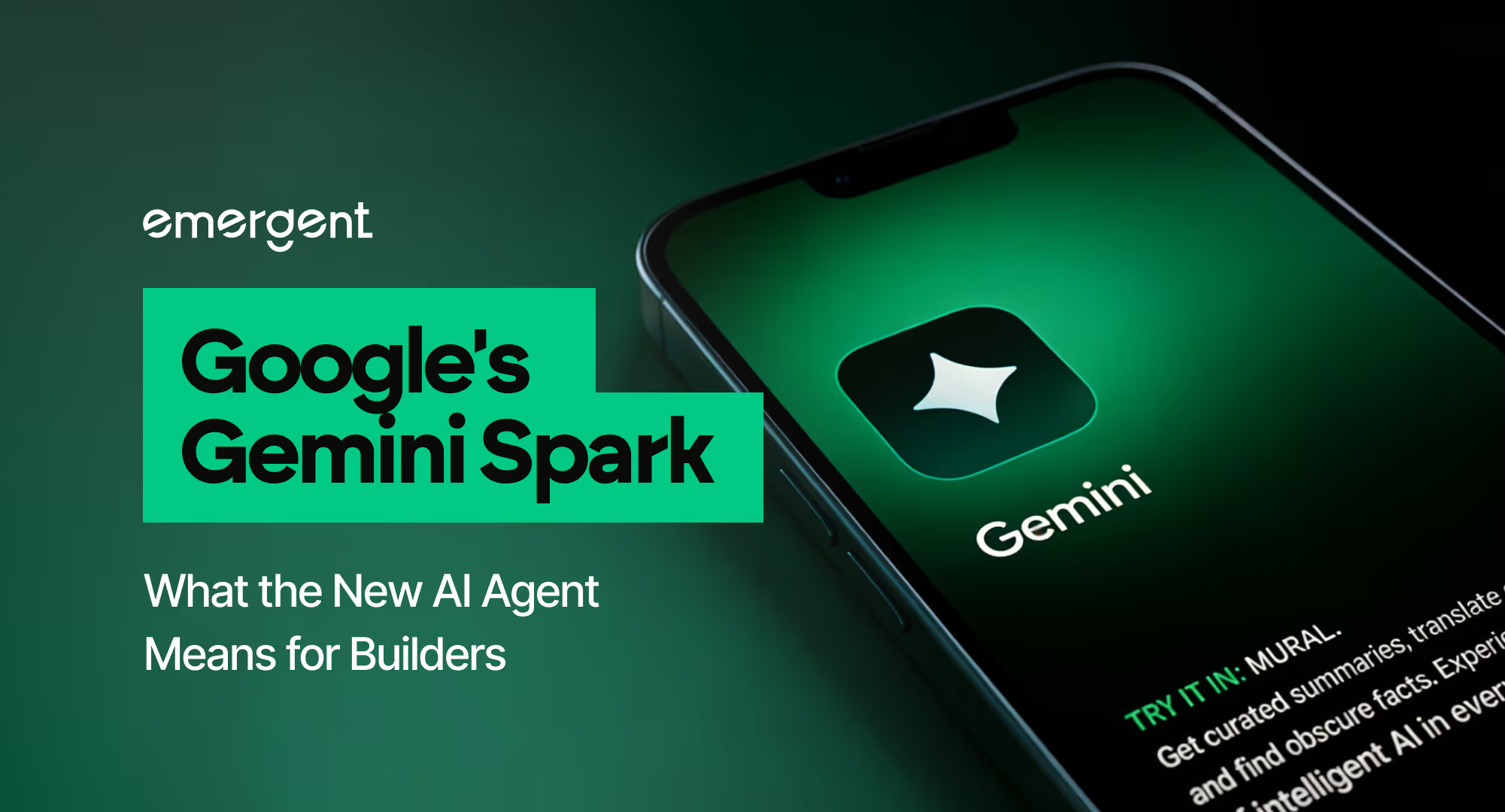
At Google I/O 2026 on May 19, Google unveiled Gemini Spark, a personal AI agent designed to handle tasks across your email, calendar, documents, and dozens of third-party apps without you needing to keep your laptop open. It is the clearest signal yet that the biggest companies in tech believe AI agents, not chatbots, are where the industry is heading next.
For anyone running a small business, freelancing, or building a product without a technical team, this announcement matters. Not because you need to use Spark specifically, but because it confirms a shift that will change the tools available to you over the next year.
What Gemini Spark actually does
Spark is not another chatbot. It is a persistent AI agent that runs on dedicated virtual machines in Google Cloud, powered by Google's new Gemini 3.5 Flash model and a runtime called Antigravity 2.0. That means it keeps working in the background even when your device is off.
During a press briefing ahead of the launch, Alphabet CEO Sundar Pichai described it this way: "It's your personal AI agent that helps you navigate your digital life, taking action on your behalf and under your direction".
Out of the box, Spark connects to Gmail, Google Docs, Slides, Calendar, and Chat. It also supports more than 30 third-party services through MCP integrations, including Asana, Adobe, Dropbox, Canva, and OpenTable.
Josh Woodward, VP of the Gemini app and AI Studio, pitched the practical use case directly: "Small businesses are using Spark. They can watch over their inbox, so they never miss a question from a customer".
Spark is launching in beta next week, available only to U.S. subscribers on Google's new AI Ultra plan at $100 per month.
The model underneath: Gemini 3.5 Flash
Spark runs on Gemini 3.5 Flash, which went live the same day. It is Google's fastest model yet, reportedly four times faster than comparable frontier models while costing significantly less. DeepMind CTO Koray Kavukcuoglu told reporters it outperforms Gemini 3.1 Pro on nearly all benchmarks, calling its speed "ideal for coding and agentic tasks"
For builders, the practical takeaway is this: the AI models powering tools like Spark are getting faster and cheaper at the same time. That trend benefits anyone building on AI-powered platforms, whether they interact with the model directly or not.
A crowded race: Who else is building AI agents
Google is not the only company making this bet. The AI agent space has accelerated rapidly in 2026, with multiple major players staking their positions.
OpenClaw, the open-source agent framework created by Austrian developer Peter Steinberger, crossed 200,000 GitHub stars within months of its launch. Steinberger joined OpenAI in February 2026, where Sam Altman tweeted and called him "a genius with a lot of amazing ideas about the future of very smart agents".
OpenClaw lets users run a personal AI agent locally on their computer, connecting it to messaging apps, email, and file systems. It is powerful but requires technical setup and has faced recurring security concerns.
Anthropic launched Claude Cowork in April, which connects to Google Drive, Gmail, DocuSign, and other enterprise tools. Kate Jensen, Head of Americas at Anthropic, told CNBC the company expects "every knowledge worker will feel that way about Cowork".
And just three days before Google I/O, OpenAI merged ChatGPT and Codex into a single agentic platform under co-founder Greg Brockman, signaling its own move toward agents that act, not just answer.
The market numbers back up the urgency. Grand View Research estimates the global AI agents market at $7.63 billion in 2025, growing to $10.91 billion in 2026 at a 49.6% CAGR. Gartner predicts 40% of enterprise apps will feature task-specific AI agents by 2026, up from less than 5% in 2025.
The ecosystem advantage, and the lock-in question
Google's strongest card is its ecosystem. Workspace serves 3 billion users and 13 million paying customers. When your agent already has access to your Gmail, Docs, and Calendar, setup friction nearly disappears.
But that depth cuts both ways. The more your workflows depend on a single provider's agent, the harder it becomes to switch. VentureBeat noted that "the concentration of personal context in a single AI system, accessible through natural language, creates a surface area that will attract scrutiny from regulators". UC Today put it more plainly: an agent that reads your inbox and acts on its contents effectively operates with the same permissions as you do.
For independent builders and small teams, this is worth thinking about. An agent that only works well inside one company's products is convenient right up until you need something that company doesn't offer.
What this means for non-technical builders
The bigger pattern here is more important than any single product launch. The largest technology companies in the world are now racing to build agents that do your work, not just help you think about it. That is a direct validation of the direction the entire industry is moving: toward AI that takes action on your behalf, across the tools you already use.
This matters if you are a founder managing operations through a handful of apps, a freelancer juggling client work, or a small team trying to do more without hiring. The tools that automate your busywork are about to get dramatically better, and you will have choices about which ecosystem to trust with that automation.
Some of those choices will look like Spark: powerful, deeply integrated, and tied to a specific platform. Others, like Emergent's Wingman, take the opposite approach by living inside WhatsApp, Telegram, and iMessage, meeting billions of users inside the apps they already have open. Neither approach is universally right. The question worth asking is: "Which agent fits how I actually work?"
The question worth asking is not "which agent is best" but "which agent fits how I actually work?"
Try it yourself
If you are already deep inside Google's ecosystem, Spark is worth testing once the beta opens next week. And if your daily work runs through messaging, give Wingman a try. It handles scheduling, research, outreach, and inbox management right inside WhatsApp or Telegram, with no new app to learn and no $100 monthly commitment.
Either way, the AI agent era is no longer a prediction. It is shipping.
Keep reading this space for the latest updates on AI, vibe coding, and the tools shaping how people build. Explore more on Emergent News.

on Emergent today




