




According to the 6sense global B2B buyer behavior research, a significant majority of buyers conduct extensive online research, often completing roughly 70 % of their decision journey independently before engaging with sales, highlighting the critical role of a company’s website and digital presence in shaping vendor shortlists and influencing purchase outcomes As B2B buying cycles become more research-driven and self-serve, the website has effectively replaced the first sales meeting. The ability to build a website with AI allows B2B companies to move faster from strategy to a live, high-performing digital presence.
For modern B2B companies, a website is not a marketing asset alone. It is a revenue engine, product education layer, trust signal, and integration point for sales, marketing, and operations. The right B2B website builder must support complex buyer journeys, enterprise credibility, scalability, integrations, and performance, far beyond what consumer-focused builders are designed to handle.
What is a B2B website builder?
A B2B website builder is a platform designed to help companies create and manage websites that support business-to-business sales models, longer decision cycles, and multi-stakeholder buying processes. Unlike consumer website builders, B2B-focused platforms prioritize structured content, conversion paths, integrations with CRM and analytics tools, and the ability to scale as products, teams, and markets grow.
These platforms are used by SaaS companies, service providers, manufacturers, consultancies, and enterprises that need their website to educate buyers, support sales enablement, capture qualified leads, and integrate tightly with internal systems. A strong B2B website builder balances design flexibility with operational robustness and long-term maintainability.
From Landing Pages to Leads: The 5 Best B2B Website Builders
Not All Website Builders Work for B2B — These 5 Do
Suggested Read: Best AI Website Builder
What are the key features of B2B website builders?
1. Support for complex buyer journeys and conversion paths
B2B websites must guide multiple stakeholders through research, evaluation, and decision-making over time. A capable builder supports structured pages for solutions, industries, use cases, and resources while enabling clear calls to action such as demos, trials, or consultations. This structure is critical for nurturing high-intent leads rather than impulse purchases.
2. Deep integration with sales, marketing, and data systems
B2B websites rarely operate in isolation. They must integrate seamlessly with CRM platforms, marketing automation tools, analytics systems, and internal databases. A strong website builder allows these integrations natively or through extensible APIs, ensuring the website functions as part of a broader revenue stack.
3. Scalability for growing products, teams, and markets
As B2B companies expand, their websites must handle more pages, content contributors, regions, and use cases without becoming unmanageable. Website builders for B2B must support scalable content structures, permissions, and performance optimization. This prevents the site from becoming a bottleneck as the business grows.
4. Enterprise-grade performance, security, and reliability
B2B buyers expect fast, reliable, and secure websites that reflect operational maturity. A suitable platform provides optimized hosting, uptime guarantees, and security controls without constant manual intervention. Performance issues directly impact trust and conversion in B2B contexts.
5. Flexibility for customization and differentiation
B2B companies often need to differentiate through positioning, messaging, and product storytelling. Website builders must allow sufficient customization to reflect unique value propositions rather than forcing generic layouts. This flexibility is essential in competitive B2B markets where credibility and clarity matter.
What are the benefits of using B2B website builders?
1. Faster go-to-market for new products and offerings
B2B website builders allow teams to launch and iterate on product pages, solution pages, and campaigns without waiting on engineering cycles. This speed helps companies respond quickly to market changes. Faster updates translate directly into competitive advantage.
2. Better alignment between marketing and sales teams
A well-structured B2B website becomes a shared asset for marketing and sales. Content can be aligned with sales conversations, objections, and buyer education needs. This alignment improves lead quality and shortens sales cycles.
3. Improved buyer trust and professional credibility
A polished, high-performing website signals operational maturity to B2B buyers. Clear messaging, structured content, and reliable performance build confidence before any direct interaction. Trust is especially critical in high-value B2B deals.
4. Centralized control over brand and messaging
Website builders give B2B companies direct control over how their brand, products, and value propositions are presented. Teams can ensure consistency across pages and markets. This centralization reduces fragmentation as organizations scale.
5. Long-term scalability without constant rebuilds
Choosing the right B2B website builder allows companies to grow without needing to replatform frequently. Scalable content structures and integrations support long-term evolution. This reduces technical debt and operational disruption.
5 Best B2B Website Builders
B2B website builders serve very different segments of the market, from full-stack custom platforms to commerce-first solutions and design-driven builders. Some prioritize deep customization and system integration, while others focus on speed, templates, or commerce workflows. The platforms listed below stand out in 2026 because they address real B2B needs without sacrificing scalability, credibility, or operational control.
1. Emergent
Emergent is one of the best, full-stack, AI-powered vibe coding and no code platforms for B2B companies that need their website to function as a revenue-driving system rather than a static marketing surface. In 2026, B2B teams use Emergent to build high-performance websites that combine product storytelling, lead capture, gated content, integrations, and backend logic into a single, production-ready platform.
For SaaS companies, enterprise service providers, and B2B startups operating complex sales motions, Emergent treats the website as an extension of sales and operations. Instead of stitching together CMS tools, form builders, CRM plugins, and hosting providers, teams can describe their B2B website requirements in natural language and receive a fully functional system that scales with growth.
Key Features of Emergent for B2B Websites
1. Full-stack B2B website generation from natural language prompts
Emergent allows B2B teams to describe their website requirements, such as product pages, solution hubs, lead capture flows, and gated resources, in plain language and generates the complete system automatically. This includes frontend UI, backend logic, databases, authentication, and hosting without manual configuration. Teams avoid fragmented tooling and launch production-grade B2B websites faster.
2. Custom structures for products, solutions, and industries
B2B websites often require complex hierarchies for products, use cases, industries, and integrations. Emergent enables teams to define these structures explicitly rather than forcing content into flat page templates. This results in clearer buyer journeys and better alignment with how enterprise buyers evaluate solutions.
3. Built-in lead capture, routing, and workflow logic
Emergent supports advanced B2B lead capture scenarios including gated content, demo requests, qualification forms, and routing based on rules. Instead of relying on external form tools, teams can embed logic directly into the website. This improves data quality and reduces operational friction between marketing and sales.
4. Native authentication and gated B2B experiences
For B2B companies offering customer portals, partner areas, or private documentation, Emergent includes authentication and access control by default. Teams can gate pricing pages, technical docs, or account-specific content securely. This is critical for enterprise sales models where controlled access builds trust.
5. Deep integration readiness with CRM and internal systems
Emergent-generated websites are designed to integrate cleanly with CRM platforms, analytics tools, and internal APIs. This allows the website to function as part of the revenue stack rather than an isolated marketing layer. B2B teams gain better visibility and operational alignment.
6. One-click deployment with enterprise-grade performance
Once generated, B2B websites can be deployed instantly with scalable hosting, performance optimization, and security handled automatically. Teams do not manage infrastructure or release pipelines. This ensures reliability during traffic spikes from campaigns, launches, or enterprise evaluations.
Unique Features of Emergent for B2B Websites
1. Vibe coding for complex B2B logic and flows
Emergent’s vibe coding approach allows teams to describe multi-step B2B workflows, such as lead qualification, demo scheduling, or partner onboarding, conversationally. The platform translates intent directly into working logic. This removes the traditional gap between business requirements and technical execution.
2. No template ceiling for enterprise differentiation
Unlike template-driven builders, Emergent imposes no design or logic ceiling. B2B teams can create differentiated layouts, interactive product storytelling, and custom conversion paths. This flexibility is essential in crowded B2B markets where generic websites erode credibility.
3. Unified platform replacing fragmented B2B tooling
Emergent consolidates CMS, backend logic, authentication, integrations, and hosting into a single system. B2B teams avoid maintaining multiple vendors and plugins. This reduces long-term technical debt and operational overhead.
4. Production-grade systems without engineering bottlenecks
Websites generated by Emergent are production-ready from day one, not prototypes. Teams can ship serious B2B websites without waiting on engineering bandwidth. This accelerates go-to-market without compromising quality or scalability.
5. Adaptability for evolving B2B business models
As pricing models, sales motions, or product lines change, Emergent websites can evolve without replatforming. Teams can iterate on structure and logic safely. This adaptability is critical for scaling B2B companies.
6. Strong foundation for enterprise and regulated industries
Emergent supports complex access control, data handling, and integration needs required by enterprise buyers. This makes it suitable for regulated or high-trust B2B industries. Few website builders operate comfortably at this level.
Advantages of Emergent for B2B Websites
- Enables B2B teams to build revenue-grade websites that integrate deeply with sales, marketing, and operations systems.
- Removes template and plugin limitations, allowing true differentiation in messaging, structure, and buyer experience.
- Supports complex lead capture, routing, and gated content workflows natively within the website.
- Scales from early-stage startups to enterprise deployments without forced migrations.
- Reduces technical debt by consolidating website, logic, and infrastructure into one platform.
- Aligns website execution directly with business intent through natural language workflows.
Limitations of Emergent for B2B Websites
- May be more powerful than necessary for B2B teams seeking only a simple brochure-style site.
- Requires thoughtful articulation of requirements to fully leverage its customization capabilities.
- Not positioned for users who prefer rigid templates over flexible system design.
Pricing and Plans of Emergent
| Plan | Pricing | Key Highlights |
|---|---|---|
| Free | $0/month |
|
| Standard | $20/month |
|
| Pro | $200/month |
|
| Team | $300/month |
|
| Enterprise | Custom |
|
Read More About: Emergent Pricing and Plans
2. Shopify
Shopify is primarily known as an ecommerce platform, but in 2026 it has become a serious option for B2B companies whose websites revolve around catalog-driven selling, wholesale workflows, and transactional relationships. For manufacturers, distributors, and B2B brands selling physical or digital products at scale, Shopify acts as both the website and the commerce engine.
For B2B use cases, Shopify is less about storytelling-heavy marketing sites and more about structured product catalogs, pricing logic, account-based purchasing, and operational reliability. It works best when commerce is central to the B2B business model rather than secondary to sales-led or consultative motions.
Key Features of Shopify for B2B Websites
1. Native B2B commerce workflows and wholesale functionality
Shopify includes built-in B2B features such as company profiles, customer-specific pricing, purchase order support, and net payment terms. This allows B2B sellers to manage wholesale buyers, distributors, and repeat customers directly through the website. These workflows reduce reliance on custom commerce development.
2. Structured product and catalog management at scale
B2B companies with large product catalogs benefit from Shopify’s robust product management system. Teams can organize SKUs, variants, collections, and pricing rules cleanly. This structure is critical for buyers who expect clarity, consistency, and accurate product information.
3. Account-based access and gated pricing
Shopify allows B2B companies to gate pricing and purchasing behind customer accounts. Buyers log in to see negotiated pricing and terms. This mirrors real-world B2B sales relationships and supports long-term customer retention.
4. Reliable checkout, payments, and tax handling
Shopify handles payments, invoicing, taxes, and compliance across regions. For B2B sellers operating internationally, this reduces operational risk and complexity. The platform is battle-tested for high-volume transactions.
5. Extensive app ecosystem for extending B2B functionality
Shopify’s app marketplace offers tools for ERP integration, inventory management, shipping logic, and analytics. B2B teams can extend the website’s capabilities without rebuilding core systems. However, complexity grows as more apps are added.
6. Enterprise-grade hosting and performance stability
Shopify manages hosting, security, and performance at scale. B2B websites remain reliable during high traffic or order volumes. This operational stability is a major reason enterprises adopt Shopify.
Unique Features of Shopify for B2B Websites
1. Commerce-first architecture optimized for transactions
Shopify is fundamentally designed around selling. For B2B companies where transactions are the primary website goal, this focus is a strength. The platform excels at turning visitors into buyers through optimized commerce flows.
2. Mature ecosystem supporting complex supply chains
Many B2B companies integrate Shopify with ERP, fulfillment, and inventory systems. This ecosystem maturity supports complex supply chains. Few website builders match Shopify’s commerce reach.
3. Proven scalability for high-revenue businesses
Shopify powers some of the largest online businesses globally. B2B companies benefit from infrastructure designed to scale without degradation. This is critical for growing or enterprise-level operations.
4. Standardized workflows reduce operational errors
Shopify enforces best-practice commerce workflows. This standardization reduces errors in pricing, checkout, and fulfillment. B2B teams gain predictability over flexibility.
5. Strong partner and developer ecosystem
A large network of agencies and developers support Shopify. B2B companies can find implementation and customization help easily. This lowers adoption risk for complex deployments.
6. Continuous platform investment and updates
Shopify consistently invests in platform improvements, especially around B2B commerce. Companies benefit from ongoing innovation without managing upgrades. This future-proofs commerce-heavy websites.
Advantages of Shopify for B2B Websites
- Excellent choice for B2B companies where online transactions and catalogs drive revenue.
- Native support for wholesale pricing, accounts, and purchase workflows.
- Highly reliable hosting and global payment infrastructure.
- Massive ecosystem for extending commerce operations.
- Scales well from mid-market to enterprise B2B businesses.
- Strong compliance and security posture for transactional websites.
Limitations of Shopify for B2B Websites
- Less flexible for content-heavy or storytelling-driven B2B marketing sites.
- Custom buyer journeys outside commerce often require apps or custom work.
- App dependencies can increase long-term costs and complexity.
- Not ideal for consultative or demo-led B2B sales models.
- Backend logic customization is constrained by platform rules.
- Website differentiation is limited compared to full-stack builders.
Pricing and Plans of Shopify
| Plan | Pricing | Key Highlights |
|---|---|---|
| Basic | $39/month |
|
| Grow | $105/month |
|
| Advanced | $399/month |
|
| Shopify Plus | From $2,300/month (3-year plan) |
|
| Enterprise | Custom pricing |
|
3. BigCommerce
BigCommerce is a commerce-first website platform designed for B2B companies that need advanced selling logic, large catalogs, and operational control without relying heavily on third-party apps. BigCommerce is widely used by manufacturers, distributors, and B2B brands that want strong native commerce capabilities paired with flexibility for custom integrations.
For B2B teams, BigCommerce positions itself between rigid commerce platforms and fully custom builds. It offers more built-in B2B functionality than many website builders while still allowing developers and technical teams to extend the platform as business requirements evolve.
Key Features of BigCommerce for B2B Websites
1. Native B2B pricing, quoting, and customer group logic
BigCommerce includes built-in features for customer groups, tiered pricing, and negotiated pricing rules. This allows B2B companies to present different prices, catalogs, and terms to different buyers without complex workarounds. These capabilities closely mirror real-world B2B sales agreements.
2. Support for large and complex product catalogs
B2B companies with extensive product lines benefit from BigCommerce’s ability to manage large catalogs efficiently. The platform supports variants, bulk pricing, and detailed product attributes. This structure is essential for buyers who rely on accuracy and clarity during evaluation and purchasing.
3. API-first architecture for system integrations
BigCommerce is built with an API-first approach, making it easier to integrate with ERP systems, CRM tools, inventory management platforms, and custom internal software. This flexibility is critical for B2B companies with established operational stacks. The website becomes part of a broader business ecosystem.
4. Flexible frontend options for custom B2B experiences
Unlike tightly coupled platforms, BigCommerce allows teams to decouple the frontend from the backend using headless or hybrid approaches. This enables custom B2B experiences while retaining strong commerce foundations. It suits companies with internal development resources.
5. Built-in checkout, tax, and compliance handling
BigCommerce manages checkout flows, tax calculations, and compliance requirements out of the box. B2B companies operating across regions benefit from reduced complexity. This reliability supports global selling without constant manual configuration.
6. Scalable hosting and performance for high-volume B2B traffic
The platform includes managed hosting optimized for performance and uptime. B2B websites remain stable during traffic spikes, product launches, or seasonal demand. Performance consistency contributes directly to buyer trust.
Unique Features of BigCommerce for B2B Websites
1. Strong B2B capabilities without heavy app dependency
BigCommerce includes many B2B features natively, reducing reliance on third-party apps. This simplifies maintenance and lowers long-term costs. B2B teams benefit from a more cohesive platform experience.
2. Headless commerce readiness for modern B2B stacks
BigCommerce’s headless capabilities allow companies to build custom frontends while using BigCommerce as the commerce engine. This supports advanced B2B use cases and modern tech stacks. Few commerce platforms offer this balance as cleanly.
3. Greater control over checkout and pricing logic
Compared to some competitors, BigCommerce provides more flexibility in customizing checkout and pricing rules. This is important for B2B businesses with non-standard purchasing workflows. Custom logic can be implemented without breaking the core platform.
4. Vendor-agnostic approach to integrations
BigCommerce does not lock users into a single ecosystem. B2B companies can choose best-in-class tools for CRM, analytics, or fulfillment. This openness supports long-term architectural flexibility.
5. Enterprise-friendly compliance and security posture
The platform supports enterprise security standards and compliance requirements. This is critical for B2B companies handling sensitive pricing and customer data. Trust and governance are built into the system.
6. Balanced focus on flexibility and stability
BigCommerce prioritizes predictable behavior while still allowing customization. B2B teams avoid constant platform surprises. This balance appeals to companies with long-term planning horizons.
Advantages of BigCommerce for B2B Websites
- Strong native support for B2B pricing, customer groups, and purchasing logic.
- Suitable for companies with large catalogs and complex product data.
- API-first design enables deep integration with enterprise systems.
- Reduced dependency on third-party apps compared to some competitors.
- Supports headless and custom frontend architectures.
- Reliable hosting and performance for scaling B2B operations.
Limitations of BigCommerce for B2B Websites
- Requires technical expertise to fully leverage advanced customization options.
- Less intuitive for non-technical teams compared to simpler builders.
- Design flexibility depends heavily on development resources.
- Not ideal for content-heavy B2B storytelling without additional tooling.
- Smaller ecosystem compared to Shopify in some regions.
- Can feel complex for early-stage B2B startups.
Pricing and Plans of BigCommerce
| Plan | Pricing | Key Highlights |
|---|---|---|
| Standard | $39/month |
|
| Plus | $105/month |
|
| Pro | $399/month |
|
| Enterprise | Custom pricing |
|
4. Wix
Wix is a general-purpose website builder that many B2B companies use when speed, visual polish, and ease of use matter more than deep system integration or custom backend logic. In 2026, Wix is commonly adopted by early-stage B2B startups, professional services firms, consultants, and agencies that need a credible web presence quickly without engineering involvement.
For B2B use cases, Wix works best as a marketing and lead-generation website rather than a deeply integrated revenue system. It excels at producing attractive, content-forward sites, but it is not designed to model complex sales workflows, enterprise integrations, or advanced buyer logic.
Key Features of Wix for B2B Websites
1. Visual drag-and-drop editor for fast B2B site creation
Wix’s editor allows B2B teams to design pages visually without writing code, making it easy to launch product pages, service descriptions, and landing pages quickly. Teams can iterate on messaging and layout without engineering dependencies. This speed is valuable for startups validating positioning or campaigns.
2. Large template library for B2B marketing sites
Wix offers many templates suitable for SaaS, consulting, and professional services websites. These templates provide a structured starting point for common B2B layouts such as solution pages and contact flows. While templates accelerate setup, they also impose structural constraints.
3. Built-in lead capture forms and basic automation
Wix includes native forms for contact requests, demo inquiries, and newsletter signups. These tools support basic lead capture without external platforms. However, automation depth remains limited compared to specialized B2B marketing stacks.
4. App marketplace for extending website functionality
B2B teams can add apps for scheduling, chat, CRM connections, and analytics through Wix’s app market. This allows incremental extension of site capabilities. App reliance can increase complexity as requirements grow.
5. Content management for blogs and resource hubs
Wix supports blogging and content publishing, enabling B2B companies to run resource centers, announcements, and thought leadership content. This is useful for SEO and education-driven sales models. Content tools are approachable for non-technical teams.
6. Managed hosting and maintenance
Wix handles hosting, security, and updates automatically. B2B teams do not manage infrastructure. This reduces operational overhead for small teams.
Unique Features of Wix for B2B Websites
1. Wix ADI for rapid website generation
Wix ADI can generate a functional B2B website automatically based on a few inputs. This is useful for founders who need an online presence immediately. The resulting sites are serviceable but limited in depth.
2. Wide accessibility for non-technical teams
Wix is designed for users with no technical background. B2B teams can update content without training. This accessibility is a major adoption driver.
3. Built-in booking and scheduling tools
Professional services B2B companies can use Wix’s booking tools to manage consultations or demos. This supports service-led sales models. Booking features integrate directly into the website.
4. Multilingual support for global audiences
Wix allows B2B companies to publish content in multiple languages. This supports international expansion at a basic level. Localization controls are sufficient for small teams.
5. Affordable entry point for startups
Wix pricing is accessible for early-stage B2B companies. This lowers financial risk during experimentation. Cost predictability appeals to bootstrapped teams.
6. Strong visual output with minimal effort
Wix sites generally look polished without design expertise. This helps B2B companies establish credibility quickly. Visual quality is a core strength.
Advantages of Wix for B2B Websites
- Very fast to launch and iterate for non-technical B2B teams.
- Visually polished output suitable for marketing and lead generation.
- Built-in tools cover basic B2B needs without extra setup.
- Affordable pricing for early-stage companies.
- Large template and app ecosystem.
- Minimal operational overhead due to managed hosting.
Limitations of Wix for B2B Websites
- Limited flexibility for complex B2B sales workflows.
- Heavy reliance on apps for advanced functionality.
- Not designed for deep CRM or ERP integrations.
- Content and page structure can become restrictive as sites grow.
- Difficult to evolve into a full revenue system.
- Less suitable for enterprise or integration-heavy B2B companies.
Pricing and Plans of Wix
| Plan | Pricing | Key Highlights |
|---|---|---|
| Free | $0 | For trying Wix and basic experimentation |
| Light | $17 per month | Ideal for portfolios and personal sites |
| Core | $29 per month | Designed for small online stores and growing businesses |
| Business | $36 per month | Suited for established businesses needing more capabilities |
| Business Elite | $159 per month | Built for large businesses with advanced requirements |
| Enterprise | Custom pricing | Tailored for global brands with high-scale, industry-level needs |
5. Webflow
Webflow is a design-first website builder that has become a standard choice for B2B companies that care deeply about brand differentiation, layout precision, and content control. Webflow is widely used by SaaS companies, design-led startups, and marketing teams that want full visual control without handing everything to engineering.
For B2B use cases, Webflow sits between no-code builders and custom development. It offers far more design and structure control than template-driven platforms, but it does not natively handle complex backend logic, commerce workflows, or deep system integrations without external tools or custom development layers.
Key Features of Webflow for B2B Websites
1. Pixel-level visual design control without code
Webflow allows B2B teams to design layouts with precision, controlling spacing, typography, interactions, and responsive behavior visually. This enables marketing teams to create highly differentiated product pages, landing pages, and brand narratives. The resulting websites often rival custom-built designs in quality.
2. CMS-driven content structures for scalable B2B sites
Webflow’s CMS enables teams to create structured content types for blog posts, case studies, integrations, features, or resources. This structure supports scalability as content libraries grow. Marketing teams can manage large sites without hardcoding pages.
3. Clean, production-ready frontend output
Webflow generates clean HTML, CSS, and JavaScript under the hood. This results in fast-loading pages and good SEO performance. B2B companies benefit from strong technical foundations without manual optimization.
4. Advanced animations and interactions
Webflow supports sophisticated animations and interactions that enhance storytelling and user engagement. B2B companies use this to explain complex products visually. These interactions are controlled visually rather than through code.
5. Collaborative workflows for design and content teams
Designers, marketers, and editors can collaborate within Webflow using role-based permissions. This separation allows content updates without breaking layouts. Teams maintain velocity without constant engineering involvement.
6. Managed hosting with strong performance
Webflow includes hosting optimized for performance and reliability. B2B websites benefit from fast global delivery. Infrastructure management is handled by the platform.
Unique Features of Webflow for B2B Websites
1. Design-first philosophy unmatched by most builders
Webflow is built around giving designers full control. This makes it ideal for B2B brands where visual differentiation and storytelling matter. Few platforms offer comparable creative freedom without code.
2. Strong adoption among modern SaaS marketing teams
Webflow has become a de facto standard for SaaS marketing sites. This ecosystem familiarity reduces hiring and onboarding friction. Teams often already know how to use it.
3. Component-based design for consistency
Reusable components allow teams to maintain consistency across pages while iterating quickly. This supports scalable brand systems. Changes propagate cleanly.
4. SEO-friendly structure and control
Webflow provides granular control over meta tags, URLs, and site structure. B2B companies benefit from strong organic visibility. SEO teams appreciate this level of control.
5. Integration-friendly frontend layer
While Webflow lacks deep backend logic, it integrates well with third-party tools for forms, automation, and analytics. This makes it a flexible frontend layer. However, complexity grows with each integration.
6. Balance between no-code and custom development
Developers can extend Webflow with custom code when needed. This hybrid approach suits teams with partial engineering support. It offers flexibility without full custom builds.
Advantages of Webflow for B2B Websites
- Excellent choice for B2B companies prioritizing brand, design, and storytelling.
- Strong CMS capabilities support content-heavy marketing strategies.
- Clean frontend output improves performance and SEO.
- Allows marketing teams to operate independently of engineering.
- Scales well for mid-market B2B sites.
- Widely adopted with strong community and resources.
Limitations of Webflow for B2B Websites
- Lacks native backend logic for complex B2B workflows.
- Commerce and account-based features are limited.
- Advanced functionality often requires third-party tools or custom code.
- Not ideal for transaction-heavy or portal-based B2B models.
- Can become costly as sites and teams scale.
- Requires design discipline to avoid overcomplexity.
Pricing and Plans of Webflow
| Plan | Pricing | Key Highlights |
|---|---|---|
| Starter | Free |
|
| Basic | $18/month |
|
| CMS | $29/month |
|
| Business | $49/month |
|
How to choose the best B2B website builder?
1. Align the builder with your B2B sales motion
B2B companies must first assess whether their website supports product-led, sales-led, or commerce-driven buying journeys. Platforms optimized for catalogs and checkout work well for transactional models, while consultative sales require structured content, gated resources, and lead routing. Choosing a builder that matches the actual sales motion avoids forcing workarounds later.
2. Evaluate integration depth with your revenue stack
A B2B website rarely stands alone, it must integrate with CRM, analytics, marketing automation, and internal systems. Builders that treat integrations as first-class capabilities reduce operational friction. Weak integration support creates data silos and manual processes that slow growth.
3. Prioritize scalability of content and structure
As products, industries, and use cases expand, B2B websites grow quickly in complexity. Builders should support scalable content models, permissions, and performance without restructuring the site repeatedly. Long-term scalability matters more than initial launch speed.
4. Consider differentiation and design control
In competitive B2B markets, generic templates can erode credibility. Teams should assess how much freedom they need to tell their product story distinctly. Builders with design or logic ceilings limit differentiation as positioning evolves.
5. Think in terms of systems, not pages
The strongest B2B websites behave like systems that capture intent, qualify leads, and support buyers through decisions. Builders that support workflows, logic, and controlled experiences outperform page-only tools. This systems mindset is essential for serious B2B growth.
Why is Emergent the best B2B website builder?
1. Built for B2B websites as revenue systems, not brochures
Emergent treats the B2B website as an operational layer that connects marketing, sales, and product workflows. Teams can design lead capture, qualification, gated content, and integrations as part of one system. This goes far beyond traditional page-based builders.
2. Removes template and plugin dependency entirely
Most B2B builders rely on templates and third-party plugins to approximate complex needs. Emergent eliminates these constraints by generating custom structures and logic directly from business intent. This results in cleaner architecture and lower long-term technical debt.
3. Enables complex buyer journeys without engineering bottlenecks
B2B buying paths often involve multiple stakeholders, gated assets, and conditional flows. Emergent allows teams to define these journeys conversationally and deploy them as working systems. This reduces reliance on engineering for website evolution.
4. Scales cleanly from startup to enterprise
Emergent supports early-stage experimentation and enterprise-grade requirements on the same foundation. Teams do not need to replatform as complexity increases. This continuity is rare among website builders.
5. Aligns website execution directly with business intent
By translating natural language requirements into production-ready systems, Emergent closes the gap between strategy and execution. B2B teams ship faster without compromising quality or control. This alignment is its core advantage in 2026.
Conclusion
B2B website builders have evolved from simple site tools into foundational platforms that shape how buyers discover, evaluate, and trust companies. While platforms like Shopify, BigCommerce, Wix, and Webflow each serve important B2B segments, they are optimized for specific models such as commerce, design, or speed.
For B2B companies that want their website to function as a scalable, integrated revenue system with no artificial ceilings, Emergent stands out clearly in 2026. It offers a level of flexibility, depth, and future readiness that traditional builders cannot match.
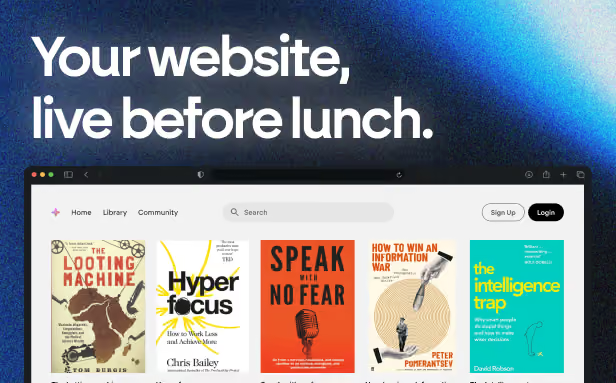
Emergent designs, writes, and publishes your whole site from one prompt. No templates, no drag-and-drop.
- Full site from one prompt
- Custom design, real pages
- Publish in minutes







