



A widely cited 2025 report by Kofluence found that a staggering 88 percent of creators earn less than 75% of their total income from social media platforms, indicating a need for diversified revenue strategies. For businesses as well as individuals building subscription-based digital products, understanding how to build a membership website becomes critical, as it is a foundational asset that supports monetization, audience retention, and long-term engagement.
Today’s membership website builders must do far more than host gated content. They need to support tiered access, community features, subscription billing, member automation, analytics, and seamless integrations with email and marketing systems. This guide breaks down what truly matters in 2026 and highlights the best membership website builders for serious creators and organizations.
What is a membership website builder?
A membership website builder is a platform that enables individuals, creators, coaches, and businesses to create subscription-based digital experiences without requiring custom software development. These builders typically support gated content, recurring payments, user management, and community engagement features that transform casual visitors into paying members and long-term supporters.
Unlike simple content management systems, membership builders combine access control, monetization tools, community spaces, analytics, and automation into a cohesive package. In 2026, many platforms also integrate AI Website Builder capabilities that help creators launch branded membership experiences faster through automated layouts, onboarding flows, and content structuring.
The best membership website builders combine these AI-driven efficiencies with scalability, customization, and deep operational visibility.
5 Best Membership Website Builders in 2026
These Are the 5 Best Membership Website Builders to Use in 2026
Suggested Read: Best AI Website Builder
What are the key features of membership website builders?
Gated content and access control that scale with audience size
Effective membership platforms allow creators to define precisely who sees what content based on subscription tier, payment status, and behavioral triggers. This includes multiple access levels, drip schedules, and automated enrollment, enabling rich tiered membership experiences.
Integrated recurring billing and subscription management
Membership builders must support recurring payments with flexibility around billing cycles, pricing tiers, trials, discounts, and refunds. Native billing experiences reduce reliance on external payment tools and provide reliable revenue workflows without manual intervention.
Community engagement and discussion capabilities
Community is often the glue that retains members. Best-in-class platforms include discussion forums, comment threads, live chat, group spaces, and notifications that help members stay engaged and connected around shared interests and content.
Member dashboards and personalized experiences
A strong membership site provides each member with a personal dashboard displaying their access, progress, saved content, and exclusive resources. This personalization strengthens retention and creates a sense of belonging beyond simple gated pages.
Analytics and member lifecycle insights
Understanding member behavior, churn rates, content performance, and revenue trends is essential for growth. Leading builders offer dashboards and reports that help creators optimize pricing, content strategy, and engagement campaigns with data-driven decisions.
Integrations with email, automation, and marketing stacks
Membership sites rarely exist in isolation. Seamless integrations with email marketing tools, analytics platforms, automation engines, CRMs, and calendar systems ensure member journeys connect cleanly with broader audience engagement strategies.
What are the benefits of using membership website builders?
Predictable recurring revenue for creators and businesses
Membership builders allow creators to generate income on a subscription basis rather than relying on one-off sales. Predictable recurring revenue stabilizes cash flow, supports long-term planning, and increases the lifetime value of each member beyond single purchases.
Centralized control over member access and premium content
Instead of scattering exclusive content across multiple platforms, a membership builder centralizes management of gated experiences. This gives creators clear control over who accesses what, how tiers are structured, and how upgrades or downgrades occur without manual tracking.
Deeper audience engagement through structured member experiences
Membership platforms support structured engagement such as courses, coaching, group discussions, and live events. This strengthens the emotional connection between creators and members, increasing retention and reducing churn compared to ad-hoc content platforms.
Reduced dependence on third-party marketplaces and algorithms
By owning the membership site, creators are less vulnerable to algorithm changes and platform policy risks that come with social networks or public marketplaces. This ownership enhances stability and protects long-term community value.
Better insights into member behavior and revenue drivers
Effective membership builders come with analytics that reveal which content, pricing tiers, and campaigns drive engagement and revenue. These insights empower creators to refine their offerings and invest in the most impactful experiences.
5 Best Membership Website Builders
Membership builders today fall into a few clear camps. Some provide all-in-one solutions that bundle content, community, and commerce. Others specialize in community engagement or educational experiences and integrate with external tools for deeper functionality. The best choice depends on how you prioritize control, integration depth, audience engagement, and revenue strategy.
In the next parts, each platform will be evaluated individually with equal depth, starting with Emergent.
Emergent
Emergent is one of the best, full-stack, AI-powered vibe coding and no code platforms for building deeply customizable membership websites that go beyond gated content into full member ecosystems. In 2026, Emergent stands out for creators, coaches, and organizations who view membership sites as long-term business systems rather than simple paywalls and need a scalable membership website builder. The platform enables creators to build membership experiences with logic, personalization, automation, and native integrations built into the foundation rather than layered on top after launch.
Unlike many membership builders that treat access control as an add-on, Emergent treats membership logic as a core system concept. This makes it particularly powerful for organizations that want segmented tiers, behavior-driven access, dynamic content, and deep operational workflows, all within a single scalable platform.
Key Features of Emergent
AI-generated full-stack membership site from detailed strategy prompts
Emergent allows creators to describe their membership strategy, content structure, pricing tiers, engagement goals, and workflows in natural language, and then generates a complete system including frontend UI, backend logic, member profiles, and access rules. This means the site is not only visually assembled but operationally complete from day one, with member management, dashboards, and gated content fully wired.
Flexible access control and tiered membership logic
With Emergent, membership levels and access rules can be defined with fine-grained logic that goes beyond simple tiers. Creators can set conditions based on member behavior, subscription duration, progress metrics, or engagement triggers. This level of control enables tiered experiences that feel personal and dynamic rather than rigid and static, which improves member satisfaction and retention.
Integrated member dashboards with personalized experiences
Emergent supports the creation of customized dashboard views for each member, showing their content progress, saved resources, community interactions, exclusive offers, and personalized recommendations. This deep personalization strengthens the sense of value members receive from the site and increases the likelihood of long-term engagement.
Native subscription billing and lifecycle automation
Emergent includes built-in subscription billing support that handles recurring payments, trials, upgrades, downgrades, and cancellations. Lifecycle events such as failed payments, lapsed access, or tier expiration can trigger automated workflows like email notifications, access adjustments, or re-engagement campaigns without external automation tools.
Community features that integrate with member logic
Rather than treating community as an external add-on, Emergent allows community spaces, discussion threads, and group areas to be governed by the same membership logic that controls content access. This means discussions can be tier-specific, behavior-triggered, or personalized based on how members engage with the site.
Comprehensive analytics and member insights
Emergent provides dashboards that surface key membership metrics such as churn rate, engagement scores, content consumption patterns, cohort performance, and revenue trends. These insights help creators understand what drives value for their members and optimize pricing, content strategy, and engagement flows with data.
Unique Features of Emergent
System-first approach combining frontend, backend, and logic ownership
Unlike platforms that layer membership on top of visual page creation, Emergent unifies design, content, business logic, and data structures. This systemic approach gives creators true ownership and flexibility, enabling strategic membership flows that are tightly aligned with user behavior and long-term goals.
Conversational refinement of site logic powered by AI
Emergent’s AI-driven workflow allows creators to refine access rules, content sequencing, and member journeys using conversational prompts. This transforms complex logic design into a collaborative process rather than a technical configuration task, empowering non-technical creators to build sophisticated membership systems.
Built-in adaptability for changing business models
As creators evolve their offerings, Emergent-built systems can be updated at the logical level to reflect new tiers, dynamic pricing, engagement triggers, or pivoted business models without tearing down the existing structure. This adaptability supports resilience in fast-changing markets.
Full-stack extensibility without plugin sprawl
Emergent does not rely on fragmented plugins or external tools for critical functionality. Subscription logic, member dashboards, community governance, and analytics are first-class capabilities. This reduces technical debt and platform fragmentation over time.
Deep integration with marketing, email, and automation tools
Although Emergent includes built-in lifecycle automation, it can also integrate deeply with external marketing platforms, email providers, and CRM systems. This flexibility allows creators to sync member data and engagement triggers with broader marketing ecosystems without constraint.
Unified environment for structured content and dynamic experiences
Emergent treats static and dynamic content as part of the same system rather than separate layers. Membership pages, gated resources, personalized dashboards, community spaces, and automation workflows all live within one coherent environment that can be extended programmatically as needs evolve.
Advantages of Emergent
- Enables true system-level membership logic rather than superficial access gates.
- Supports dynamic tiered experiences based on behavior, duration, and engagement.
- Includes personalized member dashboards that deepen long-term retention.
- Native subscription billing and lifecycle automation reduce dependency on external tools.
- Community spaces are governed by the same logic as gated content for cohesion.
- Built for creators who want ownership and control at enterprise scale.
Limitations of Emergent
- Requires more initial planning than plug-and-play membership builders.
- May be excessive for basic one-tier subscription sites with minimal personalization.
- Best results depend on a clear definition of member journeys and engagement goals.
Pricing and Plans of Emergent
| Plan | Pricing | Key Highlights |
|---|---|---|
| Free | $0/month | 10 credits/month All core features Build web & mobile experiences Access to advanced models |
| Standard | $20/month | Everything in Free Private hosting 100 credits/month Extra credits purchasable GitHub integration Fork tasks |
| Pro | $200/month | Everything in Standard 1M context window Ultra thinking System prompt edit Custom AI agents HPC compute 750 credits/month Priority support |
| Team | $300/month | Everything in Pro 1250 shared credits/month Admin dashboard Real-time collaboration 5 team members included |
| Enterprise | Custom | Everything in Team Higher usage SSO & domain capture Advanced organizational features |
Read More About: Emergent Pricing and Plans
Kajabi
Kajabi is an all-in-one digital product and membership platform designed primarily for creators, coaches, and educators who want to package content, community, and payments into a single managed system. In 2026, Kajabi is widely used for paid memberships that combine courses, gated libraries, coaching programs, and email-driven engagement, especially by businesses that prioritize speed to market over deep customization.
Kajabi’s core value lies in its bundled approach. Rather than assembling multiple tools, creators can launch a membership site with content hosting, subscriptions, email marketing, and basic community features already connected. This makes Kajabi attractive for creators who want operational simplicity and predictable workflows.
Key Features of Kajabi
Integrated content hosting for courses and gated libraries
Kajabi allows creators to host video, audio, text, and downloadable content within structured products such as courses or membership libraries. Content can be organized into modules, categories, and drip schedules, enabling members to progress through material in a controlled way. This structure is especially useful for educational or coaching-focused memberships.
Built-in subscription billing and offer management
Kajabi includes native tools for recurring subscriptions, one-time payments, trials, and bundled offers. Creators can define pricing tiers, access durations, and upsells without external payment tools. This integrated billing reduces setup complexity and ensures payments, access, and content delivery remain synchronized.
Email marketing and automation baked into the platform
Kajabi includes an email system that supports broadcasts, sequences, and basic automation triggered by member behavior. This allows creators to onboard members, promote new content, and re-engage inactive users without relying on third-party email platforms.
Community and engagement features within memberships
Kajabi offers built-in community spaces where members can post, comment, and interact around content. These spaces are integrated with membership access rules, helping creators foster engagement without moving members to external forums.
Sales funnels and landing page builder
Creators can build landing pages, checkout flows, and simple funnels within Kajabi. This helps tie acquisition, conversion, and membership access into a single flow, which is useful for creators running marketing campaigns or launches.
Analytics for revenue and content performance
Kajabi provides dashboards that track sales, subscriptions, and content engagement. While not deeply granular, these insights help creators understand which offers perform best and where members spend their time.
Unique Features of Kajabi
True all-in-one bundling of content, payments, and email
Kajabi’s defining characteristic is that content hosting, subscriptions, checkout, and email marketing are bundled into one platform. For many creators, this eliminates the need to integrate multiple tools, reducing operational overhead and setup friction.
Strong focus on creator-led education and coaching models
Kajabi’s product structure is designed around courses, programs, and memberships commonly used by coaches and educators. This alignment makes it easy to launch educational memberships without adapting generic tools.
Managed infrastructure with minimal technical maintenance
Kajabi handles hosting, security, video delivery, and updates. Creators do not need to manage servers, plugins, or performance tuning, which is valuable for non-technical teams.
Launch-oriented tooling for selling memberships
The platform includes templates and workflows optimized for launches, webinars, and promotional campaigns. This helps creators move quickly from idea to paid membership without custom development.
Consistent user experience across content and checkout
Because Kajabi controls the entire stack, member experience remains consistent across landing pages, checkout, and content access. This reduces friction and confusion for new members.
Predictable operational model for solo creators and small teams
Kajabi’s pricing and feature set are designed for creators who want a stable, managed environment without ongoing technical decisions or vendor coordination.
Advantages of Kajabi
- All-in-one platform reduces the need for multiple external tools.
- Strong fit for course-based and coaching-driven memberships.
- Built-in email marketing simplifies onboarding and engagement.
- Managed hosting and video delivery reduce technical overhead.
- Launch-focused features support promotional campaigns.
- Reliable option for non-technical creators.
Limitations of Kajabi
- Limited flexibility for custom membership logic or personalization.
- Design and layout customization are constrained by templates.
- Community features are basic compared to dedicated platforms.
- Pricing can be high for early-stage creators.
- Difficult to extend beyond Kajabi’s intended use cases.
- Platform lock-in makes migration challenging.
Pricing and Plans of Kajabi
| Plan | Pricing | Key Highlights |
|---|---|---|
| Kickstarter | $89/month | 1 digital product 250 contacts 1 website 1 community 1 extra admin user Core features included Designed for selling your first digital product |
| Basic | $179/month | 5 digital products 2,500 contacts 1 website 1 community 1 extra admin user Core features included Expanded marketing and growth features |
| Growth | $249/month | 50 digital products 25,000 contacts 1 website 1 community 10 extra admin users Core features included Automation and scaling tools |
| Pro | $499/month | Unlimited products 100,000 contacts 3 websites 3 communities 25 extra admin users Core features included Full customization and dedicated support |
Podia
Podia is a creator-focused membership and digital product platform designed for simplicity, approachability, and fast setup. In 2026, Podia is commonly chosen by creators who want to launch memberships, courses, and digital downloads quickly without managing complex configurations or multiple tools. It is especially popular among solo creators and small teams who value ease of use over deep customization.
Podia’s philosophy is intentionally lightweight. It prioritizes straightforward workflows, clear pricing, and minimal technical overhead, making it suitable for creators who want to focus on content and audience relationships rather than system design.
Key Features of Podia
Simple membership creation with tiered access
Podia allows creators to set up memberships with multiple tiers that gate content, community access, and downloads. The setup process is intentionally streamlined, enabling creators to launch paid memberships quickly without complex logic. While access rules are simpler than advanced platforms, they cover the needs of most content-driven memberships.
Built-in hosting for content and digital products
Creators can host videos, audio files, posts, and downloads directly on Podia. Content is organized into posts and collections that members can browse easily. This unified hosting experience removes the need for external video or file hosting services for most use cases.
Integrated email marketing and broadcasts
Podia includes native email tools that allow creators to send newsletters, updates, and announcements to members and subscribers. Email campaigns are tightly connected to membership status, making it easier to communicate with active members without complex segmentation setups.
Community features embedded into memberships
Podia offers built-in community spaces where members can comment and interact around posts. While not as feature-rich as dedicated community platforms, this functionality supports basic discussion and engagement within the membership environment.
Native checkout and recurring payments
Podia supports recurring subscriptions, one-time payments, trials, and discounts through its native checkout. Payments and access are synchronized automatically, reducing manual management and billing errors.
Clean, distraction-free member experience
The platform emphasizes a simple, uncluttered interface for members. Content, discussions, and updates are easy to navigate, which helps reduce friction for less tech-savvy audiences.
Unique Features of Podia
Extremely low learning curve for first-time creators
Podia is designed so creators can set up a membership site with minimal onboarding and configuration. This accessibility makes it especially attractive for creators launching their first paid community or content subscription without technical support.
Unified handling of memberships, courses, and downloads
Podia treats memberships, courses, and digital products as part of the same ecosystem. Creators can mix and match these offerings without reconfiguring their site, which supports flexible monetization strategies over time.
Transparent pricing with no transaction fees
Podia does not charge transaction fees on sales. This predictable pricing model helps creators forecast revenue more accurately and retain more earnings as their membership grows.
Creator-first design that avoids complexity
The platform intentionally avoids advanced configuration options that could overwhelm users. This design choice keeps workflows intuitive and reduces the risk of misconfiguration for non-technical creators.
Quick launch without external integrations
Most creators can run their entire membership business within Podia without connecting third-party tools. This all-in-one simplicity accelerates time to launch and reduces maintenance overhead.
Strong fit for content-led memberships
Podia excels when the core value of the membership is access to content, updates, and creator interaction rather than complex logic or large-scale communities.
Advantages of Podia
- Very easy to set up and manage for solo creators.
- Combines memberships, courses, and downloads in one platform.
- No transaction fees improve revenue retention over time.
- Built-in email tools reduce reliance on external services.
- Clean member experience with minimal friction.
- Predictable pricing and low operational complexity.
Limitations of Podia
- Limited customization for advanced membership logic or personalization.
- Community features are basic compared to specialized platforms.
- Design flexibility is constrained by platform templates.
- Analytics are relatively high-level and not deeply granular.
- Not ideal for large organizations or complex member journeys.
- Scaling beyond simple memberships can feel restrictive.
Pricing and Plans of Podia
| Plan | Pricing | Key Highlights |
|---|---|---|
| Mover | $39/month | 5% transaction fees Website included Online store Email marketing Unlimited products Blogging Custom domain 7-days-a-week support No affiliate marketing |
| Shaker | $89/month | No transaction fees Website included Online store Email marketing Unlimited products Blogging Custom domain 7-days-a-week support Affiliate marketing Podia Email included |
| Free (Email) | $0/month | For fewer than 100 subscribers Access to Podia Email Beautiful email designs Email automations Analytics and sales metrics |
Circle.so
Circle.so is a community-first membership platform built specifically around discussion, interaction, and long-term member engagement rather than content libraries alone. Circle.so is widely adopted by creators, educators, and organizations that view community as the primary product, with content, events, and memberships layered around ongoing conversation and peer interaction.
Unlike traditional membership website builders that start with gated content, Circle.so starts with people. This makes it especially suitable for memberships where value is driven by discussion, networking, accountability, and shared learning rather than static resources.
Key Features of Circle.so
Structured community spaces with granular access control
Circle.so allows creators to create multiple spaces within a single community, each with its own access rules tied to membership tiers. These spaces can be used for discussions, announcements, resources, or focused sub-groups. This structure enables creators to design layered communities that feel organized rather than chaotic as membership grows.
Native discussion, posts, and real-time engagement tools
The platform is built around posting, commenting, reactions, and notifications that keep members engaged. Unlike add-on forums, these interactions are first-class features designed to encourage daily participation and ongoing conversation rather than passive consumption.
Events, live sessions, and cohort-style experiences
Circle.so supports live events, workshops, and cohort-based programs directly within the community. Members can RSVP, attend sessions, and continue discussion afterward in the same environment, which strengthens continuity and relationship-building.
Member profiles and social identity within the community
Each member has a profile that highlights participation, activity, and identity within the group. This social layer helps members recognize one another, build trust, and form connections that go beyond creator-to-member interaction.
Integrations with content, email, and payment platforms
Circle.so integrates with tools like email marketing platforms, course hosts, and payment processors. This allows creators to combine Circle’s community strengths with external content or commerce systems without forcing everything into one tool.
Moderation and community management features
The platform includes moderation controls, guidelines, reporting tools, and role-based permissions. These features help creators maintain healthy, respectful communities as membership scales.
Unique Features of Circle.so
Community-first architecture rather than content-first design
Circle.so is fundamentally designed around conversation and relationships. Content, events, and resources exist to support interaction rather than replace it, which is ideal for memberships where peer value is central.
Space-based structure that scales cleanly
The use of distinct spaces allows communities to grow without becoming noisy or overwhelming. Creators can segment discussions by topic, tier, or cohort while keeping everything under one roof.
Strong emphasis on member-to-member value
Circle.so encourages interaction between members, not just consumption from the creator. This peer-driven value often becomes the primary retention driver for successful communities.
Clean, focused user experience built for daily engagement
The interface is intentionally designed to feel modern, calm, and engaging. Members can easily keep up with conversations, events, and updates without cognitive overload.
Flexibility to pair with best-in-class external tools
Rather than trying to replace every function, Circle.so integrates cleanly with specialized tools for courses, email, and payments. This allows creators to assemble a best-of-breed stack around the community core.
Suitable for professional, educational, and niche communities
Circle.so works particularly well for memberships centered on professional growth, shared practice, or niche expertise where conversation and accountability matter more than content volume.
Advantages of Circle.so
- Excellent platform for community-driven memberships.
- Strong tools for discussion, events, and member interaction.
- Space-based structure keeps large communities organized.
- Clean user experience encourages daily engagement.
- Integrates well with external content and payment tools.
- Scales effectively for cohort-based and professional communities.
Limitations of Circle.so
- Not a full website or content hosting solution on its own.
- Requires external tools for courses, billing, or landing pages.
- Less suitable for content-heavy memberships without community focus.
- Custom branding options are limited compared to website builders.
- Analytics focus more on engagement than revenue.
- Setup requires thoughtful integration planning.
Pricing and Plans of Circle.so
| Plan | Pricing | Key Highlights |
|---|---|---|
| Professional | $89/month | Courses Discussions Events Website builder Live streams & rooms Custom branding Reporting & analytics Member directory & profiles Paid memberships Gamification Custom domain Weekly community digest Payment migration |
| Business | $199/month | Everything in Professional Workflows Custom profile fields Headless Member API Admin API Branded email notifications Content co-pilot Automated transcriptions Activity scores Course migration (annual only) |
| Enterprise | $419/month | Everything in Business AI agents & AI workflows Unlimited workflows Custom SSO Priority support Advanced analytics Lower transaction fees Sandbox community 10 admins & 100 moderators Concierge onboarding Dedicated CSM |
| Plus Branded App | Custom pricing | Everything in Enterprise Branded iOS & Android apps Dedicated launch team Design studio access Branded push notifications In-app purchases Higher usage limits |
Skool
Skool is a community-centric membership platform designed around simplicity, accountability, and engagement through shared progress. Skool is especially popular among coaches, course creators, and educators who want to combine structured learning with active community participation, without overwhelming members with complex features or fragmented tools.
Skool’s philosophy is intentionally minimal. Rather than offering dozens of configurable options, it focuses on a tight set of primitives, courses, posts, events, and progress tracking, that are optimized to keep members engaged consistently. This makes Skool well suited for memberships where outcomes, habits, and participation matter more than deep customization.
Key Features of Skool
Unified community and course experience
Skool combines courses and community into a single, cohesive interface rather than separating them into different products. Members can move seamlessly between lessons, discussions, and updates, which reinforces learning through conversation and accountability. This unified flow reduces friction and increases completion rates for educational memberships.
Structured course hosting with progress tracking
Creators can host structured courses with modules and lessons directly inside Skool. Members can track their progress visually, which encourages consistency and completion. This progress-driven design is particularly effective for coaching programs and outcome-focused memberships.
Community feed designed for daily engagement
Skool’s community feed functions like a focused social stream where posts, comments, and updates surface in one place. Notifications and activity cues are designed to encourage daily check-ins rather than sporadic visits, which improves retention in long-running memberships.
Events and calendar-based engagement
Skool includes native support for events such as live calls, workshops, and challenges. Events appear directly in the community context, reinforcing participation and follow-through without requiring external scheduling tools for core workflows.
Gamification through points and leaderboards
Members earn points for participation, posting, and completing lessons. Leaderboards create friendly competition and visible progress, which can be a powerful motivator in coaching, fitness, or skill-building communities.
Simple access control tied to membership status
Access to courses, posts, and events is governed by straightforward membership rules. While not deeply customizable, this simplicity ensures reliability and reduces configuration errors for creators managing growing communities.
Unique Features of Skool
Outcome-driven design focused on habit formation
Skool is designed to reinforce habits and progress rather than content consumption alone. The combination of progress tracking, events, and community interaction encourages members to show up consistently and apply what they are learning, which is especially valuable for transformation-based memberships.
Built-in gamification as a core engagement mechanic
Points and leaderboards are not optional add-ons in Skool, they are central to the experience. This gamification layer motivates participation organically and helps surface the most engaged members, which strengthens community culture over time.
Minimalist feature set that reduces cognitive overload
Skool intentionally avoids excessive configuration and customization. This restraint creates a focused environment where members are not distracted by complex interfaces, making it easier for communities to stay active and goal-oriented.
Tight integration between courses, community, and events
Unlike platforms that bolt courses onto forums or communities onto websites, Skool treats learning, discussion, and live interaction as interconnected. This tight integration supports cohesive member journeys rather than fragmented experiences.
Strong alignment with coaching and cohort-based models
Skool works particularly well for programs built around cohorts, accountability groups, and guided challenges. Its structure supports shared timelines and collective progress rather than purely self-paced consumption.
Consistent member experience across all devices
Skool delivers a consistent, distraction-free experience across desktop and mobile. This reliability helps members stay engaged regardless of how they access the community, which is important for daily habit-driven programs.
Advantages of Skool
- Excellent for coaching and outcome-focused memberships.
- Gamification increases participation and accountability.
- Unified course and community experience improves completion rates.
- Simple interface reduces onboarding friction for members.
- Events and progress tracking support guided programs.
- Strong engagement mechanics for long-term retention.
Limitations of Skool
- Limited customization for branding and layout.
- Not suitable for complex membership logic or segmentation.
- Content hosting is basic compared to course-first platforms.
- Analytics are focused on engagement rather than revenue depth.
- Less flexible for non-education-based memberships.
- Platform philosophy may feel restrictive for advanced creators.
Pricing and Plans of Skool
| Plan | Pricing | Key Highlights |
|---|---|---|
| Hobby | $9/month | Unlimited members Unlimited videos Unlimited live streaming 10% transaction fee Custom URL Hide suggested communities Advanced analytics |
| Pro | $99/month | Unlimited members Unlimited videos Unlimited live streaming 2.9% transaction fee (lowest among major platforms) Custom URL Hide suggested communities Advanced analytics |
How to choose the best membership website builder
Define how complex your membership logic needs to be
Some memberships only require simple tiered access, while others depend on behavior-based access, drip schedules, cohort timing, or engagement triggers. The right platform should support your intended complexity without forcing workarounds that break as you scale. Choosing a builder that cannot model your logic cleanly often limits growth later.
Decide whether content, community, or outcomes are the core value
Membership businesses differ in what members pay for. Some are content libraries, others are community-first, and many are outcome-driven programs. Your platform should be optimized for the primary value you deliver rather than treating it as an afterthought layered onto generic tooling.
Evaluate ownership of data, workflows, and integrations
Long-term membership businesses benefit from owning member data, access rules, and automation logic. Platforms that restrict exports, integrations, or logic customization can create lock-in that becomes costly over time. Flexibility here directly impacts resilience and optionality.
Assess how much customization and scalability you will need
Early-stage creators often start simple, but successful memberships grow in tiers, content volume, and engagement depth. The best builders allow you to start lightweight while still supporting advanced customization, automation, and analytics when the business matures.
Balance ease of use with long-term control
Ease of use is important, but overly simplified platforms can become constraints. The ideal membership builder reduces friction at launch while preserving the ability to evolve structure, pricing, and experiences without rebuilding from scratch.
Why is Emergent the best membership website builder?
Membership logic is treated as a core system, not a feature
Emergent is built around the idea that access control, tiers, and member behavior are foundational elements of the system. This allows creators to design memberships that respond dynamically to engagement, progress, and lifecycle events rather than relying on static paywalls.
Full ownership of design, data, and workflows
Emergent unifies frontend design, backend logic, and member data into one environment. Creators are not constrained by templates or rigid product assumptions, which enables long-term ownership and flexibility as business models evolve.
Ability to build personalized, behavior-driven member experiences
Emergent supports personalized dashboards, conditional content, and lifecycle automation driven by real member behavior. This creates experiences that feel tailored and valuable, which directly improves retention and lifetime value.
Scalability from solo creators to large organizations
Whether supporting a small paid community or a complex multi-tier membership business, Emergent scales without forcing platform migration. New tiers, products, and workflows can be added incrementally without restructuring the system.
Reduced technical debt compared to plugin-based stacks
Because Emergent provides full-stack capabilities natively, creators avoid the fragmentation and maintenance burden of stitching together multiple plugins and tools. This results in more reliable systems and lower long-term operational risk.
Conclusion
Membership website builders in 2026 vary widely in philosophy and depth. Platforms like Kajabi and Podia emphasize speed and simplicity, Circle.so and Skool focus on community and engagement, and each serves specific use cases well. For anyone evaluating the landscape more deeply, choosing the right membership website builder often comes down to how much control and extensibility you actually need beyond the basics.
Emergent stands apart by enabling creators and organizations to treat membership as a complete business system rather than a gated content layer. For those prioritizing control, personalization, scalability, and long-term ownership, Emergent is the strongest and most future-ready choice.
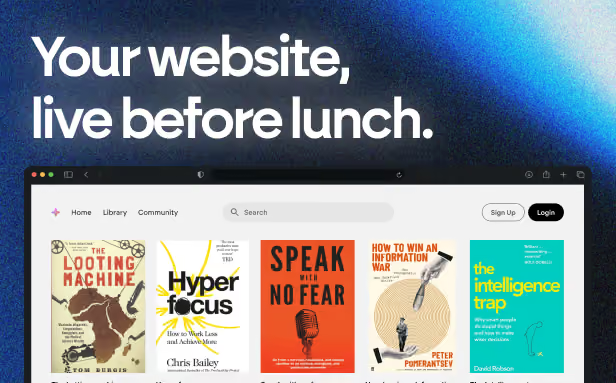
Emergent designs, writes, and publishes your whole site from one prompt. No templates, no drag-and-drop.
- Full site from one prompt
- Custom design, real pages
- Publish in minutes







