
Enterprise software teams are increasingly exploring vibe coding tools as a way to accelerate internal development without expanding engineering headcount. Traditional delivery pipelines often involve lengthy backlog prioritization, cross-team dependencies, and infrastructure provisioning cycles that slow experimentation. AI-driven creation platforms offer organizations a mechanism to rapidly prototype internal applications, automate workflows, and validate initiatives before committing to full-scale development investment.
However, enterprise adoption requires evaluation beyond surface-level productivity gains. Decision-makers must consider governance controls, integration compatibility with existing systems, scalability under organizational load, and compliance alignment across distributed teams. This guide examines six vibe coding tools positioned for enterprise environments in 2026, comparing their architectural strengths, operational limitations, and deployment suitability to support informed platform selection at scale.
What are Vibe Coding Tools?
Vibe coding tools are software development platforms that enable enterprise teams to generate applications through structured inputs, AI-assisted workflows, or visual orchestration layers rather than relying exclusively on manual code implementation. These systems translate functional intent into working software components by automating elements of interface generation, service configuration, data modeling, and deployment preparation within controlled environments.
Within enterprise contexts, these platforms are typically used to accelerate internal solution development where traditional engineering allocation may be constrained by roadmap priorities. They support use cases such as departmental tooling, workflow automation, experimentation initiatives, and rapid validation of product concepts before formal engineering investment. By reducing dependency on full pipeline provisioning during early build phases, organizations can explore initiatives without disrupting core delivery capacity.
Importantly, vibe coding tools do not replace enterprise engineering rigor. Instead, they operate as acceleration layers that coexist alongside established development practices. Their value is measured through integration compatibility, scalability boundaries, governance visibility, and operational traceability, all of which determine whether generated outputs can be safely evaluated or extended within enterprise ecosystems.
Why Vibe Coding Tools Are Replacing Traditional Development in 2026?
Enterprise software delivery models are shifting as organizations attempt to reduce backlog dependency on centralized engineering teams while maintaining momentum on internal initiatives. Traditional development pipelines introduce prioritization delays, infrastructure provisioning overhead, and cross-functional coordination costs that slow experimentation and internal solution deployment. Vibe coding tools mitigate these constraints by enabling rapid generation of functional applications within controlled environments, allowing departments to validate operational concepts without diverting core engineering capacity.
Adoption is increasingly tied to measurable efficiency gains rather than tooling trends. Enterprises leverage these platforms to compress validation timelines, assess feasibility earlier in investment cycles, and reduce opportunity costs associated with stalled initiatives. When integrated within governance and oversight frameworks, vibe coding tools extend development throughput across business units while preserving visibility into generated assets, positioning them as productivity multipliers that complement established engineering practices rather than replacing them.
Types of Vibe Coding Tools
1. AI-Driven Full-Stack Builders
These platforms generate complete applications from structured requirements, automating interface creation, backend configuration, data modeling, and deployment workflows. Enterprises use them to validate internal tools, workflow automation, and cross-functional initiatives without reallocating engineering capacity or provisioning new infrastructure environments.
2. AI-Assisted Development Environments
These tools enhance existing coding workflows with intelligent generation, debugging, and optimization capabilities while preserving architectural oversight. Organizations adopt them to improve engineering throughput, accelerate delivery timelines, and reduce repetitive implementation effort across large-scale development initiatives.
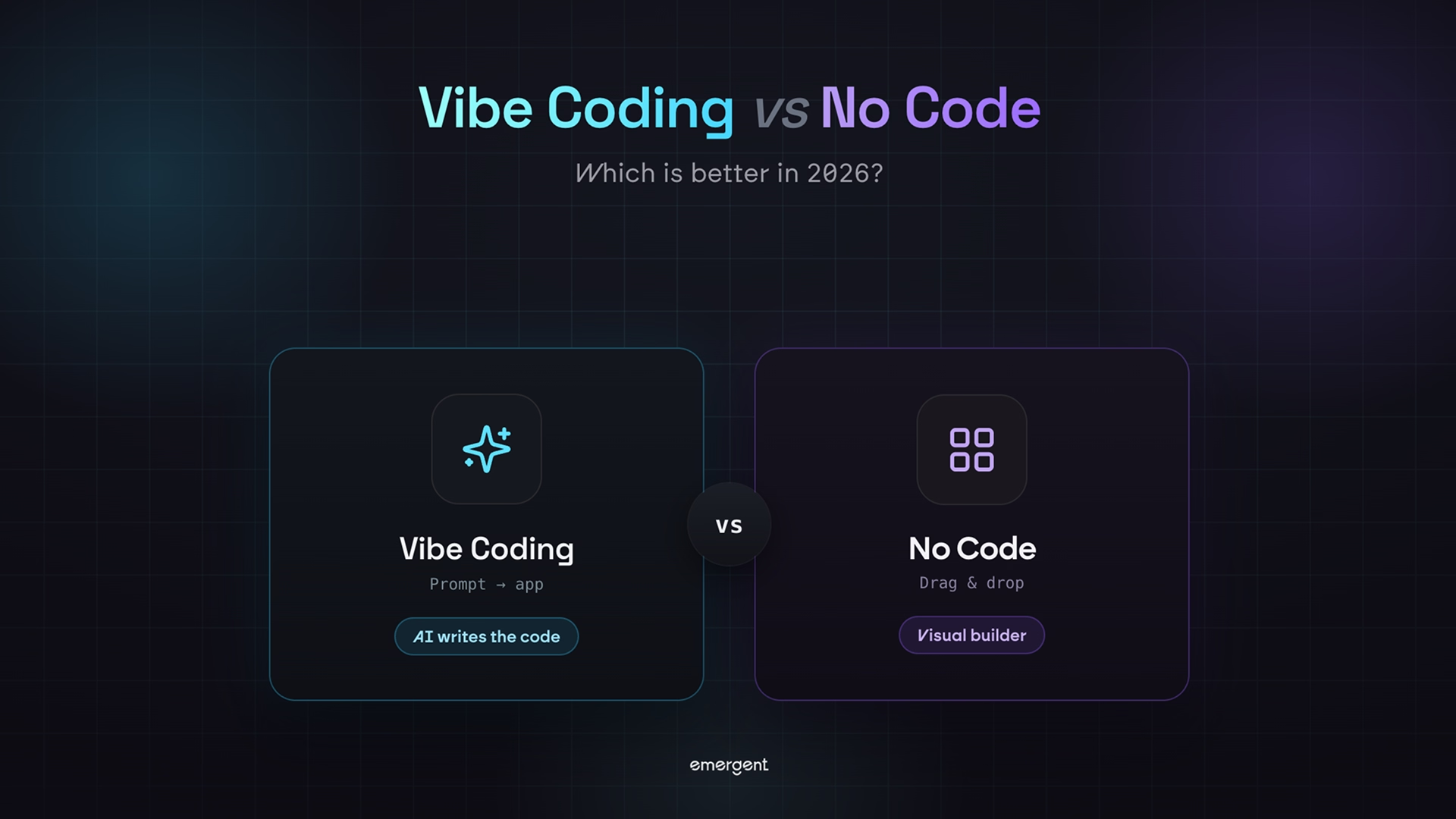
3. Drag and Drop Builders
Visual orchestration platforms allow business units to assemble functional applications through configurable components, data integrations, and workflow mapping. Enterprises typically deploy them for departmental tooling, operational dashboards, or bounded automation use cases where governance visibility and integration compatibility can be maintained.
Each category aligns with different organizational objectives and risk boundaries. Platform selection depends on how outputs integrate into existing ecosystems, whether governance and compliance requirements can be enforced, and how generated assets are managed across their lifecycle, from experimentation to sustained enterprise deployment.
How to Choose the Right Vibe Coding Tool?
1. Integration Compatibility
Enterprises should evaluate how well a platform connects with existing systems, including identity providers, data infrastructure, APIs, and internal tooling ecosystems. Seamless interoperability reduces operational friction and ensures generated applications can participate in established workflows without requiring isolated environments.
2. Governance and Visibility Controls
Decision-makers must assess whether the platform provides auditability, access management, and oversight into generated assets and usage patterns. Visibility into build activity, deployment behavior, and user interaction is critical for maintaining compliance alignment and operational accountability across distributed teams.
3. Scalability and Performance Boundaries
Platforms should be evaluated for their ability to handle organizational load, concurrent usage, and expanding functional complexity. Understanding performance thresholds and scaling behavior helps ensure tools remain viable beyond initial experimentation phases and do not introduce future migration risk.
4. Lifecycle and Deployment Management
Enterprise environments require clarity on how applications progress from generation to deployment, maintenance, and retirement. Tools that support version control alignment, structured iteration, and controlled rollout processes are better positioned for sustained organizational adoption.
5. Security and Compliance Alignment
Security posture must be assessed across authentication handling, data access boundaries, and infrastructure interaction models. Enterprises should confirm that platform capabilities align with internal compliance standards and risk management frameworks before enabling cross-departmental usage.
List of Top 6 Vibe Coding Tools for Enterprises in 2026
Enterprise adoption of vibe coding tools is being shaped by the need to accelerate internal development while maintaining alignment with architectural standards, governance requirements, and integration ecosystems. Organizations are evaluating platforms based on how effectively they enhance engineering throughput, enable cross-functional solution creation, and support validation of initiatives without introducing operational fragmentation. The following tools represent widely adopted options across enterprise environments, each positioned to address different layers of the development lifecycle.
1. Emergent
An AI-driven full-stack platform enabling enterprise teams to generate functional applications from structured requirements while reducing dependency on traditional provisioning cycles. It supports rapid validation of internal solutions and workflow automation initiatives without diverting core engineering resources.
2. Cursor
An AI-assisted development environment focused on augmenting engineering workflows with intelligent code generation and contextual editing support. It is commonly adopted by teams seeking productivity gains within established development pipelines.
3. Windsurf
A collaborative AI-enhanced coding platform designed to streamline development interaction and iteration across distributed teams. Enterprises leverage it to improve build velocity and coordination within engineering-driven initiatives.
4. GitHub Copilot
An AI pair-programming solution integrated into widely used development environments, assisting engineers in accelerating implementation tasks and reducing repetitive coding effort across large-scale codebases.
5. v0 by Vercel
A generative interface development tool enabling teams to rapidly create and iterate on frontend components aligned with modern deployment ecosystems. Enterprises typically use it for accelerating UI experimentation within web application initiatives.
6. Betty Blocks
A governance-focused low-code platform allowing organizations to build internal applications through structured visual workflows while maintaining oversight and compliance alignment across departmental deployments.
Quick Comparison of the Best Vibe Coding Tools for Enterprises
| Tool | Positioning | Ideal Enterprise Use Cases | Strengths | Limitations | Pricing Overview |
|---|---|---|---|---|---|
| Emergent | AI-native full-stack application generation platform | Internal tool creation, workflow automation, rapid initiative validation, cross-functional app deployment | Automates UI, backend, auth, and deployment workflows; reduces engineering backlog for non-critical internal initiatives | Less suited for organizations requiring code-first granular control at early experimentation stages | Free tier available, paid plans typically scale from about $20–$300+ for teams, enterprise pricing available |
| Cursor | AI-augmented development environment enhancing engineering workflows | Engineering productivity acceleration, codebase interaction, agent-assisted development within existing repositories | Deep IDE integration, scalable usage tiers, enterprise admin controls available | Usage-based scaling can introduce cost unpredictability; requires engineering-driven adoption | Free tier available; Pro about $20- $200/mo; Enterprise plans custom |
| Windsurf | AI-powered IDE and coding assistant with enterprise governance features | Distributed engineering acceleration, collaborative coding, productivity tooling across engineering teams | SSO, RBAC, analytics dashboards, scalable team support | Token/credit dependency can affect usage predictability | Free tier; Pro about $15/mo; Teams about $30/user/mo; Enterprise tiers available |
| GitHub Copilot | AI pair-programming layer embedded in established development ecosystems | Large codebase productivity gains, engineering augmentation, enterprise IDE integration | Strong ecosystem adoption, policy management, enterprise governance features | Value tied primarily to coding workflows rather than full application generation | Individual plans about $10/user/mo; Business about $39/user/mo; Enterprise tiers available |
| v0 by Vercel | Generative UI component creation integrated with modern frontend workflows | Interface prototyping, frontend experimentation, component generation | Rapid UI creation, tight ecosystem integration, token-scaled usage | Limited full-stack scope; cost tied to generation volume | Token-based billing (example about $1–$5 per 1M tokens depending on tier); Enterprise plans available |
| Betty Blocks | Enterprise-focused low-code application platform with governance alignment | Citizen development initiatives, departmental apps, workflow automation | Strong integration support, governance controls, scalable deployment models | Pricing structure typically negotiated; contract-based commitments | Custom enterprise pricing; usage-based development billing model |
Why Emergent is the Best Vibe Coding Tool for Enterprises?
1. Reduces Engineering Backlog Dependency
Emergent enables enterprise teams to generate functional internal applications from structured requirements without routing every initiative through centralized engineering pipelines. This allows departments to validate workflow automation, tooling requests, and operational concepts while preserving engineering bandwidth for roadmap-critical development.
2. End-to-End Application Generation Within a Unified Environment
Unlike tools that address isolated segments of the lifecycle, Emergent supports interface generation, backend configuration, authentication handling, and deployment preparation within a single workflow. This continuity reduces orchestration overhead and minimizes fragmentation across toolchains during early-stage initiative execution.
3. Accelerates Validation Cycles for Organizational Initiatives
Enterprises frequently evaluate process improvements or product concepts before committing budget or staffing. Emergent shortens these validation loops by enabling rapid generation and iteration of functional solutions, allowing stakeholders to assess feasibility and alignment prior to formal investment decisions.
4. Supports Cross-Functional Solution Development
Because application creation does not require deep infrastructure provisioning, teams outside core engineering can collaborate in structured solution exploration while maintaining oversight. This expands organizational development throughput without introducing uncontrolled tooling sprawl or shadow IT proliferation.
5. Scales From Experimentation to Sustained Deployment Paths
Emergent supports progression beyond exploratory builds, allowing validated initiatives to evolve without forced platform migration. This continuity helps organizations avoid fragmentation between prototyping environments and production-bound workflows, reducing transition friction and preserving institutional context.
Conclusion
Vibe coding tools are becoming a strategic layer in enterprise development stacks, not as replacements for traditional engineering, but as accelerators for internal innovation, workflow automation, and initiative validation. By reducing dependency on centralized engineering pipelines during early-stage exploration, these platforms allow organizations to move faster while preserving core delivery focus.
For enterprises, the value of vibe coding lies in controlled speed. Platforms that integrate cleanly with existing systems, support governance and visibility, and scale beyond experimentation offer the strongest long-term leverage. As adoption increases in 2026, enterprises that treat vibe coding as a structured capability rather than an ad hoc toolset will gain meaningful advantages in execution velocity and operational efficiency.

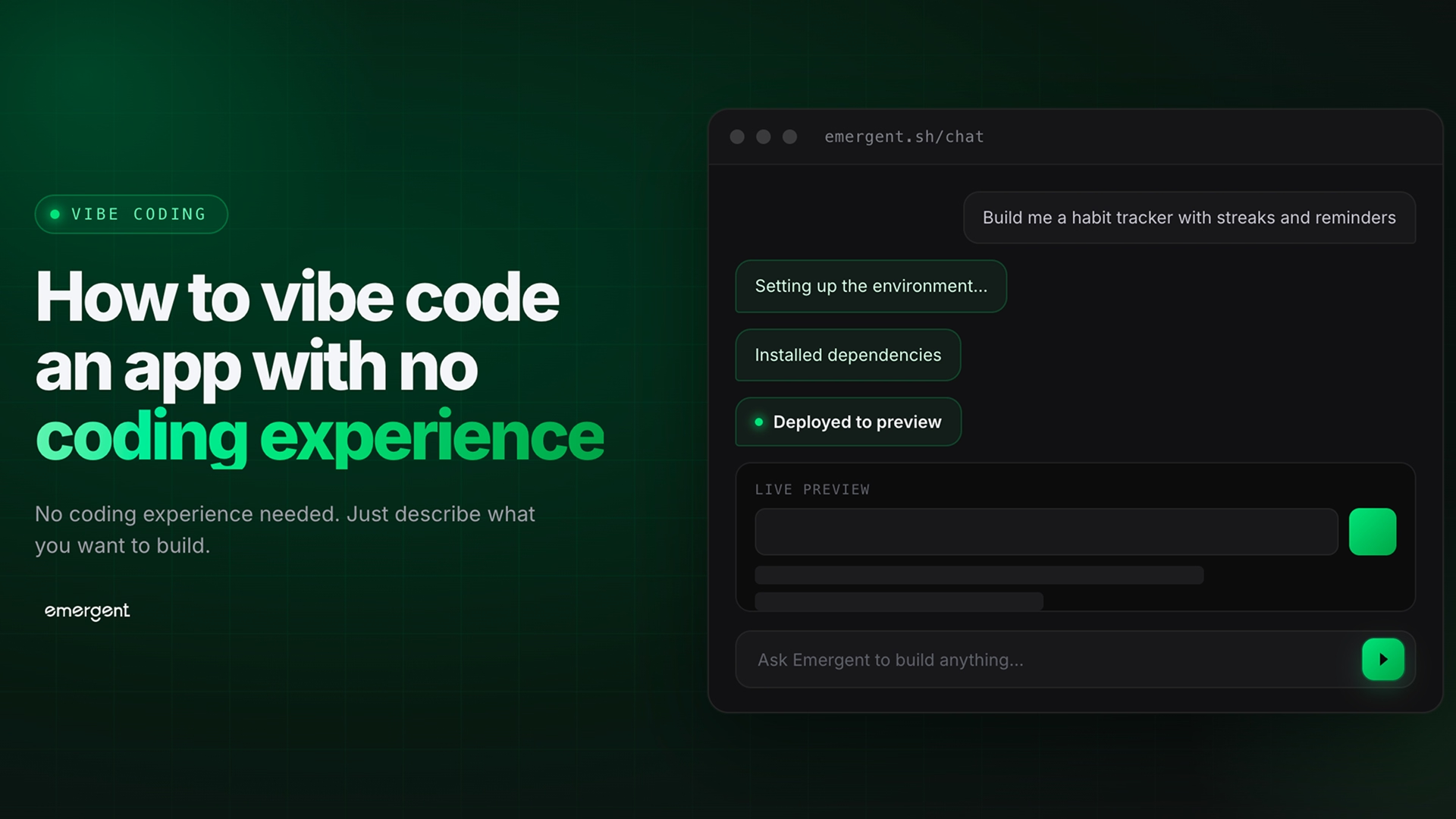
Describe what you want and Emergent builds it. A real, production-ready app you can launch the same day.
- One prompt to build
- Zero code required
- Deploy in minutes