
In 2026, an Accounting Today research highlights that accounting firms’ digital presence, including professional websites, online information, and digital engagement, plays a critical role in how clients perceive credibility and evaluate firms before initiating contact, reflecting broader trends in professional services toward digital trust and online decision behavior. For accountants, whether independent, part of a firm, or offering advisory services, a website is both a credibility signal and a client acquisition engine in a field where trust and clarity matter deeply.
A strong accounting website must clearly communicate services, expertise, compliance posture, and contact pathways while managing practical workflows such as secure messaging, client portals, booking, and resource delivery. The wrong website builder can impose structural limitations, induce unnecessary technical debt, or create security risks. The right one, especially with the emergence of AI website builders that simplify design and structure, aligns client experience with professional standards and operational needs.
What is a website builder for accountants?
A website builder for accountants is a platform that enables accounting professionals, bookkeepers, CPA firms, and financial advisors to create, manage, and evolve websites without relying on extensive technical support. These builders prioritize professional presentation, clear service hierarchies, secure interactions, and integration capabilities that align with accounting workflows such as contact forms, document delivery systems, and business growth tools.
Unlike generic website tools that focus primarily on visual templates, the best accounting website builders support structured content, credibility signals, compliance readiness, and extensibility with booking, client intake, and CRM systems. Whether the goal is a polished informational presence or a client-acquisition system, the builder must reduce friction rather than introduce it.
Accountants: These 5 Website Builders Are Worth Using in 2026
Planning an Accounting Website This Year? These 5 Builders Make It Easy in 2026
- Emergent
- CPA Site Solutions
- Wix
- Webflow
- WordPress
Suggested Read: Best AI Website Builder
What are the key features of website builders for accountants?
1. Professional service page structuring for financial offerings
Accountants must present a range of services clearly, tax preparation, audit support, advisory, bookkeeping, and compliance guidance. A strong website builder enables structured content hierarchies that break down services logically and accessibly so prospects can understand offerings without confusion or overload.
2. Secure client interaction tools such as forms and gated resources
Many accounting engagements require secure document exchange, confidential inquiries, or quote requests. Website builders should support secure forms, document upload interfaces, and gated resources without resorting to brittle plugins or third-party hacks that risk data leakage or compliance issues.
3. Integration readiness with client management and calendaring systems
Accountant websites often need to integrate with scheduling tools, CRM systems, email automation, and practice management software. The best builders provide extensible integration options, whether through native connections or robust APIs, so the website becomes a smooth part of the operational stack rather than a silo.
4. Professional design controls that reinforce trust and credibility
Design matters for accountants because aesthetic cues influence perceptions of reliability, precision, and professionalism. Website builders should offer controls that support clean layouts, readable typography, accessible navigation, and brand alignment without forcing cookie-cutter templates that make different firms look the same.
5. Mobile responsiveness and accessibility compliance
Clients frequently search for financial services on mobile devices, and accessibility requirements are increasingly important for professional services. Website builders must produce responsive sites that function consistently across devices and conform to accessibility standards so all users, including those with disabilities, can interact effectively.
What are the benefits of using website builders for accountants?
1. Faster professional online presence with minimal technical overhead
Accountants can launch a credible and dependable website without deep technical expertise or extended development cycles. This speed enables firms to focus on client services rather than backend infrastructure, helping them compete effectively in a digital-first market.
2. Better client education and conversion through structured content
A well-built website helps prospective clients understand complex accounting services and pricing, which reduces repetitive inquiries and accelerates onboarding. Clear, organized content positions accountants as experts and reduces friction in the decision-making process.
3. Reduced dependency on external developers for updates and changes
With a capable website builder, accountants and their teams can update service pages, blog posts, and client resources independently. This autonomy reduces ongoing maintenance costs and turnaround times for critical updates, such as regulatory changes or new service offerings.
4. Integration with tools that support operational workflows
Website builders that integrate cleanly with scheduling, CRM, and practice management systems allow accountants to centralize client interactions. This improves lead tracking, appointment setting, and follow-up workflows while preserving a smooth client experience.
5. Scalability as practices grow and service offerings expand
As accounting practices evolve, adding new services, markets, or locations, a scalable website allows content and functionality to grow without disruptive replatforming. This reduces long-term technical debt and preserves continuity in client experience.
5 Best Website Builders for Accountants
Website builders for accountants serve a spectrum of needs, from simple informational sites to client acquisition systems that integrate with operational tools. Some emphasize ease of use while others offer design precision or extensibility for growth workflows. The platforms below stand out in 2026 because they align with real accounting workflows and support professional credibility without unnecessary complexity.
1. Emergent
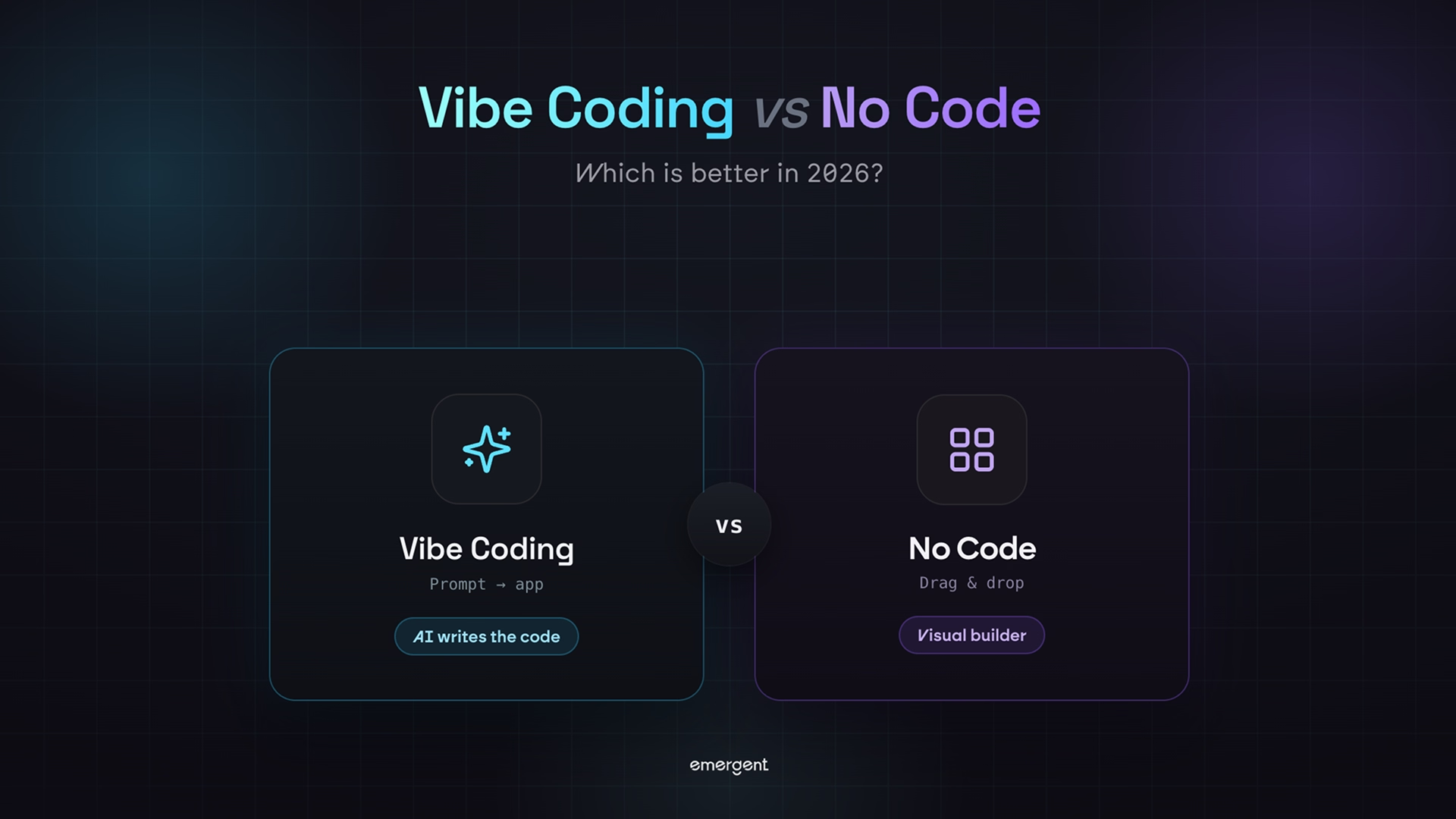
Emergent is one of the best, full-stack, AI-powered vibe coding and no code platforms for accountants who want their website to function as a client acquisition and operations-ready system, not just a digital brochure. In 2026, accounting firms, CPAs, and advisory practices use Emergent to build websites that combine service clarity, secure interactions, structured content, and future-ready workflows into a single production-grade foundation.
For accountants, the website is often the first trust checkpoint before a client shares sensitive financial information. Emergent reframes the accounting website as a controlled, extensible system that supports credibility, secure communication, and long-term growth without relying on fragile plugins or template limitations.
Key Features of Emergent for Accounting Websites
1. Full-stack accounting website generation from natural language prompts
Emergent allows accountants to describe their website requirements, such as service pages for tax, audit, and advisory work, contact and intake flows, gated resources, and firm information, in plain language. The platform generates the complete system including frontend UI, backend logic, data models, authentication, and hosting. This removes the need to stitch together CMS tools, form plugins, and security add-ons that often create risk in professional services sites.
2. Structured service hierarchies for accounting offerings
Accounting firms typically offer multiple services with different buyer intents and compliance considerations. Emergent enables explicit structuring of services, sub-services, industries served, and engagement types rather than forcing everything into flat pages. This clarity helps prospects understand offerings quickly while reinforcing professional depth and specialization.
3. Secure forms and controlled client inquiry workflows
Emergent supports secure form handling and controlled data flows by design, which is critical when collecting client inquiries that may reference sensitive financial information. Forms can be configured with logic for routing, gating, or follow-up actions. This reduces the risk associated with generic form builders and improves operational discipline.
4. Native authentication for client-only resources and portals
Emergent includes built-in authentication and role-based access control, allowing accountants to create client-only areas for resources, updates, or future portals. This capability supports evolution into document sharing or advisory dashboards without replatforming. Access control reinforces trust and professionalism.
5. Integration readiness with accounting and CRM systems
Emergent-generated websites are designed to integrate cleanly with CRM tools, scheduling platforms, analytics systems, and internal software. This allows the website to act as an entry point into the firm’s operational stack rather than a disconnected marketing surface. Integration readiness becomes more important as practices scale.
6. One-click deployment with secure, reliable hosting
Once generated, accounting websites can be deployed instantly with hosting, performance optimization, and security handled automatically. Firms do not manage servers or updates. Reliability and uptime are critical for professional credibility and client trust.
Unique Features of Emergent for Accounting Websites
1. Vibe coding for accounting-specific workflows
Emergent’s vibe coding approach allows accountants to describe workflows such as consultation requests, service qualification, or gated content access conversationally. The platform translates intent directly into working logic. This removes the gap between business requirements and technical implementation.
2. No template ceiling for professional differentiation
Unlike accounting-specific template builders, Emergent does not impose rigid layouts or visual constraints. Firms can design sites that reflect their positioning, whether conservative, modern, or advisory-led. This flexibility supports differentiation without sacrificing professionalism.
3. Unified platform replacing plugin-heavy accounting stacks
Emergent consolidates CMS, backend logic, authentication, integrations, and hosting into a single system. Accounting firms avoid managing multiple vendors and plugins that increase maintenance and security risk. Operational simplicity improves long-term stability.
4. Production-grade architecture suitable for regulated environments
Websites generated by Emergent are built as production systems with clean architecture and scalability in mind. This foundation aligns well with regulated professional environments where reliability, governance, and auditability matter. Few website builders prioritize this level of robustness.
5. Ability to evolve into advisory and client engagement platforms
Emergent allows accounting websites to evolve into client engagement hubs over time, supporting portals, resources, or dashboards without rebuilding. This future-readiness is important as firms move toward advisory and value-added services. The website grows with the practice.
6. Equally suitable for solo CPAs and large firms
Whether building a solo practitioner site or a multi-partner firm presence, Emergent supports depth and scale without changing platforms. Content, logic, and access can be adjusted as teams grow. This versatility is rare among accounting website tools.
Advantages of Emergent for Accounting Websites
- Enables accountants to build secure, structured, and scalable websites without relying on fragile plugins.
- Supports clear presentation of complex accounting services and specializations.
- Reduces compliance and security risk through unified architecture and controlled data handling.
- Scales from simple informational sites to client engagement systems on the same foundation.
- Integrates cleanly with CRM, scheduling, and operational tools.
- Aligns website execution directly with professional standards and firm growth.
Limitations of Emergent for Accounting Websites
- May be more powerful than required for firms seeking only a basic one-page site.
- Requires thoughtful definition of services and workflows to unlock full value.
- Not positioned as a drag-and-drop template tool for instant launches.
Pricing and Plans of Emergent
| Plan | Pricing | Key Highlights |
|---|---|---|
| Free | $0/month |
|
| Standard | $20/month |
|
| Pro | $200/month |
|
| Team | $300/month |
|
| Enterprise | Custom |
|
Read More About: Emergent Pricing and Plans
2. CPA Site Solutions
CPA Site Solutions is a niche website platform built specifically for accounting professionals, CPAs, and tax firms that want an industry-aligned website without assembling a custom stack. In 2026, it is widely used by small to mid-sized accounting practices that value compliance awareness, accounting-specific content, and turnkey setup over customization flexibility.
For accountants, CPA Site Solutions functions as a specialized, opinionated platform. It prioritizes regulatory alignment, tax-focused content, and practice management conveniences, but it trades off design freedom, deep integrations, and long-term extensibility in favor of predictability and ease.
Key Features of CPA Site Solutions for Accounting Websites
1. Accounting-specific templates aligned with CPA standards
CPA Site Solutions provides templates designed explicitly for accounting firms, tax professionals, and CPAs, with layouts that emphasize services, credentials, compliance disclosures, and trust signals. These templates reduce the risk of unprofessional presentation and help firms meet industry expectations quickly. However, the predefined structures limit differentiation for firms with unique positioning.
2. Built-in tax and accounting content libraries
The platform includes prewritten articles, tax updates, newsletters, and financial resources that firms can publish directly on their site. This content helps firms appear current and informative without producing everything internally. The downside is that many firms publish similar content, which can reduce SEO differentiation.
3. Secure client portals and document exchange options
CPA Site Solutions supports client portals for document sharing, tax organizers, and secure communication. This capability aligns well with accounting workflows where confidentiality is critical. Portal functionality is practical but not deeply customizable.
4. Integrated compliance and disclosure features
Accounting websites often require specific disclosures and regulatory notices. CPA Site Solutions includes features that help firms maintain compliance visibility. This reduces oversight risk but also reinforces a conservative, standardized site structure.
5. Practice management and newsletter tools
The platform integrates newsletters, email communication, and basic practice management features tailored to accounting firms. These tools support client retention and engagement. Integration depth remains shallow compared to dedicated CRM systems.
6. Hosting and maintenance managed for accounting firms
CPA Site Solutions handles hosting, updates, and maintenance internally. Firms avoid infrastructure management. This convenience is attractive for practices without IT resources.
Unique Features of CPA Site Solutions for Accounting Websites
1. Purpose-built exclusively for accountants and CPAs
Unlike general website builders, CPA Site Solutions is designed solely around accounting workflows and expectations. This specialization reduces setup friction. However, it limits applicability outside traditional accounting models.
2. Prepackaged compliance-friendly structure
The platform’s structure reflects conservative accounting standards and regulatory awareness. Firms reduce risk of misrepresentation. Creative or advisory-led firms may find this restrictive.
3. Turnkey content for ongoing client communication
Ready-made tax and accounting content helps firms communicate regularly with clients. This supports engagement without additional content teams. Original thought leadership becomes harder to showcase.
4. Client portal integration without third-party tools
Secure portals are built into the platform rather than added via plugins. This reduces integration complexity. Custom workflows or UI adjustments are limited.
5. Familiar experience for traditional accounting firms
Many firms already recognize and trust CPA Site Solutions. Adoption friction is low. This familiarity supports conservative firms resistant to experimentation.
6. Predictable, low-variation platform behavior
CPA Site Solutions changes slowly and prioritizes stability. Firms experience fewer breaking changes. Innovation pace is slower than modern builders.
Advantages of CPA Site Solutions for Accounting Websites
- Built specifically for CPAs and accounting firms.
- Includes ready-made accounting and tax content.
- Integrated client portals support secure document exchange.
- Compliance-aware structure reduces oversight risk.
- Low technical overhead for firms without IT teams.
- Stable, predictable platform behavior.
Limitations of CPA Site Solutions for Accounting Websites
- Limited design customization and differentiation.
- Shared content reduces SEO uniqueness.
- Shallow integration with modern CRM or analytics tools.
- Not suitable for advisory-led or tech-forward firms.
- Platform evolution is slow.
- Difficult to extend beyond traditional accounting use cases.
Pricing and Plans of CPA Site Solutions
| Plan | Pricing | Key Highlights |
|---|---|---|
| Silver | $85/month |
|
| Gold | $106/month |
|
| Platinum | $132/month |
|
| Diamond | $161.50/month |
|
3. Wix
Wix is a general-purpose website builder that many accountants use when they want a clean, professional online presence without dealing with technical complexity. In 2026, Wix is commonly adopted by solo CPAs, small accounting firms, bookkeeping practices, and advisory professionals who prioritize speed, ease of use, and visual clarity over deep system integration or compliance-heavy workflows.
For accountants, Wix functions best as a marketing and lead-intake website rather than an operational or client-portal system. It helps firms present services, build trust, and capture inquiries efficiently, but it introduces clear ceilings when practices require secure document workflows, structured client portals, or advanced integrations.
Key Features of Wix for Accounting Websites
1. Accounting-friendly templates for rapid professional setup
Wix offers templates suitable for accountants, tax consultants, and professional services firms that emphasize service clarity, credentials, testimonials, and contact paths. These templates allow firms to launch quickly with a credible structure that aligns with client expectations. However, template-driven layouts limit how deeply firms can customize service hierarchies or advisory positioning over time.
2. Visual drag-and-drop editor for non-technical accounting teams
Accountants can update service descriptions, bios, announcements, and pricing information using Wix’s visual editor without coding knowledge. This independence reduces reliance on external developers for routine changes. The tradeoff is limited control over underlying structure and logic as complexity grows.
3. Built-in forms for client inquiries and consultations
Wix includes native contact and inquiry forms that firms use for consultation requests, onboarding questions, and general communication. These forms are easy to configure and manage. They are not designed for collecting sensitive financial documents or supporting structured intake workflows securely.
4. Appointment scheduling for consultations and reviews
Accounting firms can use Wix’s scheduling tools to allow prospects to book consultations or review meetings. This supports lead conversion and reduces manual coordination. Scheduling logic remains basic and does not integrate deeply with accounting practice management software.
5. Content publishing tools for tax updates and insights
Wix supports blogs and content pages that accountants use to publish tax updates, regulatory insights, and educational resources. This helps firms demonstrate expertise and improve SEO visibility. Content modeling remains shallow compared to professional publishing platforms.
6. Managed hosting and platform maintenance
Wix handles hosting, SSL, updates, and security patches automatically. Accounting firms avoid infrastructure responsibilities. This convenience is attractive for small practices but limits control over security posture.
Unique Features of Wix for Accounting Websites
1. Wix ADI for fast accountant website generation
Wix ADI can generate an accounting website automatically based on a few inputs about services and location. This allows solo practitioners to get online extremely quickly. Customization depth remains limited after generation.
2. App marketplace for extending basic accounting workflows
Wix offers apps for chat, CRM connectors, analytics, and email marketing that accounting firms can add incrementally. This supports gradual capability expansion. App dependency can increase operational and compliance complexity.
3. Multilingual support for diverse client bases
Firms serving multilingual clients can publish content in multiple languages using Wix. This is useful for local practices in diverse regions. Localization features are basic but accessible.
4. Built-in SEO guidance for local accounting discovery
Wix includes SEO tools that help firms optimize pages for local search terms such as city-based accounting services. This supports client acquisition in local markets. Advanced SEO customization is limited.
5. Cost accessibility for small and solo firms
Wix pricing is affordable for small practices and independent accountants. This lowers barriers to entry for digital presence. Cost efficiency matters for early-stage or solo professionals.
6. Polished visual output without design expertise
Wix sites generally look professional without requiring design skills. This helps firms establish credibility quickly. Visual polish compensates for limited structural depth.
Advantages of Wix for Accounting Websites
- Easy to use for non-technical accountants and staff.
- Fast setup with professional-looking templates.
- Built-in tools support basic lead capture and scheduling.
- Affordable for solo and small accounting practices.
- Managed hosting reduces technical overhead.
- Suitable for marketing-focused accounting websites.
Limitations of Wix for Accounting Websites
- Not designed for secure document exchange or client portals.
- Limited compliance and data-handling controls.
- App-based extensions introduce security and maintenance risks.
- Difficult to scale into advisory or client engagement platforms.
- Structural limitations for complex service offerings.
- Often requires replatforming as firms grow.
Pricing and Plans of Wix
| Plan | Pricing | Key Highlights |
|---|---|---|
| Free | $0 | For trying Wix and basic experimentation |
| Light | $17 per month | Ideal for portfolios and personal sites |
| Core | $29 per month | Designed for small online stores and growing businesses |
| Business | $36 per month | Suited for established businesses needing more capabilities |
| Business Elite | $159 per month | Built for large businesses with advanced requirements |
| Enterprise | Custom pricing | Tailored for global brands with high-scale, industry-level needs |
4. Webflow
Webflow is a design-first website builder increasingly used by accounting firms that want a highly differentiated, modern web presence without committing to a fully custom engineering build. In 2026, Webflow is most commonly adopted by boutique accounting firms, advisory-led practices, and modern CPA brands that position themselves as strategic partners rather than traditional compliance-only providers.
For accountants, Webflow functions as a powerful front-end platform rather than a complete operational system. It excels at visual precision, structured content, and brand storytelling, but it does not natively handle secure client portals, document exchange, or regulated workflows without external systems.
Key Features of Webflow for Accounting Websites
1. Pixel-level design control for professional differentiation
Webflow allows accounting firms to control layout, typography, spacing, and interactions with near-code-level precision. This enables firms to present a polished, modern image that differentiates them from template-based competitors. For advisory-led practices, visual differentiation directly influences perceived sophistication and trust.
2. CMS collections for structured accounting content
Webflow’s CMS enables firms to model services, industries served, team members, resources, and insights as structured content types. This supports scalability as firms expand offerings or publish educational material. Structured CMS usage improves clarity and long-term maintainability.
3. Clean, performant frontend output
Webflow generates clean HTML, CSS, and JavaScript, resulting in fast-loading pages and strong SEO performance. Accounting websites benefit from technical credibility and responsiveness. Performance reliability supports client trust during high-intent visits.
4. Advanced interactions for explaining complex services
Webflow supports animations and interactions that help explain advisory services, workflows, or value propositions visually. Firms can simplify complex financial concepts through design rather than dense text. This enhances user understanding and engagement.
5. Collaboration workflows for designers and content teams
Webflow allows designers to control layout while content editors manage copy independently. This separation prevents accidental design breakage. It supports efficient collaboration within growing firms.
6. Managed hosting with strong uptime and security
Webflow includes hosting, SSL, and infrastructure management. Accounting firms avoid server maintenance. Security controls are solid for marketing sites but not sufficient for sensitive client data handling.
Unique Features of Webflow for Accounting Websites
1. Design-first approach aligned with advisory branding
Webflow is well-suited for firms positioning themselves as modern advisors rather than traditional accountants. Its design flexibility supports strategic branding. Few builders offer comparable visual control without custom development.
2. Component-based consistency across pages
Reusable components ensure consistent presentation of services, CTAs, and layouts. This helps maintain brand coherence as sites grow. Consistency reinforces professionalism.
3. SEO control at a granular level
Webflow provides control over URLs, metadata, schema, and site structure. Accounting firms benefit from improved local and niche SEO performance. This matters in competitive service markets.
4. Easy handoff to developers if needed
Webflow sites can be extended or integrated with external systems by developers later. This provides a future upgrade path. However, integration still requires engineering effort.
5. Strong fit for content-driven accounting strategies
Firms that invest in education, insights, and thought leadership benefit from Webflow’s CMS and design capabilities. Content becomes a strategic asset. This aligns well with advisory growth models.
6. Modern aesthetic that signals professionalism
Webflow websites often signal intentionality and quality. For prospective clients comparing firms, visual maturity influences trust. A modern aesthetic supports premium positioning.
Advantages of Webflow for Accounting Websites
- Excellent design control for differentiation and branding.
- Strong CMS capabilities for scalable service and content pages.
- Clean, fast frontend performance improves credibility.
- Good SEO tooling for competitive local and niche markets.
- Supports advisory-led and modern firm positioning.
- Managed hosting reduces infrastructure burden.
Limitations of Webflow for Accounting Websites
- No native support for secure client portals or document exchange.
- Integrations with accounting systems require custom work.
- Not suitable for regulated data handling without external tools.
- Requires design expertise to use effectively.
- Higher cost compared to basic builders.
- Functions best as a frontend layer only.
Pricing and Plans of Webflow
| Plan | Pricing | Key Highlights |
|---|---|---|
| Starter | Free |
|
| Basic | $18/month |
|
| CMS | $29/month |
|
| Business | $49/month |
|
5. WordPress
WordPress is the most flexible and widely adopted website platform used by accounting firms across the spectrum, from solo CPAs to multi-location advisory practices. In 2026, WordPress remains a dominant choice for accountants who want full control over content, structure, integrations, and long-term scalability, provided they are willing to manage or outsource technical complexity.
For accountants, WordPress functions as a foundational framework rather than a turnkey builder. Its strength lies in extensibility through themes, plugins, and custom development, which allows firms to tailor websites to specific service models, compliance needs, and client engagement workflows over time.
Key Features of WordPress for Accounting Websites
1. Custom content structures for accounting services and expertise
WordPress allows firms to define custom post types for services, industries served, team members, resources, and insights. This enables clear separation between tax, audit, advisory, and bookkeeping offerings rather than forcing everything into generic pages. Structured content improves clarity for prospects and supports scalable growth.
2. Extensive plugin ecosystem for accounting functionality
WordPress offers plugins for appointment scheduling, secure forms, client portals, document management, analytics, and CRM integration. Firms can assemble functionality to match their workflows. This flexibility is powerful but requires careful plugin selection to avoid conflicts or security risks.
3. Full control over hosting, security, and data governance
Unlike hosted builders, WordPress allows accountants to choose their own hosting environment, security stack, and backup strategy. This control is valuable for firms with specific compliance or governance expectations. Responsibility for configuration and maintenance rests with the firm or its vendors.
4. Strong publishing tools for tax updates and thought leadership
WordPress excels at content publishing, making it ideal for blogs, regulatory updates, guides, and long-form educational resources. Accounting firms can build authority through consistent insights. Content depth and organization support SEO and client trust.
5. Developer-friendly architecture for custom integrations
Accounting firms with access to developers can extend WordPress using custom code and APIs. This enables integration with practice management systems, CRMs, analytics platforms, and internal tools. Flexibility increases as technical investment increases.
6. Scalable foundation for growing accounting practices
With proper architecture and hosting, WordPress can scale to support high traffic, multi-site setups, and complex content structures. Many large professional services firms rely on WordPress for this reason. Scalability depends on implementation quality rather than the core platform.
Unique Features of WordPress for Accounting Websites
1. Open-source ownership with no vendor lock-in
WordPress is open source, giving accounting firms full ownership of their website and data. This reduces dependency on a single vendor. Long-term control is particularly important for professional services firms.
2. Multi-site capability for multi-location firms
WordPress supports multi-site configurations that allow firms to manage multiple offices or brands from a single installation. This is useful for regional or national accounting practices. Centralized management improves consistency and governance.
3. Ability to meet compliance needs with proper setup
With appropriate hosting, security plugins, and development practices, WordPress can be configured to meet professional and regulatory expectations. Compliance depends on execution rather than defaults. This makes WordPress viable for firms willing to invest correctly.
4. Vast ecosystem of themes and developers
Because WordPress is so widely used, firms can find designers, developers, and agencies easily. Talent availability reduces adoption risk. Long-term maintenance and evolution are easier to staff.
5. Flexibility to support both conservative and modern branding
WordPress does not impose a visual identity. Firms can choose conservative, traditional designs or modern advisory-led aesthetics. Branding flexibility supports different positioning strategies.
6. Long-term platform maturity and stability
WordPress has a long history and continues to evolve. Accounting firms benefit from platform longevity and a predictable upgrade path. Stability matters for long-term professional websites.
Advantages of WordPress for Accounting Websites
- Extremely flexible and customizable for diverse accounting needs.
- Large ecosystem supports nearly any required feature.
- Full control over data, hosting, and security decisions.
- Excellent for content-heavy tax and advisory strategies.
- Scales to large, multi-location firms with proper setup.
- No vendor lock-in due to open-source nature.
Limitations of WordPress for Accounting Websites
- Requires technical expertise or agency support to manage securely.
- Plugin-heavy setups can introduce maintenance and security risk.
- Ongoing updates and monitoring are the firm’s responsibility.
- Not a plug-and-play solution for non-technical teams.
- Costs can grow as complexity increases.
- Quality varies significantly based on implementation discipline.
Pricing and Plans of WordPress
| Plan / Setup Type | Pricing | Key Highlights |
|---|---|---|
| Self-Hosted WordPress (Basic) | ~$10–$50/month |
|
| Self-Hosted WordPress (Business) | ~$50–$200+/month |
|
| Self-Hosted WordPress (High-Traffic) | ~$200–$400+/month |
|
| WordPress.com (Hosted) | Free to $45+/month |
|
How to choose the best website builder for accountants?
1. Prioritize trust, structure, and compliance readiness
Accounting websites are evaluated differently from generic business sites because visitors are deciding whether to trust a firm with sensitive financial information. The builder should support clear service hierarchies, professional presentation, and secure interaction patterns rather than flashy layouts. Even if compliance is not immediately enforced on the website, structural readiness matters for long-term credibility.
2. Evaluate how client inquiries and data are handled
Most accounting websites collect consultation requests, financial context, or documents at some stage. Builders that rely on generic forms or third-party plugins introduce unnecessary risk. A strong choice supports controlled data flows, secure handling, and the ability to evolve into gated or authenticated experiences if required.
3. Match the platform to your firm’s growth direction
A solo CPA, a traditional compliance-focused firm, and an advisory-led practice have very different digital needs. Builders optimized for static marketing sites often become blockers as firms add advisory services, resources, or client engagement workflows. Choosing a platform aligned with where the firm is going avoids costly replatforming.
4. Balance ease of use with long-term control
Ease of editing is important, but it should not come at the expense of structural control. Accounting firms should assess whether non-technical updates can be made without locking the firm into rigid templates. Sustainable platforms allow both autonomy and depth.
5. Think beyond pages and toward systems
The most effective accounting websites function as systems that guide prospects, qualify inquiries, and support engagement over time. Builders that only manage pages eventually limit operational growth. System-level thinking is increasingly important as firms modernize.
Why is Emergent the best website builder for accountants?
1. Built for accountants who need more than a brochure website
Emergent treats accounting websites as operational assets rather than static marketing pages. Firms can model services, inquiry flows, gated resources, and future client areas natively. This approach aligns with how modern accounting practices operate and grow.
2. Reduces compliance and security risk through unified architecture
Traditional accounting websites often rely on multiple plugins for forms, security, and integrations, increasing exposure. Emergent consolidates frontend, backend logic, authentication, and hosting into a single system. Fewer moving parts mean lower operational and compliance risk.
3. Supports advisory-led and modern accounting practices
As firms move beyond compliance into advisory and value-added services, their websites must evolve accordingly. Emergent allows structured content, workflows, and access control to expand without rebuilding. This future-readiness is critical for competitive firms.
4. Enables secure evolution into client engagement platforms
Emergent includes native authentication and role-based access, allowing firms to introduce client-only resources or portals when ready. This evolution happens on the same foundation. Firms avoid disruptive migrations that can erode client trust.
5. Aligns digital execution with professional standards
Emergent emphasizes clarity, structure, and reliability over templates or gimmicks. The resulting websites reflect the precision and discipline expected from accounting professionals. This alignment strengthens credibility with prospects and clients alike.
Conclusion
Website builders for accountants range from niche, compliance-oriented platforms to highly flexible general-purpose tools. CPA Site Solutions, Wix, Webflow, and WordPress each serve specific firm types and priorities, but most impose ceilings around security, structure, or long-term evolution.
For accounting firms that want a website capable of supporting growth, advisory services, and secure client interaction without accumulating technical debt, Emergent stands out in 2026. Its system-first approach, unified architecture, and scalability make it the strongest choice for serious accounting professionals.
Emergent designs, writes, and publishes your whole site from one prompt. No templates, no drag-and-drop.
- Full site from one prompt
- Custom design, real pages
- Publish in minutes