




Industry data shows that subscription landing pages (a core part of a company’s website) convert visitors at measurable rates, with average landing page conversion around 5.8 % and that a large majority (69%) of subscription businesses reported positive revenue growth, underscoring the importance of effective online acquisition and conversion strategies for recurring revenue success. As subscription services continue to scale across coaching, digital products, curated boxes, memberships, and specialized info services, a professional, high-trust website is essential not just for presentation but for conversion, engagement, and lifecycle management. A modern website builder can help subscription businesses launch and optimize these sites with minimal technical overhead.
For creators and businesses offering subscription services, a website must communicate value clearly, manage recurring payments or gated access, support member onboarding, and provide ongoing content or product delivery. The best website builders for subscription services in 2026 are those that combine content depth, conversion-ready structures, payment handling, recurring billing support, and audience engagement tools without requiring deep technical infrastructure.
What is a website builder for subscription services?
A website builder for subscription services is a platform that enables solopreneurs, startups, and enterprises to create a professional subscription-ready website without custom coding. Unlike generic business sites, subscription service websites must integrate with recurring billing systems, member authentication, gated content or product delivery, onboarding flows, and renewal reminders. They must also support clear messaging, pricing tables, and value articulation that reduces visitor hesitation and improves lifetime value.
In 2026, strong subscription website builders support customizable member areas, flexible pricing and plan structures, integrated payment gateways, email or automation workflows, SEO-friendly marketing pages, and responsive design so that subscribers can join, engage, and renew regardless of device. The goal is to create a digital environment where trust, clarity, and frictionless conversion drive long-term engagement.
Running a Subscription Business? These 5 Website Builders Actually Work
From Sign-Ups to Renewals: The 5 Best Website Builders for Subscription Services in 2026
Suggested Read: Best AI Website Builder
What are the key features of website builders for subscription services?
1. Native support for recurring payments and billing workflows
Subscription services revolve around recurring revenue. The right website builder must support integrated payment processing with recurring billing logic, plan upgrades or downgrades, trial periods, and secure handling of payment methods. This ensures subscribers can join and renew seamlessly while providing the business with reliable revenue capture.
2. Member area or gated content access controls
Subscription services often hide premium content, tools, courses, or downloads behind authentication barriers. A strong builder allows hosts to define who gets access to which resources, and to update access instantly as memberships change, which supports content gating without technical friction.
3. Customizable pricing plans with clear differentiation
Different subscribers choose different levels of value. Website builders should allow multiple pricing tiers, feature comparisons, and plan explanations so prospects can easily compare and select the option that aligns with their needs and budget.
4. Audience engagement and communication workflows
Subscription services benefit greatly from ongoing engagement. Builders should include or integrate with email workflows, notifications, drip content, or onboarding sequences so that new subscribers receive value immediately and remain engaged over time.
5. SEO and marketing tools to attract organic traffic
Most subscription businesses rely on organic search to attract new members over time. Website builders need to provide SEO basics such as customizable meta tags, readable URLs, content structures, and blogging tools so that subscription offerings show up in relevant search results.
6. Responsive and conversion-optimized page elements
Subscription landing pages and pricing tables must convert well across devices. The best builders offer responsive layouts, clear calls to action, visual hierarchy for pricing and benefits, and analytics integration to help hosts understand what drives conversions.
What are the benefits of using website builders for subscription services?
1. Converts visitors into long-term members more effectively
By combining structured messaging, clear pricing, and frictionless sign-up flows, subscription-ready website builders help businesses convert curious visitors into paying members more reliably than generic landing pages without integrated value articulation.
2. Simplifies recurring billing and payment handling
Instead of stitching together payment gateways and external tools, the right builder manages recurring billing within the platform. This reduces technical risk, improves subscription continuity, and minimizes the risk of payment failures or manual reconciliation.
3. Strengthens audience engagement and retention
Builders that support automated emails, onboarding flows, and member dashboards help businesses maintain engagement over time, which increases retention and reduces churn. This is especially valuable for knowledge products, communities, or ongoing services.
4. Provides a professional brand presence for credibility
Subscription services compete not just on features but on perceived value. A professional, structured website enhances credibility, reassures prospects, and supports premium pricing, whereas a poorly constructed site can undermine trust.
5. Reduces operational overhead with integrated workflows
By combining site content, payment logic, member management, and communication tools, these builders reduce the need for complex stacks of plugins or third-party services, lowering maintenance overhead and integration risk.
6. Supports long-term growth and diversification
As subscription businesses evolve, adding new plans, tiers, digital products, or community features, a flexible website builder allows expansion without requiring a rebuild or costly migration.
5 Best Website Builders for Subscription Services
Subscription service website builders in 2026 range from platforms with deeply integrated membership and billing systems to general site builders that support third-party subscription tools. The best choice depends on whether subscription logic, branding control, content depth, or growth pathways are the priority.
In the next part, we will start with Emergent, evaluated in full depth specifically for subscription service use cases.
1. Emergent
Emergent is one of the best, full-stack, AI-powered vibe coding and no code platforms for building subscription service websites in 2026 that go far beyond simple paywalls or recurring payment buttons. It enables founders, creators, and product teams to design subscription businesses as complete systems, combining marketing pages, pricing logic, gated access, onboarding flows, and lifecycle communication inside one unified platform.
Emergent is especially strong for subscription website builders that treat membership as an ongoing relationship rather than a one-time transaction and need flexibility as offerings, pricing, and delivery models evolve.
Key Features of Emergent
1. AI-generated subscription architectures built from business intent
With Emergent’s AI website builder, teams can describe their subscription model, whether it is content-based, service-based, community-driven, or product subscriptions, along with pricing tiers, trial logic, and delivery cadence. From this context, the platform generates a complete site architecture, including landing pages, pricing sections, member dashboards, gated content areas, and onboarding flows that reflect how the business actually operates.
2. Native recurring billing logic with flexible plan control
Emergent supports recurring payment workflows that include monthly or annual billing, free trials, upgrades, downgrades, pauses, and cancellations. This flexibility is critical for subscription services that want to experiment with pricing or reduce churn without rebuilding payment infrastructure.
3. Granular access control for gated content and features
Subscription services often offer different value at different tiers. Emergent allows precise control over which content, tools, or features are accessible at each plan level, ensuring subscribers only see what they have paid for while making upgrade paths visible and intuitive.
4. Structured onboarding flows that reduce early churn
Emergent supports guided onboarding experiences that introduce new subscribers to core value immediately after signup. These flows can include welcome messages, orientation content, feature walkthroughs, or initial tasks, which significantly improves activation and long-term retention.
5. Integrated communication and lifecycle workflows
Email notifications, renewal reminders, usage nudges, and re-engagement messages can be triggered directly from subscription events. This allows subscription businesses to manage member communication as part of the platform rather than relying on disconnected tools.
6. Performance-first delivery for conversion and retention
Subscription websites must load quickly and behave reliably across devices. Emergent is built for high-performance delivery, ensuring pricing pages, signup flows, and member dashboards remain responsive even as content and membership scale.
Unique Features of Emergent
1. Subscription websites treated as living product systems
Emergent approaches subscription sites as evolving products rather than static websites. Pricing logic, content delivery, onboarding, and retention mechanisms are designed to be iterated on continuously without restructuring the site.
2. Unified ownership of subscribers, data, and workflows
All subscriber data, access rules, communication flows, and content live within one system. This reduces tool sprawl and ensures businesses fully own their subscriber relationships rather than fragmenting data across platforms.
3. Ability to support complex and hybrid subscription models
Emergent handles combinations such as content plus services, memberships plus digital products, or tiered access plus usage-based features. This adaptability is critical for modern subscription businesses that rarely fit a single template.
4. Clean separation between marketing, conversion, and delivery layers
Emergent allows teams to independently evolve marketing pages, pricing experiments, and member experiences. This separation helps optimize conversion without disrupting active subscribers.
5. Scales from early-stage creators to enterprise subscriptions
Whether launching a small paid community or operating a large B2B subscription service, Emergent adapts without architectural limits. New tiers, regions, or offerings can be added without platform changes.
6. Long-term flexibility without plugin dependency
Unlike plugin-heavy platforms, Emergent avoids brittle integrations. Subscription logic, access control, and workflows are native, reducing maintenance risk and improving long-term stability.
Advantages of Emergent
- Deep control over subscription logic and lifecycle.
- Strong onboarding and retention workflow support.
- Flexible pricing and access management.
- Unified ownership of subscriber data.
- Scales across diverse subscription models.
- High performance for conversion-critical pages.
Limitations of Emergent
- Requires clarity around subscription structure upfront.
- More capability than needed for very simple memberships.
- Best value realized when lifecycle features are used fully.
Pricing and Plans of Emergent
| Plan | Pricing | Key Highlights |
|---|---|---|
| Free | $0/month |
|
| Standard | $20/month |
|
| Pro | $200/month |
|
| Team | $300/month |
|
| Enterprise | Custom |
|
Read More About: Emergent Pricing and Plans
2. Wix
Wix is a widely used general-purpose website builder that many subscription-based businesses rely on in 2026 to launch and manage visually flexible membership and subscription sites without custom development. It is commonly chosen by coaches, content creators, small SaaS-style offerings, and service subscriptions that want speed to launch, creative control, and access to a broad ecosystem of apps.
Wix is best suited for subscription services that want design freedom and built-in tools for payments and member access, and that are comfortable operating within a structured platform rather than building deeply customized subscription logic.
Key Features of Wix
1. Native subscription and recurring payment support through Wix Payments
Wix allows businesses to set up recurring billing for memberships and subscription products directly within the platform. Subscription owners can define billing cycles, free trials, and cancellation rules without relying on external payment processors, which simplifies setup and reduces operational friction.
2. Member areas with gated content and user accounts
Wix provides built-in member areas where subscribers can log in to access exclusive pages, files, videos, or services. This enables clear separation between public marketing content and paid member experiences, which is essential for subscription-based offerings.
3. Flexible pricing plans and tiered membership structures
Subscription services can create multiple plans with different access levels, pricing points, and benefits. Wix supports clear plan differentiation, making it easier for prospects to understand value tiers and choose the right option.
4. Visual page builder for conversion-focused landing pages
Wix’s drag and drop editor allows subscription businesses to design landing pages, pricing pages, and onboarding content with high creative freedom. This flexibility helps teams test messaging, layouts, and calls to action that improve conversion rates.
5. Built-in email marketing and automation tools
Wix includes basic email campaigns and automation features that can be triggered by subscription events. This supports welcome emails, renewal reminders, and engagement messages without requiring an external email platform.
6. App marketplace for extending subscription functionality
Through the Wix App Market, businesses can add CRM tools, community features, advanced analytics, or third-party integrations. This extensibility allows subscription sites to grow incrementally as needs evolve.
Unique Features of Wix
1. Balanced approach between simplicity and functionality
Wix provides enough native subscription features to launch quickly while still allowing customization through apps. This balance appeals to subscription services that want to avoid technical complexity but still need flexibility.
2. Strong fit for content-driven and service-based subscriptions
Wix works particularly well for subscriptions centered on content libraries, coaching programs, or recurring services where member access and scheduling matter more than complex product logic.
3. Large ecosystem of templates and onboarding resources
The platform offers subscription-ready templates and extensive documentation. This reduces learning curves and helps non-technical founders get to market faster.
4. Rapid iteration for pricing and messaging experiments
Subscription businesses can quickly modify pricing pages, benefit descriptions, or promotional offers. This agility supports ongoing optimization as customer feedback and market conditions evolve.
5. Integrated scheduling and service delivery options
For service subscriptions, Wix supports booking tools and calendars that integrate with member accounts. This is valuable for recurring consultations, classes, or sessions tied to subscriptions.
6. Predictable managed hosting and platform stability
Wix handles hosting, security, and updates automatically. This reliability allows subscription owners to focus on growth rather than infrastructure maintenance.
Advantages of Wix
- Native support for subscriptions and memberships.
- Easy setup with visual editing tools.
- Built-in member areas and access control.
- Large app ecosystem for extensions.
- Suitable for content and service subscriptions.
- Managed hosting with low technical overhead.
Limitations of Wix
- Subscription logic is less flexible than custom systems.
- Advanced lifecycle automation is limited.
- Platform constraints on backend customization.
- Performance can vary with heavy app usage.
- Less suitable for complex hybrid models.
- Long-term scalability may require migration.
Pricing and Plans of Wix
| Plan | Pricing | Key Highlights |
|---|---|---|
| Free | $0 | For trying Wix and basic experimentation |
| Light | $17 per month | Ideal for portfolios and personal sites |
| Core | $29 per month | Designed for small online stores and growing businesses |
| Business | $36 per month | Suited for established businesses needing more capabilities |
| Business Elite | $159 per month | Built for large businesses with advanced requirements |
| Enterprise | Custom pricing | Tailored for global brands with high-scale, industry-level needs |
3. Squarespace
Squarespace is a design-forward website builder that many subscription businesses use in 2026 to present their offering with clarity, polish, and credibility. It is commonly chosen by creators, educators, boutique subscription brands, and premium services that rely on strong brand perception, clear value articulation, and content-led conversion rather than complex backend subscription logic.
Squarespace is best suited for subscription services that prioritize storytelling, content quality, and visual trust signals, and that are comfortable handling subscription mechanics through native tools or light integrations.
Key Features of Squarespace
1. Professionally designed templates optimized for subscription storytelling
Squarespace offers high-quality templates with strong typography, spacing, and visual hierarchy. For subscription services, this helps clearly communicate value propositions, benefits, and outcomes, which is essential when asking users to commit to recurring payments.
2. Built-in membership and recurring payment capabilities
Squarespace supports paid memberships and recurring billing for gated content and subscription offerings. Businesses can define plans, pricing intervals, and access rules without relying entirely on third-party tools, which simplifies setup for content-driven subscriptions.
3. Flexible content pages for value education and retention
Subscription businesses can publish long-form content such as guides, lessons, updates, or thought leadership articles. This content helps educate prospects before conversion and keeps existing members engaged, improving retention over time.
4. Integrated email campaigns and announcements
Squarespace includes email campaign tools that allow subscription owners to send updates, onboarding messages, and announcements to members. This supports consistent communication without immediately requiring a separate email marketing platform.
5. Clear pricing page structures with visual comparison
Squarespace makes it easy to create clean pricing pages with plan comparisons, feature breakdowns, and calls to action. This clarity reduces friction during the decision stage and improves conversion rates.
6. Managed hosting, security, and reliability
Squarespace handles hosting, SSL, and platform updates automatically. For subscription services that depend on consistent access and uptime, this reliability is critical to maintaining trust and reducing support issues.
Unique Features of Squarespace
1. Strong brand credibility for premium subscription offerings
Squarespace sites often signal professionalism and quality. For premium subscriptions, this perception can directly impact willingness to pay and long-term brand trust.
2. Excellent support for content-heavy subscriptions
Subscriptions built around writing, education, or curated insights benefit from Squarespace’s robust content tools. Pages remain readable, well structured, and visually consistent as libraries grow.
3. Balanced approach between simplicity and control
Squarespace avoids overwhelming users with configuration options while still allowing meaningful customization. This balance appeals to founders who want stability and clarity over deep technical control.
4. Predictable editing experience for non-technical teams
The editor behaves consistently across pages, which reduces the risk of layout breakage when updating content or pricing. This is important for subscription businesses that update messaging frequently.
5. Integrated commerce for add-ons and upsells
Beyond subscriptions, Squarespace supports one-time products and add-ons. This allows subscription businesses to experiment with bundles, upsells, or premium content without adding new platforms.
6. Long-term suitability for brand-led growth
Squarespace works well for businesses that grow through authority, content, and referrals. The platform supports this steady growth without forcing early architectural decisions.
Advantages of Squarespace
- High-quality design and brand presentation.
- Native support for memberships and recurring payments.
- Strong content creation and publishing tools.
- Clean pricing page layouts.
- Reliable managed hosting.
- Suitable for premium and content-led subscriptions.
Limitations of Squarespace
- Subscription logic is less flexible than custom platforms.
- Limited automation for complex lifecycle flows.
- Not ideal for highly complex tiered access models.
- Integrations may be needed for advanced workflows.
- Less backend extensibility than developer tools.
- Scaling complex subscriptions may require migration.
Pricing and Plans of Squarespace
| Plan | Pricing | Key Highlights |
|---|---|---|
| Personal | $25/month | Simple websites for portfolios and blogs, SSL and unlimited bandwidth included, limited to 2 contributors |
| Business | $36/month | Advanced analytics, custom code, professional email integration, supports selling with a 3% transaction fee |
| Basic Commerce | $40/month | Full e-commerce features, no Squarespace transaction fees on physical products, POS support for online stores |
| Advanced Commerce | $72/month | Advanced e-commerce tools like subscriptions, abandoned cart recovery, advanced shipping, and lowest transaction fees |
4. WordPress
WordPress is the most flexible and extensible website platform used for subscription services in 2026, powering everything from small paid newsletters to large, multi-tier membership businesses. It is commonly chosen by founders and teams who want full ownership, deep customization, and the ability to design highly specific subscription logic using plugins and custom configurations.
WordPress is best suited for subscription services that need maximum control over content structure, access rules, integrations, and long-term scalability, and that are comfortable managing a more complex technical stack.
Key Features of WordPress
1. Plugin-driven recurring billing and membership systems
WordPress supports subscriptions through specialized plugins that handle recurring payments, trials, upgrades, downgrades, and cancellations. This modular approach allows businesses to choose billing systems that match their exact subscription model rather than adapting to platform-imposed constraints.
2. Granular access control for gated content and features
Membership plugins enable precise control over who can access specific pages, posts, downloads, tools, or integrations. This is essential for subscription services with tiered offerings, role-based access, or progressive content unlocking.
3. Highly customizable pricing and plan structures
WordPress allows complete freedom in how pricing pages, plan comparisons, and upgrade paths are designed. Subscription businesses can tailor messaging, feature visibility, and calls to action to match different audience segments.
4. Content management at scale for subscription libraries
WordPress excels at managing large volumes of content, including articles, lessons, resources, and updates. For content-heavy subscriptions, this scalability ensures that libraries remain organized, searchable, and maintainable as they grow.
5. Deep integration with external tools and services
WordPress integrates with email platforms, CRMs, analytics tools, community software, and automation services. This allows subscription businesses to build sophisticated lifecycle workflows across onboarding, engagement, and retention.
6. Full ownership of data, hosting, and infrastructure
Unlike closed platforms, WordPress gives businesses complete ownership of their site, subscriber data, and hosting environment. This ownership reduces platform risk and supports long-term strategic flexibility.
Unique Features of WordPress
1. Unlimited extensibility through a mature ecosystem
WordPress has a vast ecosystem of plugins and developers. This makes it possible to build highly specific subscription experiences that are difficult or impossible on closed platforms.
2. Suitable for complex and enterprise-grade subscriptions
Large subscription businesses use WordPress to support advanced access logic, integrations, and custom workflows. This makes it viable for serious, long-term subscription products.
3. Control over SEO and content architecture
WordPress provides fine-grained control over URLs, metadata, internal linking, and content hierarchy. This supports organic growth strategies critical for subscription acquisition.
4. Ability to decouple frontend and backend systems
WordPress can act as a headless CMS or backend system while using custom frontends. This flexibility supports advanced product architectures for subscription services.
5. Independence from vendor pricing or roadmap changes
Because WordPress is open-source, businesses are not locked into a single vendor’s pricing or feature decisions. This independence is valuable for subscriptions with long lifecycles.
6. Large talent pool and long-term viability
WordPress has been widely adopted for decades, making it easier to find developers, agencies, and support. This longevity reduces risk for mission-critical subscription platforms.
Advantages of WordPress
- Maximum flexibility and customization.
- Strong support for complex subscription models.
- Full ownership of data and infrastructure.
- Excellent content management capabilities.
- Deep integration ecosystem.
- Long-term platform stability.
Limitations of WordPress
- Requires ongoing maintenance and updates.
- Subscription setup depends on third-party plugins.
- Performance optimization is user responsibility.
- Higher technical complexity than hosted builders.
- Security requires proactive management.
- Initial setup can be time intensive.
Pricing and Plans of WordPress
| Plan / Setup Type | Pricing | Key Highlights |
|---|---|---|
| Self-Hosted WordPress (Basic) | ~$10–$50/month | Shared hosting ($3–$20/mo), domain ~$10–$20/year, free themes/plugins, suitable for blogs and small sites |
| Self-Hosted WordPress (Business) | ~$50–$200+/month | Better or managed hosting, premium themes/plugins, improved performance and security for growing businesses |
| Self-Hosted WordPress (High-Traffic) | ~$200–$400+/month | Managed hosting (WP Engine, Flywheel), custom development, built for scale and heavy traffic |
| WordPress.com (Hosted) | Free to $45+/month | All-in-one hosting platform, simpler setup, limited control on lower plans, higher tiers for business and e-commerce |
5. Podia
Podia is an all in one platform designed specifically for creators and small businesses that sell subscriptions, memberships, digital products, and ongoing access services. In 2026, Podia is widely used by educators, coaches, indie creators, and niche subscription businesses that want to launch quickly with minimal technical setup while still handling payments, content delivery, and member communication in one place.
Podia is best suited for subscription services that prioritize simplicity, speed to market, and integrated delivery over deep customization or complex backend logic.
Key Features of Podia
1. Native subscription and membership setup without external tools
Podia allows creators to set up recurring subscriptions directly within the platform, including monthly or annual billing options. This native setup removes the need for third-party payment or membership plugins, making it easier for non-technical users to launch subscription services quickly and reliably.
2. Built-in member dashboards for content delivery
Subscribers receive access to a dedicated dashboard where they can view content, downloads, updates, and announcements tied to their membership. This centralized experience helps members understand what they are paying for and encourages ongoing engagement.
3. Simple pricing tiers with clear access rules
Podia supports multiple subscription tiers with clearly defined access boundaries. This makes it easy to offer basic and premium memberships without complex configuration, which is ideal for creators offering layered value.
4. Integrated email marketing and subscriber communication
Podia includes built-in email tools that allow subscription owners to communicate with members directly. Welcome emails, updates, and promotional messages can be managed from the same system that handles billing and access.
5. Support for digital products alongside subscriptions
In addition to subscriptions, Podia allows creators to sell one-time digital products such as courses, downloads, or workshops. This flexibility enables hybrid business models where subscriptions and products coexist naturally.
6. Hosted infrastructure with minimal operational overhead
Podia manages hosting, security, payments, and updates automatically. This allows subscription owners to focus on content creation and customer experience rather than infrastructure maintenance.
Unique Features of Podia
1. Creator-first experience with minimal configuration
Podia is intentionally designed to remove complexity. Subscription services can be launched with minimal setup, making it accessible to creators who want to focus on value delivery rather than technical decisions.
2. Unified system for selling, delivery, and communication
Payments, content access, and email communication live in one platform. This reduces fragmentation and simplifies day-to-day operations for small subscription businesses.
3. Clear and simple member experience
Subscribers interact with a straightforward interface that focuses on content access and updates. This clarity improves perceived value and reduces support questions.
4. Ideal for early-stage and niche subscriptions
Podia works particularly well for niche subscription ideas that need validation. Its low setup friction supports experimentation without heavy upfront investment.
5. Predictable pricing without transaction fees
Podia does not take transaction fees on sales, which helps subscription businesses forecast revenue more accurately as they grow.
6. Fast launch without technical debt
Because Podia is fully hosted and opinionated, businesses can launch quickly without accumulating technical debt that later requires cleanup or migration.
Advantages of Podia
- Very easy setup for subscription services.
- Native memberships and recurring payments.
- Integrated email and content delivery.
- No transaction fees on subscriptions.
- Minimal technical maintenance required.
- Strong fit for creators and educators.
Limitations of Podia
- Limited design and layout customization.
- Subscription logic is relatively simple.
- Not ideal for complex tiered access models.
- SEO flexibility is basic.
- Platform constraints limit backend customization.
- Scaling into advanced products may require migration.
Pricing and Plans of Podia
| Plan | Pricing | Key Highlights |
|---|---|---|
| Mover | $39/month + 5% transaction fee |
|
| Shaker | $89/month • 0% transaction fees |
|
How to choose the best website builder for subscription services
1. Define how central subscriptions are to your business model
Some businesses treat subscriptions as an add-on, while others are entirely subscription-driven. If recurring revenue is core to your business, the website builder must support pricing experiments, access control, and lifecycle communication as first-class features, not secondary integrations that break under scale.
2. Evaluate flexibility in pricing, access, and plan evolution
Subscription services rarely stay static. You may introduce new tiers, bundles, trials, or hybrid offerings over time. Choosing a builder that allows pricing structures and access rules to evolve without rebuilding the site prevents growth from becoming operationally painful.
3. Assess onboarding and early value delivery capabilities
The first few days after signup strongly influence retention. A strong website builder should support onboarding flows, welcome experiences, and guided access to core value so subscribers quickly understand what they are paying for and how to engage.
4. Consider ownership of subscriber data and relationships
Subscription businesses depend on direct access to subscriber data, behavior, and communication channels. Builders that fragment data across plugins or external tools increase risk, while unified systems enable better retention strategies and long-term customer value.
5. Plan for scale beyond the initial subscription idea
Many successful subscription services expand into communities, products, services, or enterprise plans. A future-ready website builder should support this expansion without forcing platform changes or architectural resets as the business matures.
Why is Emergent the best website builder for subscription services?
1. Subscription websites are built as lifecycle systems, not paywalls
Emergent treats subscriptions as ongoing relationships rather than gated pages. Pricing, access, onboarding, engagement, and renewal workflows are designed together, which allows subscription businesses to optimize for retention and lifetime value instead of just initial conversion.
2. Deep flexibility for complex and hybrid subscription models
Emergent supports subscriptions that combine content, services, communities, and products under one system. This flexibility allows businesses to experiment with bundles, tiered value, and evolving offerings without restructuring the site or billing logic.
3. Native control over onboarding, engagement, and retention flows
Emergent enables subscription owners to design how members are welcomed, educated, and re-engaged based on behavior and lifecycle stage. This control directly impacts churn reduction and subscriber satisfaction over time.
4. Unified ownership of subscribers, data, and workflows
All subscription logic, member access, and communication live in one platform. This eliminates fragmentation, reduces operational risk, and ensures businesses fully own their subscriber relationships rather than relying on fragile integrations.
5. Scales cleanly from early traction to enterprise subscriptions
Emergent adapts as subscription businesses grow in complexity, volume, and scope. New plans, regions, teams, and delivery models can be added without migrating platforms, which is critical for long-term subscription businesses.
Conclusion
In 2026, subscription services succeed not just by charging recurring fees, but by delivering consistent, evolving value through clear communication and thoughtful lifecycle design. Subscription services are those that combine conversion, access control, engagement, and ownership into a cohesive system.
Emergent stands out by enabling subscription businesses to build websites that function as complete platforms rather than simple gated experiences, and for teams evaluating a scalable subscription website builder, it offers a far more flexible and retention-focused approach. For founders and teams who care about long-term growth, adaptability, and lifecycle management, Emergent provides a strong, system-level foundation.
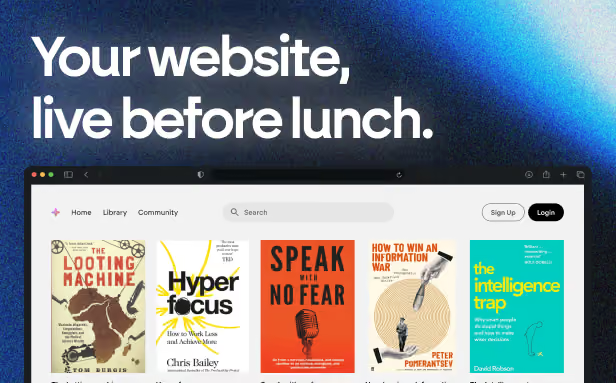
Emergent designs, writes, and publishes your whole site from one prompt. No templates, no drag-and-drop.
- Full site from one prompt
- Custom design, real pages
- Publish in minutes







