




Recent education research shows that teachers increasingly rely on digital communication tools, including classroom websites, portals, and apps because technology supports greater student engagement and facilitates more effective communication with parents. Surveys indicate that approximately 76% of students find technology makes learning more engaging, and educators are adopting digital tools to keep families informed and involved. As learning models continue to span in-person, online, and asynchronous formats, having the right school website builder has become increasingly important for educators and institutions managing communication at scale.
For teachers today, a website is not about marketing or self-promotion. It is about creating a single, reliable space where lessons, expectations, resources, and updates live in an organized and accessible way. The right website builder must respect teachers’ time constraints while supporting real educational workflows such as frequent updates, structured content delivery, privacy controls, and long-term reuse of teaching materials.
What is a website builder for teachers?
A website builder for teachers is a platform that enables educators to create, manage, and update professional teaching websites without needing coding knowledge or technical support. These tools are designed to help teachers publish lesson plans, assignments, schedules, announcements, and learning resources in a structured and accessible format that students and parents can rely on consistently.
Unlike generic website builders, teacher-oriented platforms prioritize simplicity, clarity, and maintainability. They account for the realities of education workflows, where content changes frequently, information must remain well-organized, and access controls are often required for student-only or paid materials. The best platforms also adapt across teaching contexts, including K–12 classrooms, higher education, tutoring businesses, and independent course creation.
Setting Up a Teacher Website? Start With These 5 Builders
The Website Builders More Teachers Are Choosing Right Now
Also read our best AI website builders guide to see how these options compare in 2026.
What are the key features of website builders for teachers?
1. Simple content editing for frequent academic updates
Teachers regularly update lesson plans, homework instructions, classroom announcements, and schedules, sometimes on a daily basis. A suitable website builder must allow these changes to be made quickly and confidently without breaking page layouts or requiring technical steps that interrupt teaching time. This ensures educators can keep information accurate and current while staying focused on instruction rather than website maintenance.
2. Structured organization for lessons, resources, and timelines
Educational content becomes ineffective when it is not clearly organized. Website builders for teachers must support logical hierarchies for classes, subjects, weeks, or modules so students can independently find materials without confusion. Strong structural organization also helps parents understand expectations and timelines, reducing repetitive clarification requests throughout the academic term.
3. Secure access control and privacy management
Teacher websites often host restricted content such as student-only resources, assessments, or paid learning materials. A reliable platform must include built-in authentication, gated pages, or permission-based access to ensure sensitive information is protected. Privacy management is especially critical in education, where responsible access and data protection are non-negotiable requirements.
4. Support for digital learning materials and payments
Many teachers now offer downloadable worksheets, recorded lessons, tutoring sessions, or complete online courses. Website builders for teachers should support file hosting, content delivery, and payment processing when needed. This allows educators to expand beyond the classroom while keeping educational content centralized on a platform they control.
5. Mobile responsiveness and accessibility readiness
Students and parents frequently access teacher websites from mobile devices. A strong website builder ensures content remains readable, navigable, and usable across phones and tablets without additional configuration. Accessibility support such as readable layouts and compatibility with assistive technologies is also essential for inclusive learning environments.
What are the benefits of using website builders for teachers?
1. Centralized communication for students and parents
A dedicated website provides a single authoritative source for announcements, schedules, assignments, and updates. This reduces confusion caused by scattered emails or messaging platforms and ensures everyone refers to the same information. Over time, centralized communication builds trust and consistency across students, parents, and administrators.
2. Better organization and long-term reuse of teaching materials
Website builders allow teachers to structure lessons and resources in a reusable format that can be refined over time. Instead of recreating materials each term, educators can improve and republish content efficiently. This supports curriculum continuity and makes adapting lessons for different classes or academic years significantly easier.
3. Stronger professional credibility and digital presence
A well-designed website helps teachers present their experience, teaching philosophy, certifications, and classroom work in a professional manner. This is especially valuable for tutors, trainers, and educators working independently. A credible digital presence also supports career growth, collaboration opportunities, and institutional recognition.
4. Reduced administrative workload and time savings
By hosting materials, schedules, and answers to common questions in one place, teachers spend less time responding to repetitive inquiries. This reduces administrative overhead and frees up time for lesson planning and student support. Over the long term, a well-maintained website functions as a passive communication assistant.
5. Flexibility to support evolving teaching models
Education continues to evolve toward hybrid, remote, and digital-first formats. Website builders give teachers the flexibility to adapt how content is delivered as these models change. Whether supporting remote learners or launching paid educational offerings, teachers retain control over how their teaching scales online.
5 Best Website Builders for Teachers
Teachers use website builders for a wide range of needs, from simple classroom hubs to fully monetized learning platforms or institution-level education websites. Some tools prioritize deep customization and control, while others focus on simplicity, governance, or content delivery. The platforms below stand out in 2026 because they align closely with real teaching workflows while remaining reliable, scalable, and manageable for educators.
1. Emergent
Emergent is one of the best, full-stack, AI-powered vibe coding and no code platforms for teachers who want complete control over how their educational websites, learning tools, and digital classrooms are designed, structured, and scaled. Instead of forcing educators into rigid templates, Emergent enables teachers to build fully custom teaching websites, learning portals, and resource platforms using natural language prompts, while automatically generating the frontend, backend, data models, authentication, and deployment layers.
For teachers in 2026 who operate beyond simple classroom pages, such as private tutors, course creators, trainers, academic consultants, and institutions building long-term digital education assets, Emergent offers a fundamentally different approach. It treats a teacher’s website not as a static page, but as a living educational system that can evolve with curriculum changes, new teaching formats, student growth, and monetization needs.
Key Features of Emergent for Teachers
1. Full-stack website and learning platform generation by prompt
Emergent allows teachers to describe exactly what they want in plain language, such as a lesson hub, student dashboard, resource library, or course website, and generates the complete production-ready system automatically. This includes frontend UI, backend logic, database structure, and hosting configuration without requiring manual setup. Teachers are not constrained by predefined layouts and can build platforms that match their teaching style and subject complexity.
2. Custom content structures for lessons, modules, and curricula
Unlike template-based builders, Emergent lets teachers define custom content hierarchies for subjects, grades, weeks, or learning modules. This is especially valuable for educators managing complex syllabi or multi-level courses where rigid page structures fail. The platform adapts to how teachers actually organize learning rather than forcing content into generic website sections.
3. Built-in authentication for student-only and paid access
Emergent supports secure authentication and role-based access control out of the box, allowing teachers to gate content for students, parents, or paying learners. This is critical for private tutors, online educators, and institutions that need controlled access to lessons, assessments, or premium materials. Access rules can be adjusted as teaching models evolve.
4. Integrated support for digital products and online courses
Teachers can build websites that include paid courses, downloadable materials, subscriptions, or tutoring bookings without relying on external tools. Emergent handles the logic required for payments, gated content delivery, and user access, making it possible to run an entire education business from one platform. This reduces fragmentation and long-term maintenance overhead.
5. Scalable backend logic for advanced education workflows
Emergent enables teachers to go beyond static pages by adding logic such as progress tracking, student dashboards, automated notifications, or form-driven workflows. These capabilities are especially useful for educators running cohorts, certifications, or structured learning programs. The platform scales from simple teaching sites to fully interactive education systems.
6. One-click deployment and production-ready hosting
Once a teaching website or platform is generated, Emergent deploys it with secure hosting, scalability, and performance optimizations built in. Teachers do not need to manage servers, updates, or infrastructure decisions. This ensures reliability for student access while allowing educators to focus on content and instruction rather than operations.
Unique Features of Emergent for Teachers
1. Vibe coding for education-specific website logic
Emergent’s vibe coding approach allows teachers to describe educational workflows conversationally, such as assignment submissions, gated lesson access, or cohort-based learning, and have the system generate the required logic automatically. This removes the traditional barrier between pedagogical intent and technical implementation. Teachers can iterate on ideas without technical translation friction.
2. No template lock-in or design ceiling
Unlike most website builders, Emergent does not impose design ceilings through templates. Teachers can create unique layouts, custom dashboards, or subject-specific interfaces that reflect how they teach. This is particularly valuable for educators who want their website to feel like an extension of their classroom rather than a generic web page.
3. Unified platform for website, app, and learning system creation
Emergent allows teachers to build not just websites, but also web apps and internal tools from the same foundation. This makes it possible to expand a teaching website into a full learning management system or student portal over time. Educators are not forced to migrate platforms as their needs grow.
4. Production-grade architecture without engineering teams
The systems generated by Emergent are production-ready, not prototypes. Teachers benefit from robust architecture, clean codebases, and scalable infrastructure without hiring developers. This is especially important for long-term education projects where reliability and maintainability matter.
5. Deep customization for institutional and enterprise education use
For schools, training organizations, or education startups, Emergent supports highly customized workflows, branding, and integrations. Teachers operating within larger institutions can align their platforms with governance, compliance, and reporting needs. This level of flexibility is rare in traditional website builders.
6. Future-proof foundation for evolving teaching models
Emergent is designed to adapt as education models change, whether through hybrid learning, AI-assisted teaching, or new monetization structures. Teachers can evolve their platforms without rebuilding from scratch. This makes Emergent a long-term investment rather than a short-term website tool.
Advantages of Emergent for Teachers
- Enables teachers to build fully custom, production-grade education platforms that go far beyond basic classroom websites while remaining manageable without technical expertise.
- Removes template limitations entirely, allowing teaching websites to mirror real pedagogical structures instead of generic page layouts.
- Supports advanced workflows such as gated learning, progress tracking, and paid courses within a single unified platform.
- Scales seamlessly from individual educators to institutions without forcing platform migrations or redesigns.
- Reduces long-term technical debt by generating clean, maintainable systems from the start.
- Empowers teachers to iterate, expand, and adapt their digital teaching presence as educational needs evolve.
Limitations of Emergent for Teachers
- May feel excessive for teachers who only need a simple static classroom page with no plans to expand functionality.
- Requires thoughtful upfront description of requirements to fully leverage its customization potential.
- Not positioned as a plug-and-play template builder, which may not suit educators seeking instant visual themes.
Pricing and Plans of Emergent
| Plan | Pricing | Key Highlights |
|---|---|---|
| Free | $0/month |
|
| Standard | $20/month |
|
| Pro | $200/month |
|
| Team | $300/month |
|
| Enterprise | Custom |
|
Read More About: Emergent Pricing and Plans
2. Payhip
Payhip is a lightweight website and digital product platform that teachers commonly use when their primary goal is selling educational materials rather than building a fully custom teaching website. In 2026, Payhip is especially popular among independent educators, tutors, and course creators who want a simple way to publish lesson resources, worksheets, recorded sessions, or short courses without managing complex site structures.
For teachers whose websites revolve around monetization rather than deep classroom workflows, Payhip offers a focused and low-friction experience. It prioritizes payments, file delivery, and compliance over design flexibility or advanced educational logic, making it suitable for specific teaching business models rather than broad instructional needs.
Key Features of Payhip for Teachers
1. Built-in digital product selling for educational materials
Payhip is designed around selling digital products, making it easy for teachers to upload worksheets, lesson plans, recordings, or guides and start selling them quickly. The platform handles product pages, checkout, and secure file delivery without requiring additional tools. This is particularly useful for educators monetizing teaching assets alongside their regular instruction.
2. Simple website pages for educator storefronts
Teachers can create basic website pages to introduce themselves, explain offerings, and guide students or parents toward products. While not a full website builder, Payhip provides enough structure to present educational content professionally. This simplicity appeals to teachers who want minimal setup and ongoing maintenance.
3. Integrated payment processing and tax handling
Payhip manages payments, VAT, and digital tax compliance automatically, which removes a significant administrative burden for teachers selling globally. Educators do not need to configure third-party payment gateways or worry about regional tax rules. This allows teachers to focus on content creation rather than financial logistics.
4. Secure content delivery and download protection
Purchased educational materials are delivered securely through Payhip’s platform, reducing the risk of unauthorized sharing. Teachers benefit from controlled access to paid resources without building custom authentication systems. This is especially valuable for educators selling premium or proprietary teaching content.
5. Subscription and membership support for recurring learning
Payhip supports subscriptions and memberships, enabling teachers to offer recurring access to lesson libraries or ongoing learning programs. This feature suits educators running monthly tutoring content, resource clubs, or continuous professional development offerings. It provides predictable revenue without complex setup.
6. Lightweight management dashboard for non-technical users
The platform includes a straightforward dashboard for managing products, sales, and customers. Teachers can track performance without navigating complex analytics systems. This ease of use makes Payhip approachable for educators with limited technical confidence.
Unique Features of Payhip for Teachers
1. Education-friendly monetization focus
Payhip is purpose-built for selling digital products, which aligns well with teachers monetizing worksheets, lesson packs, or recordings. Unlike general website builders, its entire workflow is optimized for education-focused digital sales. This clarity reduces unnecessary features that teachers do not need.
2. Automatic compliance for global digital sales
Teachers selling educational materials internationally benefit from Payhip’s built-in tax and VAT handling. This removes legal complexity that many educators struggle with when selling online. It is a significant advantage for teachers operating independently across borders.
3. No-code setup with minimal configuration overhead
Payhip allows teachers to launch quickly without worrying about hosting, security, or integrations. The platform abstracts away technical decisions that can overwhelm educators. This makes it ideal for teachers who want results without platform management.
4. Embedded checkout and buy buttons
Teachers can embed Payhip checkout buttons into existing websites or platforms. This flexibility allows educators to combine Payhip with other tools while still using it as the monetization layer. It suits teachers who already have a basic web presence.
5. Focused feature set without platform sprawl
Payhip avoids feature overload by concentrating on selling and delivery. Teachers are not distracted by unrelated website or marketing features. This focus supports clarity and faster onboarding for educators.
6. Cost-efficient entry point for independent educators
Payhip offers a low barrier to entry for teachers just starting to monetize their content. Its pricing structure is accessible compared to full-featured website platforms. This makes it attractive for early-stage teaching businesses.
Advantages of Payhip for Teachers
- Extremely easy for teachers to sell digital educational materials without technical setup or platform management complexity.
- Built-in payment processing and tax compliance reduce administrative workload for independent educators.
- Secure delivery of paid resources protects proprietary teaching materials effectively.
- Subscription support enables recurring revenue models for ongoing educational content.
- Lightweight interface is approachable for teachers with limited technical confidence.
- Cost-effective option for educators focused primarily on monetization rather than full websites.
Limitations of Payhip for Teachers
- Limited website customization makes it unsuitable for teachers who need structured classroom pages or rich content layouts.
- Not designed for complex educational workflows such as progress tracking or student dashboards.
- Branding and design flexibility are constrained compared to full website builders.
- Lacks deep content organization features for multi-class or multi-grade teaching contexts.
- Not ideal for institutional or school-level education websites.
- Scaling beyond digital product sales often requires integrating additional platforms.
Pricing and Plans of Payhip
| Plan | Pricing | Key Highlights |
|---|---|---|
| Free Forever | $0/month + 5% transaction fee |
|
| Plus | $29/month + 2% transaction fee |
|
| Pro | $99/month • No transaction fees |
|
3. Wix
Wix is one of the most widely used website builders among teachers who want a visually polished website without dealing with technical setup or backend complexity. In 2026, Wix remains a common choice for educators building classroom websites, tutoring pages, or professional profiles because of its large template library, intuitive editor, and broad feature ecosystem.
For teachers, Wix sits in the middle ground between simplicity and flexibility. It does not offer deep education-specific logic out of the box, but it provides enough design control, content tools, and extensions to support most teaching use cases, especially for educators who value aesthetics and ease of use over custom workflows.
Key Features of Wix for Teachers
1. Drag-and-drop editor for visually structured teaching websites
Wix’s visual editor allows teachers to place text, images, videos, and documents exactly where they want without writing code. This is useful for educators who want to design lesson pages, classroom hubs, or resource sections that feel intuitive and visually engaging. The editor provides immediate feedback, helping teachers see how students and parents will experience the site.
2. Large template library tailored to education and personal sites
Wix offers a wide range of templates that teachers can adapt for classrooms, tutoring businesses, or academic portfolios. These templates provide a strong starting point for educators who do not want to design from scratch. While templates impose some structure, they help teachers launch quickly with a professional look.
3. Built-in blogging and content publishing tools
Teachers can use Wix’s blogging features to post announcements, lesson updates, reflections, or classroom news. This is useful for ongoing communication with students and parents. The blogging system is simple enough for regular updates without requiring external platforms.
4. App market for extending classroom functionality
Wix includes an app marketplace where teachers can add features such as contact forms, calendars, booking tools, or simple e-commerce. This allows educators to extend their website’s capabilities without custom development. However, functionality depends on third-party app quality and limitations.
5. Media hosting for documents, videos, and presentations
Teachers can upload PDFs, images, videos, and slides directly to their Wix sites. This supports sharing lesson materials and supplementary resources in one place. Media management is straightforward, making it accessible for educators with varying technical comfort levels.
6. Mobile optimization and responsive design controls
Wix automatically generates mobile-friendly versions of websites and allows teachers to adjust layouts for smaller screens. This ensures students and parents can access content easily from phones or tablets. Mobile editing tools provide additional control when needed.
Unique Features of Wix for Teachers
1. ADI assisted website creation for fast setup
Wix ADI can generate a basic website automatically based on a few inputs, which helps teachers launch quickly when time is limited. This feature is useful for educators who want a functional site without spending hours on design decisions. It lowers the barrier to getting online.
2. Extensive ecosystem of third-party integrations
Wix’s app market offers integrations for scheduling, forms, payments, and communication tools. Teachers can assemble a functional teaching website by combining these apps. This ecosystem approach provides flexibility but can introduce dependency on external providers.
3. Built-in booking tools for tutoring and sessions
Teachers offering tutoring or consultation sessions can use Wix’s booking features to manage appointments. This is particularly helpful for independent educators. Scheduling tools integrate directly into the website experience.
4. Custom domains and branding control
Wix allows teachers to use custom domains and adjust branding elements such as colors and fonts. This supports a more professional presentation for educators building personal teaching brands. Branding flexibility is strong within template constraints.
5. Multilingual site support for diverse classrooms
Teachers working with multilingual communities can create content in multiple languages using Wix’s language tools. This supports inclusivity and accessibility in diverse education environments. It is especially useful for international or community-focused educators.
6. Reliable hosting and maintenance handled by the platform
Wix manages hosting, security updates, and platform maintenance automatically. Teachers do not need to worry about technical upkeep. This reliability appeals to educators who want predictable performance without operational responsibility.
Advantages of Wix for Teachers
- Very approachable for teachers with no technical background who want a professional-looking website quickly.
- Strong visual design capabilities make classroom and tutoring sites engaging and easy to navigate.
- Large ecosystem of apps allows educators to add functionality without coding.
- Reliable hosting and maintenance reduce operational overhead for teachers.
- Suitable for a wide range of teaching use cases, from classrooms to private tutoring.
- Good balance between flexibility and ease of use for non-technical educators.
Limitations of Wix for Teachers
- Template-based structure limits deep customization for complex educational workflows.
- Advanced functionality often depends on third-party apps, which can increase costs and complexity.
- Not designed for building full learning management systems or advanced student portals.
- Content structure can become unwieldy for teachers managing many classes or resources.
- Scaling beyond basic teaching websites may require platform migration.
- Less control over backend logic compared to full-stack or developer-oriented platforms.
Pricing and Plans of Wix
| Plan | Pricing | Key Highlights |
|---|---|---|
| Free | $0 | For trying Wix and basic experimentation |
| Light | $17 per month | Ideal for portfolios and personal sites |
| Core | $29 per month | Designed for small online stores and growing businesses |
| Business | $36 per month | Suited for established businesses needing more capabilities |
| Business Elite | $159 per month | Built for large businesses with advanced requirements |
| Enterprise | Custom pricing | Tailored for global brands with high-scale, industry-level needs |
4. Morweb
Morweb is a content management and website platform built specifically for organizations in education, nonprofits, and institutions that require structured governance, accessibility compliance, and controlled publishing workflows. In 2026, Morweb is commonly used by schools, districts, educational programs, and teaching organizations rather than individual classroom teachers, but it remains highly relevant for educators working within institutional environments.
For teachers operating inside schools, colleges, or education-led organizations, Morweb serves a very different role compared to consumer website builders. If you're specifically looking for the best school website builder rather than a personal teaching page, Morweb is one of the more established options in that space.
It emphasizes consistency, accessibility, and administrative control over visual freedom or rapid experimentation, making it suitable for environments where compliance, approvals, and long-term stability matter more than customization speed.
Key Features of Morweb for Teachers
1. Institution-grade content management for education websites
Morweb provides a structured CMS that allows teachers and administrators to manage large volumes of educational content across departments, classes, and programs. This is particularly valuable in schools where multiple educators contribute to the same site and content must remain organized over time. The platform supports long-term maintainability rather than ad hoc page creation.
2. Role-based publishing and approval workflows
Teachers can be assigned specific permissions, ensuring content changes go through proper review before being published. This helps institutions maintain accuracy and consistency across educational websites. Approval workflows are essential in regulated environments where content oversight is required.
3. Built-in accessibility compliance tools
Morweb places strong emphasis on accessibility, supporting WCAG compliance and inclusive design practices. Teachers benefit from tools that help ensure content is accessible to students with disabilities. This reduces institutional risk and improves learning inclusivity.
4. Structured page templates for academic content
Morweb offers predefined page structures tailored to educational use cases such as programs, staff directories, and resource pages. These templates help teachers publish content consistently without worrying about layout decisions. Structure is prioritized over creative freedom.
5. Secure hosting and enterprise-level reliability
The platform includes managed hosting with security, backups, and performance optimization. Teachers and institutions do not need to manage infrastructure. This reliability is critical for public-facing education websites that serve large audiences.
6. Centralized media and document management
Morweb allows educators to manage documents, images, and media assets in a centralized library. This supports efficient reuse of teaching materials across pages. Centralization reduces duplication and content sprawl.
Unique Features of Morweb for Teachers
1. Education and nonprofit-first platform design
Morweb is designed specifically for education and mission-driven organizations, not general consumers. This focus ensures features align with institutional teaching needs rather than commercial marketing goals. Teachers benefit from workflows that reflect academic realities.
2. Accessibility-by-default publishing environment
Unlike many website builders where accessibility is optional, Morweb embeds accessibility considerations into the publishing process. Teachers are guided toward compliant content creation. This reduces the burden of manual accessibility checks.
3. Governance-friendly website architecture
Morweb supports hierarchical site structures and content governance, which is critical for schools and districts. Teachers can contribute within defined boundaries. This prevents fragmentation and ensures long-term site coherence.
4. Long-term stability over rapid feature changes
Morweb prioritizes platform stability and reliability rather than frequent UI changes. Teachers working in institutions benefit from predictable behavior and reduced retraining. This is especially important in academic environments with limited technical support.
5. Support for large-scale educational sites
The platform handles complex sites with many pages, contributors, and audiences effectively. Teachers can rely on Morweb for institution-wide communication. This scalability is a key differentiator compared to consumer builders.
6. Dedicated support for education organizations
Morweb provides support tailored to education and nonprofit customers. Teachers and administrators receive guidance aligned with institutional constraints. This specialized support improves onboarding and long-term success.
Advantages of Morweb for Teachers
- Well-suited for teachers working within schools or institutions that require structured publishing and governance.
- Strong accessibility focus supports inclusive education and regulatory compliance.
- Role-based permissions reduce content errors and maintain consistency across large sites.
- Reliable hosting and maintenance minimize technical risk for institutions.
- Scales effectively for multi-department or district-level education websites.
- Encourages long-term content organization rather than ad hoc page creation.
Limitations of Morweb for Teachers
- Not ideal for individual teachers seeking creative freedom or rapid experimentation.
- Customization options are limited compared to consumer-focused website builders.
- Learning curve can be higher due to institutional CMS complexity.
- Less suitable for monetization or independent teaching businesses.
- Visual design flexibility is constrained by structured templates.
- Overkill for small classroom or personal teaching websites.
Pricing and Plans of Morweb
| Plan | Pricing | Key Highlights |
|---|---|---|
| Starter | Starting at $149/month |
|
| Grow | Starting at $199/month |
|
| Engage | Custom pricing |
|
| Enterprise | Custom pricing |
|
5. Duda
Duda is a professional website builder designed for teams and organizations that need speed, consistency, and strong design control across multiple sites. In 2026, Duda is commonly used by education consultancies, tutoring companies, and schools that manage multiple teacher or program websites under a single system rather than by individual classroom teachers working alone.
For teachers, Duda is most relevant when the goal is to operate within a standardized framework where design quality, performance, and scalability matter more than deep instructional workflows. It excels at producing fast, polished websites efficiently, but it is not built to model complex teaching logic or classroom-specific systems.
Key Features of Duda for Teachers
1. Structured site builder optimized for speed and consistency
Duda enables teachers and education teams to build websites quickly using a highly structured editor that prioritizes layout consistency and performance. This is useful in environments where multiple teaching pages or educator profiles must follow the same design system. The platform reduces design variability while maintaining a professional look.
2. Team collaboration and client-style permissions
Duda supports multiple user roles, allowing administrators, designers, and teachers to collaborate within controlled boundaries. This is valuable for schools or tutoring organizations where teachers contribute content but do not manage the entire site. Permissions help prevent accidental layout or structural changes.
3. High-performance hosting and optimized page speed
Duda emphasizes fast load times and reliable performance, which benefits student and parent access across devices. Teachers do not need to worry about optimization or hosting configuration. Performance consistency is one of Duda’s strongest advantages.
4. Reusable sections and global design elements
Teachers and administrators can create reusable sections such as headers, footers, or lesson layouts that update across the site automatically. This supports consistency and saves time when managing multiple pages. It is especially helpful for education organizations maintaining standardized layouts.
5. Built-in personalization and content targeting
Duda allows basic personalization based on visitor attributes, which can be used to show different content to different audiences. While not education-specific, this can support segmented communication for parents, students, or prospective learners. Personalization remains surface-level rather than instructional.
6. Mobile-first design controls
Duda provides strong control over mobile layouts, ensuring teaching content remains usable on phones and tablets. Teachers benefit from predictable mobile behavior without additional configuration. Mobile performance is a core strength of the platform.
Unique Features of Duda for Teachers
1. Agency-grade site management for education teams
Duda is built for managing many websites efficiently, which suits tutoring companies, school networks, or education consultancies. Teachers working within these organizations benefit from a stable, standardized environment. This is uncommon among consumer website builders.
2. Centralized updates across multiple pages
Global sections and styles allow administrators to push updates across many teaching pages at once. This is useful for policy changes, announcements, or branding updates. Teachers do not need to manually update every page.
3. White-label and branding control for institutions
Duda supports white-labeling and brand consistency, which benefits schools or organizations presenting a unified identity. Teachers’ pages align visually with institutional branding. This supports professionalism and trust.
4. Built-in client management and approvals
The platform includes workflows for feedback and approvals, allowing administrators to review content changes. Teachers can submit updates without publishing directly. This is useful in regulated or brand-sensitive environments.
5. Predictable design system with low layout risk
Duda minimizes the risk of broken layouts through constrained editing. Teachers are less likely to accidentally disrupt site structure. This stability appeals to organizations prioritizing reliability over creative freedom.
6. Strong focus on performance and reliability
Duda’s infrastructure is optimized for uptime and speed. Teachers and students experience consistent access. Reliability is treated as a core product feature rather than an afterthought.
Advantages of Duda for Teachers
- Excellent choice for education organizations managing multiple teacher or program websites at scale.
- Strong performance and reliability ensure consistent access for students and parents.
- Role-based collaboration supports controlled content contributions by teachers.
- Reusable sections reduce repetitive work and maintain design consistency.
- Professional design output without requiring deep technical knowledge.
- Suitable for tutoring businesses or schools with standardized branding needs.
Limitations of Duda for Teachers
- Limited support for education-specific workflows such as assignments or progress tracking.
- Not designed for individual teachers seeking full creative control.
- Monetization and course delivery features are basic compared to education platforms.
- Custom backend logic is not supported.
- Less flexible for experimental or evolving teaching models.
- Best suited to teams rather than solo educators.
Pricing and Plans of Duda
| Plan | Pricing | Key Highlights |
|---|---|---|
| Basic | $25/month |
|
| Team | $39/month |
|
| Agency | $69/month |
|
| White Label | $199/month |
|
| Custom | Custom pricing |
|
How to choose the best website builder for teachers?
1. Match the platform to your teaching model and goals
Teachers should first evaluate whether their website is meant to be a simple classroom hub, a professional profile, or a full digital learning platform. Builders optimized for templates and visual design work well for basic communication, but they struggle when teachers need structured curricula, gated access, or advanced workflows. Choosing a platform that aligns with long-term teaching goals prevents painful migrations later. Understanding how to build a school website starts with this decision, because the platform you pick shapes everything from content structure to student access.
2. Prioritize ease of updates over visual complexity
Teaching content changes constantly, and a website that is hard to update quickly becomes outdated. Teachers should look for builders that allow confident edits without breaking layouts or requiring technical steps. The right platform supports frequent updates while keeping structure intact for students and parents.
3. Consider content organization and scalability
A good website builder must support logical organization for lessons, resources, and schedules as teaching materials grow over time. Platforms that rely on flat page structures often become chaotic as content expands. Teachers should choose tools that scale cleanly as classes, grades, or offerings increase.
4. Evaluate access control and privacy needs
Teachers often handle student-only or paid materials that require controlled access. Builders without built-in authentication or permission management create security risks or require third-party tools. Choosing a platform with native access control simplifies compliance and protects sensitive content.
5. Think beyond the current academic year
Teachers’ needs evolve with new teaching formats, programs, or monetization opportunities. A platform that supports future expansion without rebuilding saves time and resources. Long-term flexibility should outweigh short-term convenience when selecting a website builder.
Why is Emergent the best website builder for teachers?
1. Full-stack control aligned with real teaching workflows
Emergent allows teachers to build websites that reflect how they actually teach rather than forcing content into rigid templates. Lessons, modules, dashboards, and gated resources can be structured exactly as needed. This alignment between pedagogy and platform is rare among website builders.
2. Ability to evolve from a website into a learning system
Teachers can start with a simple site and expand into full learning platforms without migrating tools. Emergent supports this evolution through scalable backend logic, authentication, and data structures. This makes it suitable for educators planning long-term digital growth.
3. No design or logic ceiling as teaching needs grow
Most website builders impose limits as complexity increases. Emergent removes these ceilings by generating production-grade systems that handle advanced workflows. Teachers are not forced to compromise as their instructional models mature.
4. Unified platform for content, access, and monetization
Emergent combines website creation, gated content, payments, and logic into one system. Teachers avoid juggling multiple tools. This unified approach reduces maintenance and improves reliability.
5. Future-ready foundation for modern education models
As education incorporates AI, personalization, and hybrid delivery, Emergent provides a foundation that adapts without rebuilding. Teachers can iterate and expand confidently. This future-readiness sets Emergent apart in 2026.
Conclusion
Website builders for teachers are no longer just tools for publishing classroom information. They have become foundational platforms that support communication, organization, and increasingly, digital learning delivery. The right choice depends on whether a teacher needs simplicity, institutional structure, or full control over how teaching systems are built and scaled.
For educators who want maximum flexibility, long-term scalability, and the ability to build real learning platforms rather than static pages, Emergent stands out clearly in 2026. Other platforms serve important roles for specific teaching models, but none match Emergent’s ability to align technology with pedagogy at every stage of growth.
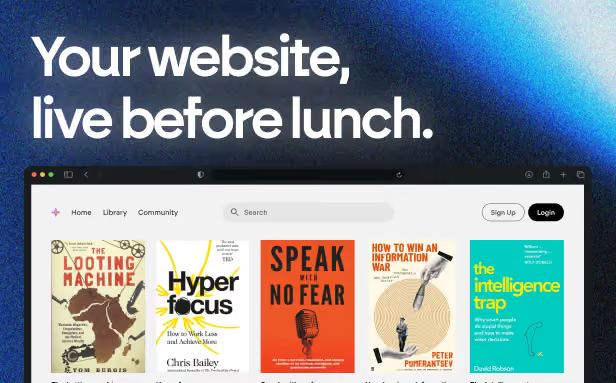
Emergent designs, writes, and publishes your whole site from one prompt. No templates, no drag-and-drop.
- Full site from one prompt
- Custom design, real pages
- Publish in minutes







