If you are comparing Bolt.new and Claude, you are really comparing two different layers of AI development.
Bolt.new is an AI-powered browser builder that generates full-stack applications directly from prompts. It handles scaffolding, file structure, and instant previews.
Claude, developed by Anthropic, is a large language model focused on reasoning, code generation, writing, and analysis. It is not a development platform by itself. It powers workflows inside tools, IDEs, and APIs.
So the real question is:
Do you want an AI coding model, or an AI app-building environment?
This comparison breaks that down clearly.
Key Takeaways
- Bolt.new is an AI-powered app builder with in-browser execution and previews.
- Claude is an advanced AI model for reasoning, code generation, and structured problem solving.
- Choose Bolt.new if you want to generate and run full-stack apps instantly.
- Choose Claude if you want powerful AI reasoning integrated into your own workflow or product.
Quick Comparison Table
Both use AI, but at completely different layers of the stack.
| Parameter | Bolt.new | Claude |
|---|---|---|
| Development Approach | AI-powered full-stack browser builder with instant previews. ⭐️⭐️⭐️⭐️ | Advanced AI reasoning model accessible via chat or API. ⭐️⭐️⭐️⭐️⭐️ |
| Primary Use Case | Generate and preview full-stack web apps from prompts | Code generation, reasoning, analysis, and content creation |
| Coding Required | Partial. AI scaffolds most structure but refinement needed. ⭐️⭐️⭐️⭐️ | Yes. Developer must integrate output into projects. ⭐️⭐️⭐️⭐️⭐️ |
| Full Stack from Prompts | Designed for full-stack app generation inside browser. ⭐️⭐️⭐️⭐️ | Generates code but does not host or deploy applications. ⭐️⭐️⭐️ |
| Hosting & Deployment | Built-in preview and quick deployment workflow. ⭐️⭐️⭐️⭐️ | Not included. Deployment handled externally. ⭐️⭐️ |
| Scalability | Scales within platform hosting limits depending on plan. ⭐️⭐️⭐️⭐️ | Scales via API usage and model capacity, not application hosting. ⭐️⭐️⭐️⭐️⭐️ |
| Collaboration | Project-based sharing; limited compared to full IDEs. ⭐️⭐️⭐️ | Depends on integration platform or API usage. ⭐️⭐️⭐️⭐️ |
| Code Ownership | Exportable project files. ⭐️⭐️⭐️⭐️ | Fully yours when generated via API or chat. ⭐️⭐️⭐️⭐️⭐️ |
| Best For | Indie hackers, rapid MVP builders | Developers, researchers, product teams integrating AI |
Bolt.new vs Claude: Key Features Comparison in Detail
To compare Bolt.new and Claude properly, we need to move chronologically through the builder journey. From setup, to AI depth, to deployment, to scalability.
They operate at different layers, so the differences become clearer as we go deeper.
Ease of Setup & Getting Started
The first question most users have is simple. How quickly can I start building?
Bolt.new
Bolt.new is built for immediacy. You open the browser, describe your app idea, and it begins generating a structured full-stack project. There is no local setup, no repository cloning, and no dependency installation.
Within minutes, you typically get a working preview. This makes it extremely accessible for founders and non-traditional developers.
Read More About: 5 Best Bolt Alternatives
Claude
Claude is not a development environment. It is an AI model developed by Anthropic that you access via chat interface or API.
To build something real, you must integrate Claude’s output into your own IDE, hosting setup, or product infrastructure. Setup depends entirely on how you use it.
Our Recommendation:
If you want zero setup and instant generation, Bolt.new wins. If you want AI reasoning integrated into your own workflow, Claude is more flexible.
AI Workflow Depth & Reasoning
This is where the core difference becomes obvious.
Bolt.new
Bolt.new focuses on structured app generation. It is optimized for turning prompts into runnable full-stack apps.
It handles scaffolding, file structure, and UI components well. However, its reasoning depth is tied to the app-building context rather than general-purpose analytical capability.
Claude
Claude is known for strong reasoning, long-context understanding, and structured code generation. It can analyze large codebases, refactor logic, explain architecture decisions, and solve complex algorithmic problems.
It is not limited to app generation. It can assist with system design, documentation, debugging, and technical planning.
Our Recommendation:
For deep reasoning and complex problem-solving, Claude is stronger. For fast structured app scaffolding, Bolt.new is more streamlined.
Development Flexibility & Control
Once the project grows, flexibility matters.
Bolt.new
Bolt.new abstracts infrastructure. It generates projects that you can edit and export, but you are working within its managed environment while building.
This makes it simpler but can feel restrictive for highly customized architectures.
Claude
Claude imposes no development constraints because it is not the environment itself. You control the stack, framework, hosting, and infrastructure.
It can generate code for any language or architecture, but execution and deployment remain your responsibility.
Our Recommendation:
If you want control over every layer of your stack, Claude provides freedom. If you prefer an opinionated environment that accelerates output, Bolt.new reduces complexity.
Deployment & Production Readiness
Shipping matters more than generation.
Bolt.new
Bolt.new provides built-in preview and deployment workflows. You can quickly publish or share your generated app.
This makes it suitable for MVP launches and early validation without configuring external infrastructure.
Claude
Claude does not include hosting or deployment. It generates code that you must deploy using external services such as cloud platforms, servers, or CI/CD pipelines.
Production readiness depends entirely on your implementation.
Our Recommendation:
For quick deployment inside one ecosystem, Bolt.new is more convenient. Claude is more powerful when integrated into professional production pipelines.
Scalability & Long-Term Growth
The final layer is long-term sustainability.
Bolt.new
Bolt.new scales within its hosting and platform constraints. It works well for early-stage apps and prototypes.
For highly complex infrastructure or enterprise-grade systems, you may eventually migrate to a more traditional stack.
Claude
Claude scales through API usage and model access tiers. It can support large-scale applications if embedded properly into backend systems.
It does not scale apps directly. It scales intelligence inside your applications.
Our Recommendation:
If you want to scale AI reasoning across products, Claude is stronger. If you want to scale a generated app within a managed ecosystem, Bolt.new is simpler.
Context Window & Large Codebase Handling
As projects grow, the ability to understand long conversations or large files becomes critical.
Bolt.new
Bolt.new works within the context of the project it generates. It understands the structure of the app it creates and can iterate on features within that environment.
However, its context handling is primarily scoped to the active project and prompt flow. It is optimized for app-building continuity rather than extremely large multi-repository analysis.
Claude
Claude is known for strong long-context handling and structured reasoning across large inputs. It can analyze long documents, multiple files, and extended conversations without losing coherence.
This makes it useful for reviewing large codebases, refactoring systems, and performing architectural reasoning beyond simple scaffolding.
Our Recommendation:
For analyzing large systems or maintaining context across complex technical discussions, Claude is stronger. For iterative development inside a generated app environment, Bolt.new is sufficient.
Multi-File Refactoring & Codebase Evolution
Serious applications require structured refactoring over time.
Bolt.new
Bolt.new can modify and extend the generated project through prompts. It updates files and components as requested.
However, heavy architectural refactoring or deep backend restructuring may require manual oversight, especially as complexity increases.
Claude
Claude can refactor code across multiple files when given proper context. It can explain trade-offs, propose architecture improvements, and rewrite modules systematically.
Because it is model-driven rather than platform-limited, it works across frameworks and languages without being tied to one ecosystem.
Our Recommendation:
For deep technical refactoring and architecture redesign, Claude offers more analytical strength. Bolt.new focuses more on iterative product-level changes.
API & Ecosystem Integration
Modern applications depend on external services.
Bolt.new
Bolt.new supports integration within its generated environment, allowing you to connect APIs, databases, and third-party services depending on platform capabilities.
Integration complexity is partially abstracted, which makes setup easier but may reduce low-level control.
Claude
Claude is available via API, allowing you to integrate it into your own backend, SaaS product, or internal tooling.
It becomes a building block inside your application rather than the environment itself. This makes it highly flexible for custom workflows.
Our Recommendation:
If you want AI embedded inside your product, Claude’s API flexibility is powerful. If you want guided integration within a managed app builder, Bolt.new simplifies the process.
Security & Data Control
For teams building serious products, data governance matters.
Bolt.new
Security depends on the platform’s hosting model and account-level controls. It simplifies infrastructure, but users must rely on platform-managed security policies.
Exportability of code can reduce vendor lock-in risk, but runtime remains ecosystem-based while hosted.
Claude
Claude’s deployment depends on how you use it. Through API usage, developers can control where data flows, how it is stored, and what security standards are applied.
Enterprise access typically includes compliance and governance options depending on subscription tier.
Our Recommendation:
For full infrastructure-level control over data and compliance, Claude integrated into your own stack offers more flexibility. Bolt.new prioritizes ease over granular infrastructure control.
Performance & Execution Model
The way apps run differs significantly.
Bolt.new
Bolt.new executes within its managed environment. Performance depends on the platform’s hosting and compute limits.
For standard web applications and MVPs, this is sufficient. Extremely resource-heavy systems may hit platform constraints.
Claude
Claude does not execute your applications. It generates code or responses. Execution performance depends on your hosting infrastructure.
Its scalability is tied to API limits and subscription tiers rather than app runtime capacity.
Read More About: Best Claude Alternatives
Our Recommendation:
If runtime performance and infrastructure tuning are priorities, Claude integrated into your own cloud setup provides more control. Bolt.new is optimized for convenience rather than infrastructure optimization.
Review Comparisons
Star Ratings Overview
| Platform | G2 Rating | Capterra Rating | Product Hunt |
|---|---|---|---|
| Bolt.new | 3.8 / 5 ⭐⭐⭐☆ | Limited presence | 4.3 / 5 ⭐⭐⭐⭐☆ |
| Claude | 4.4 / 5 ⭐⭐⭐⭐☆ | 4.6 / 5 ⭐⭐⭐⭐⭐ | 5.0 / 5 ⭐⭐⭐⭐⭐ |
Ratings reflect publicly available listings and may change over time.
Review Summary Analysis
Bolt.new
G2:
Users appreciate how quickly Bolt.new can generate full-stack applications from prompts. Rapid prototyping and instant previews are commonly praised.
However, reviewers mention friction around token consumption, debugging complexity in larger builds, and occasional workflow instability when scaling projects.
Product Hunt:
Early adopters respond positively to the idea-to-app speed. The product is seen as innovative, though still evolving in maturity.
Overall Sentiment:
Bolt.new is praised for speed and accessibility, but long-term depth and cost predictability receive mixed feedback.
Claude
G2:
Claude is highly rated for reasoning ability, structured responses, and strong performance in coding and analysis tasks. Users highlight clarity, long-context handling, and reliability.
Capterra:
Reviewers praise output quality and consistency across tasks including technical writing, code generation, and documentation support.
Product Hunt:
Claude has received a perfect rating on Product Hunt, reflecting strong community enthusiasm and trust in its reasoning capabilities.
Overall Sentiment:
Claude is widely regarded as one of the strongest reasoning-focused AI models, particularly valued for deep analysis and long-form context handling.
What Users Are Saying
Reddit often reveals practical, unfiltered experiences that structured review platforms miss. Below are recent discussions around Bolt.new and Claude.
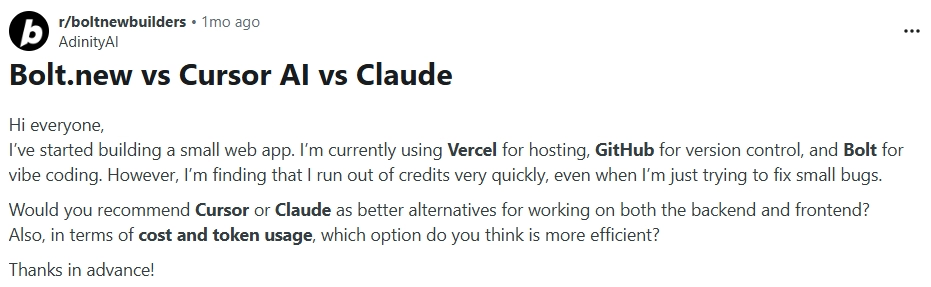
r/boltnewbuilders – Bolt.new vs Cursor AI vs Claude
In this thread, users compare Bolt.new, Cursor AI, and Claude across workflow depth and productivity.
Several commenters point out that Bolt.new is strong for quickly generating apps, while Claude is better for reasoning-heavy tasks and deeper coding assistance. The discussion highlights how the choice depends on whether you want a builder environment or a reasoning engine.
Source: Reddit
Insight: Bolt.new is positioned as execution-first, while Claude is positioned as intelligence-first. Users see them as complementary rather than direct replacements.
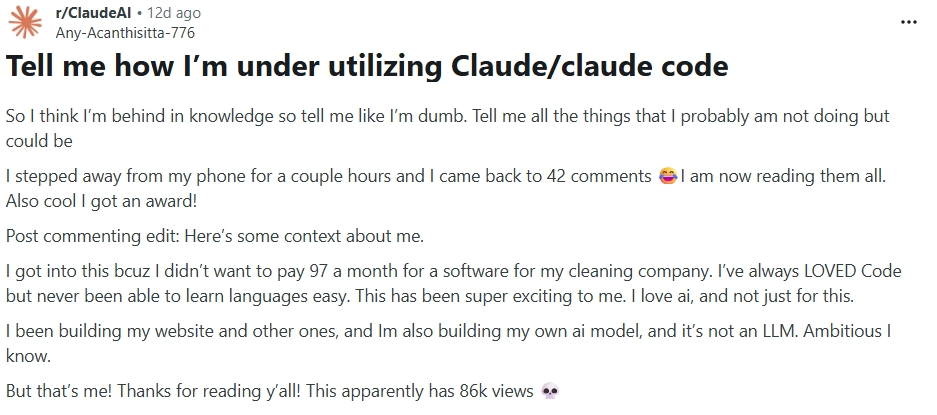
r/ClaudeAI – Underutilizing Claude
In this thread, users discuss how they may not be fully leveraging Claude’s capabilities.
Many responses suggest using Claude for system design, multi-file refactoring, structured planning, and long-context debugging rather than just small code snippets. The conversation reinforces that Claude’s strength lies in reasoning and structured analysis, not just simple code generation.
Source: Reddit
Insight: Users often underuse Claude by treating it like a simple autocomplete tool rather than a reasoning partner.
r/ClaudeAI – Is the Subscription Worth It?
This discussion centers around whether Claude’s paid subscription provides enough value.
Subscribers mention improved usage limits and better workflow continuity compared to free access. However, some users evaluate the cost based on how frequently they rely on deep reasoning or large-context tasks.

Source: Reddit
Insight: Claude’s subscription value increases significantly for heavy users who depend on structured reasoning, long documents, or code-heavy workflows.
Pricing Comparison
Below is the most accurate combined pricing table for Bolt.new and Claude (covering both subscription access and API usage where relevant). Pricing is pulled from current official plans and publicly available documentation.
| Plan Tier | Bolt.new (2026) | Claude (Anthropic) |
|---|---|---|
| Free Plan | Free Tier: Limited token access to start building with AI. Basic project creation and preview. | Free Access: Claude has a free tier with limited monthly usage for chat and reasoning. |
| Entry Paid Plan | Bolt.new Pro: ~$25 / month — ~10M tokens, private projects, custom domains, API access, exportable code. | Claude Basic Pro: ~$20 / month — Expanded usage limits for individuals on web/chat. |
| Team Plan / Mid Tier | Bolt.new Teams: ~$30+ / user / month — Shared token pools, collaboration features, higher usage. | Claude Team: ~$30 / user / month (min ~5 users) — Larger context windows, team access. |
| High Usage / Premium | Bolt.new Enterprise: Custom pricing — High-volume tokens, enterprise support, SLAs. | Claude Max / Advanced: ~$100 / month — Priority access, higher token thresholds (varies by platform). |
| API / Developer Usage | N/A outside token tiers — Usage tied to subscription bucket. | Claude API: Billed per token — Example Sonnet model: ~ $3 input + $15 output per 1M tokens; Opus higher at ~$5 + $25 per 1M tokens (approx). |
| Billing Notes | Token-based billing; unused tokens may rollover based on plan terms. | Web subscription vs API usage — API billed per million-token usage. |
Notes & Sources:
- Bolt.new pricing is token credit–based. Higher subscriptions grant more monthly tokens and feature unlocks like custom domains and exportable code.
- Claude pricing includes both consumer subscriptions as well as separate API billing for developers, API costs vary by model choice (Sonnet/Opus).
Introducing Emergent
When comparing Bolt.new and Claude, you are evaluating execution speed versus reasoning depth. Emergent positions itself as a structured AI-native system that bridges both intelligence and production workflows.
Here is how it compares on dimensions not covered in the quick comparison:
| Parameter | Emergent | Bolt.new | Claude |
|---|---|---|---|
| AI Depth & Reasoning | Combines structured AI generation with architectural guidance. ⭐️⭐️⭐️⭐️⭐️ | Strong for app scaffolding but limited deep reasoning scope. ⭐️⭐️⭐️⭐️ | Advanced long-context reasoning and multi-step logic processing. ⭐️⭐️⭐️⭐️⭐️ |
| Architecture Control | Guided but structured system design to reduce chaos in builds. ⭐️⭐️⭐️⭐️⭐️ | App structure generated, but architectural flexibility depends on platform constraints. ⭐️⭐️⭐️⭐️ | Full freedom since architecture is controlled externally by the developer. ⭐️⭐️⭐️⭐️⭐️ |
| Workflow Structure | Opinionated product-building flows with production awareness. ⭐️⭐️⭐️⭐️⭐️ | Prompt → generate → iterate workflow optimized for speed. ⭐️⭐️⭐️⭐️ | Flexible conversational or API workflow with no enforced structure. ⭐️⭐️⭐️⭐️⭐️ |
| Production Orientation | Designed for structured transition from idea to scalable product. ⭐️⭐️⭐️⭐️⭐️ | Strong for MVP and early validation, less structured for long-term systems. ⭐️⭐️⭐️⭐️ | Depends entirely on external implementation and deployment setup. ⭐️⭐️⭐️⭐️ |
| Intelligence vs Execution Layer | Balances AI reasoning with execution environment. ⭐️⭐️⭐️⭐️⭐️ | Execution-focused app builder with integrated AI assistance. ⭐️⭐️⭐️⭐️ | Pure intelligence layer, no execution environment. ⭐️⭐️⭐️⭐️⭐️ |
How to Choose the Best AI Builder
Choosing between Bolt.new, Claude, and Emergent depends on how you want to build.
Do You Want an Environment or a Model?
If you want a full environment that generates and previews apps instantly, Bolt.new fits that need.
If you want a powerful AI brain that you integrate into your own systems, Claude is the better choice.
If you want structured AI-guided product building with deployment intent, Emergent bridges both.
Are You Building an MVP or a Long-Term Product?
Bolt.new excels at rapid MVP creation.
Claude helps you design and reason about complex systems but requires external infrastructure.
Emergent focuses on structured growth from early stage to production-ready system.
How Much Technical Control Do You Need?
Claude offers maximum flexibility because you control the entire stack.
Bolt.new abstracts infrastructure for simplicity.
Emergent balances abstraction with architectural structure.
Do You Care About Deployment Simplicity?
Bolt.new offers built-in preview and deployment flows.
Claude does not handle hosting.
Emergent emphasizes production intent within guided workflows.
Is AI Assistance or AI Architecture More Important?
Claude gives you powerful reasoning.
Bolt.new gives you instant execution.
Emergent focuses on turning AI reasoning into structured, scalable product systems.
Conclusion
When comparing Bolt.new vs Claude, you are not choosing between two similar tools. You are choosing between two different layers of AI development.
Bolt.new is an execution environment. It turns prompts into runnable full-stack apps inside the browser. It handles scaffolding, previews, and quick deployment. If your goal is speed, MVP validation, and launching something without setting up infrastructure, Bolt.new delivers immediate results.
Claude, developed by Anthropic, is an intelligence layer. It does not host apps or deploy projects. Instead, it provides deep reasoning, structured code generation, long-context understanding, and advanced problem solving. It becomes powerful when integrated into your own stack, IDE, or product.
So the real decision comes down to this:
- Choose Bolt.new if you want fast app generation and built-in execution.
- Choose Claude if you want advanced reasoning and AI integrated into your own systems.
If you want structured AI-guided product building that bridges execution and intelligence, platforms like Emergent position themselves between these two layers.
There is no universal winner. The better platform depends entirely on whether you need AI to build apps for you, or AI to think with you.
Most AI app builders stop at prototypes. Emergent creates production-ready apps you can actually launch.
- Production-ready apps
- Web & mobile apps
- Deploy in minutes