Anthropic shipped Opus 4.8 on May 28. Six weeks later, OpenAI dropped the entire GPT-5.6 family with three model tiers and a multi-agent "ultra" mode. Both flagships now cost $5 per million input tokens, and the benchmark leads keep flipping depending on the category. If you're picking a model for a production app, a coding agent, or an AI-powered product, the wrong choice means paying more for worse results on your specific workload.
TL;DR
- GPT-5.6 Sol edges ahead on math, terminal coding, and multi-agent orchestration. Claude Opus 4.8 wins on SWE-bench Pro (real codebase fixes) and costs $5 less per million output tokens.
- Both cost $5 per million input tokens. Sol costs $30 output; Opus 4.8 costs $25. For output-heavy work, Opus 4.8 is cheaper.
- Neither model is the absolute best from its lab. Fable 5 and Mythos 5 outperform Opus 4.8; OpenAI benchmarks Sol against those models, not Opus. But at $5 input, both Sol and Opus 4.8 are where the practical decision happens.
- If you want to build with either model without writing code, Emergent's Universal LLM Key lets you switch between GPT and Claude from one dashboard.
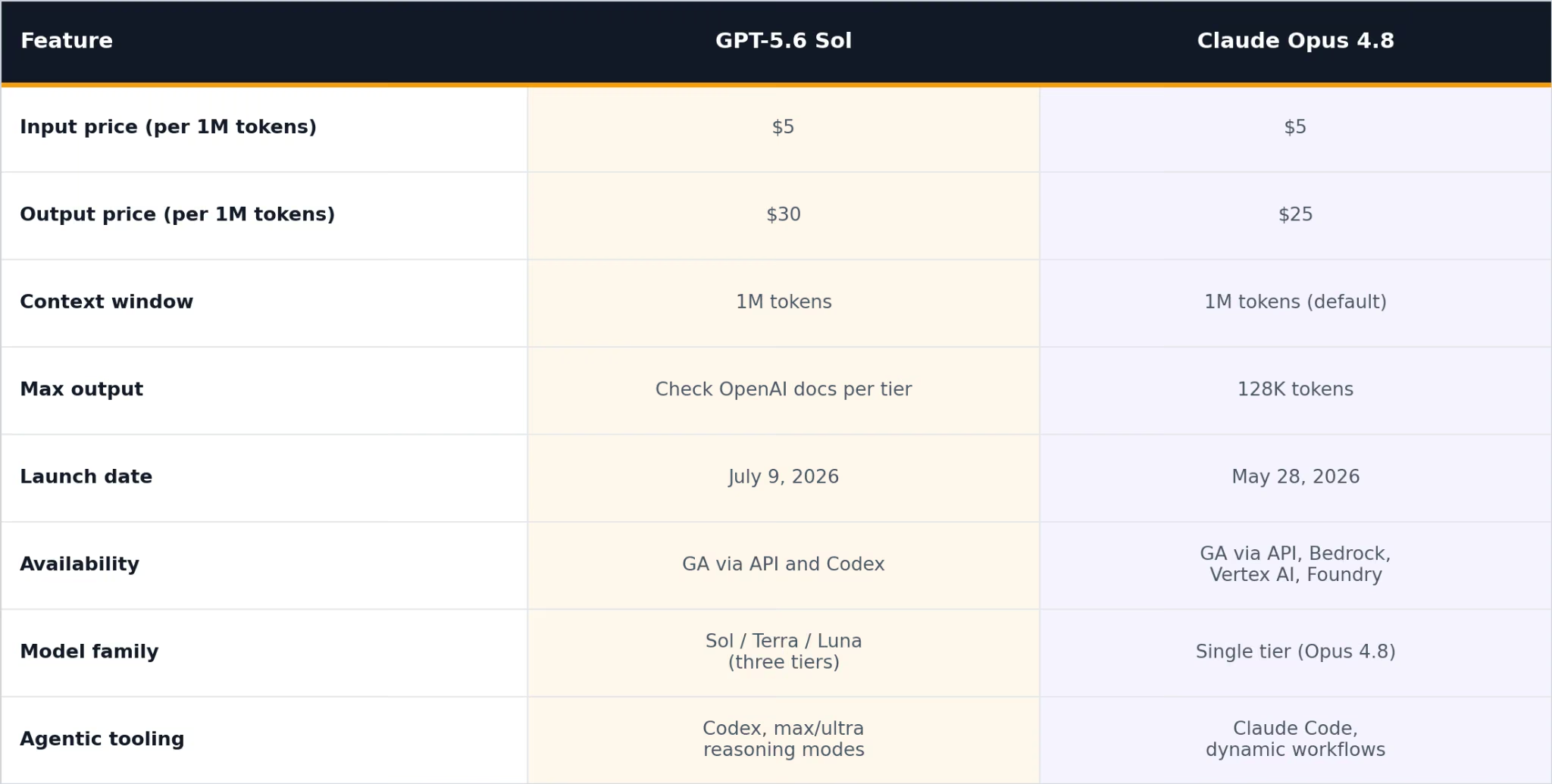
GPT-5.6 vs Claude Opus 4.8 at a glance
The gap between these two models is smaller than most comparison articles suggest. They share the same input price, similar context windows, and both reached general availability in mid-2026. The differences are real but workload-specific.
Pricing as of July 2026.
| Feature | GPT-5.6 Sol | Claude Opus 4.8 |
|---|---|---|
| Input price (per 1M tokens) | $5 | $5 |
| Output price (per 1M tokens) | $30 | $25 |
| Context window | 1M tokens | 1M tokens (default) |
| Max output | Check OpenAI docs per tier | 128K tokens |
| Launch date | July 9, 2026 | May 28, 2026 |
| Availability | GA via API and Codex | GA via API, Bedrock, Vertex AI, Foundry |
| Model family | Sol / Terra / Luna (three tiers) | Single tier (Opus 4.8) |
| Agentic tooling | Codex, max/ultra reasoning modes | Claude Code, dynamic workflows |
The sticker prices look close, but the $5 output gap compounds on long-running coding agents that generate thousands of lines of code per session. We'll break that down in the pricing section below.
Pricing and cost comparison
Opus 4.8 is the cheaper flagship on output, and for most AI-powered applications, output tokens are where the bill lives.
Both models charge $5 per million input tokens. The split happens on output: Sol charges $30 per million, Opus 4.8 charges $25. That's a 17% difference. On a workload that consumes 5 million output tokens per month (not unusual for a production coding agent or document generation pipeline), the difference is $25 per month. Meaningful over time, but not enough to drive the decision alone.
The real pricing story is GPT-5.6's three-tier structure. Sol is the flagship, but Terra ($2.50/$15) and Luna ($1/$6) offer dramatically cheaper options for tasks that don't need frontier reasoning. Luna costs one-fifth of Opus 4.8 on input and roughly one-quarter on output. If your pipeline includes a lot of classification, summarization, or routing work alongside complex reasoning, mixing Luna for the simple tasks and Sol or Opus 4.8 for the hard ones can cut costs substantially.
GPT-5.6 model family pricing vs Claude Opus 4.8. Pricing as of July 2026.
| Model | Input (per 1M tokens) | Output (per 1M tokens) | Best for |
|---|---|---|---|
| GPT-5.6 Sol | $5 | $30 | Hardest reasoning, frontier coding, multi-agent |
| GPT-5.6 Terra | $2.50 | $15 | Everyday work, balanced cost/performance |
| GPT-5.6 Luna | $1 | $6 | High-volume, latency-sensitive, simple tasks |
| Claude Opus 4.8 | $5 | $25 | Complex coding, long-context, agentic workflows |
One thing token pricing does not capture: cost per completed task. A model that gets the answer right on the first attempt is cheaper than a model that requires three retries, even if the per-token rate is lower. We don't have reliable independent task-completion-rate data for both models yet, so this comparison stays at the token level for now. Run both on your actual workload before committing budget.
Benchmark performance
GPT-5.6 Sol wins most published benchmarks, but nearly every score cited below comes from the vendor that made the model. Treat them as directional signals, not gospel.
The benchmark landscape for these models has a specific problem worth knowing about: Cursor published research in June 2026 showing that frontier models can retrieve solutions from the internet or git history during standard benchmark runs, inflating scores. Under stricter evaluation conditions, performance dropped meaningfully. That doesn't mean benchmarks are useless. It means the margin between two models on a given benchmark may be smaller (or larger) in practice than the published numbers suggest.
With that caveat, here's where the published data points:
| Benchmark | GPT-5.6 Sol | Claude Opus 4.8 | Winner | Category |
|---|---|---|---|---|
| Terminal-Bench 2.1 | 88.8% | 78.9% | Sol | Agentic coding |
| SWE-bench Pro | 64.6% | 69.2% | Opus 4.8 | Real codebase fixes |
| BrowseComp | 92.2% | 84.3% | Sol | Agentic browsing |
| GPQA Diamond | 94.6% | 92% | Sol | Scientific reasoning |
| FrontierMath v2 (Tiers 1-3) | 89% | ~47% | Sol | Advanced math |
| OSWorld 2.0 | 62.6% | 54.8% | Sol | Computer use |
| Coding Agent Index (Artificial Analysis) | 80 | 72.5 | Sol | Coding (independent) |
| Intelligence Index (Artificial Analysis) | 59 | 56 | Sol | Overall (independent) |
Sol wins the majority of these head-to-heads. The exception that matters most is SWE-bench Pro, which tests the ability to fix real bugs in real codebases, not solve self-contained problems. Opus 4.8 scores 69.2% vs Sol's 64.6%. For teams whose primary use case is maintaining and debugging production code, that gap is worth weighting heavily.
The Artificial Analysis data is notable because it comes from an independent evaluator, not from OpenAI or Anthropic. Their Intelligence Index puts Sol at 59 and Opus 4.8 at 56 (both at max reasoning effort). Close enough that practical differences will depend more on your specific use case than on a three-point index gap.
Coding and agentic workflows
Opus 4.8 is the stronger pick for disciplined code review and long-running agent reliability. Sol is stronger for terminal-driven work and rapid multi-agent execution.
This is where the competition gets interesting, because "coding" is not one task. Writing a function from scratch, reviewing a pull request, debugging a production incident, and migrating a framework across a monorepo are all "coding," but they test completely different model capabilities.
Claude Opus 4.8's edge: self-review and persistence. Anthropic reports that Opus 4.8 is roughly four times less likely than its predecessor (Opus 4.7) to let flaws in its own code pass unremarked. That number comes from Anthropic's internal evaluation, so take it with appropriate skepticism, but the claim maps to a real failure mode that wastes developer time: an agent that confidently declares a half-broken task done. Opus 4.8 also powers Claude Code, Anthropic's agentic coding tool, which recently shipped dynamic workflows that can orchestrate hundreds of parallel subagents for codebase-scale migrations.
GPT-5.6 Sol's edge: terminal work and ultra mode. Sol claims state-of-the-art performance on Terminal-Bench 2.1, which tests shell-based agentic coding. OpenAI published no numeric score with this claim during the initial announcement, though subsequent third-party evaluations report 88.8%. Sol also introduces ultra mode, where the model coordinates multiple subagents in parallel to tackle complex tasks faster. OpenAI reports that on Terminal-Bench 2.1, ultra mode pushed Sol's score to 91.9%.
A developer who spent a week running both models on Project Euler problems found a telling pattern: the difference between getting a correct answer and a wrong one had less to do with raw intelligence and more to do with verification thoroughness. Opus 4.8 spontaneously incorporated cross-checks and brute-force verification without being instructed to. Sol ran faster but occasionally skipped candidate verification at medium reasoning effort, which led to wrong answers that passed the problem's built-in test cases (source: DevelopersIO, July 2026).
For coding agents in production, measure more than whether the model produces plausible code. Track whether it selects the right files, uses tools safely, recovers from failures, runs appropriate tests, explains unresolved issues, and finishes within the permitted scope.
Context window and long-document handling
Both models offer a 1M-token context window, which eliminates the context gap that used to separate them from smaller models.
Opus 4.8's context window is the more thoroughly documented of the two. Anthropic confirms 1M tokens by default with 128K max output (extendable to 300K via the Message Batches beta). On Microsoft Foundry, Opus 4.8 is capped at 200K, so if your organization runs Claude through Azure, plan for the smaller window.
GPT-5.6's context window is listed at 1M tokens by Artificial Analysis, matching Opus 4.8. Some community reports have cited 1.5M, but this figure does not appear in OpenAI's official documentation. Don't build production plans around it.
For practical purposes, both models can ingest a large codebase, a set of legal documents, or a lengthy research corpus in a single call. The question isn't whether they can hold the context but whether they can reliably retrieve and reason over details buried deep in that million-token window. Long-context retrieval accuracy is harder to benchmark than simple capacity, and neither vendor publishes comprehensive retrieval-accuracy data at the full 1M limit.
If long-document work is central to your use case, test both models with questions whose answers are distributed across the context rather than concentrated near the beginning or end.
The GPT-5.6 model family: Sol, Terra, and Luna
GPT-5.6 is not one model. It's three, and understanding the tiers matters for both cost planning and capability matching.
OpenAI structured GPT-5.6 around a naming convention it intends to keep across future generations. The numbers (5.6) represent the generation. The names (Sol, Terra, Luna) represent capability tiers that can advance independently.
Sol is the flagship. It targets the hardest reasoning, coding, and agentic workloads. It includes max mode (deeper single-agent reasoning) and ultra mode (multi-agent parallel execution). Sol is the tier that competes directly with Opus 4.8 and Fable 5.
Terra is the balanced middle tier. OpenAI positions it as delivering GPT-5.5-level performance at roughly half the cost. At $2.50/$15, Terra is meaningfully cheaper than either Sol or Opus 4.8, and Artificial Analysis scores it at 55 on their Intelligence Index, just one point below Opus 4.8's 56. For workloads that don't need absolute frontier capability, Terra may deliver 90% of the quality at half the price.
Luna is the speed and cost tier. At $1/$6, it's built for high-volume, latency-sensitive tasks: classification, extraction, tagging, simple summarization, and routing decisions. OpenAI has not published capability benchmarks for Luna (only safety and health evaluations), so don't assume it can replace Opus 4.8 on hard tasks.
The smart architecture is not loyalty to one tier. Route frontier work to Sol or Opus 4.8 and routine work to Luna or Terra. A pipeline split 80/20 between Luna and Opus 4.8 can cut costs by more than half while keeping full flagship quality on the tasks that need it.
What about Claude Fable 5? Why this comparison isn't the full picture
Neither GPT-5.6 Sol nor Claude Opus 4.8 is the top model from its respective lab, and being transparent about that matters more than pretending it doesn't.
Anthropic's model hierarchy goes Opus 4.8 → Fable 5. OpenAI's own GPT-5.6 announcement page benchmarks Sol against Fable 5 and "Mythos Preview," not against Opus 4.8. That tells you where OpenAI sees the real competition.
So why compare Sol and Opus 4.8 at all? Because for most teams and most budgets, this is where the decision actually happens.
Fable 5 costs $10 per million input tokens and $50 per million output tokens. That's double Sol and double Opus 4.8. For a production pipeline running millions of tokens daily, the difference between $25 and $50 per million output tokens is the difference between a sustainable operating cost and one that forces you to ration usage.
The benchmark picture between Sol and Fable 5 is closer than you might expect:
| Benchmark | GPT-5.6 Sol | Claude Fable 5 | Claude Opus 4.8 |
|---|---|---|---|
| Intelligence Index (Artificial Analysis) | 59 | 60 | 56 |
| Coding Agent Index | 80 | 77.2 | 72.5 |
| SWE-bench Pro | 64.6% | 80% | 69.2% |
| Agents' Last Exam | 53.6% | 40.5% | 45.2% |
| Terminal-Bench 2.1 | 88.8% | 83.1% | 78.9% |
Fable 5 dominates on SWE-bench Pro (80% vs Sol's 64.6%) and leads the Artificial Analysis Intelligence Index by a single point. Sol wins on terminal-agent work and Agents' Last Exam by significant margins. They trade blows on the Coding Agent Index.
The pattern: Fable 5 is the better model for pure software engineering at established codebases. Sol is stronger at terminal-driven execution and long-horizon professional workflows. Opus 4.8 trails both but costs half as much as Fable 5 and still scores competitively on most evaluations.
For the users who want the absolute best and can afford it, Fable 5 deserves serious evaluation.
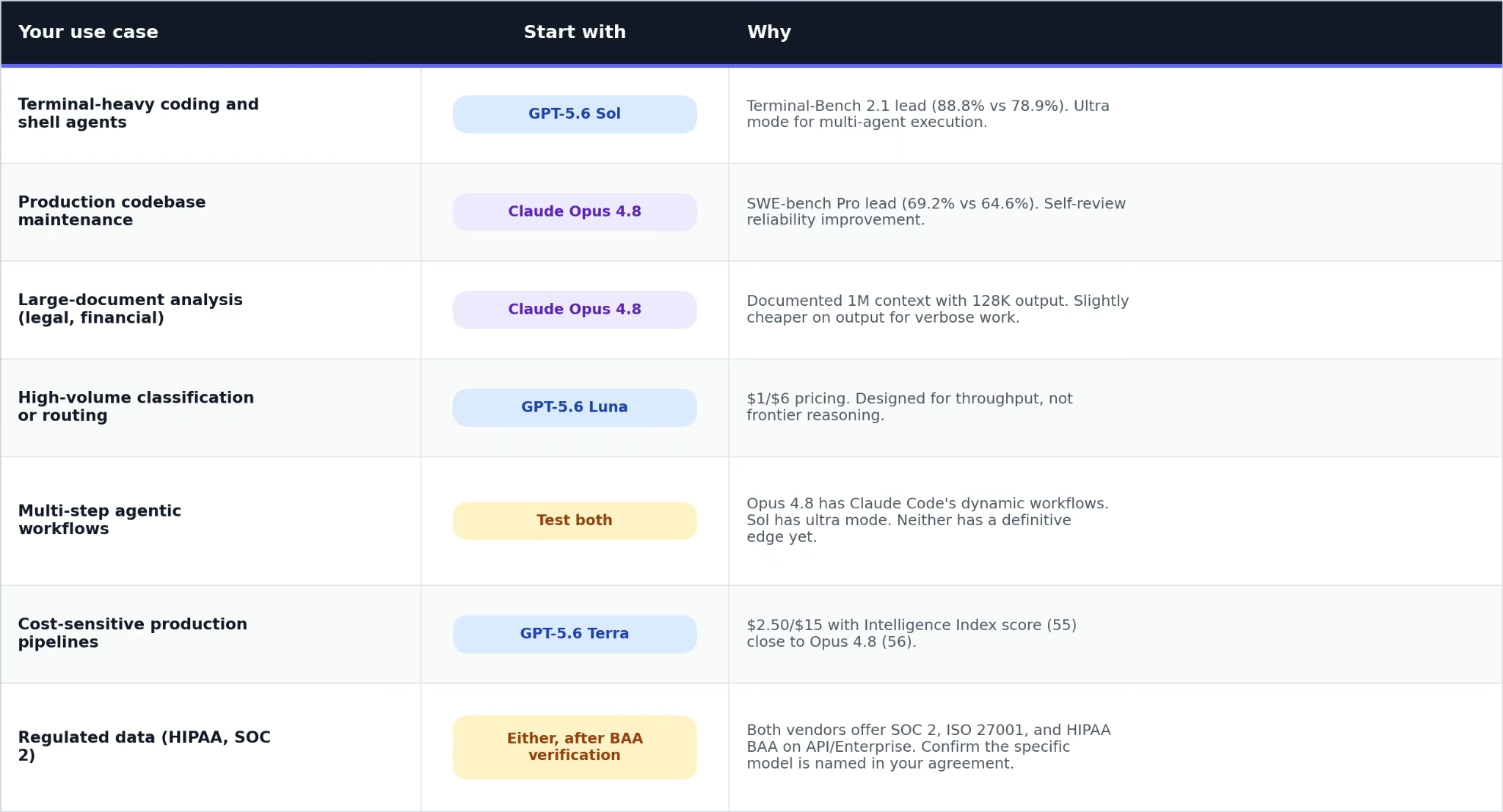
Which model should you choose?
Pick based on what you're building, not on which model scores higher on an aggregate leaderboard.
| Your use case | Start with | Why |
|---|---|---|
| Terminal-heavy coding and shell agents | GPT-5.6 Sol | Terminal-Bench 2.1 lead (88.8% vs 78.9%). Ultra mode for multi-agent execution. |
| Production codebase maintenance | Claude Opus 4.8 | SWE-bench Pro lead (69.2% vs 64.6%). Self-review reliability improvement. |
| Large-document analysis (legal, financial) | Claude Opus 4.8 | Documented 1M context with 128K output. Slightly cheaper on output for verbose work. |
| High-volume classification or routing | GPT-5.6 Luna | $1/$6 pricing. Designed for throughput, not frontier reasoning. |
| Multi-step agentic workflows | Test both | Opus 4.8 has Claude Code's dynamic workflows. Sol has ultra mode. Neither has a definitive edge yet. |
| Cost-sensitive production pipelines | GPT-5.6 Terra | $2.50/$15 with Intelligence Index score (55) close to Opus 4.8 (56). |
| Regulated data (HIPAA, SOC 2) | Either, after BAA verification | Both vendors offer SOC 2, ISO 27001, and HIPAA BAA on API/Enterprise. Confirm the specific model is named in your agreement. |
If you're torn, the honest answer is: run both on the same set of representative tasks from your actual workload. Token pricing and benchmark tables can narrow the candidates. Only your own evaluation can pick the winner.
How to build with GPT-5.6 or Claude Opus 4.8 without writing code
Once you've settled on a model, the next question is practical: how do you actually build with it without managing API keys, provider accounts, and infrastructure for each one?
Emergent already supports GPT-5.6 Sol, and GPT-5.6 Terra, and Opus 4.8. Describe your app in plain English, and Emergent's agents handle the code, database, auth, payments, and deployment. If a future release shifts the performance balance, switch models without rebuilding anything.
You don't even need to leave your existing AI workflow to start. Emergent's MCP Connector lets you build full-stack apps directly from ChatGPT or Claude. If you're already inside one of those tools comparing models, you can go from "describing your app" to "my app is deployed" without opening a new tab.

Most AI app builders stop at prototypes. Emergent creates production-ready apps you can actually launch.
- Production-ready apps
- Web & mobile apps
- Deploy in minutes