To settle the Replit vs. Lovable vs. Emergent debate, I gave all three the same brief: a client tracker with logins, a database, and per-user views. Only one shipped it.
Replit vs. Lovable vs. Emergent: At a Glance
These three tools solve the same problem (I want to build an app without an engineering team) in very different ways. Lovable generates a pretty interface and leaves the hard parts to you. Replit hands you full control of the code and assumes you know what to do with it. Emergent tries to handle everything, from the first screen to the live URL.
| Tool | Best For | Starting Price | Key Strength |
|---|---|---|---|
| Replit | Developers who want AI help inside a real coding environment | Free, or $20/mo Core ($18/mo billed annually) | A full browser-based coding workspace in one tab |
| Lovable | Solo builders who need a polished prototype fast | Free (5 credits/day), or $25/mo Pro ($21/mo billed annually) | The best-looking first draft, plus the strongest user reviews |
| Emergent | Non-technical founders who want a working web or mobile app, fully deployed | Free (10 credits/mo), or $20/mo Standard ($17/mo billed annually) | Builds, tests, and deploys automatically, including mobile |
Choose Emergent if you want to describe your app in plain language and get something live without managing the technical setup yourself.
Choose Lovable if you need something that looks great fast and you're okay finishing the complex parts later.
Choose Replit if you can read code and want to stay in control while AI speeds you up.
Meet the Contenders
Replit: A Coding Environment With an AI Agent Inside
Replit puts the code front and center. It's a browser-based coding environment, so you open a tab, describe what you want, and the AI agent writes code you can read and edit yourself.
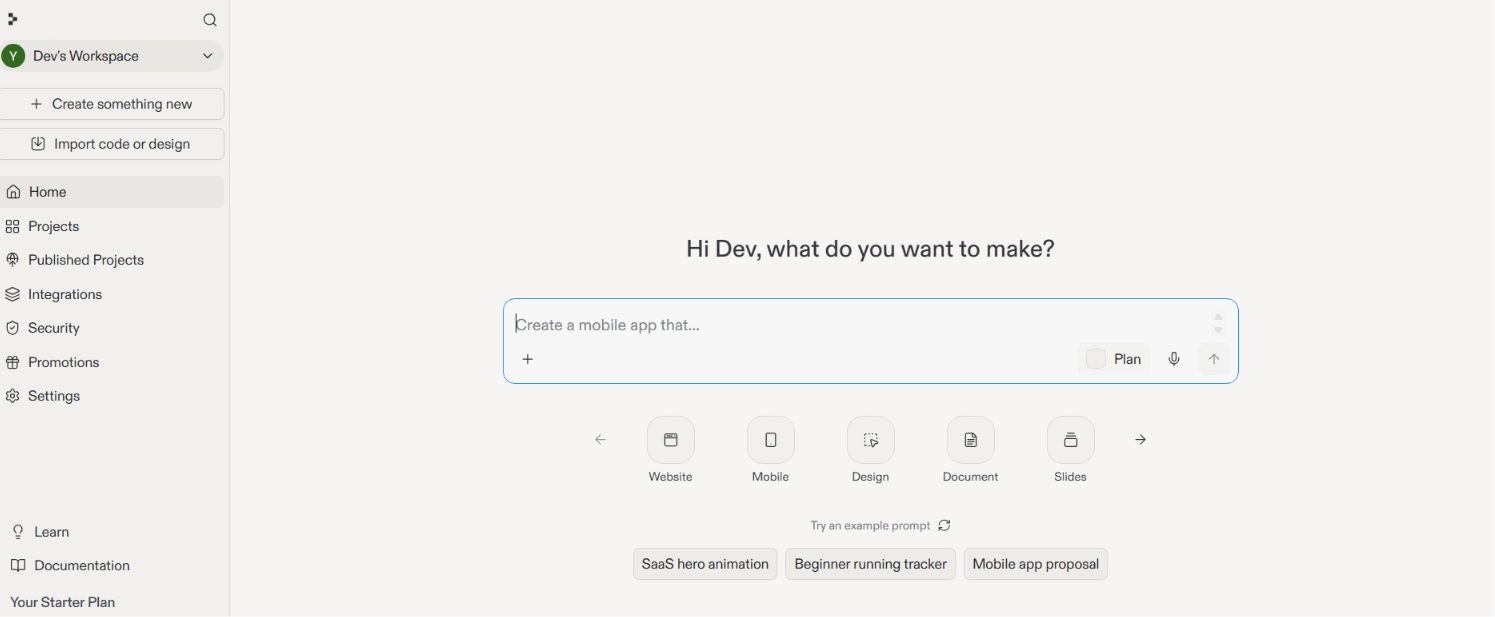
For the project tracker, I could see every file, every database table, and every line. If you know what you're looking at, that's incredibly useful. You can catch the AI's mistakes and fix them directly. If you don't, it's overwhelming, and Replit doesn't pretend otherwise. It's built for people comfortable with code or willing to learn.
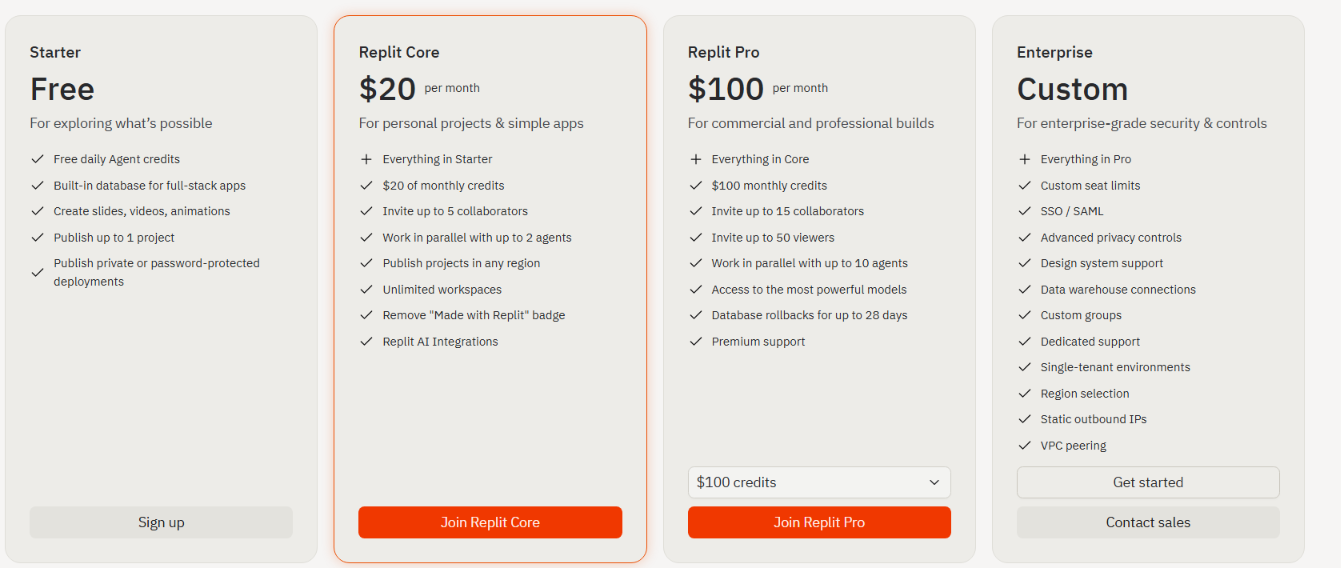
Pricing is free for Starter, which includes daily Agent credits. Core is $20/month, or $18/month billed annually, and includes $20 in monthly credits, up to five collaborators, and up to two parallel agents. Pro is $100/month, or $90/month billed annually, and includes $100 in monthly credits, up to 15 collaborators, up to 50 viewers, and up to 10 parallel agents.
Lovable: The Fastest Way to Something That Looks Real
Lovable is about a good-looking first draft, fast. The same project tracker came out polished on the first try: clean layout, professional components, the kind of UI that makes you feel like you hired a designer.
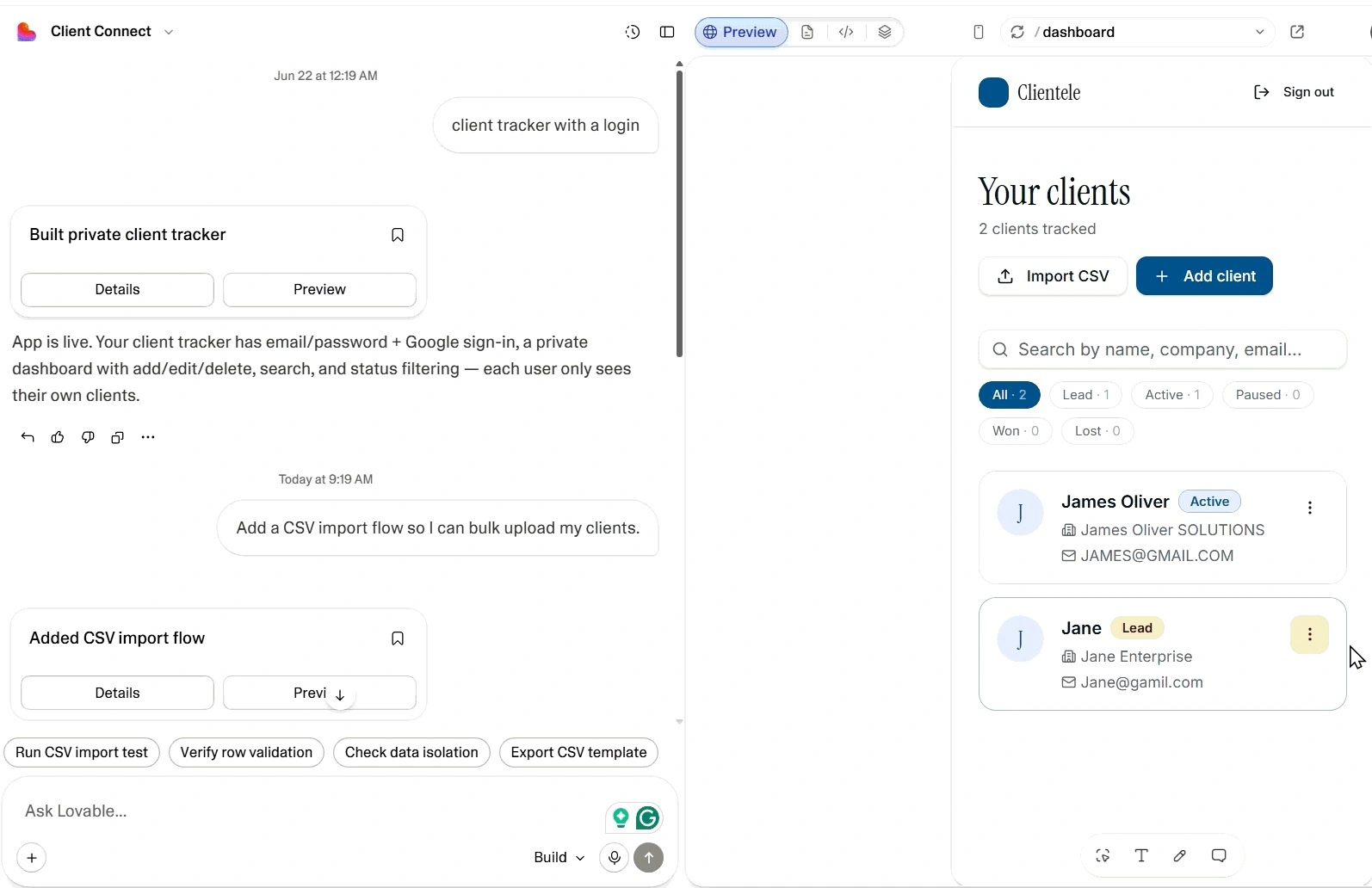
Lovable builds web apps using React with a Supabase backend (an open-source tool that handles your database and user logins). You don't need to know that to use it. You do need to know it exists, because fixing backend issues later often takes technical knowledge that the interface hides.
Want to see what else is worth trying before you commit? Our best Lovable alternatives breakdown covers the closest options.
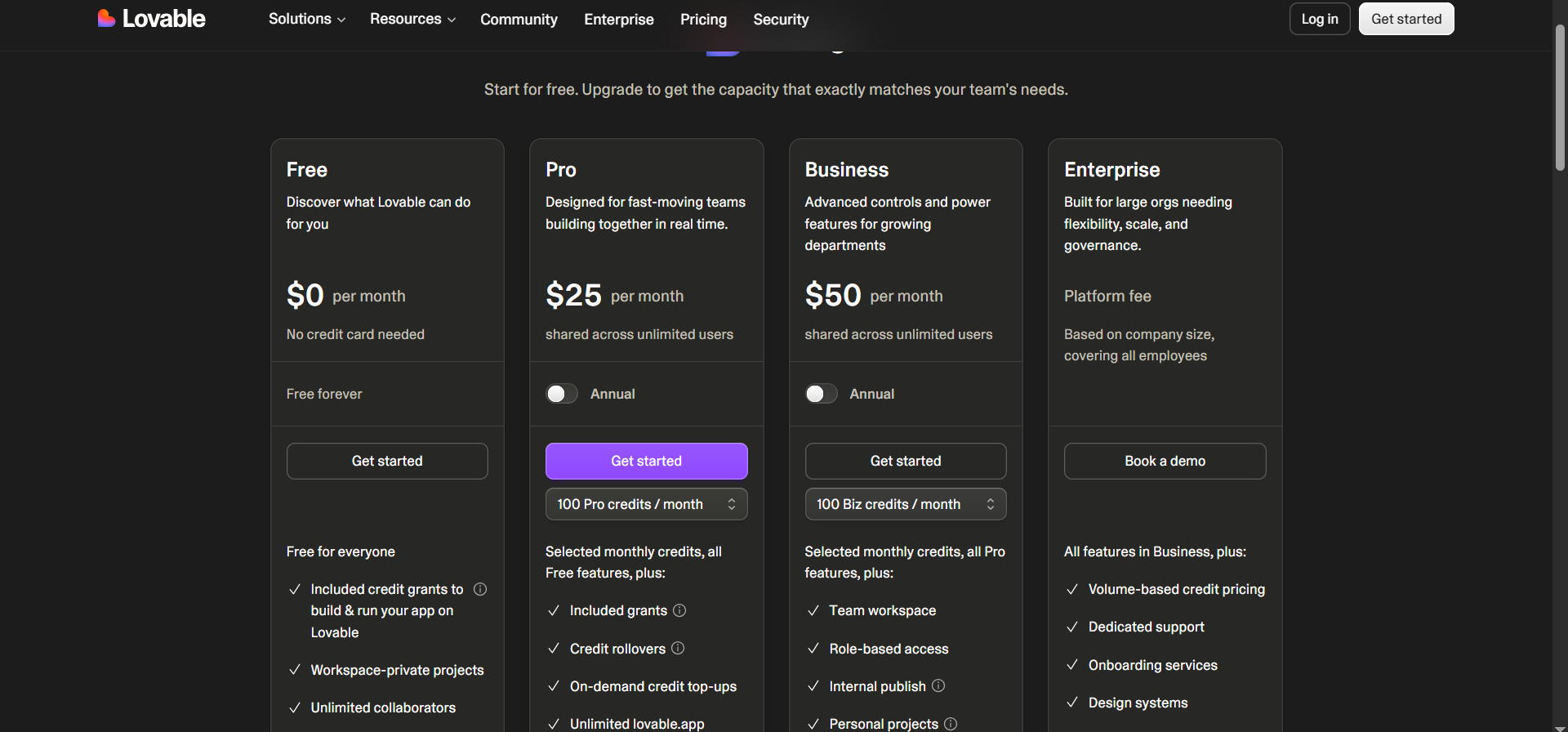
Lovable has a free plan with five daily credits (up to 30 per month), workspace-private projects, unlimited collaborators, and five lovable.app domains. Pro is $25/month, or $21/month billed annually, and adds 100 monthly credits, credit rollovers, top-ups, custom domains, and badge removal.
Business is $50/month, or $42/month billed annually, adding team workspaces, SSO, internal publishing, role-based access, design templates, and a security center.
Emergent: Handles The Whole Build For You
Most app builders give you a starting point and leave the rest to you. Emergent works differently. You describe what you want, and a system of specialized agents splits the work: some shape the interface, others handle the backend logic and integrations, and testing agents check everything before it reaches you.
I used it to build a client-facing project tracker, the kind where a client logs in, sees their project status, and leaves comments. That needs user accounts, a database, and different views per user. I described all of it in one prompt, and Emergent started building.
The part that sets it apart is what happens after the build. Emergent also handles deployment, meaning it gets your app onto the internet automatically. Emergent does not require server setup or a separate hosting plan.
It supports web and mobile apps, with mobile built on React Native and Expo (a framework that publishes to the App Store and Google Play). GitHub access comes with the Standard plan, so a developer can take over if needed.

Pricing runs free (10 credits/month), $20/month Standard ($17/month billed annually, 100 credits), and $200/month Pro ($167/month billed annually, 750 credits, plus a larger context window for complex builds).
Feature Breakdown
First-Draft Quality
Every builder needs to turn the first prompt into something usable. Given the same brief, the three landed in different places.
Replit sat in the middle on looks and ahead on transparency, since the full codebase is visible from the start. That setup is great for a developer, but overwhelming for everyone else.
Lovable looked best. It had clean spacing and sensible colors, and it felt client-ready within the hour. The catch is that looking finished and working correctly are different things. Some buttons misbehaved, and the logic between screens needed follow-up prompts.
Emergent wasn't the prettiest, but its core features worked. That testing agent running before you see anything is the reason. For an app that needs real logins and real data, working beats pretty on day one.
Winner: Lovable wins on first impressions. Emergent wins if you need the app to function.
Getting Past The First 80%
Every builder produces something in 10 minutes. The real test is the refining, fixing, and adding that comes after. The first version gives you the basic structure. Making it livable is the slow, expensive part.
For the tracker, I needed each user to see only their own projects. That takes row-level security, a set of rules controlling who can access which data.
Replit has the same loop, but effort-based pricing raises the stakes, since a session where the agent tries five approaches costs far more than one that works on the first try. You find out after the credits are gone.
Lovable struggled to get it right, and every fix broke something else. That prompt-fix-break loop is where its credits vanish: A single complex session can burn 20 to 30 of your 100 monthly credits.
Emergent handles this stage best. The testing agent catches issues before you see them, and it holds up better on larger codebases without breaking what already works. Emergent still has limits. Past your third or fourth round of major changes, your local version and the live version can drift apart in ways that are hard to reconcile.
Winner: Emergent wins because its testing agent catches regressions before you see them, and it holds up on larger codebases without breaking what already works.
Deployment And Hosting
Deployment takes your app from your screen to other people's browsers. It's where a lot of builds stall.
Replit offers flexible options like autoscaling, and its free Starter tier supports private or password-protected deployments. Private deployments at scale live on the Pro plan ($100/month).
Lovable deploys to its own hosting in one click, or you can export to GitHub and host on Vercel yourself. Hosting is billed separately from credits, which is an easy bill to miss once you have real traffic.
Emergent is the most hands-off. Apps deploy automatically with a working URL, custom domains via IONOS (free for the first year), and a dashboard showing traffic, errors, and health checks. Mobile apps publish straight to the App Store and Google Play once you link your developer account.
Winner: Emergent. Automatic deployment, real monitoring, and mobile publishing in one place.
Pricing Predictability
All three charge by credits, where each AI request costs more depending on its complexity. Credit pricing is the most common complaint across every tool.
Replit is the hardest to budget. Effort-based pricing means a task's cost depends on how hard the agent worked, which you learn only afterward. One Reddit user called it "pricing is officially a casino," and "expensive" shows up in roughly 18% of Replit's G2 reviews.
Lovable is the most predictable. Simple changes cost about 0.5 credits, complex ones around 1.2, so you can roughly estimate a session before you start. The surprise isn't the rate; it's how many messages a bug fix swallows.
Want the full breakdown of what each plan actually covers? Our Lovable pricing guide goes deeper on what you're really paying for.
Emergent sits between them, structured like Lovable but with fewer expensive loops, since the testing agent prevents some of the back-and-forth. The credit-burn complaint still appears in its reviews, so the problem is less severe but still there.
Winner: Lovable. Cost-per-message is something you can plan around.
Technical Accessibility
This is how much you need to know before the tool is useful to you.
Replit asks for the most technical comfort. The interface is a coding environment first, built on the assumption that you can read what the AI produces and correct it. Without that, you're requesting changes you can't verify.
Lovable is the easiest entry point. You do not need code for a working prototype. The limits appear once you go past a simple form and need to troubleshoot. Code editing inside Lovable needs the Pro plan; GitHub export works on all plans.
Emergent is built for non-technical users without hiding the depth. The code is there when you want it. For beginners, the Universal LLM Key is a standout because it lets you add AI features (a chatbot, a content generator) using Emergent credits. You do not have to sign up for OpenAI or Google separately or manage API keys, the passwords that connect your app to an AI model.
Winner: Emergent wins for non-technical builders. Replit wins for developers who want full control.
What Real Users Are Saying
My testing is one project by one person. To check it against the long haul, I read through G2, Trustpilot, and Reddit. The shared theme: every tool impresses early and frustrates later. Where that frustration lands is what separates them.
Lovable
Liked: The strongest reputation of the three, at 3.9/5 on Trustpilot rating across 1,200+ reviews and 4.65 rating on G2. The praise matches my experience: Lovable was fast and easy, and its first drafts looked good. One G2 reviewer cited "how quickly it helps turn an idea into a usable web app."
Disliked: I hit two problems. The two problems were credits and security gaps on apps that look done but aren't. A developer who fixes broken Lovable projects flagged "Supabase security holes (RLS not enforced, data leaks)," meaning an app can ship with user data exposed. That's why many treat Lovable as a starting point, syncing to GitHub once "credits run out."
Want more hands-on takes before you decide? Read our Lovable Reviews for a closer look at what real users actually ran into.
Replit
Liked: Among people who code, a strong 4.5/5 rating on G2, with ease of use the top-cited strength. One Trustpilot reviewer said it "does the 99% work for you," as long as you direct it well.
Disliked: Users complained most loudly about cost. One user said the agent was "burning through my credits like wild fire." A beginner tracked $355 in charges over 10 days. Another summed up the model: "I have no idea if my project is going to cost me $10 or $100 by the end of the night."
Want more hands-on takes before you decide? Read our Replit Reviews for a closer look at what real users actually ran into.
Emergent
Liked: The end result. One Trustpilot reviewer wrote, "I've created an app that people are using every day." On G2, a user called it "one of the best vibe coding apps out there." Mobile support and automatic deployment come up most.
Disliked: Credits, the same complaint that follows every tool in this category. One Trustpilot reviewer described the agent charging to "fix the same issue they couldn't fix again and again."
Another drew a line on fit: "For small project or test it's ok, not for professional use.” Worth reading those with context, though: Emergent actively asks customers for feedback and replies to ~76% of negative reviews, usually within a week, so its profile captures more raw, unfiltered input.
Which Tool Should You Choose?
There's no single winner. It comes down to what you're building, how technical you are, and how much billing uncertainty you can stomach. All three nail the early stretch. They split on the final stretch, where your app has to work for real users, so weigh that heavily
Choose Lovable if you:
- Need the best-looking first version, fast
- Are building a landing page, MVP, or prototype where looks lead
- Will finish the harder parts in GitHub or with a developer
- Have a budget that fits the $25/month plan
Choose Replit if you:
- Can read and edit code and want control over what the AI produces
- Want a full coding environment in one place
- Want AI to speed you up, not replace your judgment
- Will watch your credit usage closely
Choose Emergent if you:
- Want something live without setting up hosting, databases, or deployment
- Are non-technical and need logins and data storage to be handled for you
- Are building real complexity (multiple user types, payments, client logins)
- Plan to publish a mobile app without learning a framework
My Final Verdict
For the person most likely reading this, a non-technical founder or a small team without a developer, I'd point to Emergent.
I tested all three tools on the same tracker app. Only Emergent produced a working, deployed app without requiring outside tools or extra knowledge.
Lovable gave the best-looking result, good for mockups, but needing real security rules, sent it to GitHub and a prompt loop. Replit is the strongest tool for developers, but the meter runs while the agent debugs its own mistakes, which gets costly fast if you can't step in.
Emergent isn't flawless. Its 2.8/5 Trustpilot score is the weakest of the three, and the credit complaints are real. What tips it is everything it handles automatically that the others make you assemble the build, the testing, the deployment, the mobile publishing, and the monitoring. For someone without engineers, that bundle is the difference between launching and stalling.
Credit anxiety is a category problem in 2026 rather than a problem specific to Emergent or Replit. Every tool here charges by usage and loops sometimes. The better question is which tool gets you furthest before you hit a wall. For most people, building something real, that's Emergent.
Ready to Build Your First App?
Don't start with the easy stuff. Point Emergent at the part of your idea you're least sure about, the login, the database, or whatever you'd otherwise pay a developer to figure out, and watch how it handles the hard part before you commit.
Emergent's free plan gives you 10 credits and asks for no card, enough to find that out before you spend a dollar. The Standard plan is $20/month when you want more. One tip from my testing: start with a detailed, specific first prompt. The clearer it is, the less you'll spend fixing things later.

Every alternative has trade-offs. Emergent just builds production-ready apps from one prompt.
- Production-ready apps
- Web & mobile apps
- Deploy in minutes