


AI Learns Your Job: Replacement or Workplace Revolution?

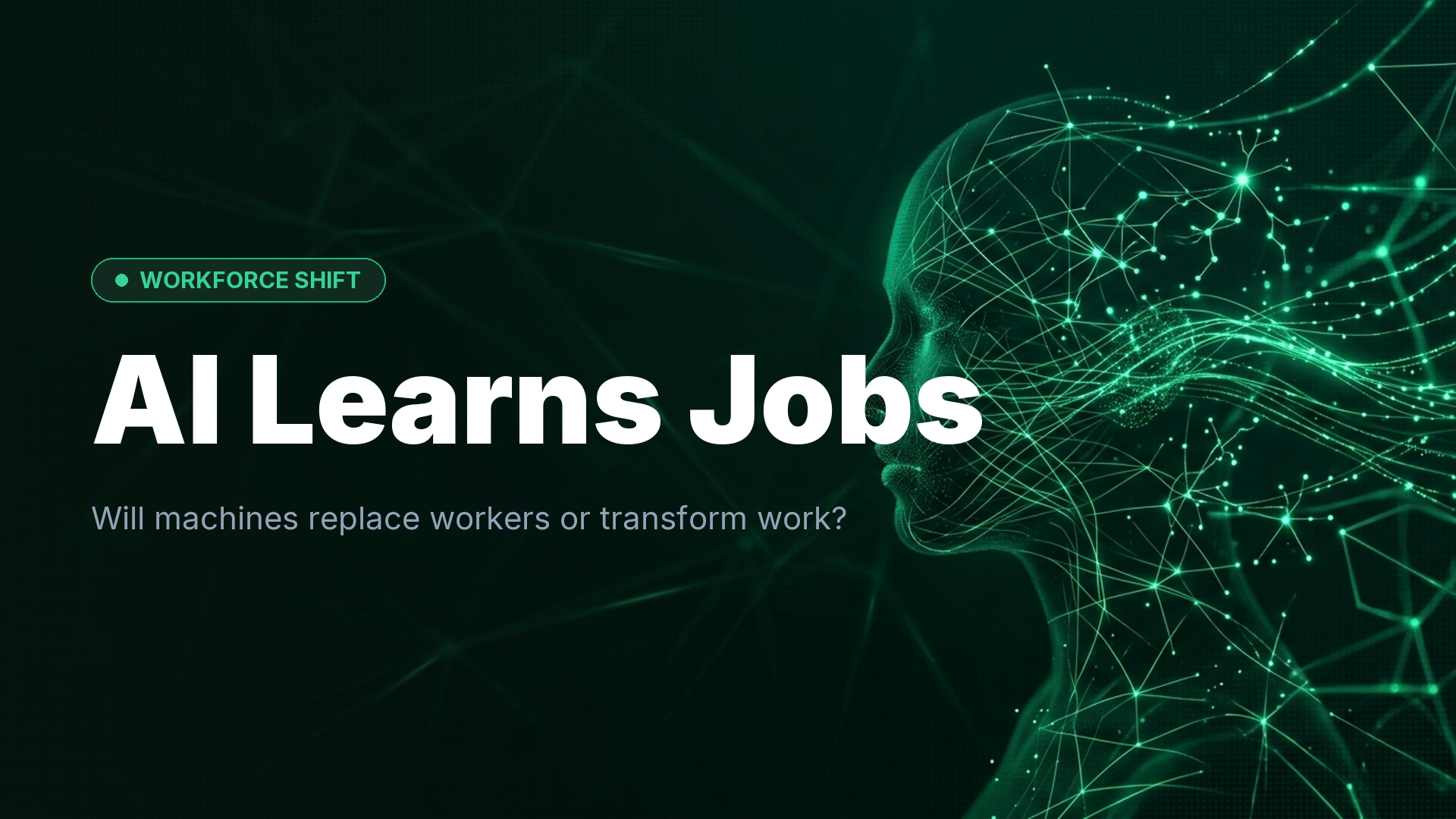
Officially launched on October 4, 2026.
Artificial intelligence systems are now being trained to perform tasks that once required years of human expertise, sparking urgent questions about the future of work. From customer service representatives to creative professionals, no industry remains untouched as AI capabilities expand at an unprecedented pace. The critical question facing workers in 2026 is not whether AI will impact their careers, but how to position themselves in a rapidly evolving job market.
What AI Can Do Now
Today's AI systems handle complex workflows that seemed impossible just two years ago. Business intelligence platforms now autonomously analyze market trends and generate strategic recommendations. Customer service bots resolve intricate support tickets without human intervention. AI writing assistants draft legal documents, marketing copy, and technical reports with increasing accuracy.
The technology has moved beyond simple automation. Modern AI systems learn organizational processes, adapt to company-specific workflows, and execute multi-step tasks requiring contextual understanding. Industries from healthcare to finance report significant productivity gains from AI implementation, with some organizations reducing task completion time by 60-70 percent.
Jobs at Risk and Jobs Evolving
Research indicates that roles involving repetitive tasks, data entry, and routine decision-making face the highest displacement risk. Call center operators, data processors, and basic bookkeepers see AI systems already performing their core functions. However, complete job elimination remains rare. Instead, most positions are experiencing radical transformation.
The pattern emerging across sectors shows AI handling routine components while humans focus on exceptions, relationship management, and strategic thinking. A job search analysis reveals growing demand for hybrid roles combining domain expertise with AI tool proficiency. Employers increasingly seek candidates who can supervise AI systems, validate outputs, and apply human judgment to complex situations.
- Entry-level positions shrinking as AI handles initial screening and basic tasks
- Mid-career roles expanding to include AI system management and output validation
- Senior positions refocusing on strategic oversight and uniquely human decision-making
- New career paths emerging in AI training, prompt engineering, and human-AI workflow design
The Skills That Matter Now
Workers thriving in the AI era share common characteristics. They view AI as a productivity amplifier rather than a threat, actively learning to integrate these tools into their workflows. Critical thinking, emotional intelligence, and creative problem-solving have become premium skills that AI cannot easily replicate.
Technical literacy now extends beyond traditional IT roles. Professionals in marketing, human resources, and operations increasingly need to understand AI capabilities, limitations, and appropriate use cases. The ability to effectively communicate with AI systems through precise prompting has emerged as a valuable meta-skill across industries.
Organizations report that employees who embrace AI training programs advance faster than peers who resist technological change. Companies are investing heavily in reskilling initiatives, recognizing that their competitive advantage depends on workforces capable of human-AI collaboration.
Availability and Impact Timeline
These AI workplace automation capabilities are officially launched and currently available across enterprise platforms. Major technology providers including OpenAI, Google, and Anthropic have released business-focused AI tools throughout 2026, with adoption accelerating across sectors. The transformation is happening now, not in some distant future.
Industry analysts project that within 18 months, virtually every knowledge worker will interact with AI systems daily. Organizations not implementing AI productivity tools risk falling behind competitors who leverage these capabilities for speed and efficiency advantages.
What This Means
The AI workplace revolution represents transformation rather than replacement for most workers. Success in this new environment requires proactive adaptation, continuous learning, and strategic positioning. Workers who develop complementary skills, embrace AI collaboration, and focus on uniquely human contributions will find expanded opportunities. Those who resist change face increasing career challenges as AI-augmented colleagues demonstrate superior productivity. The choice facing today's workforce is clear: evolve with the technology or risk obsolescence in an increasingly AI-integrated professional landscape.
on Emergent today




