


ChatGPT Work and Codex Education Plugins Now Available

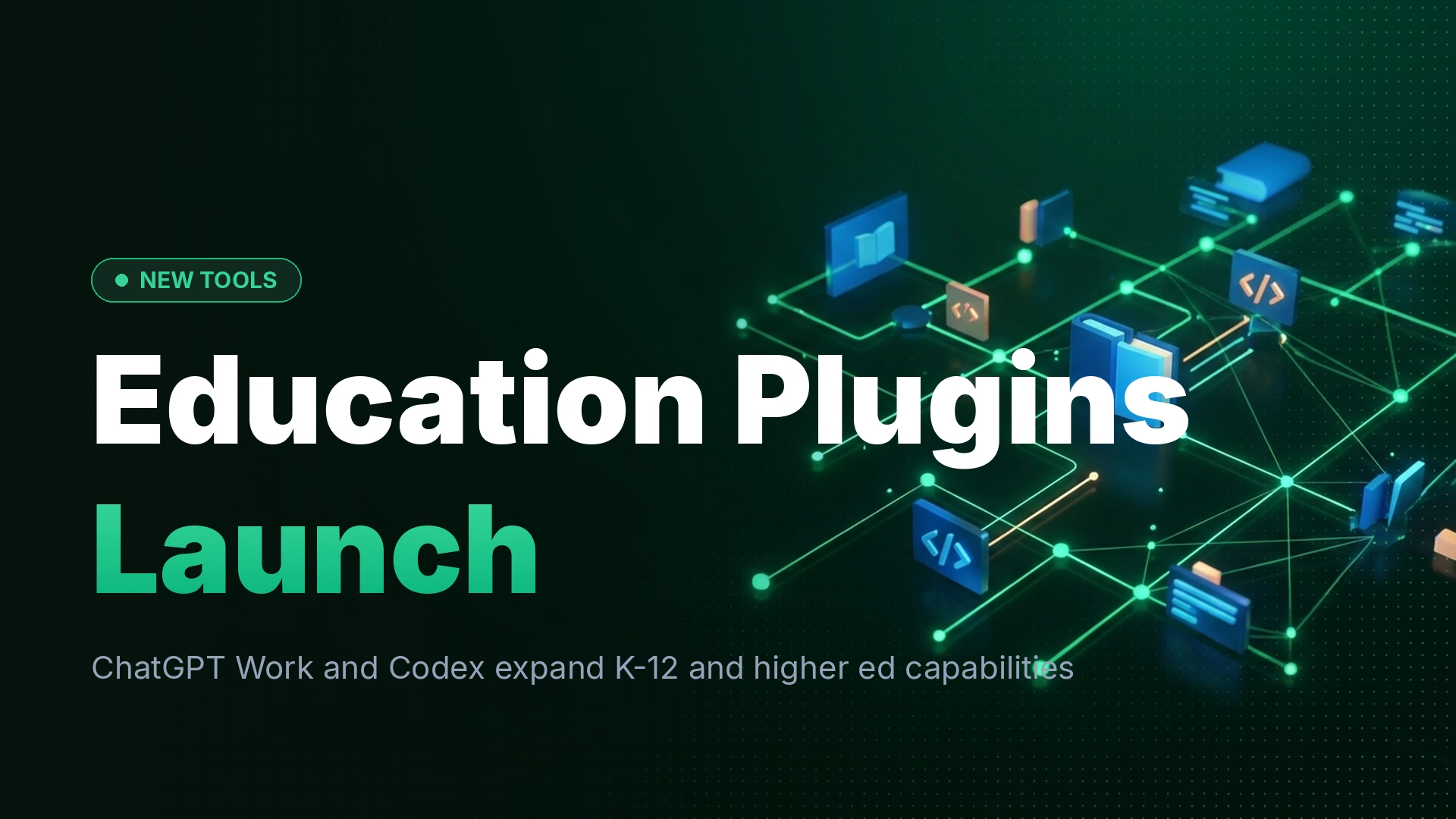
OpenAI has released a suite of education-focused plugins for ChatGPT Work and Codex, designed to support K-12 teachers, college educators, and students across teaching, learning, research, and coding activities. The new tools integrate directly into existing ChatGPT Work and Codex environments, providing educators and learners with specialized capabilities tailored to academic workflows.
Plugin Features for K-12 Teachers
The K-12 education plugins offer lesson planning assistance, curriculum alignment tools, and differentiated instruction support. Teachers can generate age-appropriate content, create assessment rubrics, and develop individualized learning materials within ChatGPT Work. The plugins include safety filters and content moderation specifically calibrated for younger students, ensuring outputs meet educational standards and child safety requirements.
Educators can also access pre-built templates for common classroom activities, including writing prompts, math problem generators, and science experiment guides. The system maintains context awareness across multiple interactions, allowing teachers to refine materials iteratively without starting from scratch each session.
College and University Applications
For higher education, the plugins expand research capabilities and academic writing support. College educators can use ChatGPT Work to analyze literature, generate research questions, and structure complex arguments across disciplines. The Codex integration enables computer science and STEM faculty to demonstrate coding concepts, debug student submissions, and create programming assignments with automated test cases.
Students gain access to research assistance tools that help identify relevant sources, synthesize academic literature, and organize citation management. The plugins support multiple citation formats (APA, MLA, Chicago) and can generate bibliographies from source lists. Graduate students and researchers can use the tools to outline dissertations, draft methodology sections, and explore statistical analysis approaches.
Codex Integration for Programming Education
The Codex component delivers specialized support for computer science education. Students can receive explanations of code snippets in natural language, convert pseudocode to working programs, and understand error messages with contextual debugging assistance. The system supports over 20 programming languages, including Python, JavaScript, Java, C++, and R.
Key Codex education features include:
- Step-by-step code walkthroughs with line-by-line explanations
- Automated unit test generation for student projects
- Code quality suggestions following industry best practices
- Algorithm visualization and complexity analysis
- Project scaffolding for common assignment types
Privacy and Data Handling
OpenAI has implemented specific privacy protections for educational use cases. Student data entered through the education plugins is not used for model training, and institutions can configure data retention policies through administrative controls. The plugins operate within existing ChatGPT Work enterprise security frameworks, including SOC 2 Type II compliance and single sign-on integration with common learning management systems.
Educational institutions can deploy the plugins across campus networks while maintaining control over usage policies, content filters, and access permissions. Administrators receive usage analytics and audit logs to monitor deployment effectiveness and ensure responsible AI use.
What This Means
The introduction of purpose-built education plugins represents OpenAI's effort to address specific academic workflows rather than requiring educators to adapt general-purpose AI tools. By integrating directly with ChatGPT Work and Codex, the plugins reduce friction for institutions already using OpenAI's enterprise products. The launch signals growing competition in the educational AI space, where platforms increasingly differentiate through vertical-specific features rather than general capabilities. Educators now have structured tools for incorporating AI assistance while maintaining pedagogical control and institutional data governance requirements.

on Emergent today




