


Florida Sues OpenAI Over AI Extinction Risk Claims

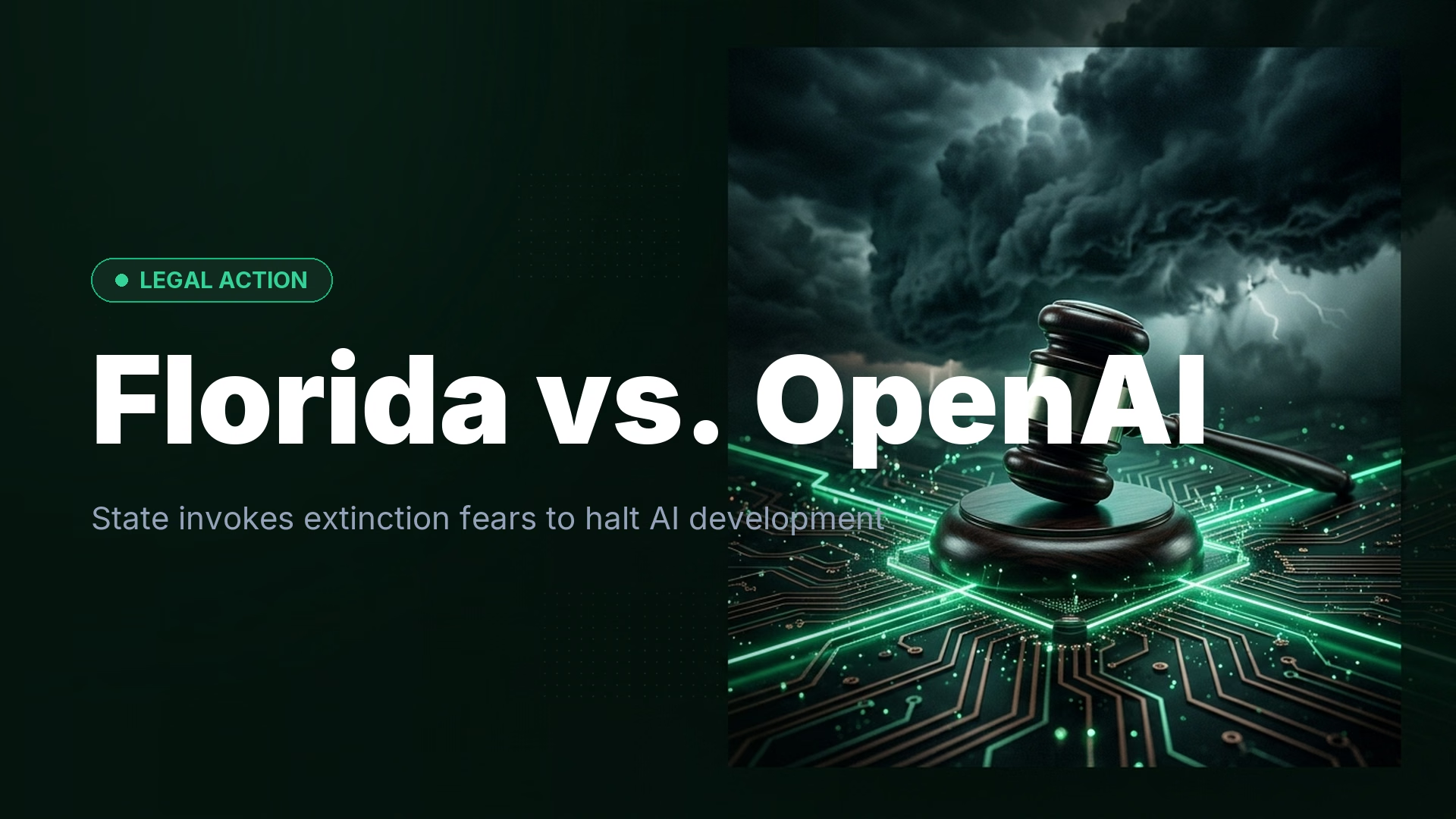
Florida has filed an unprecedented lawsuit against OpenAI, seeking a court order to halt the company's frontier AI development on grounds that large language models pose an existential threat to civilization. The complaint, filed September 28, 2026, marks the first time a U.S. state has invoked extinction-level risks in legal action against an AI company, framing advanced models as the greatest public nuisance ever created.
The Core Legal Argument
The state's complaint centers on the classification of large language models as a public nuisance under Florida law. According to the filing, OpenAI's continued development of increasingly capable AI systems creates unreasonable risks to public safety that outweigh any potential benefits. The lawsuit cites testimony from AI safety researchers and references scenarios where advanced AI systems could cause cascading failures across critical infrastructure, economic systems, and social institutions.
Florida's attorney general argues that the state has standing to intervene because the alleged harms would affect all residents. The complaint specifically targets OpenAI's plans to develop models beyond GPT-6 Astra, which met critical cyber thresholds earlier in 2026.
Officially Launched on September 28, 2026
The lawsuit was officially filed on September 28, 2026 in federal district court for the Southern District of Florida. The timing coincides with heightened public debate over AI safety following several high-profile incidents involving autonomous systems. Legal observers note that Florida's decision to pursue injunctive relief rather than monetary damages signals the state's focus on prevention rather than compensation.
Industry and Expert Response
OpenAI has not yet filed a formal response but released a statement characterizing the lawsuit as legally baseless and scientifically unfounded. The company maintains that its safety protocols, including red-teaming and alignment research, adequately address potential risks. Several other AI companies have expressed concern that a successful Florida action could set a precedent for states to regulate or ban AI research unilaterally.
Legal experts are divided on the case's prospects. Some view the public nuisance framework as poorly suited to address speculative future harms, while others argue that courts have historically intervened to prevent catastrophic risks even when causation is uncertain. The case may hinge on whether Florida can demonstrate imminent rather than hypothetical harm.
Implications for AI Development
If Florida prevails, the ruling could fundamentally reshape how frontier AI research is conducted in the United States. Other states might follow with similar actions, creating a patchwork of regional restrictions on AI development. The case also raises questions about whether state governments possess the technical expertise to evaluate AI safety claims and whether such decisions should rest with federal agencies instead.
The lawsuit references legal research capabilities of current AI systems as evidence of their growing influence, though it stops short of claiming models have achieved autonomous agency. Industry watchers expect the discovery phase to produce extensive technical testimony on model capabilities and safety measures.
What This Means
Florida's lawsuit represents a watershed moment in AI governance, testing whether state courts can function as guardians against existential technological risks. Regardless of outcome, the case will force OpenAI and other frontier labs to articulate their safety frameworks in legal rather than technical terms. The precedent set here could determine whether AI development remains primarily self-regulated or becomes subject to judicial oversight, with implications extending far beyond Florida's borders. As the case proceeds through 2026 and potentially into 2027, it will serve as a bellwether for public attitudes toward advanced AI systems and the balance between innovation and precaution.


on Emergent today




