


Harvey Tenet: Legal AI Agent Built on Kimi K3 Launches

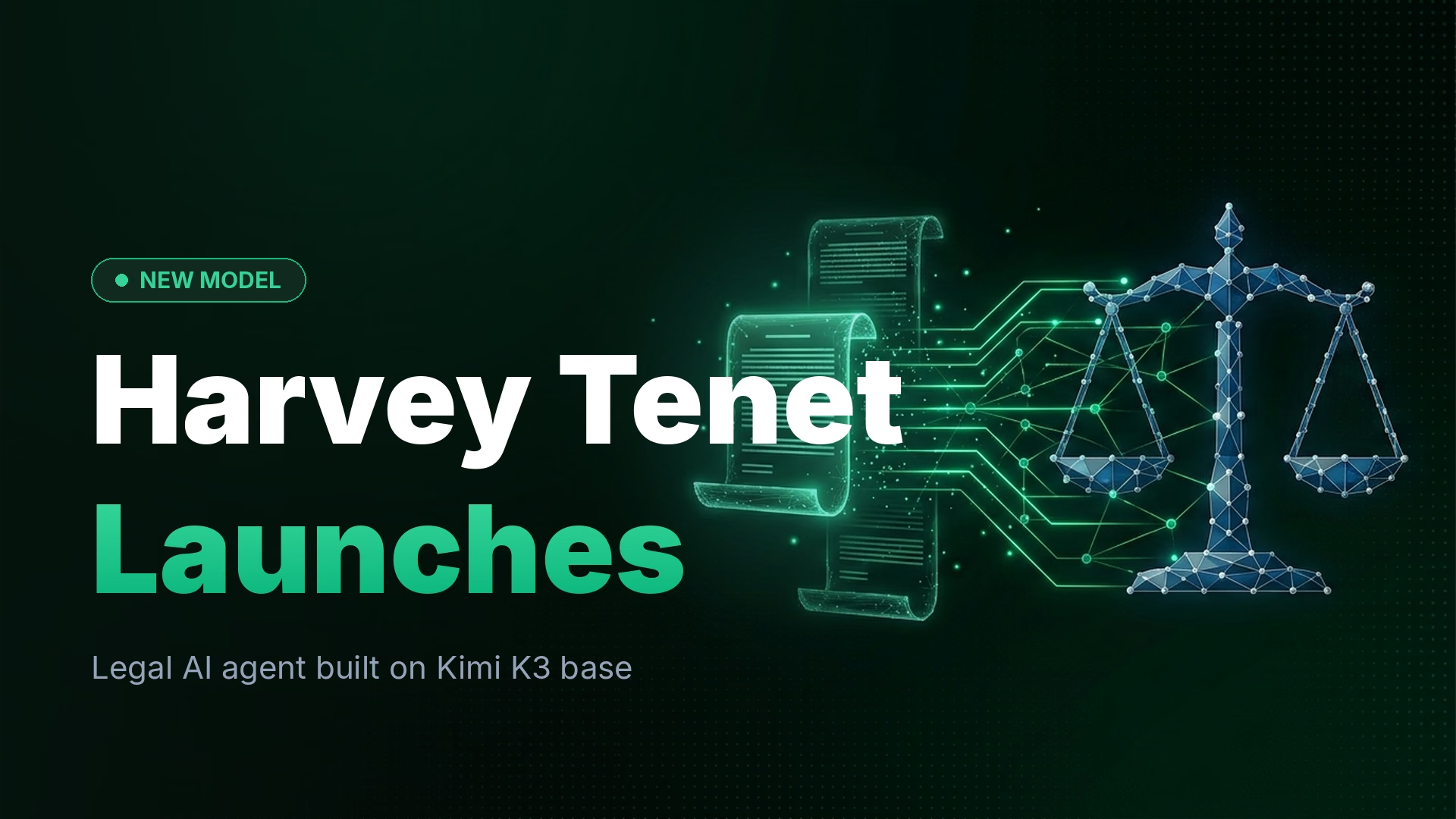
Harvey, the legal AI platform serving major law firms, officially launched Harvey Tenet on August 23, 2026, its first internally developed model built through post-training Moonshot AI's Kimi K3 base. Developed in partnership with Fireworks AI, Tenet targets long-horizon legal agent workflows where prior general-purpose models struggled with multi-step legal reasoning and document analysis tasks spanning hours or days.
Architecture and Training Approach
Harvey Tenet represents a domain-specific adaptation strategy rather than a foundation model trained from scratch. The company took Kimi K3, known for extended context windows exceeding 200,000 tokens, and applied proprietary post-training techniques focused on legal reasoning patterns, procedural workflows, and citation accuracy. Fireworks AI provided the infrastructure and training pipeline optimization that allowed Harvey to customize the model without building internal training clusters.
The architecture preserves Kimi K3's core strengths in handling lengthy documents while adding legal-specific instruction tuning and reinforcement learning from expert feedback collected across Harvey's client base. This hybrid approach aims to balance general reasoning capabilities with specialized legal knowledge that generic models lack.
Performance Claims and Verification Issues
Harvey initially claimed Harvey Tenet nearly doubles task completion rates on the LAB (Legal Agent Benchmark) compared to baseline Kimi K3, citing internal testing showing improvements from 42% to 78% completion on multi-step contract analysis tasks. However, independent verification efforts have surfaced discrepancies. According to the source material, only one benchmark number from Harvey's original claims survived independent verification as of the publication date.
The verification challenges highlight ongoing issues in AI performance reporting, particularly for specialized domains where standardized benchmarks remain limited. Legal AI evaluation requires measuring not just accuracy but also adherence to jurisdictional rules, citation precision, and procedural correctness across tasks that may span multiple days of agent operation.
Release Date and Availability
Harvey Tenet was officially released on August 23, 2026, to Harvey's existing enterprise client base, which includes Am Law 100 firms and corporate legal departments. The model operates exclusively through Harvey's platform rather than as a standalone API, reflecting the company's focus on integrated legal workflows rather than general-purpose model distribution.
Access requires existing Harvey enterprise contracts, with no public API or academic research access announced at launch. This closed deployment model limits external validation but aligns with legal industry confidentiality requirements and Harvey's enterprise-focused business model.
Partnership with Fireworks AI
The collaboration with Fireworks AI addresses a critical bottleneck for specialized AI companies: training infrastructure. Rather than building internal GPU clusters, Harvey leveraged Fireworks' platform for efficient fine-tuning and deployment. This partnership model reflects a broader trend where domain-specific AI companies focus on data curation and task-specific training while outsourcing infrastructure to specialized providers.
Fireworks contributed optimized training pipelines that reportedly reduced post-training compute costs by 60% compared to standard fine-tuning approaches, enabling faster iteration on legal-specific training datasets collected from real attorney workflows.
What This Means
Harvey Tenet marks a shift toward verticalized AI models built on strong foundation bases rather than general-purpose systems. The verification challenges underscore the need for transparent, reproducible benchmarks in specialized domains where marketing claims can outpace technical reality. For legal professionals, the model's real-world impact will depend less on headline benchmark numbers and more on reliable performance across the tedious, multi-day research and drafting tasks that dominate modern legal practice. The closed deployment limits immediate assessment, but the post-training approach offers a template for other specialized industries seeking to adapt frontier models without building from scratch.

on Emergent today




