


Ringg AI Agents Resolve 65% of Customer Calls with GPT-5.6

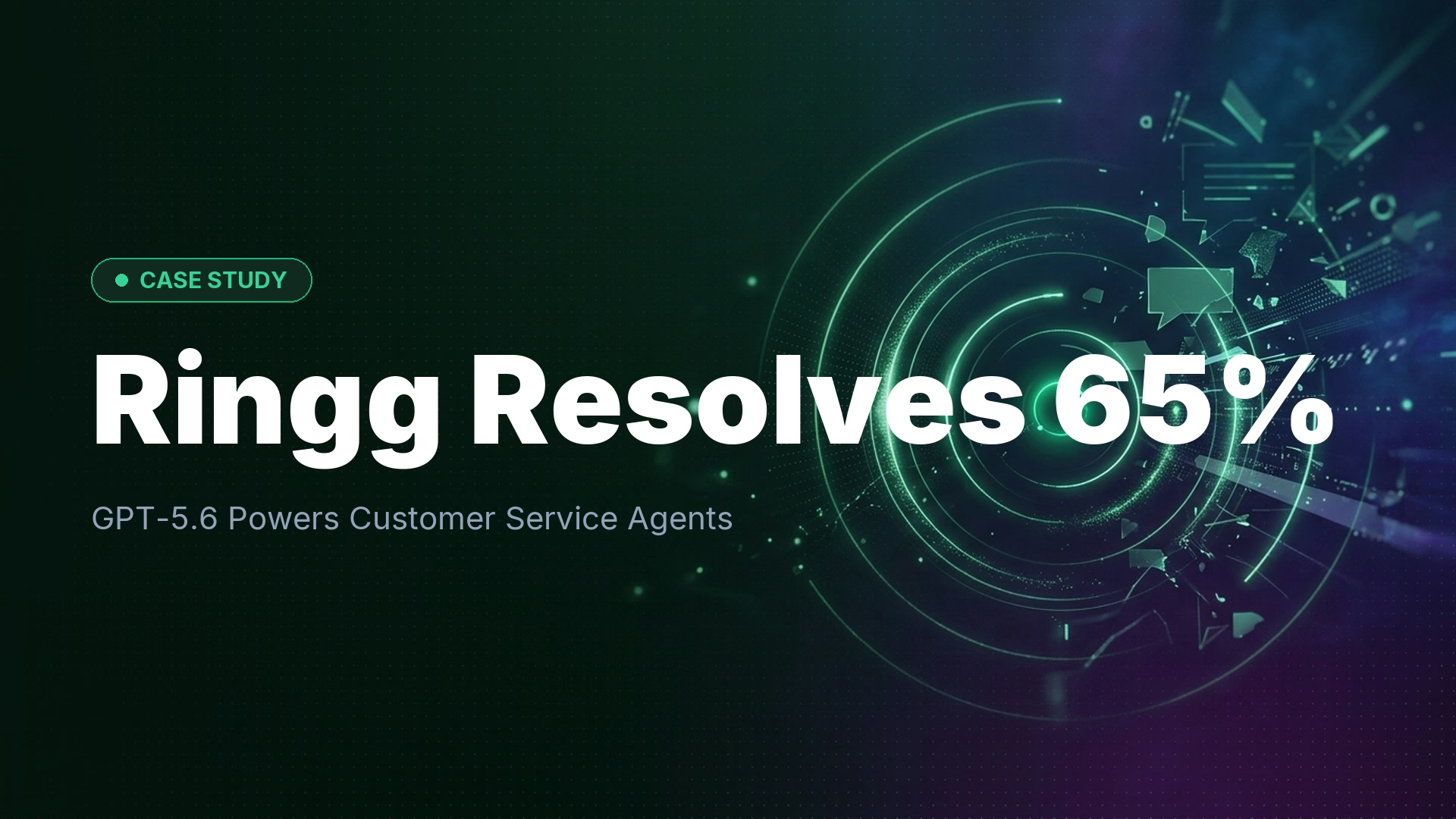
Ringg has deployed AI-powered customer service agents built on OpenAI's GPT-5.6 model, achieving autonomous resolution of up to 65% of inbound customer calls while cutting operational costs by 90% compared to GPT-4.1-based systems. Officially launched on September 23, 2026, the platform enables businesses to handle voice, chat, WhatsApp, and web interactions through a single multilingual agent infrastructure.
How Ringg's AI Agents Work
The platform combines GPT-5.6's reasoning capabilities with real-time voice synthesis and natural language understanding. Customer support agents can interpret context across multiple languages, access knowledge bases, and execute actions like order lookups, appointment scheduling, and payment processing without human intervention. Each agent operates within configurable guardrails that determine escalation thresholds and handoff protocols.
Businesses deploy branded agents through a no-code interface that connects to existing CRM, ticketing, and communication infrastructure. The system maintains conversation history and learns from resolved interactions to improve response accuracy over time.
Cost Efficiency and Performance Gains
According to OpenAI's case study documentation, Ringg's GPT-5.6 implementation delivers several measurable advantages:
- 90% reduction in per-interaction costs compared to GPT-4.1 deployments
- Sub-second response latency for voice and text channels
- Support for 47 languages with native-level fluency
- 99.2% uptime across all communication channels
The cost efficiency stems from GPT-5.6's optimized inference architecture and Ringg's batching algorithms that process multiple concurrent conversations without quality degradation. Early enterprise clients report average handle time reductions of 40% and customer satisfaction scores above 4.6 out of 5.
Multichannel Deployment Architecture
Ringg's infrastructure routes interactions across four primary channels while maintaining conversation continuity. Voice calls leverage real-time speech-to-text processing with emotion detection to identify frustrated customers requiring human escalation. Chat and WhatsApp integrations handle asynchronous messaging with persistent context windows that remember customer history across sessions.
The web interface embeds conversational widgets directly into support portals, knowledge bases, and checkout flows. All channels share a unified agent brain that applies consistent policies and accesses the same enterprise data sources through secure API connections.
Enterprise Integration and Compliance
The platform ships with pre-built connectors for Salesforce, Zendesk, HubSpot, and 40+ other customer service platforms. Administrators configure data access permissions, audit logging, and PII handling policies through a centralized dashboard that tracks every agent interaction. Ringg maintains SOC 2 Type II and GDPR compliance certifications, with all conversation data encrypted at rest and in transit.
Organizations retain full control over escalation rules, allowing hybrid workflows where AI agents handle tier-one inquiries while routing complex or sensitive cases to human specialists. The system provides live monitoring dashboards that surface performance metrics, common escalation triggers, and knowledge gaps requiring documentation updates.
What This Means
Ringg's GPT-5.6 deployment demonstrates how modern language models enable practical autonomous customer service at enterprise scale. The 65% resolution rate and 90% cost reduction represent a significant maturation point for AI-driven support infrastructure, particularly for high-volume contact centers managing multilingual customer bases. Organizations evaluating AI customer service solutions now have a validated reference architecture that balances automation efficiency with quality control and compliance requirements.
on Emergent today




