
Two years ago, launching an ecommerce store meant choosing a template, manually configuring product pages, integrating payment processors, and assembling a stack of apps for email marketing, inventory management, and abandoned cart recovery. The process was slow, fragmented, and heavily dependent on whether the platform you chose happened to support what your business needed.
AI ecommerce website builders have changed this. The best platforms in this category use AI to generate store layouts, create product content, configure workflows, and automate operations, reducing the time and technical knowledge required to get from idea to live store. But the category spans a wide range, from AI tools that generate a basic storefront in thirty seconds, to full-stack builders that generate complete ecommerce applications with custom logic, native integrations, and production-grade infrastructure.
This guide reviews the six best AI ecommerce website builders in 2026, with verified pricing, honest trade-offs, and clear guidance on which platform fits which type of business. Whether you are looking for a complete ecommerce website builder or a platform with strong AI capabilities layered on top of established ecommerce tools, the options below cover the full spectrum.
Key Takeaways
Emergent is the strongest option for businesses that need a fully custom, AI-built ecommerce store with native workflows, integrations, and business logic, all generated without developer dependency
Shopify is the most established ecommerce platform with the broadest app ecosystem and Shopify Magic AI tools built into the merchant experience
Wix is the most accessible AI-assisted ecommerce builder for small businesses and first-time sellers who want fast setup with design flexibility
Squarespace is the best choice for design-driven brands and small catalog stores where visual presentation is the primary conversion driver
Framer is a design-first website builder with ecommerce possible through third-party plugins, best suited for brands where visual identity is the priority and product catalog complexity is low
Webflow Ecommerce is the strongest choice for design-led businesses that need pixel-level control over their store's visual experience alongside a capable ecommerce backend
What is an AI ECommerce Website Builder?
An AI ecommerce website builder is a platform that uses artificial intelligence to help users create, manage, and scale online stores without manually configuring every technical component. These builders assist with storefront generation, product catalog setup, checkout logic, payment integration, order management, and customer experience optimization using natural language or guided inputs.
Unlike traditional e-commerce platforms that rely heavily on themes and plugins, AI e-commerce builders can reason about store structure, customer flows, and operational logic. This allows them to automate decisions around layout, pricing rules, personalization, and integrations, making it easier to build functional and conversion optimized stores with minimal technical effort.
How AI ECommerce website builders are changing online store creation?
Traditional ecommerce platforms were built around templates and configuration screens. You selected a theme, filled in product information, connected a payment processor, and published the store. AI ecommerce website builders take a different starting point: instead of configuring what already exists, they generate what is needed based on what the business requires.
The shift is meaningful for businesses of all sizes, though it shows up differently depending on the type of platform.
Faster ecommerce website creation
The most immediate impact of AI on ecommerce website building is speed. AI-assisted setup tools can generate a complete store structure, including homepage, product listing pages, collection pages, and checkout flow, in minutes rather than hours. For businesses that previously spent days adapting a template to fit their brand and product range, the time compression is significant.
Platforms like Wix's AI website generator and Squarespace's Blueprint AI can produce a first version of a store from a brief description of the business. These are starting points rather than finished products, but they dramatically reduce the blank-page problem that slows down traditional store launches.
AI-generated product and store content
Writing product descriptions is one of the most time-consuming parts of launching an ecommerce store, particularly for businesses with large catalogs. AI writing tools integrated into ecommerce platforms can generate product copy from basic inputs, suggest image alt text for SEO, create collection page descriptions, and draft email marketing content without requiring a copywriter.
Shopify Magic, Wix's AI text generator, and Squarespace's Beacon AI all provide versions of this capability. The quality of AI-generated content varies by platform and requires human review, but the time saved at scale, particularly for catalog expansions, is a genuine operational advantage.
AI-powered automation and workflows
Beyond content generation, AI is increasingly embedded in ecommerce operational workflows. Abandoned cart recovery, dynamic pricing adjustments, inventory alerts, customer segmentation for email campaigns, and fraud detection are all areas where AI-driven automation reduces the manual effort required to run a store effectively.
The most capable platforms in this category are moving toward a model where the merchant describes what they want the store to do, and the AI handles the underlying setup. This is a meaningful departure from traditional ecommerce builders, where every automation required selecting tools from an app marketplace, configuring them separately, and managing their individual billing.
Simplifying ecommerce operations
The fragmentation of traditional ecommerce operations, where email, inventory, shipping, analytics, and customer service each live in separate tools, is the operational problem that AI-powered builders are best positioned to address. Platforms that offer native integrations as part of the store build, rather than requiring merchants to assemble their own stack, reduce both the initial setup complexity and the ongoing management overhead.
For businesses evaluating their options across the full spectrum of ecommerce platforms, the guide to the best online store website builders covers the broader landscape in detail.
Quick comparison of the best AI ecommerce website builders
Here is a concise overview of the six platforms based on the factors that matter most for ecommerce decision-making.
| Platform | Best for | AI capabilities | Ecommerce features | Scalability | Starting price |
|---|---|---|---|---|---|
| Emergent | Fully custom AI-built stores | Full-stack prompt-based generation; multi-LLM | Native, built to specification | Very high | Free; from $20/month (Standard) |
| Shopify | Established ecommerce with AI tools | Shopify Magic for copy, images, and automation | Very strong; 10,000+ apps | Very high | $29/month (annual) |
| Wix | Small businesses and first-time sellers | AI site generator; Wix ADI; AI text tools | Strong; app marketplace | Medium-high | $17/month (annual) |
| Squarespace | Design-focused brands with small catalogs | Beacon AI; Blueprint AI templates | Good for small catalogs; limited B2B | Medium | $16/month (annual) |
| Framer | Design-led brands using third-party commerce | AI copy and layout generation | Via plugins (Framer Commerce for Shopify) | Medium | $10/month (Basic) |
| Webflow Ecommerce | Design-led stores needing visual control | Webflow AI layout and content tools | Strong; 2% transaction fee on Standard | High | $29/month (Ecommerce Standard, annual) |
6 best AI ecommerce website builders compared
Every AI ecommerce website builder on this list balances simplicity, customization, AI capabilities, ecommerce features, and scalability differently. The right platform is the one that fits your business model, your team's technical capacity, and where you expect your store to be in two years.
The reviews below reflect those differences rather than ranking platforms in a one-size-fits-all order.
1. Emergent
Best for
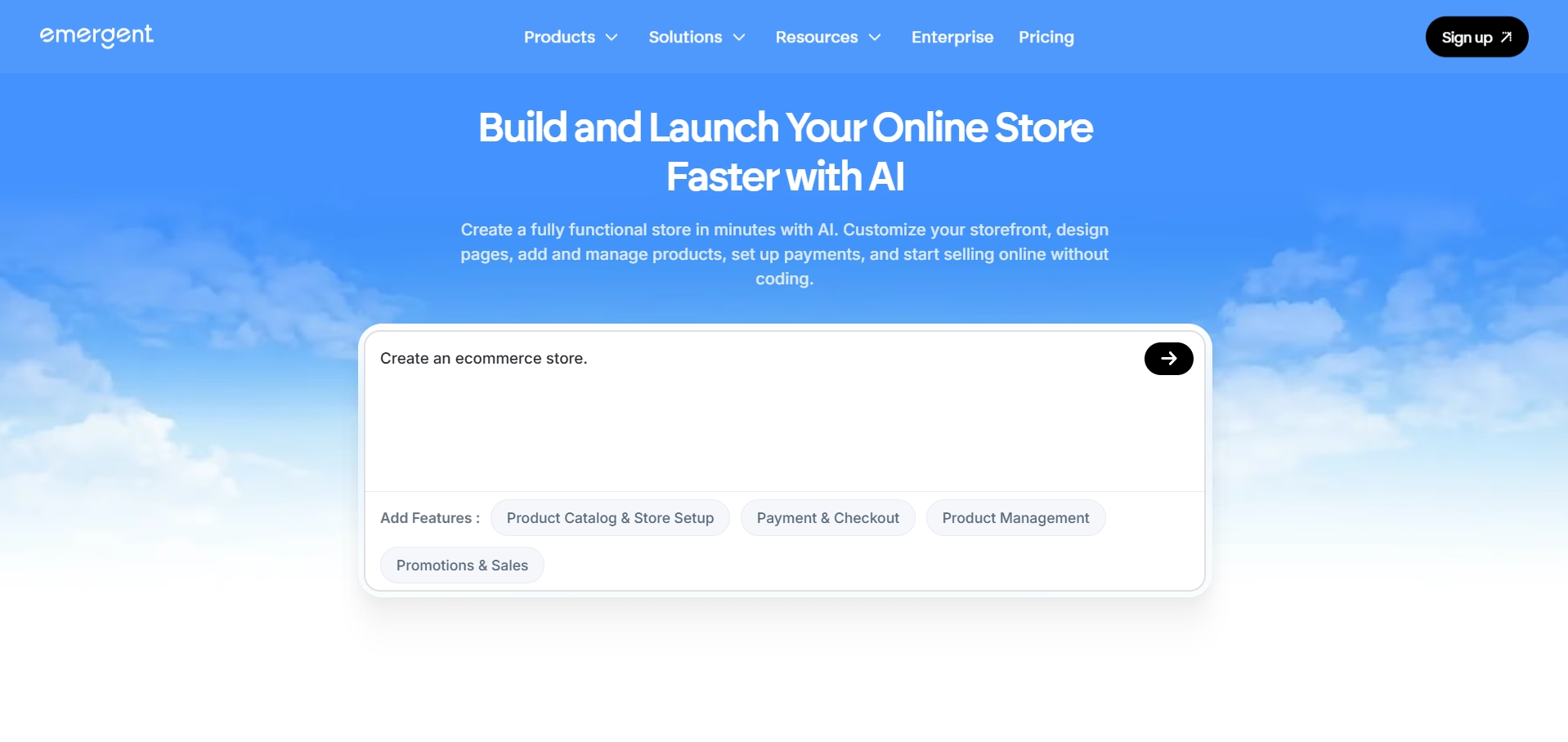
Ecommerce businesses, entrepreneurs, and creators who need a fully customized online store built around their exact product catalog, pricing logic, customer workflows, and integrations, without relying on a developer or assembling a tool stack from scratch.
Emergent is equally well-suited to building a straightforward ecommerce store and a complex multi-vendor marketplace, a subscription-based product business, or a B2B store with tiered pricing and custom checkout logic.
Key features
- Emergent has prompt-based ecommerce store generation. Describe your products, pricing model, checkout flow, and customer experience in plain language and Emergent builds it
- Full-stack output built on React (frontend), Python (backend), and MongoDB with Atlas (database), producing a production-ready ecommerce application rather than a configured template
- Native integrations configured through prompts. You can connect payment processors, shipping providers, inventory systems, email platforms, and CRMs without manual API setup
- Custom business logic built into the store from the start, covering subscription models, tiered pricing, multi-vendor setups, B2B pricing rules, and complex checkout flows that template-based platforms require apps or custom development to handle
- Multiple large language models applied at different stages of the build, matching the best AI model to each specific task across frontend, backend, and content generation
- Flexible domain management allows you to connect an existing domain, buy a new domain on Emergent, claim a free domain through the IONOS partnership, or use an Emergent subdomain
What sets Emergent apart
The fundamental difference between Emergent and every other platform on this list is that Emergent builds the ecommerce store around the business's requirements rather than asking the business to adapt to the platform's structure.
A merchant selling a subscription box with custom frequency options, a bundle builder, and a loyalty program cannot configure that cleanly on Shopify without assembling multiple apps. On Wix or Squarespace, the same requirements hit the boundaries of what their ecommerce systems were designed to handle.
On Emergent, the merchant describes these requirements and the platform generates a store that supports them natively, without plugins, without workarounds, and without ongoing compatibility issues as plugins update independently of each other.
Third-party integrations that would typically require developer time on any standard ecommerce platform can be added through prompts. A merchant who wants to connect their store to a specific logistics provider, a wholesale pricing system, or an ERP does not need to find an app, configure it, and manage its separate billing. They describe the integration they need and Emergent handles the configuration.
Emergent also avoids the platform transaction fees that increase the real cost of ecommerce operations on Shopify, Webflow, and other platforms. There are no commissions on sales processed through the store.
Pros and limitations
Pros
- Built to the merchant's exact specifications rather than constrained by template structure or app availability
- No platform transaction fees on sales
- Full-stack, production-grade output on open-source technology that can be maintained and extended independently
- Native integrations reduce the app stack and associated costs that accumulate on template-based platforms
- Custom workflows and business logic built in from the start, not added through workarounds
Limitations
- The Free and Standard plans are designed for individual creators and smaller projects, so teams with higher usage requirements may eventually need to move to Pro or enterprise-level options.
- Some of the platform’s most advanced capabilities, such as custom AI agents, a 1M context window, and high-performance computing, are reserved for the Pro tier.
Pricing
Emergent offers three subscription plans for individual users, with pricing structured around feature access and monthly credits rather than charging platform transaction fees.
| Plan | Pricing | Key Highlights |
|---|---|---|
| Free | $0/month |
|
| Standard | $20/month |
|
| Pro | $200/month |
|
Emergent does not apply platform transaction fees, which can reduce total operating costs compared to platforms that combine subscription charges, app fees, and additional transaction-based costs.
2. Shopify
Best for
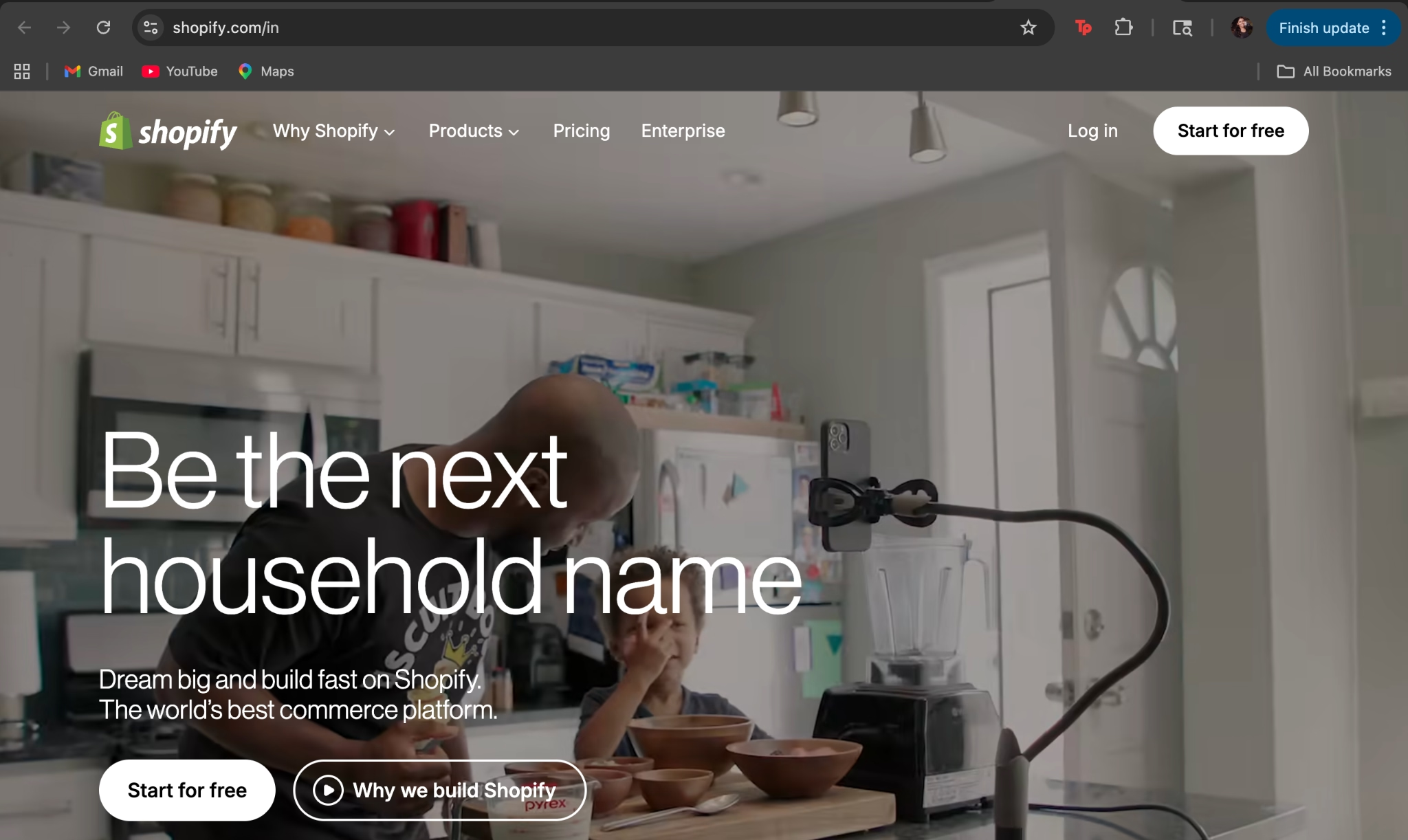
Shopify is the most established ecommerce platform globally, powering a significant share of online stores across every product category.
It is the best choice for merchants who want a proven, reliable ecommerce foundation with a mature ecosystem of over 10,000 apps, extensive developer resources, and AI tools integrated directly into the merchant experience.
Key features
- Shopify Magic includes AI-powered product description generation, image background removal, AI-assisted email subject line creation, and FAQ generation directly within the admin dashboard.
- Sidekick is an AI assistant that helps with store management through conversational support for reporting, product setup guidance, and marketing suggestions.
- Shopify offers more than 10,000 apps covering areas such as email marketing, inventory management, upsells, reviews, subscriptions, and shipping.
- Shopify Payments is a native payment processing system that removes platform transaction fees for merchants who use it.
- Shopify enables multi-channel selling by allowing businesses to manage sales across Instagram, Facebook, TikTok, Google, and Amazon from a single dashboard.
- Shopify Markets supports international selling with features for multi-currency payments, multiple languages, and international tax management.
- Shopify Flow provides workflow automation capabilities for Shopify Plus users.
What sets Shopify apart
Shopify's ecosystem maturity is unmatched in the ecommerce space. The combination of 10,000+ apps, a large developer community, extensive documentation, and 24/7 support means that almost any ecommerce requirement can be met through an existing app or integration.
For merchants who value ecosystem depth over custom flexibility, Shopify is the most reliable choice.
Shopify Magic's AI tools are genuinely useful for content production at scale. Merchants with large catalogs who need to generate or refresh product descriptions, create email campaigns, or produce image variations use these tools to reduce the time required for content work. The AI quality is consistent and the integration into the admin is seamless.
Pros and limitations
Pros
- Most mature ecommerce ecosystem with 10,000+ apps and largest developer community
- Shopify Magic AI tools embedded directly into the merchant admin
- Shopify Payments eliminates platform transaction fees for eligible merchants
- Excellent multi-channel and international selling tools
- 24/7 support across all plans
Limitations
- Platform transaction fees of 0.6% to 2% per sale apply when not using Shopify Payments, and Shopify Payments is not available in all markets
- Growing app stacks add significant monthly cost means merchants to routinely spend $200 to $500 per month on apps in addition to the subscription fee
- Deep customization of checkout logic, complex B2B pricing, and unusual product structures requires either Shopify Plus (from $2,300/month) or custom app development
Also Read: Best Shopify Alternatives
Pricing
Basic plan at $29/month (annual billing). Grow plan at $79/month (annual). Advanced plan at $299/month (annual). Shopify Plus from $2,300/month. Transaction fees apply when not using Shopify Payments.
3. Wix
Best for
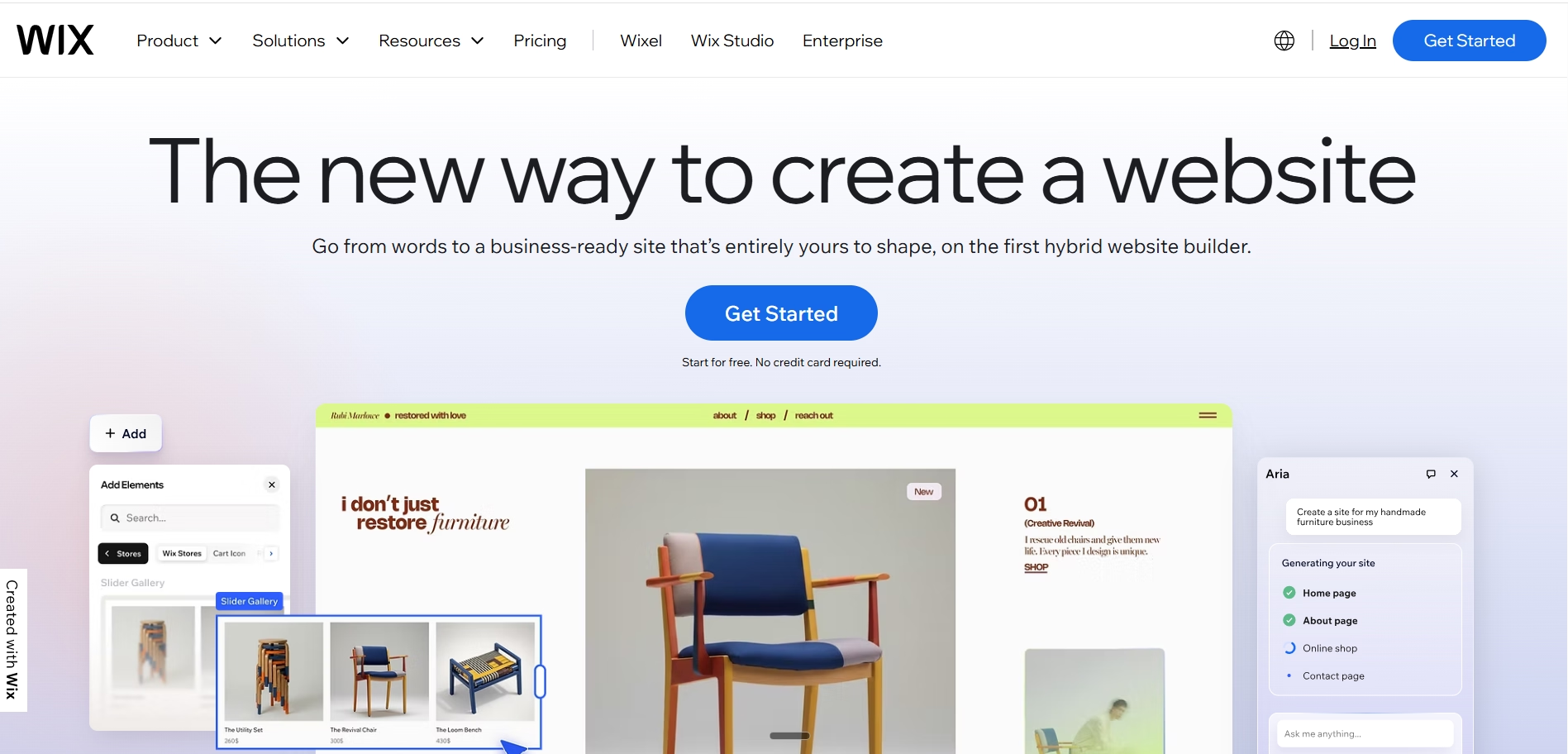
Wix is the most accessible AI-assisted ecommerce builder for small businesses, creators, and first-time sellers who want fast setup, design flexibility, and a broad app marketplace without a steep learning curve.
Its AI website generator and Wix ADI (Artificial Design Intelligence) make it possible to have a functional store live in hours.
Key features
- Wix AI website generator creates a complete site from a brief business description
- Wix ADI for guided setup including product catalog import and payment configuration
- AI text generator for product descriptions and page copy
- AI image generator for creating product visuals and marketing assets
- 0% platform transaction fees on Business and eCommerce plans
- App marketplace with tools for email marketing, loyalty programs, dropshipping, and subscriptions
- Multi-channel selling through Facebook, Instagram, and eBay
- Built-in abandoned cart recovery on Business and eCommerce plans
What sets Wix apart
Wix strikes the best balance between ease of use and feature depth for small ecommerce businesses. The drag-and-drop editor gives non-technical merchants genuine design flexibility, and the AI tools reduce the content production burden on store owners who are managing everything themselves.
The app marketplace fills most functional gaps without requiring custom development.
For merchants who also want to accept hotel or appointment bookings, run events, or offer digital downloads alongside physical products, Wix's breadth of use cases is genuinely useful. It is one of the few platforms on this list that handles multiple business model types from a single subscription.
Pros and limitations
Pros
- Most accessible drag-and-drop ecommerce builder with strong AI-assisted setup
- 0% platform transaction fees on ecommerce plans
- Broad app marketplace covering most small business ecommerce needs
- Multi-use platform handling physical products, digital downloads, bookings, and events in one subscription
Limitations
- Template lock-in means that switching templates after the site is built requires a full rebuild
- Advanced ecommerce functionality such as complex B2B pricing, subscription logic, and wholesale management requires apps, adding monthly cost
- Less suited to large catalogs or high-volume stores where performance and feature depth become critical
Also Read: Wix Website Builder Alternatives
Pricing
Business plan from $17/month (annual billing). Business Elite at $159/month (annual) for unlimited products and priority support.
4. Squarespace

Best for
Squarespace is the strongest choice for design-driven ecommerce brands where visual quality is a primary conversion factor.
Independent fashion labels, artisan food brands, fine art stores, and creative services businesses consistently choose Squarespace because its templates produce the most polished visual output of any general-purpose builder without requiring a designer.
Key features
- Beacon AI for guided store setup, product content generation, and email marketing drafts
- Blueprint AI templates that adapt to product category and brand style
- AI image generation for product photography backgrounds and marketing assets
- Designer-quality templates optimized for image-heavy product presentation
- 0% transaction fees on Core plan and above
- Built-in email marketing, abandoned cart recovery, and discount tools
- Subscription product selling and digital product delivery
- Integration with shipping carriers for real-time rate calculation
What sets Squarespace apart
Squarespace's 2025 refresh, including Beacon AI and Blueprint AI, meaningfully reduced the time to a first publishable store. Merchants who previously spent hours adapting templates can now describe their brand and get a configured starting point generated automatically.
The AI content tools produce on-brand copy that requires less editing than most competitors' equivalents.
For stores where the product photography is the primary selling tool, Squarespace's image handling and layout quality are genuinely superior to Wix, Shopify, or Webflow for non-technical merchants. The visual consistency it produces without custom design work is its clearest competitive advantage.
Pros and limitations
Pros
- Best visual output for image-heavy ecommerce without custom design work
- Beacon AI and Blueprint AI reduce setup time meaningfully for 2026 builds
- 0% transaction fees on Core plan and above
- Strong built-in marketing tools without app subscriptions
Limitations
- Business plan charges a 3% transaction fee on all sales; upgrading to Core at $23/month (annual) eliminates this fee
- B2B pricing, multi-currency, complex product variants, and wholesale functionality are limited or require third-party solutions
- No equivalent to Shopify's app store for extending ecommerce functionality
Pricing
Business plan at $16/month (annual) with a 3% transaction fee on sales. Core plan at $23/month (annual) removes the transaction fee and is the recommended starting point for ecommerce stores.
5. Framer
Best for
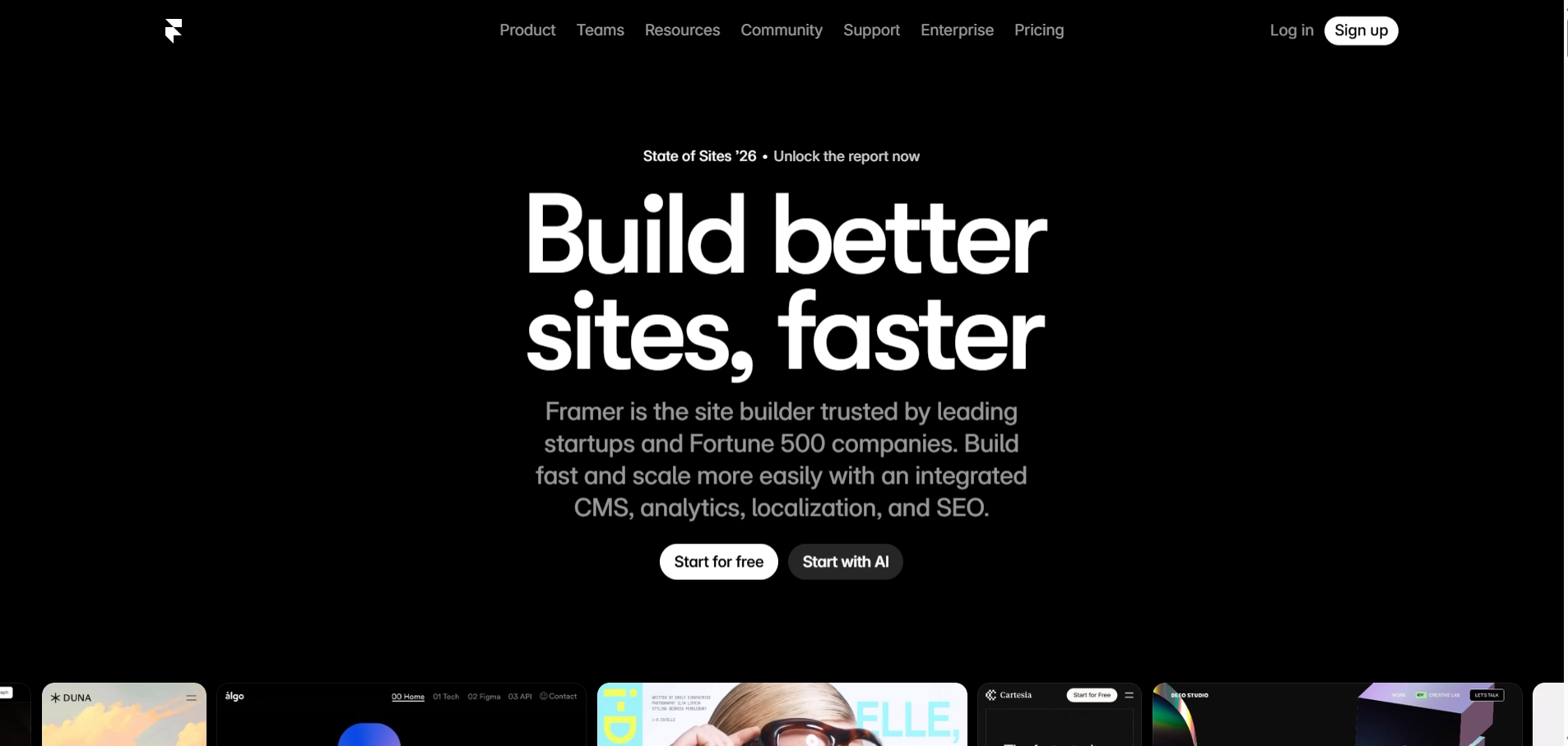
Framer is a design-first website builder built primarily for marketing sites, portfolios, and brand experiences. It is not a native ecommerce platform which means selling products requires connecting a third-party ecommerce solution through Framer's plugin ecosystem.
The most commonly used plugin is Framer Commerce, which connects a Framer site to a Shopify backend, allowing merchants to design their storefront in Framer while Shopify handles inventory, checkout, and order management.
For brands where the visual identity of the storefront is the primary business concern, and where ecommerce volume is manageable through a connected Shopify store, Framer offers design flexibility that exceeds what a standard Shopify theme can achieve without custom development.
Key features
- AI layout and content generation tools for rapid site creation
- Pixel-level design control with the most advanced visual editor in this category
- Framer Commerce plugin for Shopify product sync, 40+ Shopify UI components, and one-click product data integration
- Advanced animation and interaction design without writing JavaScript
- Clean, exportable code output with strong SEO performance
- Updated March 2026 pricing simplified to Basic ($10), Pro ($30), and Scale ($100) plans
What sets Framer apart
Framer's design capabilities are the best of any platform on this list. Brands that want a truly distinctive storefront, where the layout, transitions, and visual experience are core to the product positioning, use Framer because no other tool gives non-coders the same level of design precision. The updated 2026 pricing, simplified to three clear tiers and confirmed more affordable for most users than the previous structure, makes it more accessible than it was previously.
The key trade-off is that Framer is a frontend design tool with ecommerce as a plugin capability, not a native ecommerce platform. Merchants who need robust inventory management, complex variant logic, multi-currency support, or dedicated ecommerce support will find the Framer plus Shopify combination more complex to manage than a platform where everything lives in one system.
Pros and limitations
Pros
- Best-in-class design flexibility for brands where visual identity is the primary differentiator
- Updated 2026 pricing is simpler and more affordable than the previous five-tier structure
- Framer Commerce enables Shopify product sync for merchants who want Framer's design with Shopify's ecommerce backend
- Strong SEO output with clean, fast-loading code
Limitations
- Not a native ecommerce platform which means selling products requires a third-party plugin, most commonly Framer Commerce which connects to Shopify
- Managing a Framer storefront plus a Shopify backend means two separate dashboards, two separate billing accounts, and two separate support relationships
- Steeper learning curve than Wix, Squarespace, or Shopify for merchants who are not design-focused
- Plugin-dependent ecommerce adds cost and complexity that increases with store volume
Pricing
Framer site plans from $10/month (Basic), $30/month (Pro), and $100/month (Scale), updated March 2026. Framer Commerce plugin pricing is additional and separate. Shopify subscription costs are also additional if using the Framer plus Shopify combination.
6. Webflow Ecommerce
Best for
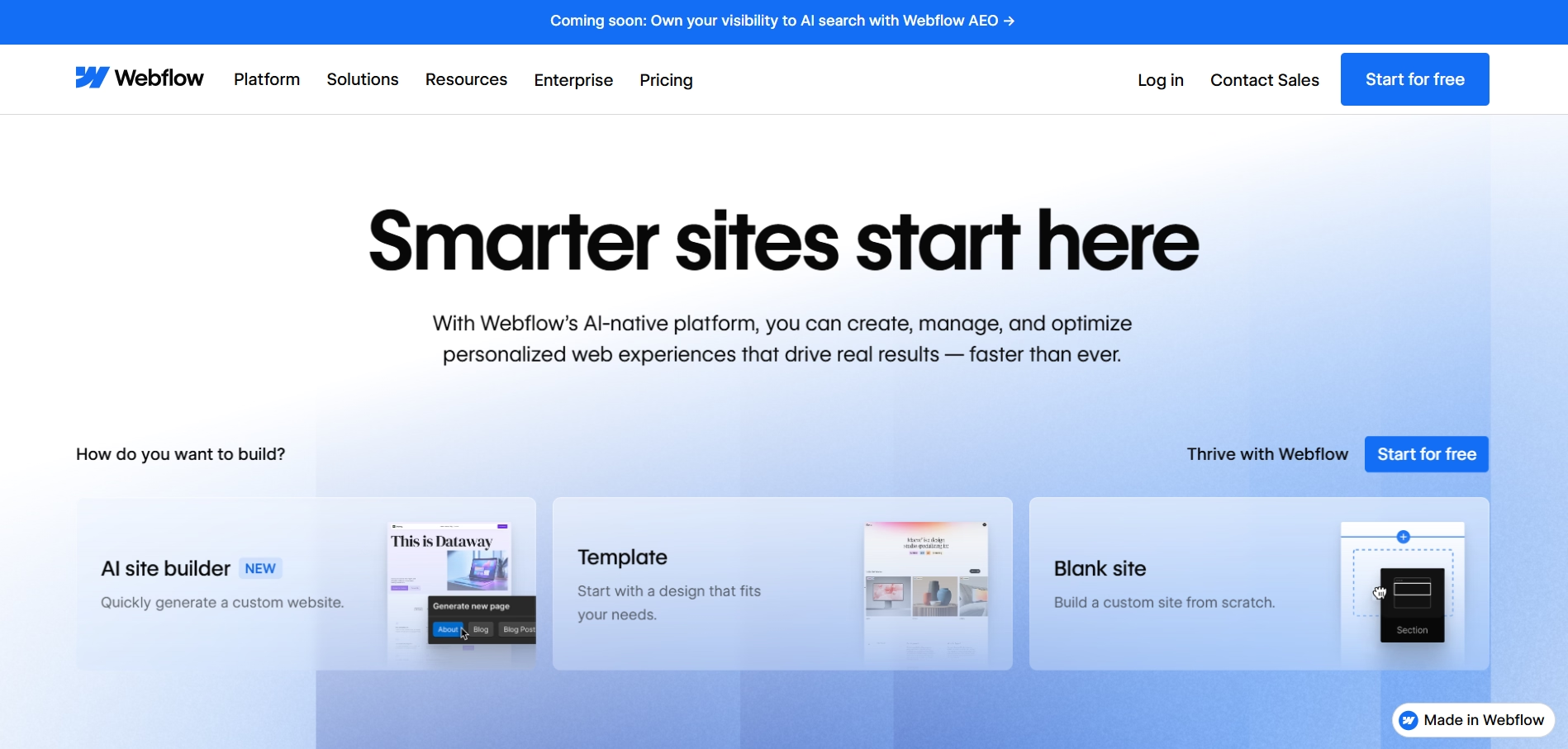
Webflow Ecommerce is the strongest option for design-led businesses that need pixel-level control over their store's visual experience alongside a capable ecommerce backend.
Webflow generates clean HTML, CSS, and JavaScript as you design, giving brands a level of visual distinction that standard Shopify themes and Wix templates cannot match without custom development.
Key features
- Pixel-precise visual editor with full control over product pages, collection layouts, and checkout design
- Webflow AI for layout generation and content assistance
- Custom checkout and cart design without code
- Built-in CMS for dynamic product content and blog
- Automatic tax calculation for sales tax and VAT at checkout
- Integrations with Stripe and PayPal for payment processing
- Multi-channel connections to Facebook, Instagram, and Google for product catalog promotion
- 100% design control over receipt and order confirmation email templates
What sets Webflow Ecommerce apart
Webflow Ecommerce is the only platform on this list that gives merchants complete visual control over every element of the shopping experience, from the product listing grid to the cart drawer to the checkout page, without writing code. For brands with strong visual identities that feel constrained by Shopify's theme customization limits, Webflow is the natural alternative.
The platform's SEO output is among the best available: clean semantic markup, fast loading times, and full control over metadata make Webflow stores highly competitive in organic search. For ecommerce businesses that rely on content marketing and SEO for customer acquisition, this is a meaningful advantage.
Pros and limitations
Pros
- Most visual design control of any ecommerce platform without custom development
- Excellent SEO output with clean code and full metadata control
- Full design control over checkout, cart, and order confirmation emails
- Built-in CMS for content marketing alongside ecommerce
Limitations
- Webflow Ecommerce Standard plan charges a 2% platform transaction fee on all sales; this is eliminated on Plus and Advanced plans
- Note that Webflow deprecated its User Accounts feature in January 2026, meaning customer login, account management, and saved carts require third-party solutions such as Outseta or Memberstack
- Steeper learning curve than Shopify, Wix, or Squarespace for non-technical merchants
- Product variant and inventory management is less robust than Shopify for large catalogs
Pricing
Webflow Ecommerce plans from $29/month (Standard, annual). Plus plan at $74/month (annual). Advanced plan at $212/month (annual). The Standard plan charges a 2% transaction fee; Plus and Advanced plans have no transaction fee.
Why businesses are switching to AI ecommerce website builders?
1. Faster store launch without technical complexity
The most immediate reason businesses move to AI ecommerce builders is the reduction in time between an idea and a live, functional store. A founder who previously needed to hire a developer, brief them on requirements, wait for design iterations, and manage a weeks-long build can now describe what they want and have a working store generated in a fraction of that time.
This speed advantage compounds for businesses that need to iterate quickly. Tasks like adding new product categories, launching seasonal campaigns, or testing different checkout flows become much faster when the underlying platform supports rapid changes without requiring developer involvement.
2. Lower cost compared to custom ecommerce development
Custom ecommerce development for a business with specific requirements typically starts at tens of thousands of dollars and scales significantly from there.
AI ecommerce platforms, including full-stack builders like Emergent, bring the cost of a custom-built store down to a fraction of that, by generating real, maintainable code from natural language descriptions rather than requiring manual development for every component.
3. Built-in intelligence for personalization and automation
AI is increasingly embedded in ecommerce operations rather than sitting as a separate layer.
Personalized product recommendations, dynamic pricing, AI-assisted customer service, and predictive inventory management are all capabilities that the leading ecommerce platforms are building into their core product in 2026.
Businesses that adopt AI-native platforms access these capabilities without integrating separate tools for each function.
4. Scalable ecommerce operations as the business grows
The platforms that serve a business well at launch are not always the ones that serve it well at scale.
AI ecommerce builders that generate production-grade infrastructure from the start, rather than building on a template layer that hits performance ceilings as volume grows, reduce the platform migration cost that growing businesses often encounter after two or three years on a general-purpose builder.
5. Reduced dependency on plugins and third-party tools
The most significant hidden cost of ecommerce platforms like Shopify is not the subscription fee. It’s the growing stack of apps required to run a fully functional store. Features like email marketing, loyalty programs, reviews, upsells, abandoned cart recovery, subscriptions, and affiliate management often depend on separate apps, each with its own billing, setup, and maintenance overhead.
AI platforms that build these capabilities natively as part of the store, rather than requiring them to be assembled afterward, reduce both cost and operational complexity.
How to choose the best AI ecommerce website builder for your store?
1. Choose based on store customization needs
If your store has standard product types with straightforward checkout logic, most platforms on this list will serve you well.
If your store requires custom pricing rules, complex product configurations, unusual checkout flows, or business logic that does not fit a standard template, the platform you choose needs to support genuine customization rather than approximating it through app combinations.
Emergent and Webflow Ecommerce are the strongest options here; Shopify supports customization through its Plus plan and custom development.
2. Choose based on ecommerce automation
Consider how much of your store's operations you want to automate, from order routing to email sequences to inventory alerts. Shopify has the broadest automation ecosystem through its app marketplace and Shopify Flow.
Emergent builds automation natively into the store. Wix and Squarespace cover basic automation on built-in tools. Framer's automation requires managing through the Shopify backend of the Framer Commerce integration.
3. Choose based on ease of store management
Who will manage the store after launch, and what is their technical background? Wix and Squarespace are the most accessible platforms for non-technical merchants managing their own stores.
Shopify is well-documented and broadly understood but has more complexity as the app stack grows. Webflow and Framer have steeper learning curves and are better suited to merchants with some design or technical background, or access to support.
4. Choose based on scalability
Think about where your store needs to be in two to three years, not just where it is today. Platforms that require expensive migrations as you grow, either because of performance ceilings or feature gaps at scale, add hidden cost to your total platform investment.
Shopify scales reliably to very high volumes. Emergent builds on infrastructure that scales independently of any proprietary billing model. Squarespace and Wix have clearer scaling limits for high-volume ecommerce.
5. Choose based on AI capabilities
Not all AI in this category is equivalent. Some platforms offer AI tools for content generation, which is useful but incremental. Others use AI to generate the entire store structure, configure integrations, and build workflows from descriptions, which is a fundamentally different level of capability.
If AI-powered automation and workflow generation are important to your business, evaluate platforms based on what the AI actually builds, not just what it helps you write.
What most AI ecommerce builders lists won't tell you?
Most comparisons of AI ecommerce website builders focus on the surface features: whether the platform can generate a homepage, write a product description, or suggest a color palette. These capabilities are real and useful, but they represent the least transformative part of what AI is doing to ecommerce platform building in 2026.
The more significant shift is happening at the infrastructure level. AI is increasingly being used not just to generate content but to generate the underlying application itself which includes the database structure, the checkout logic, the integration configurations, and the automation workflows that determine how a store actually operates. This distinction separates platforms that have added AI features to a traditional ecommerce builder from platforms that are built around AI as the primary mechanism for creating and managing the store.
Template-based ecommerce platforms, even those with strong AI content tools, are still fundamentally constrained by what their template structures and app ecosystems allow. A merchant whose business model does not fit cleanly into those structures hits a ceiling that AI content tools cannot help them pass. The next generation of ecommerce builders addresses this by generating the structure itself from requirements, rather than requiring requirements to fit a predefined structure.
Emergent represents this direction for ecommerce. It does not add AI features on top of a template-based store builder. It generates the entire store, including the product logic, the checkout flow, the integration layer, and the operational workflows, from plain language descriptions of what the business needs. For merchants who feel constrained by traditional platforms, even AI-enhanced ones, this offers a fundamentally different way to build and operate an online store. For a practical understanding of what this looks like end to end, the guide on how to build a store website walks through the full process.
Conclusion
The best AI ecommerce website builder for your business depends on what your store actually needs to do and who will manage it after launch. For the broadest ecommerce ecosystem and proven reliability at scale, Shopify remains the most established choice.
For design-first brands with a specific visual identity to protect, Webflow Ecommerce and Framer offer levels of visual control that general-purpose builders cannot match. For accessible, fast setup with solid AI tools, Wix and Squarespace are the most approachable starting points.
For businesses that need a store built precisely around their business model, their workflows, and their integrations, without assembling that capability from an app marketplace, Emergent offers a fundamentally different path.
The AI builds the store from requirements rather than asking the business to adapt to a template, which is the distinction that matters most for merchants whose needs go beyond what standard platforms were designed to handle.
Emergent designs, writes, and publishes your whole site from one prompt. No templates, no drag-and-drop.
- Full site from one prompt
- Custom design, real pages
- Publish in minutes