
An interactive website in 2026 is no longer defined by animations or visual effects. True interactivity means the website responds to user input, adapts to behavior, and creates dynamic feedback loops that guide user experience.
As per a study by Rock Content, when compared with non-interactive content, 80% of people are more willing to share interactive content with other people. Most traditional websites are presentation systems, they display information. Interactive websites are response systems, they process user input and return meaningful output. This requires different architecture, different tooling, and different design thinking.
Modern full-stack platforms have significantly reduced the technical barrier to building interactive systems. However, the architectural decisions you make early determine whether your website feels responsive, scalable, and adaptable, or slow and structurally limited.
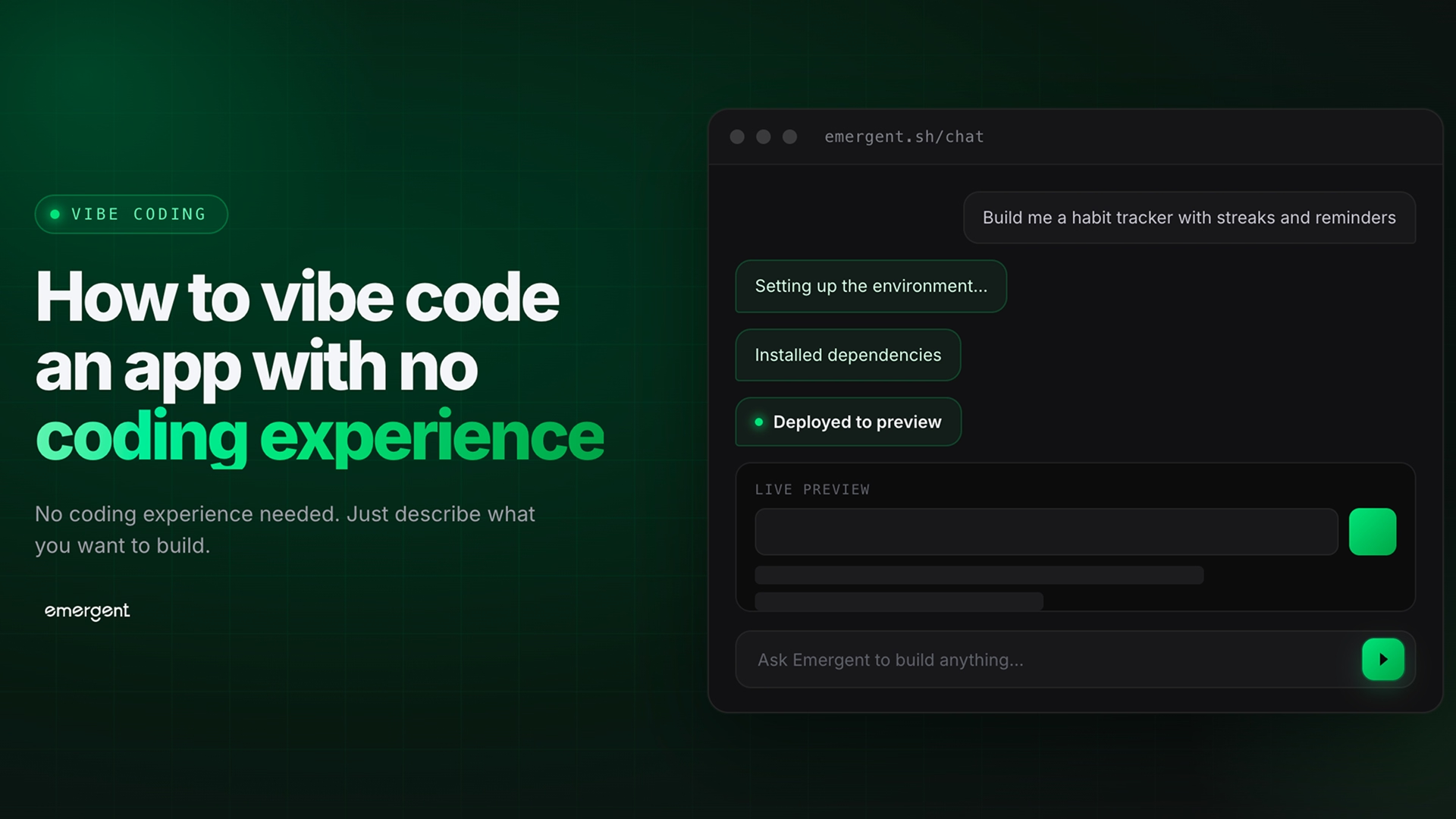
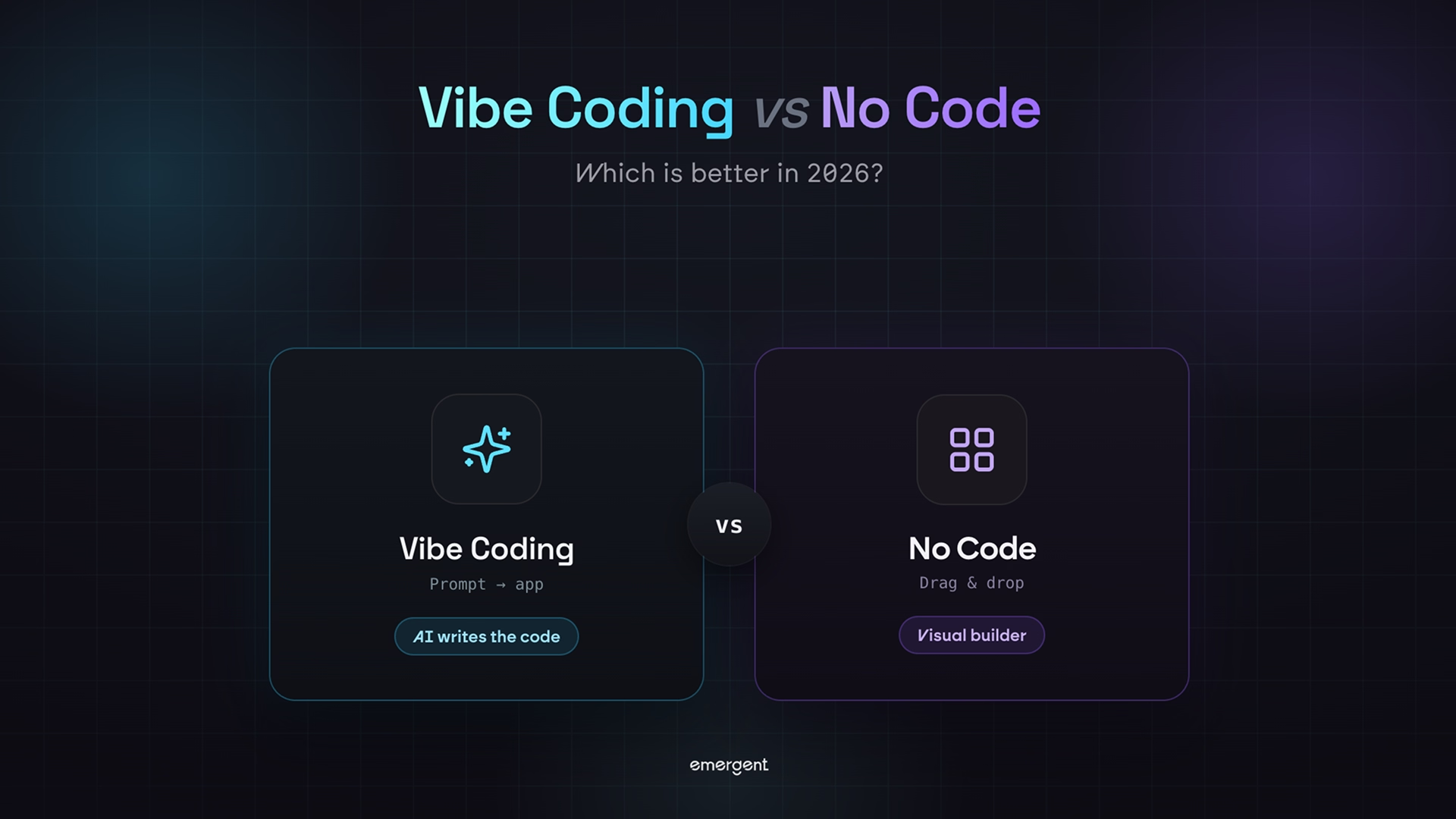
This guide breaks down how interactive websites are structured, explores methods like AI-powered (vibe coding) development, and outlines the exact steps to build one in 2026.
You might also like: Best Online Website Builders
What Makes a Website Truly Interactive in 2026?
In 2026, interactivity is no longer about animations, hover effects, or micro-transitions. True interactivity means the website behaves like a system, not a brochure. It processes input, maintains state, applies logic, and returns meaningful output dynamically.
An interactive website is essentially a lightweight application running in the browser, supported by backend infrastructure. The depth of interactivity determines how much architectural complexity is required behind the scenes.
1. Real-Time or Near Real-Time Input–Output Processing
At its core, an interactive website must respond meaningfully to user input. When a user clicks, types, selects, uploads, or configures something, the system must process that action and return structured output without friction.
This may involve dynamic content rendering, API calls, backend computations, or database reads and writes. The key is not speed alone, but logical responsiveness, the output must change based on input in a predictable way.
Why this matters long term: As interaction complexity increases, the volume of backend calls increases. If this layer is not designed efficiently, performance bottlenecks compound quickly.
Failure pattern: Many websites simulate interactivity visually but lack robust backend logic, causing inconsistency under real usage.
2. Stateful Experience Design
Interactive websites must remember context. This includes user progress, preferences, selections, authentication state, or multi-step workflows. Without state management, every interaction resets the system, breaking continuity.
State can exist at multiple layers:
- Client-side state (session, UI state)
- Server-side state (accounts, stored data)
- Persistent database state (saved configurations, dashboards)
Why this matters: Stateful systems enable configurators, onboarding flows, dashboards, and personalized experiences.
Architectural consequence: Poor state management creates bugs, inconsistency, and data synchronization issues that are difficult to debug later.
3. Backend Logic as a First-Class Component
Interactive websites require backend logic that goes beyond content storage. This includes conditional flows, calculations, validations, personalization, and structured data processing.
The backend is not optional in serious interactive systems. Even if frontend frameworks handle rendering, meaningful interaction requires logic execution somewhere in the stack.
Why this matters: As interaction complexity grows, backend logic determines whether the system remains maintainable.
Hidden cost: Websites built without scalable backend logic often require rebuilding once interaction rules become complex.
4. Seamless Frontend–Backend Communication
The frontend is the interface layer, but the backend is the processing layer. Interactive systems depend on efficient communication between the two.
This includes:
- API request handling
- Error management
- Data synchronization
- Optimistic updates and state reconciliation
Why this matters: Latency and poor synchronization break user flow.
Second-order consequence: Inefficient communication increases server load and degrades performance as traffic scales.
5. Infrastructure That Handles Dynamic Load Patterns
Interactive websites generate unpredictable traffic patterns. Unlike static websites where load is mostly page views, interactive platforms generate API requests, database queries, and dynamic rendering events continuously.
Infrastructure must support:
- Concurrent requests
- Scalable database operations
- Secure authentication flows
- Fault tolerance
Why this matters: Infrastructure limitations often only become visible under load.
Irreversibility insight: Retrofitting scalability after launch is significantly more expensive than designing for it early.
Core Mental Model Shift
A static website delivers pages.
An interactive website executes logic.
Once you understand that you are building a logic-execution system, not a page-rendering system, your architectural decisions change entirely.
What are the Different Methods to Build an Interactive Website in 2026?
Interactive websites require logic execution, state management, and backend processing. The method you choose determines how that logic is implemented, how scalable it is, and how much infrastructure complexity you must manage manually.
Unlike static sites, interactive platforms are sensitive to architectural decisions. The wrong method may work initially but introduce performance ceilings, maintenance overhead, or migration risk as interaction complexity grows.
There are four primary architectural approaches used today.
1. AI-Powered Full-Stack Builders (Fastest Logic-to-Launch Path)
AI-Powered Full stack Builders generate both frontend interfaces and backend infrastructure automatically. They handle authentication, databases, API logic, and deployment without requiring manual server configuration.
This approach allows interactive systems such as dashboards, configurators, or tool-based platforms to launch quickly without assembling infrastructure layer by layer.
When this method works best:
- Rapid product validation
- Tools with structured interaction logic
- Teams without backend engineers
Tradeoff to understand: Infrastructure is abstracted. While this reduces complexity, deep customization at the infrastructure layer may be limited compared to fully custom systems.
Long-term consideration: If the platform supports scalable backend logic, this method can handle significant growth without structural migration. If you're exploring this route, learning how to build a website with AI is a practical starting point before diving into interactive features.
Highly Recommended: Best AI Powered Website Builders in 2026
2. Backend-as-a-Service + Frontend Framework (Balanced Flexibility)
This approach separates responsibilities. A backend service handles authentication, databases, and API endpoints, while a frontend framework manages the interactive interface.
This method offers more flexibility than fully automated builders while still reducing infrastructure assembly complexity.
When this method works best:
- Platforms with moderate interaction complexity
- Teams comfortable configuring backend services
- Applications requiring custom logic rules
Tradeoff to understand: Backend configuration introduces operational responsibility. As logic complexity grows, so does maintenance overhead.
Scalability insight: This model scales well if the backend service is chosen carefully and structured efficiently.
3. Low-Code / No-Code Interaction Platforms (Visual Logic Builders)
These platforms allow users to build interactive logic using visual workflows. They handle state, conditional logic, and database interactions through graphical interfaces.
This reduces development time and removes the need for traditional coding while still supporting meaningful interaction systems.
When this method works best:
- MVPs and internal tools
- Business workflow applications
- Configurators and form-driven platforms
Tradeoff to understand: Visual logic systems can become difficult to maintain when interaction rules grow complex.
Hidden risk: Debugging and scaling complex visual workflows can introduce friction at higher usage levels.
4. Custom Development Using Full Frameworks (Maximum Control)
This approach involves building frontend and backend systems manually using development frameworks. Every interaction, API endpoint, and infrastructure layer is configured intentionally.
This provides maximum flexibility and control over performance optimization, architecture, and scalability.
When this method works best:
- High-performance applications
- Complex real-time systems
- Platforms requiring unique logic execution models
Tradeoff to understand: Development time is longer, and infrastructure management becomes a continuous responsibility.
Irreversibility factor: Custom systems provide flexibility but increase long-term operational accountability.
Decision Insight: Choose Based on Interaction Complexity, Not Feature Count
The correct method depends less on how many features you want and more on how complex your interaction logic will become over time.
If your website processes simple conditional input-output flows, infrastructure automation may be sufficient. If your platform requires real-time collaboration, heavy state synchronization, or advanced computation, deeper architectural control may be necessary.
Interactive systems fail not because of missing features, but because the architecture cannot support the interaction model they attempt to run.
How to Build an Interactive Website in 2026?(Step-by-Step Guide)
Building an interactive website is not about adding features one by one. It is about designing a logic system that can process user input, maintain state, and return meaningful output reliably and at scale.
Most interaction failures happen because builders think in terms of pages instead of systems. The correct mental model is this: you are building a lightweight application that runs through the browser and communicates with backend logic continuously.
The steps below reflect how serious interactive systems are structured.
Step 1: Define the Core Interaction Model Before Designing the Interface
Before writing code or selecting tools, define what users will do repeatedly on the website. This is the interaction loop that drives engagement.
Are users:
- Configuring something?
- Submitting inputs to generate results?
- Managing dashboards?
- Progressing through multi-step workflows?
This interaction model determines the backend logic, state requirements, and infrastructure complexity.
Why this step is critical: If the interaction model is unclear, the system architecture will become fragmented and inconsistent.
Irreversibility warning: Changing the interaction model later often requires rewriting both frontend flows and backend logic.
Step 2: Map the Logic Flow and Conditional States
Interactive websites depend on conditional logic. Define how user actions lead to system responses.
For example:
- If a user selects option A, show interface X.
- If input meets condition Y, trigger calculation Z.
- If authenticated, allow dashboard access.
Mapping logic flows early prevents chaotic rule expansion later.
Why this matters: Complex interaction logic grows exponentially if not structured intentionally.
Hidden consequence: Poorly planned logic flows create debugging complexity and unpredictable system behavior.
Step 3: Choose the Architectural Method Based on Interaction Complexity
Select your building method based on how much backend processing and state management your interaction model requires.
If the system involves:
- Simple conditional flows → full-stack builders may suffice.
- Moderate dynamic logic → backend services + frontend framework may be ideal.
- Complex real-time collaboration → custom frameworks may be required.
Why this matters: Tool choice determines whether your logic system scales smoothly or becomes difficult to maintain.
Key decision principle: Optimize for long-term interaction complexity, not short-term development speed.
Step 4: Implement Authentication and Identity Systems (If Required)
If your interactive website involves user accounts, dashboards, saved progress, or personalization, authentication must be implemented early.
Identity systems allow persistent state across sessions and enable secure data storage.
Why this matters: Interaction systems tied to user identity require consistent and secure authentication.
Failure pattern: Retrofitting identity systems after launch creates data migration and security complexity.
Step 5: Build the Backend Logic Layer
This is where the website becomes truly interactive. Backend logic handles:
- Data validation
- Conditional processing
- Calculations
- Database operations
- Dynamic content generation
Even if some logic runs on the frontend, serious interactive systems require backend processing for reliability and scalability.
Why this matters: Backend logic determines whether the system remains stable as usage grows.
Second-order consequence: Weak backend logic creates inconsistent outputs and scaling issues.
Step 6: Connect Frontend Components to Backend APIs
The frontend should act as the interface layer, while backend systems handle processing. Establish clean API communication between the two.
This includes:
- Handling user input
- Triggering backend calls
- Managing loading states
- Displaying structured results
Why this matters: Smooth communication preserves user flow and responsiveness.
Hidden risk: Poor API structure increases latency and creates fragile systems.
Step 7: Implement State Management Properly
Interactive systems must manage state efficiently, including temporary session state and persistent database state.
Improper state handling leads to:
- Lost progress
- Data inconsistencies
- UI desynchronization
Why this matters: State continuity defines user experience quality.
Architectural consequence: State mismanagement becomes harder to fix as features expand.
Step 8: Optimize for Performance Under Dynamic Load
Interactive websites generate continuous backend requests. Optimize database queries, API response times, and frontend rendering efficiency.
Test how the system behaves under multiple simultaneous interactions.
Why this matters: Performance issues compound as interaction volume increases.
Irreversibility insight: Performance refactoring after launch is significantly more complex than designing efficiently from the beginning.
Step 9: Deploy with Monitoring and Error Handling Systems
Interactive platforms require monitoring tools that track performance, errors, and user behavior.
This allows you to detect:
- API failures
- Latency spikes
- Logic errors
- Unexpected user behavior patterns
Why this matters: Monitoring transforms the website from a static product into an evolving system.
Operational insight: The most stable interactive platforms are continuously observed and refined.
Step 10: Iterate Based on Real Interaction Data
Once deployed, observe how users actually interact with the system. Identify friction points, unexpected flows, and performance bottlenecks.
Interactive websites evolve through refinement of logic, not through visual redesign alone.
Compounding advantage: Early launch allows faster data collection, leading to quicker system optimization.
Core Takeaway
An interactive website is a logic execution engine wrapped in a user interface. The strength of the system depends on how intentionally you design the interaction model, backend logic, state management, and infrastructure from the beginning.
Design for clarity, scalability, and system integrity, and the interface becomes powerful. Design only for visuals, and the system eventually collapses under complexity.
Critical Mistakes to Avoid When Building an Interactive Website
Interactive websites fail differently than static websites. They don’t usually break visually, they break logically. Most issues emerge only after users begin interacting heavily with the system, when state conflicts, performance bottlenecks, or logic inconsistencies surface.
Avoiding the following mistakes prevents your interactive website from becoming fragile as complexity increases.
1. Designing the Interface Before Defining the Logic System
Many builders start by designing screens and UI components without clearly defining how the system processes input and produces output. This leads to beautiful interfaces layered on top of weak or inconsistent logic.
When logic is added later, it often conflicts with the visual structure, requiring rework.
Pro Tip: Define the input → processing → output loop before building the interface. The UI should reflect system logic, not dictate it.
Why this becomes expensive: Rewriting logic after frontend flows are built creates cascading changes across the system.
Pro Tip
Define the input → processing → output loop before building the interface. The UI should reflect system logic, not dictate it.
2. Overloading the Frontend with Business Logic
It is tempting to implement most interaction logic directly in the frontend because it feels faster during early development. However, this creates maintainability and security issues as complexity grows.
Front-end-heavy logic becomes difficult to secure, scale, and debug under real usage conditions.
Hidden consequence: Refactoring frontend-heavy systems later is significantly more complex than structuring backend logic properly from the start.
Pro Tip
Keep critical business logic on the backend whenever possible. The frontend should orchestrate interactions, not own system intelligence.
3. Poor State Management Across Sessions
Interactive websites often require remembering user progress, preferences, or configurations. If state is not handled consistently between client-side and server-side systems, inconsistencies emerge.
Users may experience lost progress, duplicated actions, or unexpected behavior.
Why this matters: State continuity defines perceived reliability.
Failure pattern: State bugs multiply as more interaction layers are added.
4. Ignoring Performance Until Traffic Increases
Interactive websites generate API calls, database reads, and processing requests continuously. Systems that perform well with a few users may degrade quickly under higher interaction load.
Latency, slow responses, and inconsistent updates reduce engagement.
Second-order consequence: Performance bottlenecks are harder to fix after data structures and APIs are already deeply integrated.
Pro Tip
Simulate concurrent interactions early. Test how the system behaves under multiple simultaneous users.
5. Choosing Tools Based on Features Instead of Interaction Complexity
Many builders choose platforms based on feature lists rather than evaluating whether the underlying architecture can handle increasing logic complexity.
A tool may support simple interactions but struggle when workflows expand.
Why this matters: Feature-rich platforms are not always architecture-ready platforms.
Long-term risk: Platform migration due to logic constraints consumes development time and introduces operational disruption.
6. Launching Without Monitoring Logic Failures
Interactive systems require error tracking and monitoring. Without visibility into API failures, processing errors, or performance spikes, problems remain hidden until users complain.
Monitoring allows proactive detection of system weaknesses.
Why this matters: Interactive systems degrade silently before visibly failing.
Operational insight: The stability of an interactive website depends as much on monitoring as on development.
Key Insight
Interactive websites break under logical stress, not visual stress. The most common failures are rooted in architecture, state handling, and backend processing decisions made early.
Building interaction intentionally, with scalable logic and clean state management, prevents fragile systems and enables sustainable growth.
Best Platforms to Build an Interactive Website in 2026
1. Emergent
An AI-powered full-stack builder that automatically generates frontend interfaces, backend logic, authentication, and database infrastructure, making it ideal for launching interactive systems without manual infrastructure setup.
2. Bubble
A visual no-code platform that enables complex workflows, state management, and database-driven applications through drag-and-drop logic builders.
3. Webflow + Backend Services (Supabase/Firebase)
A combination that pairs advanced frontend design control with backend infrastructure for authentication, APIs, and data processing.
4.Next.js
A powerful frontend framework often used with custom backends to build high-performance interactive applications with full architectural control.
5. FlutterFlow
A visual builder that supports dynamic logic and backend integration, suitable for creating interactive web applications with app-like behavior.
Why Emergent Is the Best Platform to Build an Interactive Website in 2026?
Interactive websites fail when logic complexity outpaces infrastructure capability. Most builders underestimate how quickly interaction rules expand, state management grows messy, and backend logic becomes difficult to maintain.
Emergent is not just a faster way to build interactive websites. It changes how the logic layer, infrastructure layer, and deployment layer are assembled. Instead of stitching together frontend tools, backend services, authentication systems, and hosting separately, Emergent generates them as a unified system.
That structural shift is what sets Emergent apart and makes it the best platform for building an interactive website.
1. Treats Interactive Websites as Full Applications, Not Page-Based Sites
Most website builders are page-oriented. They are optimized for layout and content, not logic execution. When interactivity becomes complex, builders are forced to bolt backend systems onto page systems.
Emergent starts from an application-first model. Frontend, backend logic, authentication, and database layers are generated together. This ensures that interaction systems are not retrofitted onto static infrastructure.
Why this matters: Interaction-heavy systems remain coherent as logic expands instead of becoming fragmented across tools.
2. Collapses Frontend–Backend Separation into a Unified Development Layer
Traditional interactive builds require managing:
- Frontend framework
- Backend service
- Database configuration
- Authentication provider
- Deployment environment
Each layer introduces integration complexity and synchronization risk.
Emergent collapses these layers into a single generation workflow. APIs, state handling, database schemas, and authentication are created together.
Architectural advantage: Reduces integration friction, which is one of the most common failure points in interactive systems.
3. Handles State, Logic, and Data as Connected Systems
Interactive websites become fragile when state management, backend logic, and database structure evolve independently.
Emergent generates structured backend logic tied directly to data models and interaction flows. This reduces the risk of logic–data mismatch, which is a common issue in rapidly evolving interactive products.
Why this matters: As workflows grow more complex, the system remains maintainable rather than increasingly brittle.
4. Scales Interaction Load Without Re-Architecting
Interactive systems generate API calls, database writes, and conditional logic continuously. Many no-code or hybrid systems work well at low scale but require re-architecture when usage grows.
Emergent is built to generate production-ready systems that can handle dynamic interaction patterns from the start.
Operational advantage: Reduces the risk of migrating infrastructure when traffic or logic complexity increases.
5. Compresses Time-to-Iteration, Not Just Time-to-Launch
Most builders focus on launch speed. But interactive websites require continuous refinement of workflows, conditions, and user flows.
Emergent accelerates iteration because logic changes, UI changes, and backend changes exist within the same unified system.
Compounding effect: Faster iteration leads to better interaction design, better performance optimization, and stronger user retention over time.
6. Reduces Technical Debt in Logic-Heavy Systems
Interactive platforms accumulate technical debt quickly when logic is layered across multiple disconnected tools.
Emergent reduces this by generating cohesive, structured systems rather than piecemeal integrations.
Long-term benefit: The system remains evolvable instead of requiring periodic refactoring cycles.
The Real Differentiator
Interactive websites are logic engines wrapped in interfaces.
Most tools help you design the interface.
Emergent helps you generate the engine.
That difference determines whether your system scales cleanly or becomes fragile as interaction complexity grows.
Something You Might like: Build Your Own Interactive Website
Conclusion
Building an interactive website in 2026 is no longer about adding animations or dynamic UI elements. It is about designing a logic-driven system that processes input, manages state, and returns meaningful output reliably. The real complexity lies beneath the interface, in backend logic, data modeling, state management, and infrastructure scalability.
The most important decision you make is architectural. Choose a method that can support growing interaction complexity, not just initial feature requirements. Interactive systems evolve quickly, and platforms built on scalable, unified infrastructure can iterate faster and remain stable as user activity increases. When the logic engine is strong, the interface becomes powerful. When the architecture is weak, even the best-designed UI cannot compensate.

Describe what you want and Emergent builds it. A real, production-ready app you can launch the same day.
- One prompt to build
- Zero code required
- Deploy in minutes