


Emergent Shifting Focus From AI Software to Business Automation, Says CEO Mukund Jha

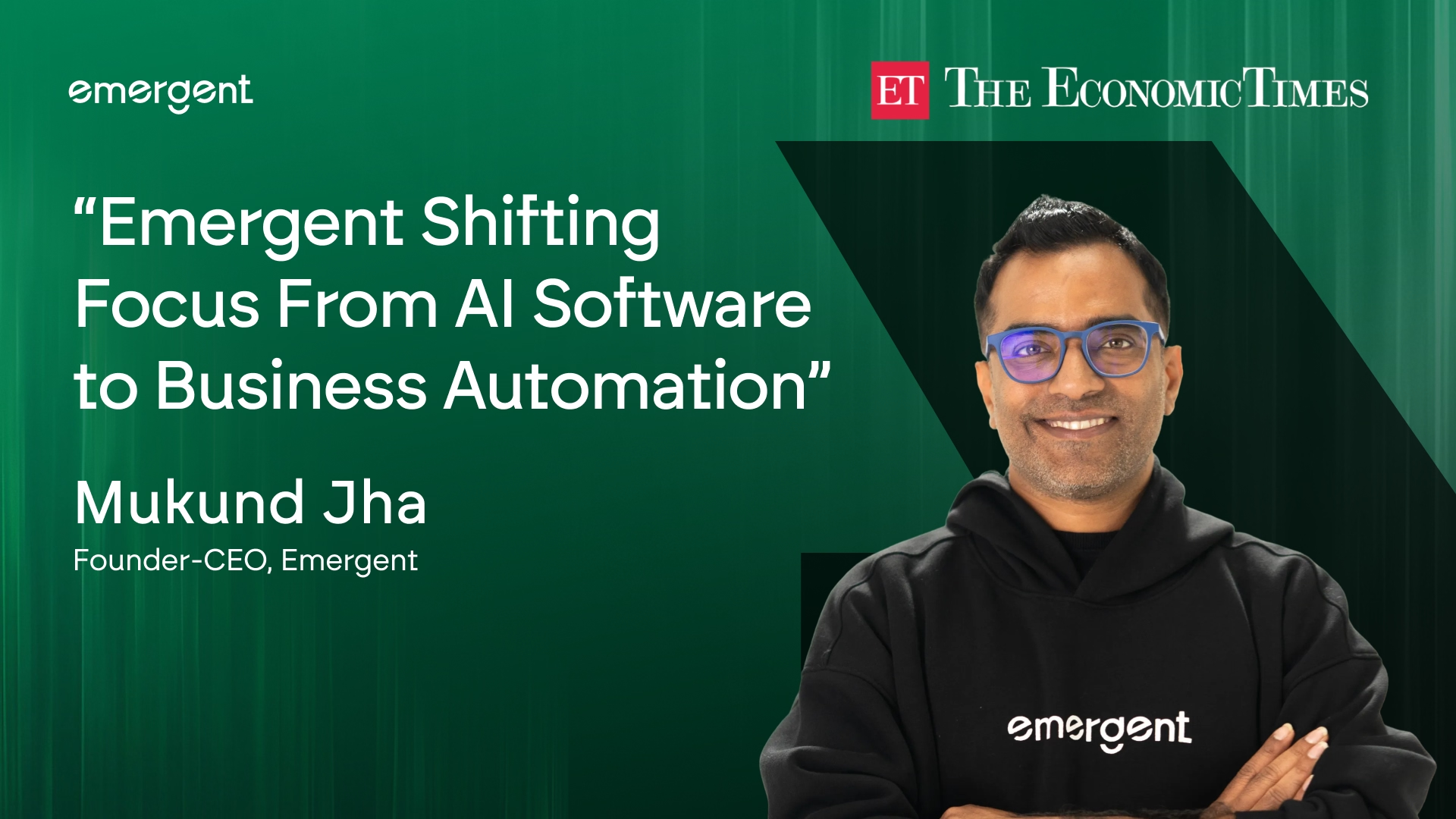
Emergent is expanding beyond app building into business automation, and cofounder and CEO Mukund Jha expects AI agents to make up a significantly larger share of revenue within 15 to 20 months. The startup lets people build web and mobile applications from natural-language prompts. Now it wants to run the businesses those apps belong to.
"We are slowly expanding into becoming an operating system for small businesses," Jha told The Economic Times in an interview.
What the agents actually do
More than half of Emergent's team is now working on the core agent technology, aimed squarely at small business owners. The agents in testing stay active in the background, monitor business metrics, and take on tasks such as cash-flow analysis, scheduling, and social media management. The through-line is simple: build the software first, then automate the operations around it.
Jha frames this as continuity, not a pivot. "Moving from software to agents is a natural extension for us," he said. As models improve, he argues, the people building on them reach for more complex applications, and Emergent's job is to help businesses coming online become AI-native from the start. The company already ships an agent builder for exactly this kind of automation.
He is willing to put a timeline on it. "I don't see a reason why, in two years' time, most businesses won't run autonomously, with agents doing most of the work," Jha said.
The awards land as Emergent changes shape
Jha's recognition has stacked up as the company shifts. He was named to the Economic Times 40 Under Forty 2026 list of corporate India's leading business figures under 40. He also won the Comeback Kid category at The Economic Times Startup Awards 2026.
That expansion is being paced deliberately. New products at Emergent are treated as experiments and expanded only after they cross internal usage and learning thresholds, while most engineering stays on the core technology.
The money is already there
Emergent raised $130 million in July at a $1.5-billion valuation, five times its valuation from a round six months earlier. The Series C made Emergent a unicorn and took total funding to roughly $230 million. Backers included Creaegis, Ranjan Pai's family office vehicles MNI Ventures and Claypond Capital, Sentinel Global, Khosla Ventures, SoftBank, Lightspeed, and Y Combinator.
The company most recently reported a $120-million annualized revenue run rate. Jha declined to update the figure but said Emergent has enough capital and is prioritizing growth over another raise. That growth is coming from two directions: new users, and existing customers doing more, with teams increasingly reaching for Emergent to run customer management, inventory, and field operations.
The competitive backdrop is crowded. Emergent competes with AI software-building companies including Replit, Lovable, and Cursor, while newer entrants such as Instinct and Meta's Muse draw attention in consumer AI agents.
Why Jha is betting on a decade, not a moment
Jha's timing runs against a louder industry mood. As leading US AI companies call for caution on the pace of model development, he agrees the concerns are warranted, since capabilities are outpacing work on understanding and controlling the systems. He just doesn't think a slowdown changes Emergent's plans.
His reasoning is that the hard work is no longer only in the models. Companies building on top of them still have to turn raw capability into products people actually use.
"Even if we just freeze all the models today, I think we still have probably a decade worth of work to be done on top of these models to bring value to the users," Jha said.
You can start building on Emergent to turn an idea into a working app in plain language.



on Emergent today




