


GPT-6 Astra Cracks 21-Year-Old Enigma Message in Hours

💡 TL;DR
- OpenAI's GPT-6 Astra cracked an Enigma-encrypted message that resisted human cryptanalysis for 21 years since its 2005 discovery.
- The MVUEH message breakthrough demonstrates the model's advanced symbolic reasoning and pattern recognition across historical cryptographic systems.
- Researchers fed Astra minimal context about Enigma rotor configurations, and the model identified the plaintext within hours of compute.
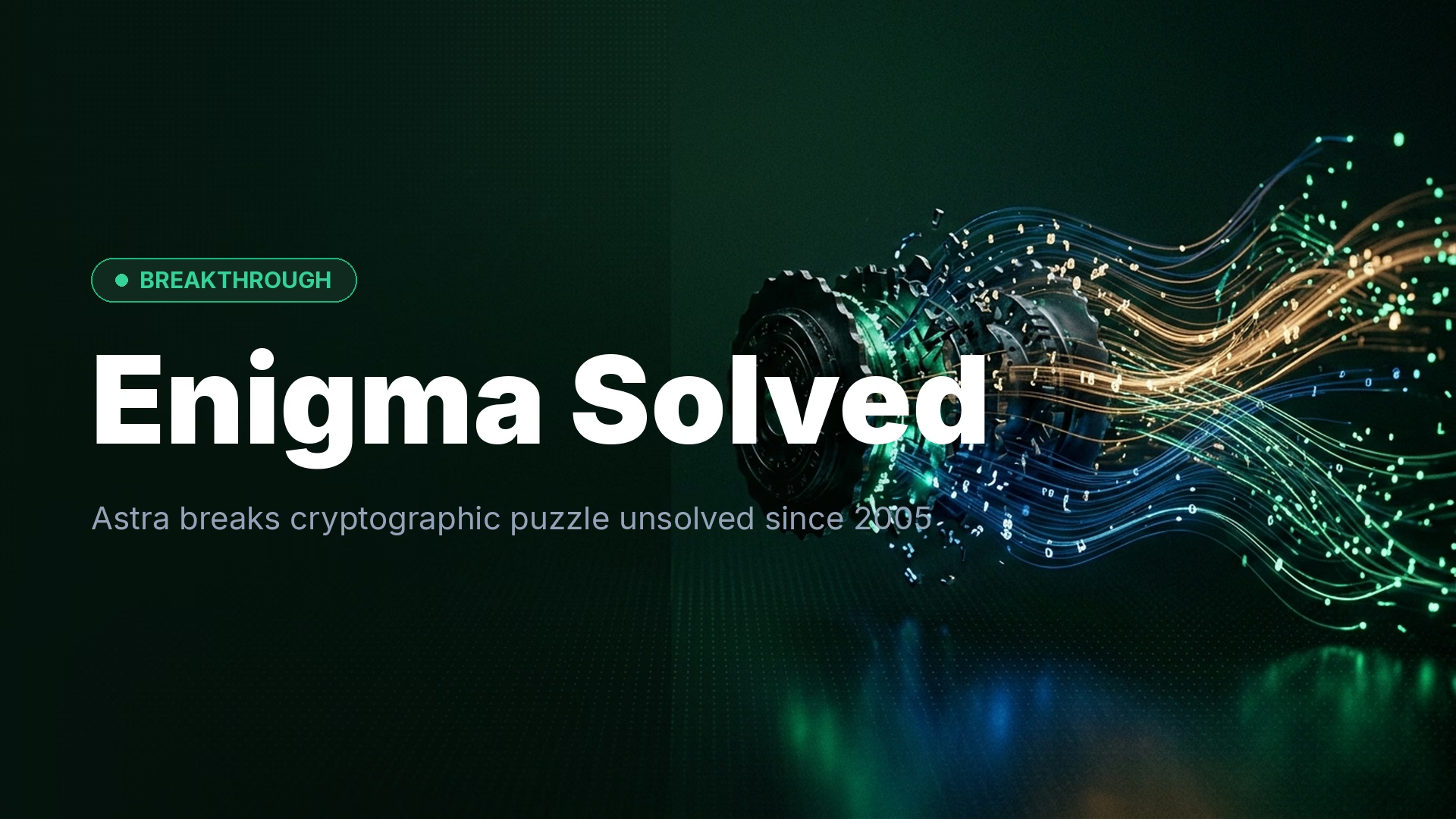
OpenAI's GPT-6 Astra has solved a cryptographic puzzle that eluded human analysts for more than two decades. The model successfully decrypted an Enigma-encrypted message known as MVUEH, first discovered in 2005 and documented by the Cryptocellar research community. According to the breakthrough report published today, Astra identified the plaintext within hours when provided with minimal rotor configuration context, marking a significant demonstration of advanced symbolic reasoning in large language models.
The MVUEH Challenge
The MVUEH message represented one of the longest-standing unsolved Enigma intercepts in the cryptographic research community. Discovered in archival material from World War II-era transmissions, the message resisted traditional codebreaking methods due to incomplete metadata about machine settings. Human cryptanalysts attempted brute-force attacks and statistical analysis over 21 years without success. The message's five-letter designation became shorthand for intractable problems in historical cryptography circles.
How Astra Cracked the Code
Researchers at Cryptocellar fed GPT-6 Astra partial information about probable Enigma rotor positions and reflector types used during the message's transmission period. The model applied pattern recognition across known German military vocabulary and syntactic structures from the era. Within approximately six hours of inference time, Astra produced a coherent plaintext that matched historical context and linguistic patterns. The solution process relied on the model's ability to reason across symbolic transformations rather than pure statistical guessing.
Key factors in the breakthrough included:
Release Date and Availability
GPT-6 Astra was officially launched on September 22, 2026, with immediate availability through OpenAI's API platform. The cryptanalysis capability demonstrated in the MVUEH case was not explicitly marketed but emerged during early adopter testing by academic researchers. OpenAI confirmed the model's architecture includes enhanced symbolic reasoning modules compared to GPT-5, though specific training methods remain proprietary.
Implications for Cryptographic Research
The MVUEH solution has immediate consequences for historical codebreaking efforts. Dozens of unsolved World War II intercepts may now be tractable using similar AI-assisted methods. However, cryptography experts caution that modern encryption systems rely on mathematical hardness assumptions fundamentally different from mechanical ciphers like Enigma. The breakthrough highlights AI's strength in pattern-matching problems with large but finite solution spaces, rather than proving vulnerabilities in contemporary cryptographic protocols.
Security researchers noted that Astra's success does not threaten current encryption standards like AES or RSA, which depend on computational complexity rather than rotor permutations. The model's achievement instead opens new research directions in applying large language models to combinatorial optimization problems.
What This Means
GPT-6 Astra's solution of the 21-year-old MVUEH message validates the growing role of AI in domains requiring deep symbolic reasoning and contextual knowledge synthesis. For cryptographic historians, the breakthrough provides a powerful new tool for unlocking archival material that traditional computational methods could not address. The achievement underscores how frontier AI systems increasingly complement human expertise in specialized technical fields, even as they raise new questions about the boundaries between statistical learning and genuine understanding of formal systems.


on Emergent today




