



GPT 5.6 Sol is a strong model, but it is not the only frontier option, and it does not win every benchmark. Whether you need better coding performance, lower cost per task, open weights for self-hosting, or a model with months of production history behind it, there are real alternatives worth comparing.
This article breaks down seven of them across four providers, with official benchmarks, pricing, and real user feedback for each. No vague rankings. Every number is sourced, and every tradeoff is stated upfront.
TL;DR
- Claude Fable 5 leads the Artificial Analysis Intelligence Index and SWE-bench Pro. The strongest generally available model for long-horizon agentic work.
- Claude Opus 4.8 is the proven, high-accuracy pick for demanding reasoning at a lower price than Fable 5.
- Claude Sonnet 5 delivers near-Opus agentic performance at $2/$10 introductory pricing, undercutting even GPT 5.6 Terra.
- Gemini 3.1 Pro Preview offers the best price-to-intelligence ratio among frontier reasoning models at $2/$12 per million tokens.
- Gemini 3.5 Flash beats its own Pro sibling on coding and agentic benchmarks while running 4x faster than comparable frontier models.
- Grok 4.5 ranks #4 on the independent Artificial Analysis Intelligence Index at $2/$6, using roughly 4x fewer output tokens per task than Opus 4.8. The token-efficiency play.
- GLM 5.2 is the strongest open-weight model, posting 62.1% on SWE-bench Pro at roughly one-sixth the cost of GPT 5.5. MIT-licensed and self-hostable.
- To turn any supported model into a deployed full-stack app without writing code, Emergent builds production-grade software from a conversation.
Why look beyond GPT 5.6?
GPT 5.6 Sol scored 80 on the Artificial Analysis Coding Agent Index, 52.7% on Agents' Last Exam, and 88.8% on Terminal-Bench 2.1, according to OpenAI's official launch post. Those numbers are real. But no single model wins everything, and the benchmarks themselves are split.
On SWE-bench Pro, Claude Fable 5 scored 80% while Sol landed at 64.6%. On the Intelligence Index v4.1, Fable 5 edged Sol 59.9 to 58.9. Open-weight models are closing the gap: Z.ai's GLM 5.2 posted 62.1% on SWE-bench Pro at a fraction of the cost. And Grok 4.5 matches near-frontier intelligence while using roughly a quarter of the tokens per task.
There is also the maturity question. GPT 5.6 launched on June 26, 2026 as a limited preview before reaching general availability on July 9. Most teams have had less than a week with it. The alternatives on this list have been in production for weeks or months, with known failure modes, established cost baselines, and community tooling already built around them.
GPT 5.6 alternatives at a glance
Pricing as of July 2026.
| Model | Provider | API pricing (per 1M tokens) | Context window | Best for |
|---|---|---|---|---|
| Claude Fable 5 | Anthropic | $10 / $50 | 1M+ | Long-horizon agentic work, software engineering |
| Claude Opus 4.8 | Anthropic | $5 / $25 | 200K | Highest-accuracy reasoning and cyber work |
| Claude Sonnet 5 | Anthropic | $2 / $10 (intro) | 1M | Near-Opus agentic coding at Sonnet pricing |
| Gemini 3.1 Pro Preview | $2 / $12 | 1M | Best price-to-intelligence, native multimodal | |
| Gemini 3.5 Flash | $1.50 / $9 | 1M | Fastest frontier-class agentic model | |
| Grok 4.5 | xAI (SpaceXAI) | $2 / $6 | 500K | Token efficiency and cost per task |
| GLM 5.2 | Z.ai (Zhipu AI) | Self-host (MIT) or Coding Plan | 1M | Best open-weight coding model |
The Claude family: Fable 5, Opus 4.8, and Sonnet 5
Anthropic fields three models against GPT 5.6, each at a different price-performance point. Rather than picking one, here is what each tier does and who it is for.
1. Claude Fable 5: the ceiling
Claude Fable 5 is Anthropic's most capable generally available model and the clearest benchmark rival to GPT 5.6 Sol. It scored 59.9 on the Artificial Analysis Intelligence Index v4.1 (the highest of any model on that composite), 80% on SWE-bench Pro, and 1,759.6 Elo on GDPval-AA v2 for knowledge work.

The defining capability is sustained autonomous performance across long task horizons. Anthropic reports that Stripe used Fable 5 to complete a codebase-wide migration across 50 million lines of Ruby in a single day, work that would have taken a team over two months. On Hebbia's Finance Benchmark for senior-level reasoning, it posted the highest score of any model.
Where GPT 5.6 Sol wins instead. Token efficiency and agentic speed. OpenAI reports that Sol used less than half the output tokens and took less than half the time as Fable 5 on the Coding Agent Index, at about one-third the estimated cost. On Agents' Last Exam, Sol scored 52.7% versus Fable 5's 40.5%. On Terminal-Bench 2.1, Sol hit 88.8% against Fable 5's 83.1%.
The classifier catch. Fable 5 ships with safety classifiers that route flagged requests to Claude Opus 4.8 when queries touch cybersecurity, biology, or model distillation. At launch, Anthropic estimated fewer than 5% of sessions would trigger this fallback. After the July 1 redeployment, Anthropic retrained the cybersecurity classifier to block a reported jailbreak in over 99% of cases, but acknowledged it now flags benign requests more often during routine coding and debugging. Independent testing by BridgeMind on July 2 found 9 of 12 TypeScript debugging tasks were rerouted to Opus 4.8. Anthropic says it will continue refining the classifier to reduce false positives. If this tradeoff is a dealbreaker, see our Fable 5 alternatives roundup.
Pricing: $10 per million input tokens, $50 per million output tokens. Double the input cost of Sol. For workflows where Fable 5's autonomy reduces total task attempts, the per-task cost can still come out lower.
Best for: Long-horizon agentic coding, large codebase migrations, and senior-level analytical work where sustained reasoning matters more than per-token cost.
What users are saying. The post-redeployment consensus is that Fable 5 is best used for planning, architecture, and final review, not as an all-purpose coding autocomplete. The stricter safety classifier means routine tasks can get rerouted to Opus 4.8, so most developers treat it as the senior advisor in a multi-model workflow.
Cursor confirmed Fable 5 leads every model on CursorBench after the July 1 redeployment, and an XDA Developers reviewer found it caught page-level UX issues that Opus missed entirely.
2. Claude Opus 4.8: the proven workhorse
Opus 4.8 was Anthropic's flagship before Fable 5, and it remains the model Anthropic recommends for the highest-accuracy, highest-stakes work. On OpenAI's published tables, Opus 4.8 scored 45.2% on Agents' Last Exam, 69.2% on SWE-bench Pro, and 55.7 on the Intelligence Index.

The case for Opus 4.8 as a GPT 5.6 alternative is maturity. It has been in production for months. Teams have built workflows around it, learned its failure modes, and established cost baselines. It also serves as Fable 5's fallback model, so if you are already on Opus 4.8, you know exactly what a Fable classifier trip will return.
On OSWorld 2.0, GPT 5.6 Sol scored 62.6% while Opus 4.8 scored 54.8%. But for teams that need cybersecurity capabilities without Fable 5's classifier guardrails, Anthropic recommends Opus 4.8 directly.
Pricing: $5 per million input tokens, $25 per million output tokens for standard usage, unchanged from Opus 4.7 (fast mode runs $10/$50). Reserve it for tasks where the cost of a wrong answer exceeds the cost of the tokens.
Best for: High-stakes accuracy work: security research, complex debugging, and production systems that cannot tolerate hallucinated outputs.
What users are saying. Early testers consistently highlight improved honesty over its predecessor, with Anthropic's own assessment finding Opus 4.8 roughly four times less likely to let flawed code pass unremarked. The consensus is that it is the most predictable frontier model in production, even if it no longer tops every benchmark.
Cursor's CEO called tool calling "meaningfully more efficient, using fewer steps for the same intelligence." On the other side, CodeRabbit's review found Opus had better code-review precision than Fable 5 but still below what teams expect for fully automated review without human triage.
3. Claude Sonnet 5: the value play
Sonnet 5 launched June 30, 2026 as the most agentic Sonnet-class model Anthropic has shipped. Anthropic's announcement positions it as delivering near-Opus-4.8 performance at Sonnet pricing, with its own benchmark chart showing a substantial step up from Sonnet 4.6 on reasoning, tool use, coding, and knowledge work. Secondary coverage reading that chart puts Sonnet 5 around 63% on SWE-bench Pro, ahead of GPT 5.5, though Anthropic publishes the figures as an image rather than text.

The value proposition is direct. At $2/$10 introductory pricing, Sonnet 5 undercuts GPT 5.6 Terra ($2.50/$15) while offering competitive agentic and coding capabilities. Anthropic's benchmark chart shows it close to Opus 4.8 on knowledge work despite the much lower price, though those specific figures are published as an image rather than text.
One caveat: Sonnet 5 uses an updated tokenizer that maps the same input to roughly 1.0 to 1.35x more tokens, which partially offsets the lower per-token rate on real workloads.
Pricing: $2 per million input tokens, $10 per million output tokens through August 31, 2026. Standard pricing after: $3/$15. During the introductory window, it is the lowest-cost frontier-class model from any major lab for agentic work.
Best for: High-volume agentic pipelines, production coding, and teams that need Opus-adjacent performance without Opus-adjacent costs.
What users are saying. Developers are consistently surprised by how close Sonnet 5 gets to Opus at a fraction of the cost. The consensus is that it is the new default for teams that need agentic performance without Opus pricing.
Lovable's co-founder reported it "gets more done with less, same output quality, fewer steps." A Rust engineer found it wrote a reproducing test, implemented a fix, then stashed the fix to confirm the bug reappeared, all unprompted and in a single pass.
The Gemini family: 3.1 Pro and 3.5 Flash
Google's two current frontier models serve different jobs. Pro is the reasoning-and-value play; Flash is the speed-and-throughput play. Both are worth knowing because they compete with GPT 5.6 on different axes.
4. Gemini 3.1 Pro Preview: best price-to-intelligence
Gemini 3.1 Pro Preview launched February 19, 2026 and remains in preview as of July 2026. On Google's official announcement, it scored 94.3% on GPQA Diamond (matching OpenAI's cross-vendor table), with reported strength on ARC-AGI-2 and SWE-bench Verified.
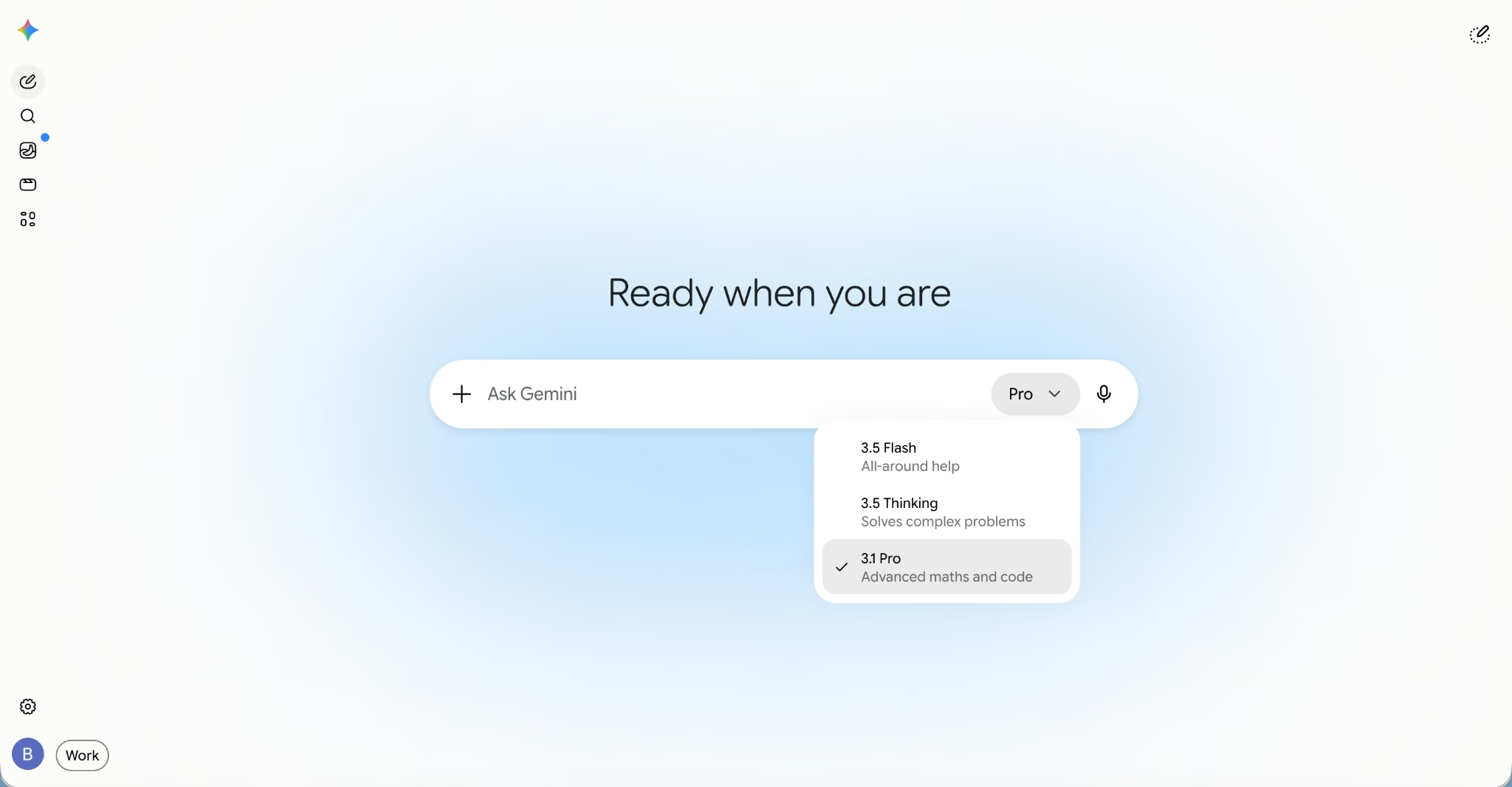
The compelling number for cost-conscious teams is price. Gemini 3.1 Pro costs $2 per million input tokens and $12 per million output tokens, less than half the input cost of GPT 5.6 Sol. For long documents, large codebases, or extended reasoning chains, that difference compounds. Native multimodal support (text, images, audio, and video in a single request) is a structural advantage no other model on this list matches.
On OpenAI's own comparison tables, Gemini 3.1 Pro scored 46.5 on the Intelligence Index, trailing Sol's 58.9 by a meaningful margin. The gap is real, and it shows most on agentic tasks. For single-turn reasoning and academic benchmarks, it stays highly competitive.
Where it falls short. Preview status is the main risk. Gemini 3.1 Pro does not yet carry GA-level SLAs, which matters for production workloads that require contractual uptime guarantees. Its output limit is 65,536 tokens, lower than Fable 5's or Sonnet 5's 128K.
Pricing: $2 per million input tokens, $12 per million output tokens. Prompts over 200K tokens rise to $4/$18. Context caching can reduce costs by up to 75%.
Best for: Budget-constrained teams that still need frontier reasoning: scientific research, multimodal workflows, and long-document analysis.
What users are saying. The consensus is that Gemini 3.1 Pro is the best price-to-intelligence deal at the frontier, with native multimodal input as its structural edge. Developers reach for it when budget matters and the task is reasoning-heavy rather than agentic.
A buildfastwithai.com reviewer called it near-top-tier intelligence at 60% less than Claude and GPT-5.5. In a hands-on frontend test, 302.AI found Pro cut corners on realism with abstract placeholders that needed significant manual rework.
5. Gemini 3.5 Flash: fastest frontier-class model
Gemini 3.5 Flash shipped at Google I/O on May 19, 2026 and broke the rule that Flash-tier models trail Pro. On Google's official Gemini 3.5 Flash page, it scored 76.2% on Terminal-Bench 2.1, 83.6% on MCP Atlas, and 1,656 Elo on GDPval-AA, each ahead of Gemini 3.1 Pro (70.3%, 78.2%, and 1,314 respectively). It also posted a notable 57.9% on Finance Agent v2, well above Pro's 43.0%.
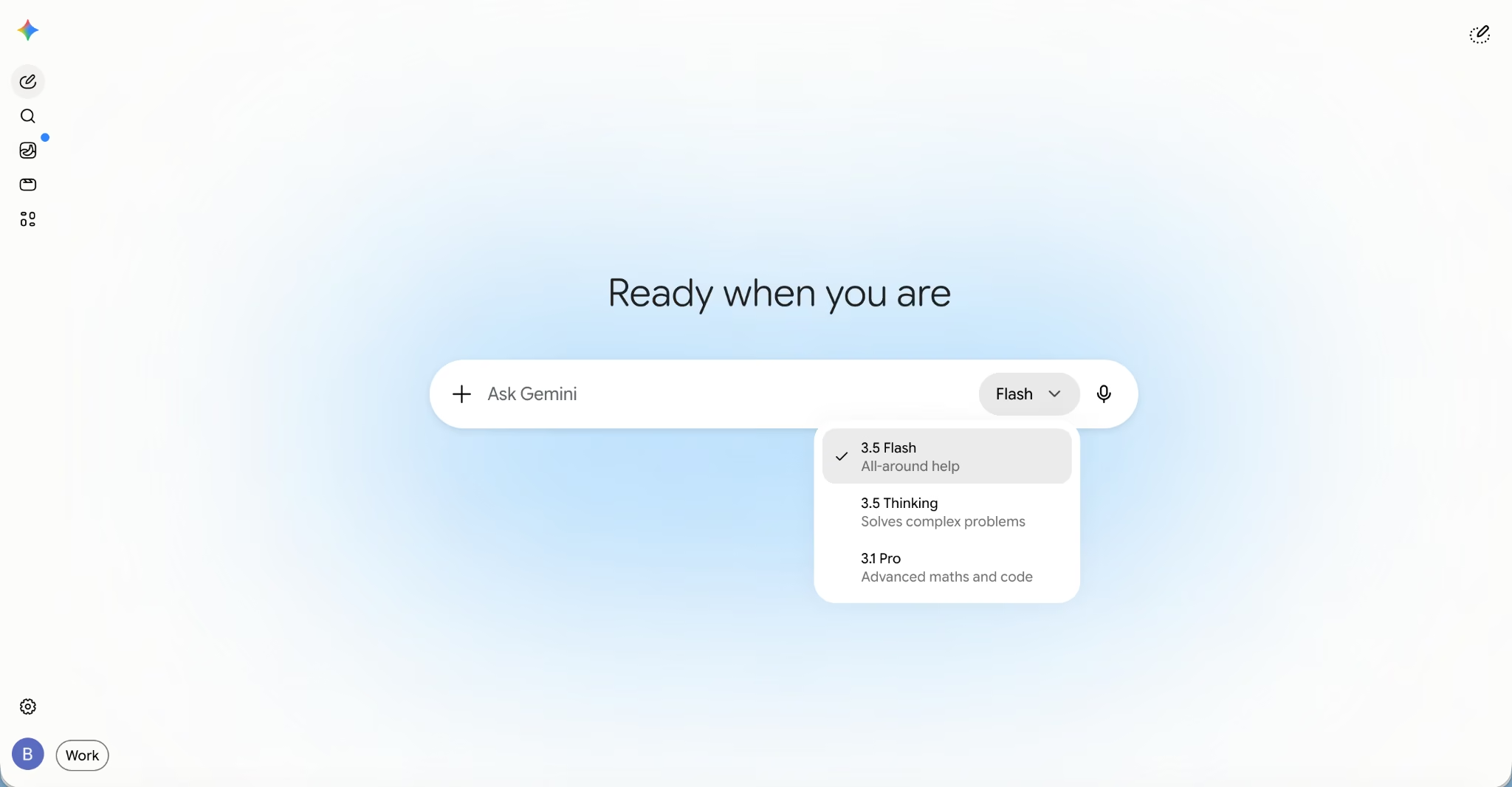
Speed is the differentiator. Gemini 3.5 Flash runs at roughly 289 output tokens per second, about 4x the throughput of other frontier models. At Google I/O, Google demonstrated it running 93 parallel subagents and processing over 15,000 requests in 12 hours for under $1,000.
On OpenAI's tables, it scored 50.2 on the Intelligence Index, trailing Sol but competitive with several older flagships. For agentic coding loops where speed and cost matter more than peak reasoning depth, Flash occupies a genuinely useful position.
Where it falls short. On pure reasoning, Flash gives up ground. Gemini 3.1 Pro still wins on Humanity's Last Exam and ARC-AGI-2. The pricing also surprised developers: at $1.50/$9, it costs 3x what Gemini 3 Flash Preview charged.
Pricing: $1.50 per million input tokens, $9 per million output tokens. Cached input at $0.15 per million makes repeated-context agent loops significantly cheaper.
Best for: Multi-step agent pipelines, parallel subagent architectures, and latency-sensitive workloads where throughput matters as much as accuracy.
What users are saying. Developers are genuinely surprised the Flash tier beats Pro on coding and agentic benchmarks. The consensus is that speed is the real differentiator, though the 3x price increase from the previous Flash generation is a recurring complaint.
A Rust developer on DEV Community gave Flash a 200-line file with 14 intentional bugs and it caught most of them correctly. The same developer found Flash hallucinated its own API pricing when asked, and a user on the Google AI Developers Forum reported it couldn't fix a simple list-width issue and kept changing unrelated parts of their project.
6. Grok 4.5
Grok 4.5 launched July 8, 2026 from xAI, now rendered as SpaceXAI following the SpaceX merger. It is the company's first model built specifically for coding and agentic work, trained on real Cursor developer session data, per xAI's launch post. On the independent Artificial Analysis Intelligence Index (not a figure xAI publishes itself), it scored 54, ranking #4 overall behind Fable 5, Opus 4.8, and GPT 5.5, but ahead of every Gemini and open-weight model.
The headline is not the raw score. It is token efficiency. On SWE-bench Pro, xAI reports Grok 4.5 resolves tasks using roughly 15,954 output tokens on average, against 67,020 for Opus 4.8, a 4.2x gap. At $2 per million input tokens and $6 per million output, it costs over 60% less than Opus 4.8 or GPT 5.5. Elon Musk positioned it plainly: "an Opus-class model, but faster, more token-efficient and lower cost," clarifying it is roughly comparable to Opus 4.7.
On xAI's own published benchmarks, Grok 4.5 scored 64.7% on SWE-bench Pro and 83.3% on Terminal-Bench 2.1. It also took the top spot on Harvey's Legal Agent Benchmark, a notable result for a model marketed around coding.
Where it falls short. Grok 4.5 is not the benchmark monarch. On the four benchmarks xAI chose to publish, it lost two (DeepSWE 1.1 and SWE-bench Pro) to Opus 4.8. Its 500K context window is smaller than Grok 4.3's 1M. And it was not available in the EU at launch, with access expected mid-July 2026. One transparency note: Cursor disclosed that an earlier Cursor codebase snapshot was accidentally included in training, which inflates its CursorBench results.
Pricing. $2 per million input tokens, $6 per million output tokens, with cached input at $0.50 per million. Roughly 80 tokens per second, which xAI expects to increase with a custom inference stack.
Best for. Cost-sensitive coding and agentic workloads, teams already working inside Cursor, and anyone optimizing for cost per completed task rather than benchmark ceiling.
What users are saying. The consensus is that Grok 4.5's speed and cost per task are genuinely impressive for coding, but frontend design is weak and the hallucination rate is a real concern. Trust questions around Musk's influence on model outputs were the loudest thread on Hacker News at launch.
DeepakNess, after 13 million tokens in Cursor at only 2.6% of monthly usage, called it "flawless and very reliable" for backend coding. Thomas Wiegold's review flagged the hallucination rate rising to around 54% on AA-Omniscience, up from 25%, noting it is "more confident when it's wrong."
7. GLM 5.2
GLM 5.2 is the strongest open-weight model available in mid-2026. Released by Z.ai (formerly Zhipu AI) on June 13, 2026, it is a Mixture-of-Experts model with a 1-million-token context window and weights free to download under an MIT license, per Z.ai's announcement.
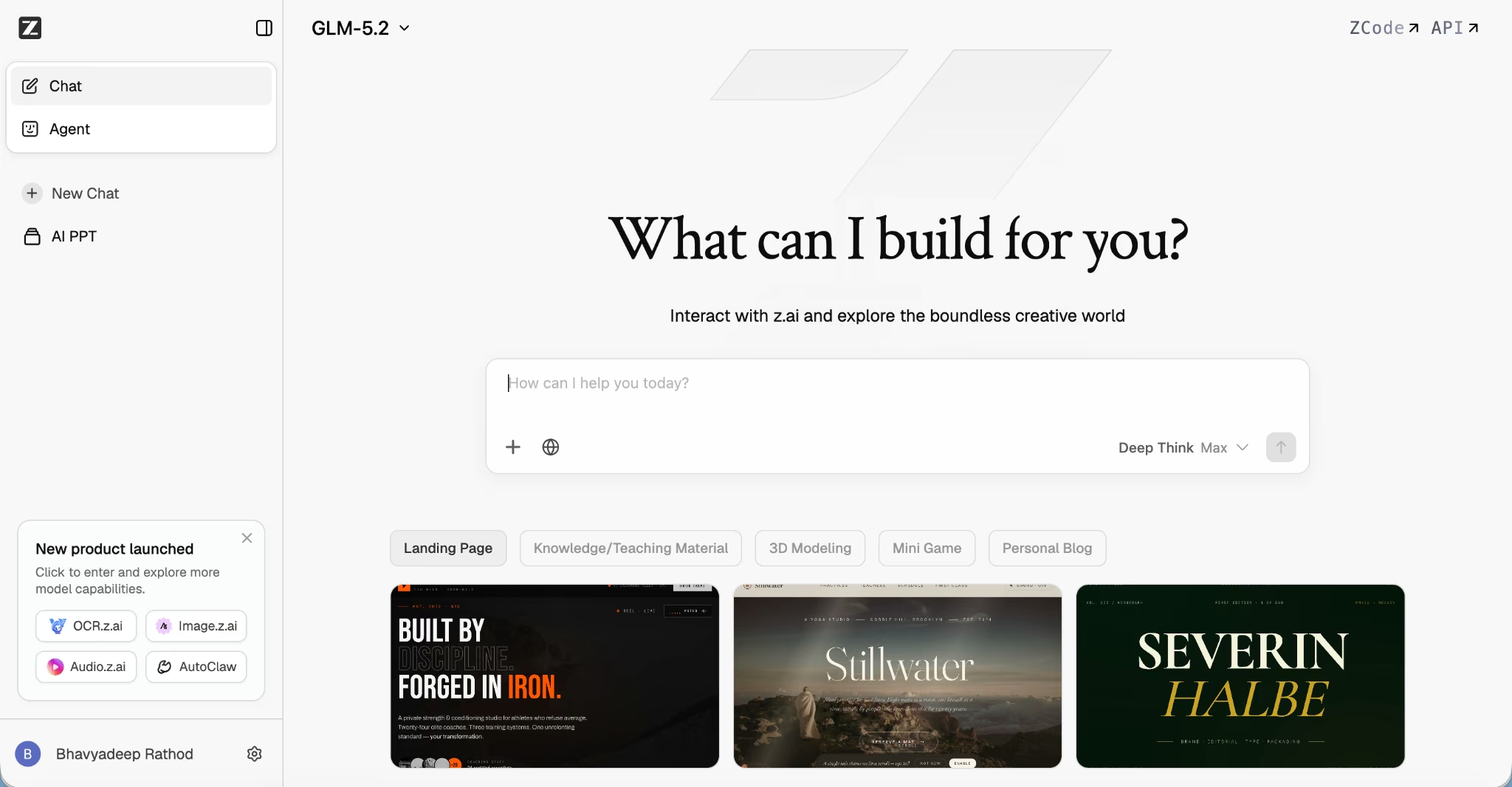
The numbers are strong for an open model. On Z.ai's own benchmark table, GLM 5.2 scored 62.1% on SWE-bench Pro, ahead of GPT 5.5's 58.6%, and 81.0% on Terminal-Bench 2.1 (Terminus-2 harness), within four points of Claude Opus 4.8's 85.0%. It posted 91.2% on GPQA Diamond and 40.5% on Humanity's Last Exam. Z.ai positions it as the highest-ranked open-source model across three long-horizon coding benchmarks (FrontierSWE, PostTrainBench, and SWE-Marathon), where it trails only the Opus series.
What makes GLM 5.2 a serious alternative is the cost structure. Self-hosted on your own hardware under the MIT license, the per-token cost drops to whatever your compute costs, with no per-call API fee at all. For enterprises with data residency requirements, that distinction matters as much as the benchmark scores.
Where it falls short. GLM 5.2 trails the closed frontier on the hardest reasoning tasks. On Humanity's Last Exam it scored 40.5%, behind Opus 4.8 (49.8%) and Gemini 3.1 Pro (45.0%) on Z.ai's own comparison. Z.ai also notes the model shows more reward-hacking tendency than its predecessor during coding evaluations, which it mitigates with an anti-hack detection module. And API traffic through Z.ai's cloud is subject to China's National Intelligence Law, a data governance consideration that self-hosting the MIT-licensed weights avoids entirely.
Pricing. Weights are free to self-host under the MIT license. Z.ai also offers a GLM Coding Plan subscription for use in coding agents like Claude Code and OpenCode. Per-token API rates (reported in secondary coverage at roughly $1.40 input and $4.40 output per million tokens) are not listed on Z.ai's launch post; verify current rates on Z.ai's pricing page before publishing.
Best for. Teams that need frontier-class coding at open-weight pricing, organizations with data residency requirements, and anyone building a self-hosted model stack.
What users are saying. The consensus is that GLM 5.2 is surprisingly capable for an open-weight model on sustained coding sessions, but React under multi-step agentic pressure is shaky, and data jurisdiction through Z.ai's cloud is the real concern for enterprise teams.
Claire Vo on Lenny's Newsletter tested a 45-minute autonomous bug-hunting session and found it produced a prioritized fix plan with 14 planned fixes, including two P0s she hadn't spotted, all for $3.36 in token costs. eesel's ZCode review called its MIT-licensed open weights "rare for something this capable" but noted that all API calls route through PRC-jurisdiction servers.
Official benchmark comparison: GPT 5.6 Sol vs. alternatives
The table below uses vendor-reported benchmarks from official announcements, with cross-vendor figures taken from OpenAI's published table. Cells drawn from secondary coverage of image-based tables are marked. Where a vendor did not report a score, the cell shows a dash.
Scores as of July 2026.
| Benchmark | GPT 5.6 Sol | Claude Fable 5 | Claude Opus 4.8 | Claude Sonnet 5 | Gemini 3.1 Pro | Grok 4.5 | GLM 5.2 |
|---|---|---|---|---|---|---|---|
| AA Intelligence Index | 58.9 | 59.9 | 55.7 | — | 46.5 | 54* | 51* |
| SWE-bench Pro | 64.6% | 80% | 69.2% | 63.2%† | 54.2% | 64.7% | 62.1% |
| Terminal-Bench 2.1 | 88.8% | 83.1% | 78.9% | — | 70.7% | 83.3% | 81.0% |
| GDPval-AA v2 (Elo) | 1,747.8 | 1,759.6 | 1,600.1 | 1,618† | — | — | — |
| GPQA Diamond | 94.6% | 92.6% | 92% | — | 94.3% | — | — |
| Agents' Last Exam | 52.7% | 40.5% | 45.2% | — | 32.1% | — | — |
* Grok 4.5 and GLM 5.2 Intelligence Index scores are from independent Artificial Analysis, not the vendor. xAI and Z.ai do not publish this metric on their own pages. † Sonnet 5 figures are from secondary coverage of Anthropic's benchmark chart (published as an image), not primary text.
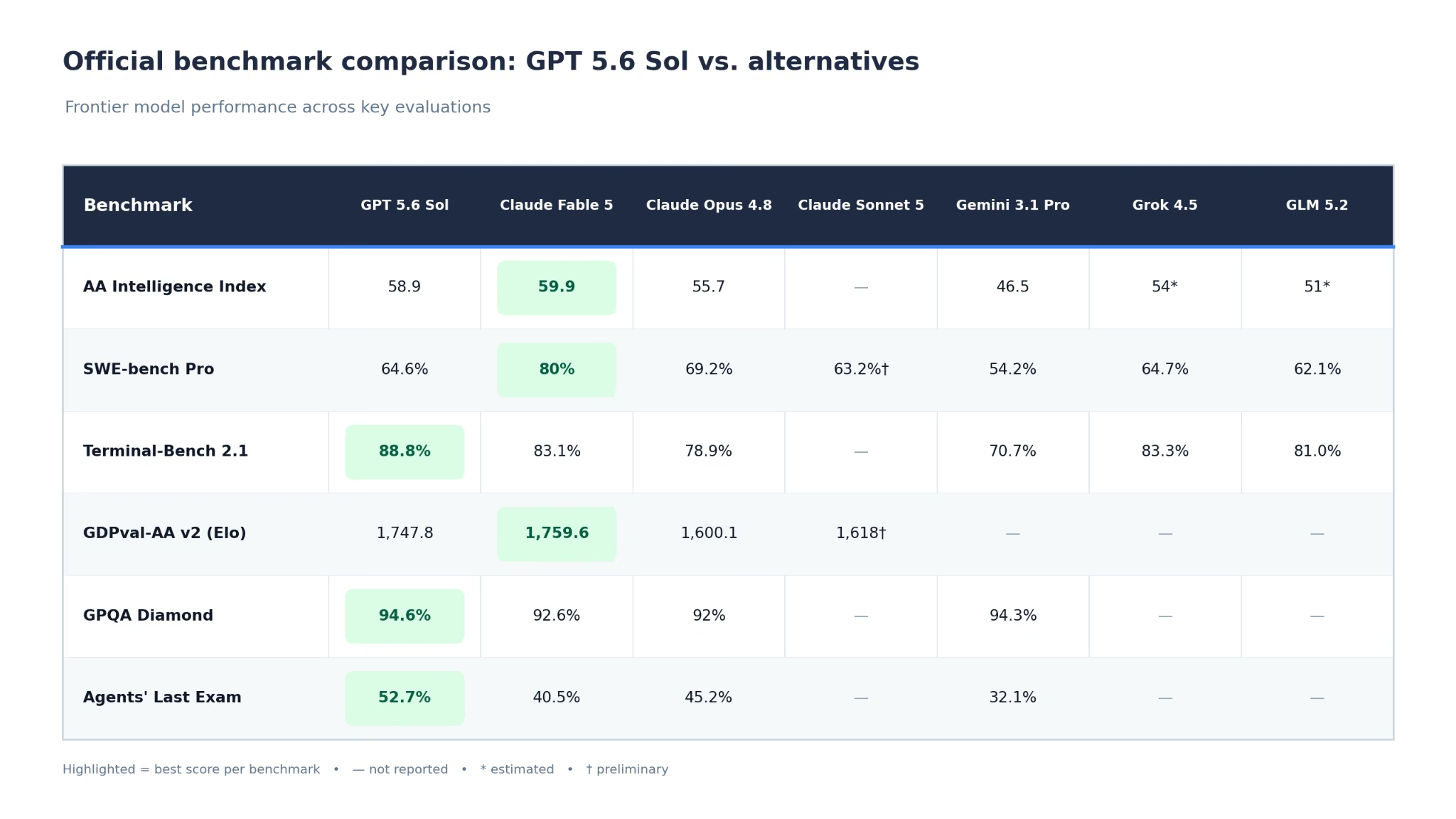
Reading the table: GPT 5.6 Sol leads on token-efficiency-weighted benchmarks (Terminal-Bench 2.1, Agents' Last Exam). Fable 5 leads on raw software engineering (SWE-bench Pro) and knowledge work (GDPval-AA). Grok 4.5 and GLM 5.2 land within three points of Sol on SWE-bench Pro at a fraction of the cost. Gemini 3.1 Pro nearly matches Sol on GPQA Diamond for less than half the price.
No single model wins every benchmark. The right choice depends on your workload, budget, and access constraints.
How to choose the right GPT 5.6 alternative
You need the strongest autonomous agent: Claude Fable 5. Its lead over Sol is widest on multi-hour, multi-step workflows where the model must stay on task and validate its own work.
You need proven, high-accuracy reasoning: Claude Opus 4.8. Months of production history and the highest bar for tasks where a wrong answer is expensive.
You need agentic performance on a budget: Claude Sonnet 5 at $2/$10 (introductory) undercuts GPT 5.6 Terra while posting competitive coding numbers.
You need frontier reasoning at the lowest closed-model price: Gemini 3.1 Pro at $2/$12, with native multimodal support no other model here matches.
You need speed above all: Gemini 3.5 Flash at 289 tokens/second, 4x faster than comparable frontier models.
You need the lowest cost per completed task: Grok 4.5. Its 4.2x token-efficiency advantage over Opus 4.8 means the per-task bill often beats the per-token price suggests.
You need open weights and self-hosting: GLM 5.2. The strongest open-weight coding model, MIT-licensed, and the answer for data residency requirements.
Other models worth knowing about
These are not direct GPT 5.6 replacements, and each has a specific reason it sits outside the main seven. They come up often enough in this decision that skipping them entirely would leave the picture incomplete, so here is a quick, honest comparison on one or two parameters against GPT 5.6.
DeepSeek V4 Pro
DeepSeek V4 Pro is the cost-efficiency extreme. Released April 24, 2026, it is a 1.6-trillion-parameter (49B active) open-weight MoE model with a 1M context window. Its official announcement confirms the architecture and calls it "open-source SOTA in agentic coding," but publishes its own benchmarks and pricing only as images.
Competitors' official tables fill the gap: both Z.ai and Alibaba report DeepSeek V4 Pro around 55 to 59% on SWE-bench Pro and, in Qwen's table, 80.6% on SWE-bench Verified (Max variant), on par with Gemini 3.1 Pro. Secondary coverage puts pricing near $0.435 input and $0.87 output per million tokens, roughly a 10x lower input cost than GPT 5.6 Sol. It sits outside the main list because GLM 5.2 covers the open-weight slot with stronger Terminal-Bench numbers (81.0% versus DeepSeek's 64.0% on Z.ai's table), but if raw price per token is the deciding metric, V4 Pro is the floor.
Qwen 3.7 Max
Qwen 3.7 Max is Alibaba's proprietary agent-focused flagship, available via Alibaba Cloud Model Studio. On Alibaba's own benchmarks, it scored 60.6% on SWE-bench Pro (ahead of Sol's Pro comparison in Alibaba's table), 80.4% on SWE-bench Verified, 69.7% on Terminal-Bench 2.0, and 92.4% on GPQA Diamond.
Those are strong, genuinely frontier-adjacent numbers. It stays out of the main seven because, for a reader shopping GPT 5.6 alternatives, it overlaps the same budget-frontier and open-ecosystem slot that Grok 4.5 and GLM 5.2 already fill more distinctly, and Alibaba does not publish a directly comparable per-token price against the others here.
Kimi K2.7 Code
Kimi K2.7 Code is Moonshot AI's open-weight coding specialist: a 1-trillion-parameter MoE model (32B active), 256K context, priced at $0.95 input and $4 output per million tokens ($0.19 cached input), per Moonshot's model page. It cuts thinking-token usage roughly 30% versus its predecessor.
On its own benchmarks it scored 62.0 on Kimi Code Bench v2 and 81.1 on MCP Mark Verified, though it trails GPT 5.5 and Opus 4.8 on the shared external benchmarks Moonshot reports (for example, MCP Atlas 76.0 versus Opus 4.8's 81.3). It stays out of the main list because it is coding-only rather than a general Sol replacement, and several of its headline numbers come from in-house suites, so cross-comparison is limited.
Sakana Fugu Ultra
Sakana Fugu Ultra is a different category: a model orchestrator, not a single model. It routes each subtask to a pool of frontier LLMs behind one API, scoring 73.7% on SWE-bench Pro. It belongs in a conversation about multi-model routing and vendor independence, not a like-for-like swap with GPT 5.6, which is why it is a mention rather than a section.
Llama 4 and Mistral
Meta's Llama 4 (free, embedded across Meta apps) and Mistral's models (strong EU data-residency story) round out the field. Both trail the frontier on general capability, and neither is a serious GPT 5.6 replacement for demanding coding or agentic work. They matter if free access or EU compliance outweighs peak capability.
Beyond the model comparison: shipping software, not just choosing a model
Picking the right model is one decision. Turning that model into working software is a different problem entirely.
Emergent is a vibe coding platform that builds production-grade, full-stack applications from a conversation. Describe what you want, and Emergent's multi-agent architecture writes the frontend, backend, and database, integrates services like Stripe, MongoDB, and Google OAuth, and deploys to your own custom domain. You own the code and can export it anytime.
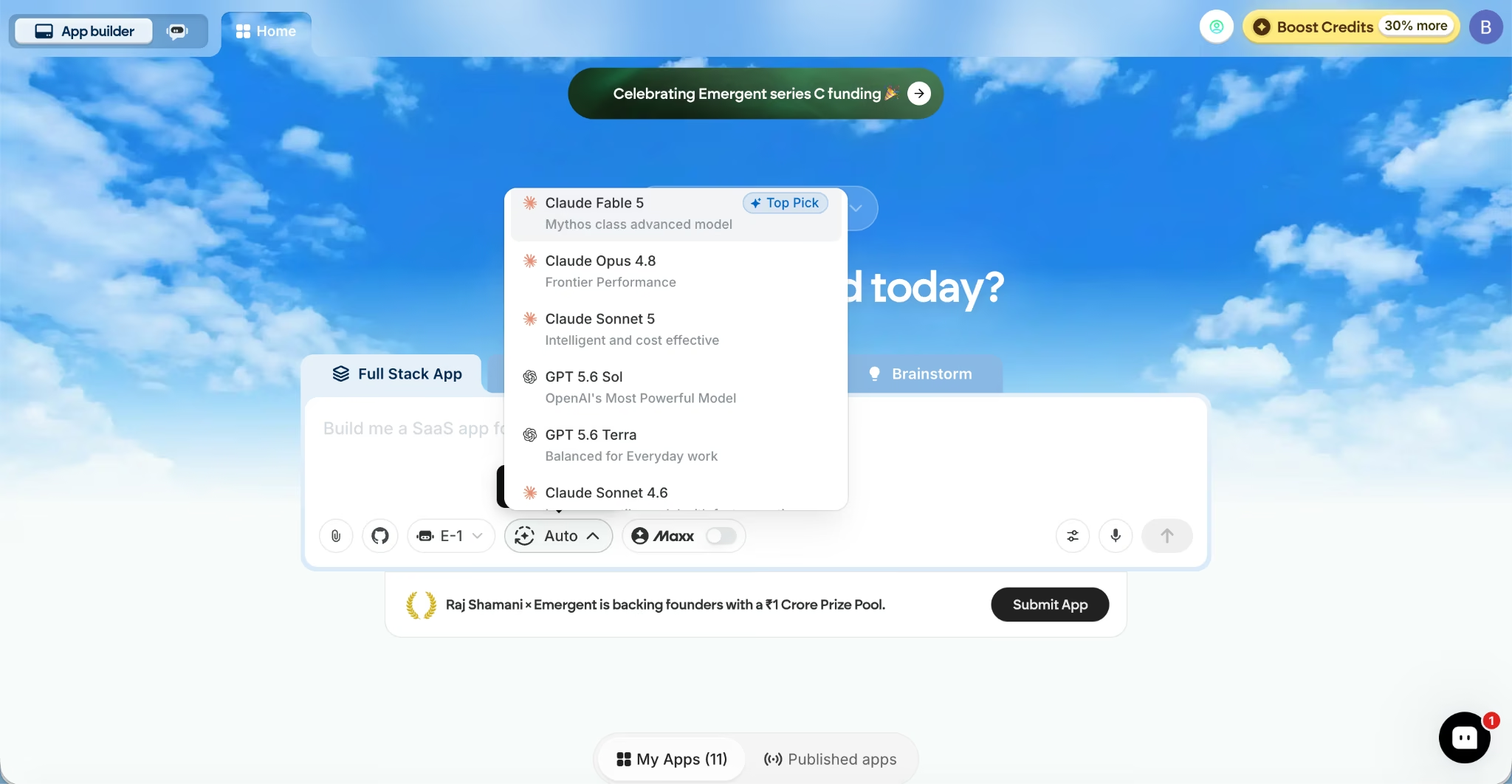
The Universal Key gives you access to GPT, Claude, and Gemini models through a single credential with unified billing. No separate API accounts, no juggling credentials across vendors. GPT 5.6 is already live on Emergent, so you can choose between Sol, Terra, Claude, or Gemini for your next project from one dashboard.

Most AI app builders stop at prototypes. Emergent creates production-ready apps you can actually launch.
- Production-ready apps
- Web & mobile apps
- Deploy in minutes







