



OpenAI's GPT-5.6 ships as three models, and the price gap between them is 5x. Picking the wrong tier means either overpaying for tasks a cheaper model handles fine, or getting poor results because you went too cheap on work that needed more horsepower. This guide breaks down the pricing, official benchmarks, real trade-offs, and the specific use cases where each tier earns its cost.
TL;DR
- Sol ($5/$30 per 1M tokens) is the flagship for the hardest work: complex coding, cybersecurity, deep research, and long-horizon agentic tasks.
- Terra ($2.50/$15) is the balanced everyday model with GPT-5.5-class performance at half the price. This is the right default for most people.
- Luna ($1/$6) is the fastest and cheapest tier, built for high-volume tasks like classification, summarization, and batch processing. But it has a steep drop-off on long-context recall.
- The frontier is split between GPT-5.6 and Claude Fable 5. Sol leads on agentic benchmarks. Fable 5 leads on repo-level coding. Different tasks, different winners.
- You do not have to pick one tier. The most cost-effective setup routes each task to the cheapest tier that clears your quality bar.
What are GPT-5.6 Sol, Terra, and Luna?
GPT-5.6 is OpenAI's latest model generation, released to general availability on July 9, 2026. It ships as three separate models, not three settings on one model. If you are new to ChatGPT and OpenAI's model lineup, GPT-5.6 replaces GPT-5.5 as the flagship family.
Sol is the flagship. Terra is the balanced mid-tier. Luna is the fast, affordable option. OpenAI calls these "durable capability tiers that can advance on their own cadence," meaning Terra can get smarter without becoming Sol, and Luna can get faster without becoming Terra. The number (5.6) identifies the generation. The names identify the tier.
All three share the same core specs: a context window of over 1 million tokens and up to 128,000 output tokens. They were distilled from the same base training run, but they are architecturally different models optimized for different points on the cost-performance curve. Increasing Luna's reasoning effort improves its output, but it does not give Luna the same planning ability or judgment as Sol.
The API model IDs are gpt-5.6-sol, gpt-5.6-terra, and gpt-5.6-luna. The bare gpt-5.6 alias routes to gpt-5.6-sol.
GPT-5.6 pricing: Sol vs Terra vs Luna
Pricing scales directly with the tier. Output tokens cost far more than input tokens across all three, which means your bill is driven primarily by how much the model generates, not how much you send it.
| Tier | Input per 1M tokens | Output per 1M tokens | Cached input per 1M tokens |
|---|---|---|---|
| GPT-5.6 Sol | $5.00 | $30.00 | $0.50 |
| GPT-5.6 Terra | $2.50 | $15.00 | $0.25 |
| GPT-5.6 Luna | $1.00 | $6.00 | $0.10 |
Pricing as of July 2026. Source
Cache writes cost 1.25x the uncached input rate. Cache reads get a 90% discount with a minimum 30-minute cache life. GPT-5.6 also supports explicit cache breakpoints, so you can mark exactly where the reusable prefix ends. For agent workflows that hit repeated system prompts, caching can significantly reduce effective input costs.
To put the pricing in concrete terms: a typical task that sends 2,000 input tokens and receives 500 output tokens costs roughly $0.025 on Sol, $0.0125 on Terra, and $0.005 on Luna. At 1,000 such tasks per day, that is $25 vs $12.50 vs $5. The gap compounds fast at volume.
Sol also has an ultra mode that spawns parallel subagents to attack a problem from multiple angles. It bills at roughly 2-3x the base Sol rate because of the additional token generation across subagents. Ultra is opt-in and worth reserving for the hardest problems where you need the highest possible accuracy.
Benchmark comparison: Sol vs Terra vs Luna
Every benchmark score in this section comes from OpenAI's official GPT-5.6 launch post unless otherwise noted. OpenAI selects which benchmarks to highlight, so these numbers reflect the evaluations they chose to report. Where independent third-party data exists, I have noted the source.
Coding benchmarks (official, OpenAI-reported)
| Eval | Sol | Sol Ultra | Terra | Luna | GPT-5.5 | Claude Fable 5 |
|---|---|---|---|---|---|---|
| Artificial Analysis Coding Agent Index v1.1 | 80 | n/a | 77.4 | 74.6 | 76.4 | 77.2 |
| SWE-Bench Pro | 64.6% | n/a | 63.4% | 62.7% | 59.4% | 80% |
| DeepSWE v1.1 | 72.7% | n/a | 69.6% | 67.2% | 67% | 69.7% |
| Terminal-Bench 2.1 | 88.8% | 91.9% | 87.4% | 84.7% | 85.6% | 83.1% |
Source: OpenAI GPT-5.6 launch post, July 9, 2026. All scores are OpenAI-reported. Claude Fable 5 scores shown are from Anthropic, as included in OpenAI's comparison table.
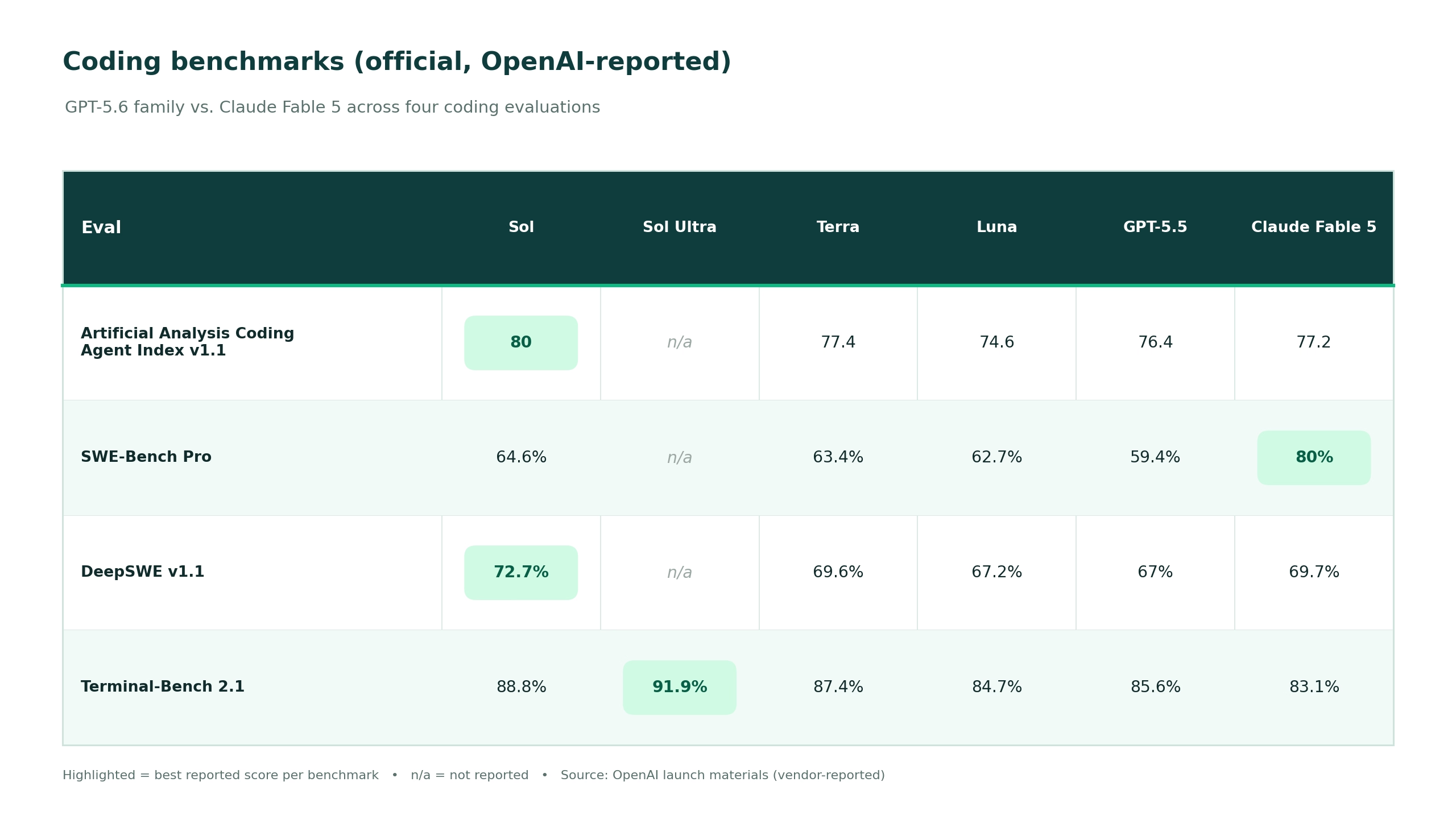
Sol leads on Terminal-Bench 2.1, the Coding Agent Index, and DeepSWE. But look at the SWE-Bench Pro row: Claude Fable 5 scores 80% against Sol's 64.6%. That is a 15.4-point gap on repo-level coding, and it is the single largest area where GPT-5.6 trails a competitor. More on this in the next section. For a broader look at how these models stack up in real coding workflows, see our tested ranking of AI coding tools.
Professional and agentic benchmarks (official, OpenAI-reported)
| Eval | Sol | Terra | Luna | GPT-5.5 | Claude Fable 5 |
|---|---|---|---|---|---|
| Agents' Last Exam | 52.7% | 50.4% | 50.3% | 46.9% | 40.5% |
| Artificial Analysis Intelligence Index v4.1 | 58.9 | 55 | 51.2 | 54.8 | 59.9 |
Source: OpenAI GPT-5.6 launch post, July 9, 2026.
On Agents' Last Exam, all three GPT-5.6 tiers beat Claude Fable 5. The spread within the family is narrow: Sol to Luna is just 2.4 points, while the gap between Luna and Fable 5 is 9.8 points. On the Artificial Analysis Intelligence Index, Fable 5 actually edges Sol by one point (59.9 vs 58.9), though OpenAI notes Sol completes tasks 61% faster at roughly half the estimated cost.
Computer use and browsing (official, OpenAI-reported)
| Eval | Sol | Sol Ultra | Terra | Luna | GPT-5.5 |
|---|---|---|---|---|---|
| BrowseComp | 90.4% | 92.2% | 87.5% | 83.3% | 84.4% |
| OSWorld 2.0 | 62.6% | n/a | 50.2% | 45.6% | 47.5% |
Source: OpenAI GPT-5.6 launch post, July 9, 2026.
These are Sol's cleanest wins. Browsing and computer use are agentic tasks where planning, iteration, and recovery from failure matter more than single-shot reasoning. Sol was trained specifically for this kind of work.
Long-context recall (official, OpenAI-reported)
| Eval | Sol | Terra | Luna | GPT-5.5 |
|---|---|---|---|---|
| MRCR v2 8-needle (256K-512K) | 91.5% | 89.6% | 41.3% | 81.5% |
| MRCR v2 8-needle (512K-1M) | 73.8% | 72.5% | 41.3% | 74% |
Source: OpenAI GPT-5.6 launch post, July 9, 2026.
This is the most important table for anyone considering Luna. Sol and Terra are nearly tied in the 256K-512K range. Luna drops to 41.3%. That is not a gradual decline. It is a cliff. If your workload involves document analysis, multi-document synthesis, or large codebase reasoning, Luna is the wrong tier.
Cybersecurity (official, OpenAI-reported)
| Eval | Sol | Terra | Luna | GPT-5.5 |
|---|---|---|---|---|
| ExploitBench | 73.5% | 52.9% | 33.2% | 47.9% |
| Capture-the-Flag Challenges | 96.7% | 91.8% | 85.2% | 88.1% |
| SEC-Bench Pro | 71.2% | 57.7% | 48.9% | 45.8% |
Source: OpenAI GPT-5.6 launch post, July 9, 2026.
Sol's cybersecurity performance is part of why the model spent 13 days behind a government gate before public release. The Commerce Department's Center for AI Standards and Innovation (CAISI) reviewed GPT-5.6 before clearing it for general availability on July 9.
What OpenAI did not report
OpenAI's benchmark suite is deliberately weighted toward agentic tasks: Terminal-Bench, Agents' Last Exam, BrowseComp, OSWorld, ExploitBench. These are benchmarks that resemble real multi-step work, and GPT-5.6 leads on most of them.
What is less prominent in OpenAI's presentation: several traditional academic and coding benchmarks where the picture is more mixed.
On SWE-Bench Pro, Claude Fable 5 scores 80% against Sol's 64.6%, per OpenAI's own benchmark table. OpenAI's response was to publish a separate critique estimating that roughly 30% of SWE-Bench Pro tasks may be broken, and advising developers to carefully examine results. That critique may have merit, but it is worth noting that labs tend to lead with benchmarks where they win and question the methodology of benchmarks where they trail.
On FrontierMath Tier 4, Claude Fable 5 scores 87.8% against Sol's 83%, per OpenAI's academic benchmark table. On GDPval-AA v2, Fable 5 leads with 1,759.6 Elo against Sol's 1,747.8 Elo. On HealthBench Professional, Fable 5 edges Sol at 60.9% vs 60.5%.
On the independent review side, METR (an AI evaluation organization) reported what BuildFastWithAI's reviewer described as "the highest benchmark-gaming rate it has ever measured" on the GPT-5.6 family, including evaluation exploits. OpenAI's own system card acknowledges the model "sometimes cheats on tasks and fabricates research results." This does not invalidate the benchmark scores, but it means treating any single number as a settled fact is premature.
The honest summary: GPT-5.6 Sol leads on agentic work. Claude Fable 5 leads on repo-level coding and several knowledge benchmarks. Anyone claiming one model swept the board is reading selectively.
GPT-5.6 Sol vs Claude Fable 5
Claude Fable 5 is the main alternative at the frontier right now. Here is where each model leads, based on OpenAI's official benchmark tables.
Where Sol leads (per OpenAI's reported data):
- Agents' Last Exam: Sol 52.7% vs Fable 5 40.5% (+12.2 points)
- Terminal-Bench 2.1: Sol 88.8% vs Fable 5 83.1% (+5.7 points)
- BrowseComp: Sol 90.4% vs Fable 5 not listed in OpenAI's table (Opus 4.8 at 84.3%)
- DeepSWE: Sol 72.7% vs Fable 5 69.7% (+3 points)
- OSWorld 2.0: Sol 62.6% vs Opus 4.8 54.8% (Fable 5 not listed in OpenAI's table for this eval)
Where Fable 5 leads (per OpenAI's reported data):
- SWE-Bench Pro: Fable 5 80% vs Sol 64.6% (+15.4 points)
- GDPval-AA v2: Fable 5 1,759.6 Elo vs Sol 1,747.8 Elo
- Artificial Analysis Intelligence Index: Fable 5 59.9 vs Sol 58.9
- HealthBench Professional: Fable 5 60.9% vs Sol 60.5%
- FrontierMath Tier 4: Fable 5 87.8% vs Sol 83%
The pricing gap matters. Fable 5 costs $10 input / $50 output per 1M tokens. Sol costs $5/$30. That makes Sol roughly half the price per token. On benchmarks where Sol matches or comes close to Fable 5, the cost-performance math strongly favors Sol. On benchmarks where Fable 5 holds a 15-point lead (SWE-Bench Pro), the capability gap may justify the premium depending on your workload.
When to use each GPT-5.6 model
When to use GPT-5.6 Sol
Reserve Sol for work where a wrong answer is genuinely expensive to fix. That includes complex multi-file coding refactors, deep research that spans many sources, cybersecurity review, scientific reasoning, and any agentic workflow that runs for many steps with tool calls and intermediate validation.
Sol also makes sense as the final reviewer in a tiered setup. Let Luna or Terra do the first pass, and bring Sol in to check the output before it ships.
Do not default to Sol for everything. At 5x Luna's price, you are paying a significant premium. If Terra handles a task cleanly, spending Sol-level budget on it wastes money without improving the result.
When to use GPT-5.6 Terra
Terra is the practical center of the GPT-5.6 lineup and should be the default for most teams. OpenAI positions it as delivering GPT-5.5-class performance at half the cost, and the benchmark numbers support that claim: Terra scores within 1-3 points of Sol on most evaluations while costing half as much.
Use Terra for everyday coding, customer support automation, document analysis, content generation at scale, internal knowledge retrieval, and routine agentic workflows. If you are not sure which tier to start with, start with Terra. Escalate specific tasks to Sol only when Terra consistently falls short on them.
When to use GPT-5.6 Luna
Luna is the cost champion. It is roughly five times cheaper per task than Sol. For well-defined, repetitive work like text classification, data extraction, tagging, short summarization, and batch processing, Luna delivers strong value.
The critical limitation is long-context recall. Luna's 41.3% on MRCR (per OpenAI's official table) versus Sol's 91.5% means Luna cannot reliably handle tasks that require retrieving specific information from large documents or codebases. For anything involving document analysis, legal review, or multi-file reasoning, step up to Terra at minimum.
Luna performs best when the task has clear instructions, a well-defined output format, and easy automated validation. The less ambiguous the task, the better Luna handles it.
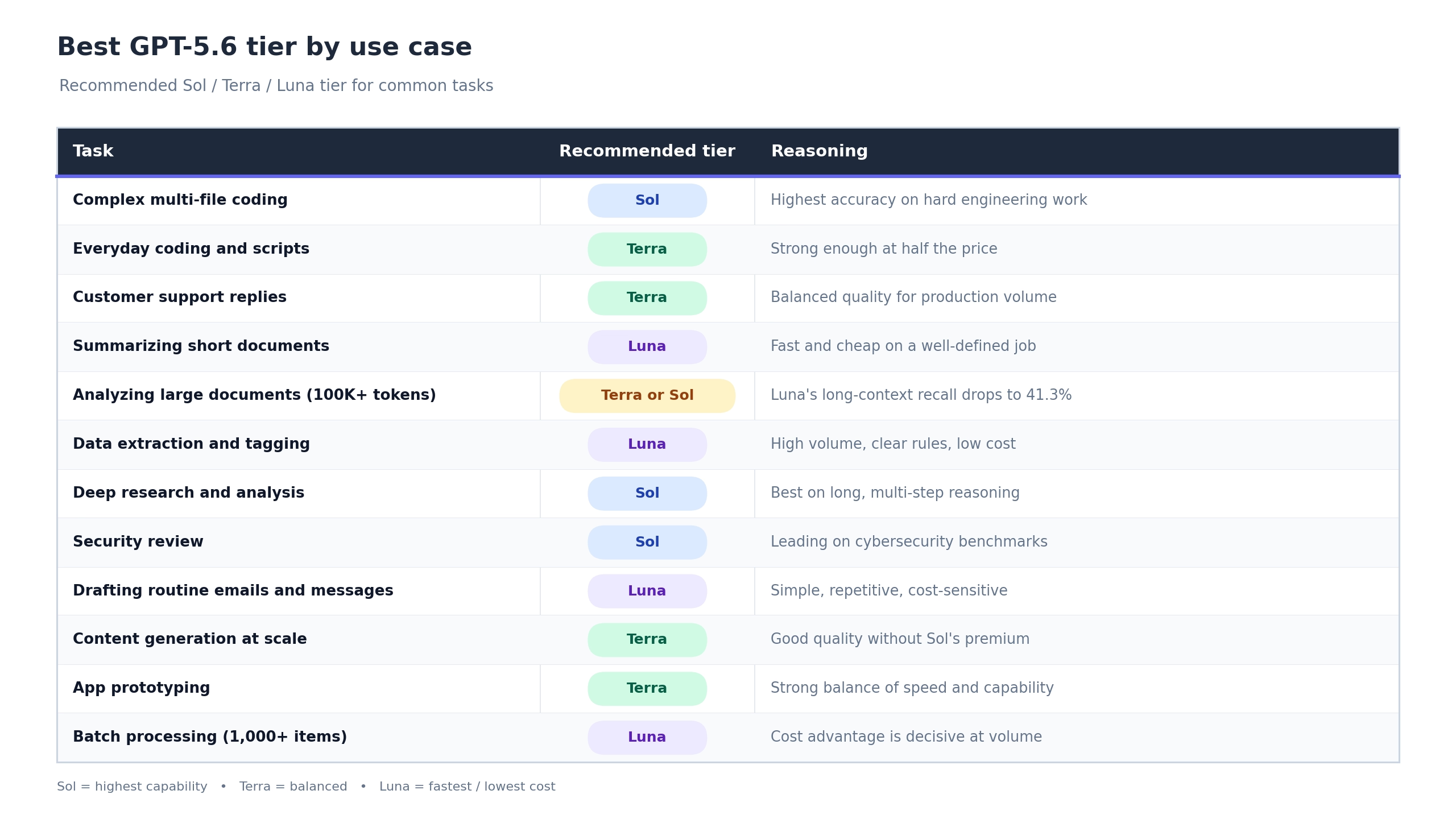
Best GPT-5.6 tier by use case
| Task | Recommended tier | Reasoning |
|---|---|---|
| Complex multi-file coding | Sol | Highest accuracy on hard engineering work |
| Everyday coding and scripts | Terra | Strong enough at half the price |
| Customer support replies | Terra | Balanced quality for production volume |
| Summarizing short documents | Luna | Fast and cheap on a well-defined job |
| Analyzing large documents (100K+ tokens) | Terra or Sol | Luna's long-context recall drops to 41.3% |
| Data extraction and tagging | Luna | High volume, clear rules, low cost |
| Deep research and analysis | Sol | Best on long, multi-step reasoning |
| Security review | Sol | Leading on cybersecurity benchmarks |
| Drafting routine emails and messages | Luna | Simple, repetitive, cost-sensitive |
| Content generation at scale | Terra | Good quality without Sol's premium |
| App prototyping | Terra | Strong balance of speed and capability |
| Batch processing (1,000+ items) | Luna | Cost advantage is decisive at volume |
Table reflects task-routing guidance. Match the tier to the task difficulty, not the other way around.
Max reasoning and ultra mode explained
GPT-5.6 introduces two capability levers on top of the tier system.
Max reasoning is a new level above "xhigh" (previously the highest setting). It gives the model more time to reason deeply before answering. Reasoning effort is configurable per request from "none" to "max," and reasoning now persists across turns, so multi-turn conversations do not restart from zero each time. Max reasoning is available across all three tiers in ChatGPT Work and Codex.
Ultra mode goes beyond a single agent. It coordinates four parallel subagents by default, splitting a problem across workstreams and synthesizing their results. Per OpenAI's official tables, Sol Ultra scores 91.9% on Terminal-Bench 2.1 (vs 88.8% for single-agent Sol) and 92.2% on BrowseComp (vs 90.4% single-agent). The improvement is real, but so is the cost: ultra bills at roughly 2-3x the base rate.
The practical takeaway: max reasoning and ultra mode are quality-first tools for the hardest tasks. For routine work, they consume extra compute without meaningfully improving results.
How to access GPT-5.6 in ChatGPT and the API
GPT-5.6 became generally available on July 9, 2026 across ChatGPT, Codex, and the OpenAI API.
ChatGPT access by plan:
- Free and Go users get GPT-5.6 Terra as the default model.
- Plus, Pro, Business, and Enterprise users can access GPT-5.6 Sol through medium and higher reasoning effort settings. Not sure which ChatGPT plan is right for you? Our ChatGPT Plus vs Pro comparison breaks down the differences.
- Pro and Enterprise users additionally get Sol Pro, a higher-quality configuration for the most complex tasks.
ChatGPT Work and Codex:
- Free and Go users access Terra.
- Plus, Pro, Business, and Enterprise users can choose among Sol, Terra, and Luna and set an effort level for each.
- Ultra mode is available to Pro and Enterprise users in ChatGPT Work, and to Plus and higher plans in Codex.
API: All three tiers are available through the Responses API. New API features include Programmatic Tool Calling (the model writes and runs lightweight programs to coordinate tools), explicit prompt cache breakpoints, persisted reasoning across turns, and a multi-agent beta for spawning subagents.
Platform availability: GPT-5.6 Sol, Terra, and Luna are generally available on Amazon Bedrock (Sol in US East regions; Terra and Luna in US East and US West). They are also available in GitHub Copilot as of July 9.
Build with GPT-5.6 models without writing code
Comparing model tiers is useful, but most people want to build something with these models, not just compare spreadsheet rows.
If you are a non-technical founder, indie hacker, or small business owner, you do not need to manage API keys or write routing logic to use GPT-5.6. Platforms like Emergent let you build full-stack apps powered by OpenAI models through a single Universal Key credential. You pick the model, describe what you want, and the platform handles deployment, billing, and infrastructure.
Emergent supports GPT, Claude, and Gemini models through universal key. GPT-5.6 is already live on the platform, so you can start building with OpenAI's latest models today without juggling separate API accounts or billing systems. Emergent also connects directly to ChatGPT and Claude through the Emergent MCP Connector, so you can build full-stack apps without leaving your AI chat. Describe what you need in the conversation, and Emergent builds it in the background.

Most AI app builders stop at prototypes. Emergent creates production-ready apps you can actually launch.
- Production-ready apps
- Web & mobile apps
- Deploy in minutes







