
In November 2022, a research lab called OpenAI released a simple chatbot called ChatGPT. It was introduced quietly as a research preview.
Within five days, it crossed one million users. Within two months, it reached one hundred million. Few consumer applications had ever grown that quickly.
The reaction across the tech industry was immediate. Google reportedly issued an internal “code red.” Microsoft deepened its partnership with OpenAI and began integrating AI across products like Word, Bing, and GitHub. Companies, including Meta and Amazon, accelerated their own AI roadmaps.
Startups pivoted overnight. Entire job categories were suddenly being questioned. Boardrooms that had never discussed artificial intelligence were now leading with it.
But the bigger shift happened outside Silicon Valley.
Students began using it to understand complex topics. Small business owners used it to handle marketing, support, and content. Developers wrote and debugged code faster. Writers used it to overcome blocks. Researchers compressed days of work into hours.
ChatGPT did not just launch a product. It launched an era. The age of AI has been discussed for decades in research papers and science fiction. In November 2022, it arrived in everyone's browser, for free, with no instruction manual required.
This guide explains exactly what ChatGPT is, how it works, what you can do with it, and how to get started.
What is ChatGPT?
ChatGPT is an AI-powered chatbot developed by OpenAI that can understand written input and generate human-like responses in real time. It is built on a large language model, which means it has been trained on a vast amount of text data to understand context, answer questions, write content, and carry on conversations that feel surprisingly natural. Whether you ask it to explain a complex topic simply, help you draft an email, or debug a piece of code, ChatGPT responds as if you were chatting with a knowledgeable colleague.
The name itself tells you quite a bit. GPT stands for Generative Pre-trained Transformer, which describes the type of AI model it uses. "Generative" means it creates new text rather than just retrieving existing content. "Pre-trained" means it learned from enormous amounts of text data before you ever typed your first message. "Transformer" refers to the underlying architecture that allows it to understand language with impressive nuance.
Why is ChatGPT so popular?
A few things came together to make ChatGPT take off the way it did.
Simplicity
You do not need a technical background or a manual. You just type what you want, the way you would type a message to a friend, and ChatGPT responds. That low barrier to entry meant people from almost every background could start using it immediately.
Versatility
Most tools do one thing reasonably well. ChatGPT does many things, writing, researching, summarising, translating, coding, problem-solving, and more, in a single place. That makes it genuinely useful across a wide range of jobs, subjects, and daily situations.
Conversational format
Unlike a search engine, where you get links and then have to piece together your own understanding, ChatGPT gives you a direct, focused response. You can then follow up, ask for clarification, or change direction entirely within the same conversation. That back-and-forth dynamic makes it feel much more like collaborating with someone than querying a database.
As of February 2026, OpenAI announced that ChatGPT has surpassed 900 million weekly active users and has over 50 million paying subscribers, making it one of the most widely adopted technology products in history.
How does ChatGPT work?
When you send a message to ChatGPT, it does not look up an answer in a database the way a search engine does. Instead, it generates a response based on patterns it learned during training, processing your full conversation in context, word by word, to produce something helpful and coherent.
Here is a closer look at how that process works:
- Trained on vast data: Before being made available to the public, ChatGPT was trained on a large dataset of text from the internet, books, articles, and other written sources.
- Learned how language works: Through this training, the model developed an understanding of grammar, reasoning, context, tone, and the relationships between ideas.
- Fine-tuned with human feedback: It was further refined using a technique called Reinforcement Learning from Human Feedback (RLHF), where human trainers rated its responses to help it produce answers that are more accurate, helpful, and safe.
- Considers full context: When you type a message, the model processes every word in context, not just the most recent one, which allows it to maintain continuity across long conversations and pick up on nuance.
- Generates responses fresh each time: Rather than pulling from stored answers, ChatGPT generates its response word by word each time, making every reply unique to your input.
- No real-time browsing by default: Its knowledge comes from training data with a cutoff date. Web search is available as a feature on certain plans, but it is not enabled by default.
How ChatGPT is different from traditional search engines
People often ask whether ChatGPT is just a smarter Google. The answer is that they do not; they do fundamentally different things, and both are still useful.
A search engine is better when you want to find a specific source, verify a fact against multiple references, or discover the latest news. ChatGPT is better when you want an explanation, need something written, want to think through a problem, or need a task done rather than a page found.
What can ChatGPT do? Real-world use cases
For students and researchers
Students can use ChatGPT to understand difficult concepts through plain-language explanations, build essay outlines, get feedback on their writing, and explore multiple perspectives on a topic. Researchers use it to summarise papers, draft literature reviews, brainstorm research directions, and structure findings. It is especially useful when you are stuck between ideas and need help turning rough thoughts into something coherent.
For teachers and educators
Teachers can use ChatGPT to create lesson plans, simplify complex topics for different age groups, generate quizzes and assignments, and design engaging classroom activities. It can also help personalise learning materials, draft feedback for students, and reduce time spent on repetitive administrative tasks.
For professionals and entrepreneurs
Professionals across industries use ChatGPT to draft emails, prepare meeting agendas, write reports, build presentations, and handle repetitive writing tasks more efficiently. Entrepreneurs use it to brainstorm product ideas, create pitch decks, draft business plans, define customer personas, and outline marketing strategies. For small teams, it can act as a flexible support system across multiple functions.
For developers and technical users
ChatGPT works well as a coding companion. Developers use it to write snippets, debug errors, explain unfamiliar code, convert between languages, and think through architecture decisions. It also assists with documentation, API usage, and identifying potential issues. It does not replace strong engineering skills, but it reduces time spent on routine problem-solving.
For content creators and marketers
Content creators use ChatGPT for ideation and drafting, from blog posts and social media captions to scripts and newsletters. Marketers use it to generate campaign ideas, write variations for A/B testing, build content calendars, and adapt messaging across audiences. It is particularly effective at solving the blank-page problem, giving you a starting point that can be refined.
For personal productivity
Many people use ChatGPT in their daily lives to plan trips, simplify complex documents, learn new skills, understand medical or technical information, write sensitive messages, and organise their thoughts. It functions as an on-demand assistant that responds instantly and adapts to a wide range of needs.
The bigger picture
The real value of ChatGPT is not limited to any one role or industry. From education and healthcare to finance, retail, and creative work, almost every sector can benefit from generative AI.
The key is not to treat it as a replacement for human expertise, but as a multiplier. When used alongside domain knowledge, critical thinking, and good judgment, tools like ChatGPT can significantly improve speed, output quality, and the ability to execute ideas.
Key features and capabilities of ChatGPT
ChatGPT comes with different features depending on which plan you are on.
The Free plan is a genuinely capable starting point for casual users, with access to core features and limited usage of the latest models. Plus, at $20 per month, is where most regular users land, offering higher usage limits, faster responses, and access to advanced features like image generation, voice mode, and file analysis.
Pro plans (where available at higher price tiers) are designed for power users who need significantly higher limits, faster performance, and priority access to the most capable models.
Business and Enterprise plans are built for teams and organisations that need shared workspaces, admin controls, collaboration features, and stronger data privacy guarantees, with organisational data typically excluded from model training by default.
Want the full breakdown of every ChatGPT plan? Also read our guide on ChatGPT pricing.
ChatGPT models and versions explained
OpenAI has released several generations of models since 2018, each meaningfully more capable than the last. Here is how that evolution looks from the beginning to today.
GPT - 1 (2018)
The original proof of concept. GPT-1 had 117 million parameters and demonstrated that a generative transformer, pre-trained on text and then fine-tuned, could handle a wide range of language tasks. It was a research milestone rather than a consumer product, but it established the foundation everything else was built on.
GPT - 2 (2019)
GPT-2 expanded the model to 1.5 billion parameters, enabling it to generate more coherent and contextually relevant text across tasks like summarisation, translation, and question-answering. OpenAI initially withheld the full model from public release due to concerns about misuse, which in itself signalled how much more powerful it was than its predecessor.
GPT - 3 (2020)
GPT-3 arrived with 175 billion parameters and introduced strong in-context learning, meaning it could perform tasks it had never explicitly been trained on just by being shown a few examples in the prompt. This was the model that made developers and researchers genuinely sit up and take notice.
GPT - 3.5 and the launch of ChatGPT (2022)
GPT-3.5 served as a bridge between GPT-3 and GPT-4, refining conversational abilities and reducing latency. It powered the first public release of ChatGPT in late 2022. The addition of reinforcement learning from human feedback (RLHF) made it far better at following instructions and giving responses that felt natural rather than robotic.
GPT - 4 (2023)
GPT-4 improved on GPT-3 with enhanced accuracy, better adaptive learning capabilities, and more reliable reasoning, particularly on complex multi-step problems. It also introduced the ability to understand image inputs alongside text, marking ChatGPT's first step into multimodal territory.
GPT - 4o (2024)
GPT-4o ("o" for "omni") was released in May 2024 as a step towards more natural human-computer interaction. It accepts text, audio, image, and video as input and can generate text, audio, and image outputs — all within a single unified model rather than separate systems stitched together. It is 2x faster and half the price compared to GPT-4 Turbo.
GPT - 4.1 (2025)
Released in April 2025, GPT-4.1 was the first production-ready model to expose a one-million-token context window to developers, enabling entirely new workflows — summarising entire books, cross-referencing large document sets, and maintaining memory across long sessions — that simply were not possible before.
GPT - 5 (2025 onwards)
GPT-5, launched in August 2025, marked a major shift in how OpenAI approached model design. Instead of maintaining separate model families for speed (like GPT-4 Turbo) and deep reasoning (like the o-series), GPT-5 unified these capabilities into a single system. It became the default model in ChatGPT, offering stronger factual accuracy, more reliable reasoning, and better performance across both everyday and complex tasks.
This shift eliminated the need for users to constantly switch models depending on the task, making the experience more seamless and predictable.
GPT - 5.3 (2026)
GPT-5.3 built on this foundation by introducing a more flexible model ecosystem. It added variants like Instant (optimized for speed and used as the default for free users) and Thinking modes for deeper reasoning in paid tiers. It also introduced intelligent fallbacks like Instant Mini, ensuring consistent performance even under heavy demand.
The focus here was usability at scale — faster responses, improved multimodal handling, and the ability to sustain longer, more complex interactions without breaking flow.
GPT - 5.4 (March 2026)
With GPT-5.4, OpenAI pushed into true “frontier model” territory. Released on March 5, 2026, it significantly improved efficiency, reasoning depth, and coding capabilities. It also expanded the model lineup (Pro, Thinking, mini, nano), giving users more control over performance vs cost.
Importantly, this version began phasing out older GPT-4 and early GPT-5 variants from the main ChatGPT experience, consolidating everything into a more powerful and consistent stack.
GPT - 5.5 (April 2026)
GPT-5.5, codenamed Spud, represents the most advanced iteration of the GPT-5 family so far. Released on April 23, 2026, it introduced major improvements in agentic capabilities - meaning the model can handle multi-step workflows, tool usage, and semi-autonomous tasks much more effectively.
It also fully embraces an omnimodal architecture, seamlessly working across text, images, audio, and video in one system. With strong gains in areas like coding, cybersecurity, and function calling, GPT-5.5 is designed less as a chatbot and more as a capable digital operator for complex, real-world tasks.
Read More: ChatGPT Plus vs Pro
Here is a quick comparison across the major versions:
For most users, the exact model name matters less than what the current generation can do. What took specialised models and significant effort a few years ago, like writing, reasoning, understanding images, or holding a long conversation, is now available to anyone, in a single chat window, for free.
How to use ChatGPT (beginner guide)
Step 1 - Create your account
Go to chat.openai.com and sign up with your email address, or continue with a Google or Apple account. You can also use ChatGPT without an account in limited mode, though signing up gives you access to conversation history, memory, and personalisation features.
Step 2 - Understand the interface
Once you are logged in, you will see a text input box at the bottom of the screen and your conversation history on the left sidebar. At the top, you can switch between available models if you are on a paid plan. Projects allow you to keep separate workspaces for different topics or goals.
Step 3 - Write your first prompt
A prompt is simply the message you type to ChatGPT. You do not need to use any special format. Start with a clear, specific request. Instead of typing "help me write something", try "write a three-paragraph introduction for a blog post about sustainable travel aimed at frequent business travellers." The more context you give, the better the response.
Step 4 - Refine with follow-up questions
ChatGPT remembers everything in the current conversation, so you can build on what it has already produced. If a response is too formal, say "make this more conversational." If it missed something, say, "Can you also include a section on cost?" This back-and-forth refinement is where ChatGPT really earns its keep.
Step 5 - Explore advanced features
Once you are comfortable with the basics, explore what else is available on your plan. On Plus and above, you can use image generation by simply describing what you want to see. You can use voice mode to speak rather than type. Some plans include advanced research-style features that can handle longer, multi-step tasks. You can also build custom GPTs, versions of ChatGPT that have specific instructions, knowledge, and personalities tailored to a particular task.
What are the benefits of using ChatGPT?
Instant access to information
You get a focused, contextual answer right away instead of sifting through multiple links to find what you need.
Saves time on repetitive tasks
Drafting emails, summarising documents, writing routine content, and explaining concepts can be done in seconds instead of minutes or hours.
Improves productivity across workflows
Whether you are writing, coding, researching, or planning, ChatGPT helps accelerate most forms of knowledge work.
Easy to use for beginners
There is virtually no learning curve. If you can type a sentence, you can use ChatGPT effectively.
Simplifies complex topics
You can ask it to break down advanced ideas into simple explanations or extract key points from dense material.
Supports creative thinking and idea generation
When you are stuck, having something to react to is far more productive than starting from a blank page.
Adapts to user input and context
It adjusts tone, level of detail, and format based on your prompts, making responses feel tailored rather than generic.
Reduces dependency on multiple tools
Writing, research, data analysis, and coding assistance can all happen in one place without constantly switching tools.
What are the limitations of ChatGPT?
ChatGPT is powerful, but it is not perfect. Knowing where it falls short helps you use it more effectively.
Here are things to keep in mind while using this tool:
Accuracy is not guaranteed
ChatGPT can produce answers that sound confident and well-written but still contain factual errors. This is often called hallucination, where the model generates information that seems plausible but is not actually correct. Important claims should always be verified.
Not always up to date
ChatGPT does not automatically know what is happening in real time. Some versions can access the web, but that depends on the tool or mode being used. Without that, it relies on previously learned patterns rather than the latest information.
Struggles with highly specialised topics
For niche or deeply technical subjects such as advanced medical diagnosis, legal interpretation, financial planning, or cutting-edge scientific research, ChatGPT may lack the depth of a true domain expert.
It can give you a useful starting point, help you frame the right questions, or summarise what is broadly known, but in high-stakes scenarios, it should support expert work rather than replace it. A doctor, lawyer, or specialist brings contextual judgment, professional accountability, and up-to-date domain knowledge that no general-purpose AI can fully replicate.
Inconsistent responses
The same question asked in different ways can sometimes produce different answers. While often directionally correct, this variability means you need to apply judgment when interpreting responses.
Prompt quality matters
The output depends heavily on how you ask the question. Vague or unclear prompts usually lead to vague answers, while specific instructions produce much better results.
Limited real-world judgment
ChatGPT does not have lived experience or true understanding. It cannot fully grasp context, emotions, or consequences the way a human can, especially in complex or sensitive situations.
Is ChatGPT safe and responsible to use?
For most everyday uses, ChatGPT is generally safe, but it is not risk-free. OpenAI has built in safety systems and content moderation to reduce the chances of harmful or inappropriate outputs, but these safeguards are not perfect. Using it thoughtfully still matters.
When it comes to data privacy, it is best to avoid sharing sensitive personal information. This includes passwords, financial details, medical records, identification numbers, or confidential business data. On individual plans like Free and Plus, conversations may be used to improve the system depending on your settings, and you can opt out. Business and Enterprise plans are designed so that organisational data is not used for model training by default.
Responsible use also means thinking critically about the outputs. ChatGPT is a powerful tool for writing and reasoning, but its responses are not guaranteed to be correct or unbiased. It works best as a support system for your thinking, not a replacement for it. For decisions with real-world consequences, such as legal, medical, or financial matters, it is always better to consult a qualified professional.
It is also important to be mindful of how you use AI-generated content. In academic or professional settings, presenting AI-generated work as entirely your own may violate policies. Many institutions now have clear guidelines on AI use, so it is worth understanding what is acceptable before relying on it for formal work.
What are the alternatives to ChatGPT?
ChatGPT leads the market, but it is not the only option. Depending on your needs, other AI chatbot tools may suit you better.
Google Gemini
Google Gemini is Google’s AI assistant, deeply integrated with Google Workspace. It is a strong choice if you already use tools like Docs, Gmail, and Drive and want an assistant that works directly within that ecosystem.
Claude
Claude by Anthropic is known for long-context understanding and thoughtful, nuanced responses. It is particularly well suited for writing tasks and working with very long documents.
Read More: ChatGPT vs Claude vs Gemini
Microsoft Copilot
Microsoft Copilot is built into Microsoft 365 and powered by OpenAI models. If your workplace relies on Word, Excel, Teams, and Outlook, Copilot integrates directly into those tools.
Perplexity
Perplexity AI is a strong option for research-heavy tasks. It provides sourced, cited answers and is designed around finding and summarising information from across the web.
Each of these ChatGPT alternatives has strengths in specific areas. The best tool is the one that fits your workflow and the tasks you actually need to do.
Also Read: Perplexity vs ChatGPT
When should you use ChatGPT?
ChatGPT is a good choice when you need to produce something, whether that is a draft, an explanation, a plan, or a piece of code. It is strong when the task involves language in some way, and when having a first draft or a starting point is genuinely valuable.
It is most useful for:
- Writing tasks where getting a solid draft quickly matters more than doing it from scratch
- Explaining topics you do not fully understand and want simplified
- Thinking through a problem or decision out loud and getting structured feedback
- Automating repetitive language tasks like summarising, reformatting, or translating content
- Generating ideas when you are stuck or want to explore options
It is less ideal for real-time information (unless you use web search), highly specialized expert work that requires deep domain accountability, or tasks where every fact needs to be independently verified before use.
What's next for ChatGPT?
OpenAI has been moving fast and shows no signs of slowing down. The pace of model releases alone tells you something: GPT-5.2 in December 2025, GPT-5.4 in March 2026, and GPT-5.5 on April 23, 2026, roughly one major release every six to eight weeks. At this cadence, the model you use today is likely not the one you will be using six months from now.
Agents are an increasingly central focus of where ChatGPT is headed. Rather than just responding to prompts, AI agents can browse the web, write and execute code, fill out forms, manage files, and complete multi-step tasks with minimal hand-holding. OpenAI president Greg Brockman described GPT-5.5 as "a real step forward towards the kind of computing that we expect in the future," specifically citing advances in agentic and intuitive computing.
Integration with external tools is also deepening steadily. The vision being built toward is an assistant that can access your actual context, your documents, your calendar, and your codebase, rather than only responding to what you type. ChatGPT already connects with a growing range of services, and that list is expanding with each new release.
The user base continues to broaden globally as well. OpenAI's data shows that by mid-2025, ChatGPT adoption was growing over four times faster in lower-income countries than in the highest-income ones. The ambition is clearly not limited to any one corner of the world.
Moving beyond ChatGPT: from ideas to real applications
ChatGPT is remarkably good at helping you think, write, and plan. But there is a natural ceiling to what a conversational AI can do on its own. It can help you draft the brief for an app, map out a workflow, or write the logic behind a process, but it cannot actually build and deploy those things for you.
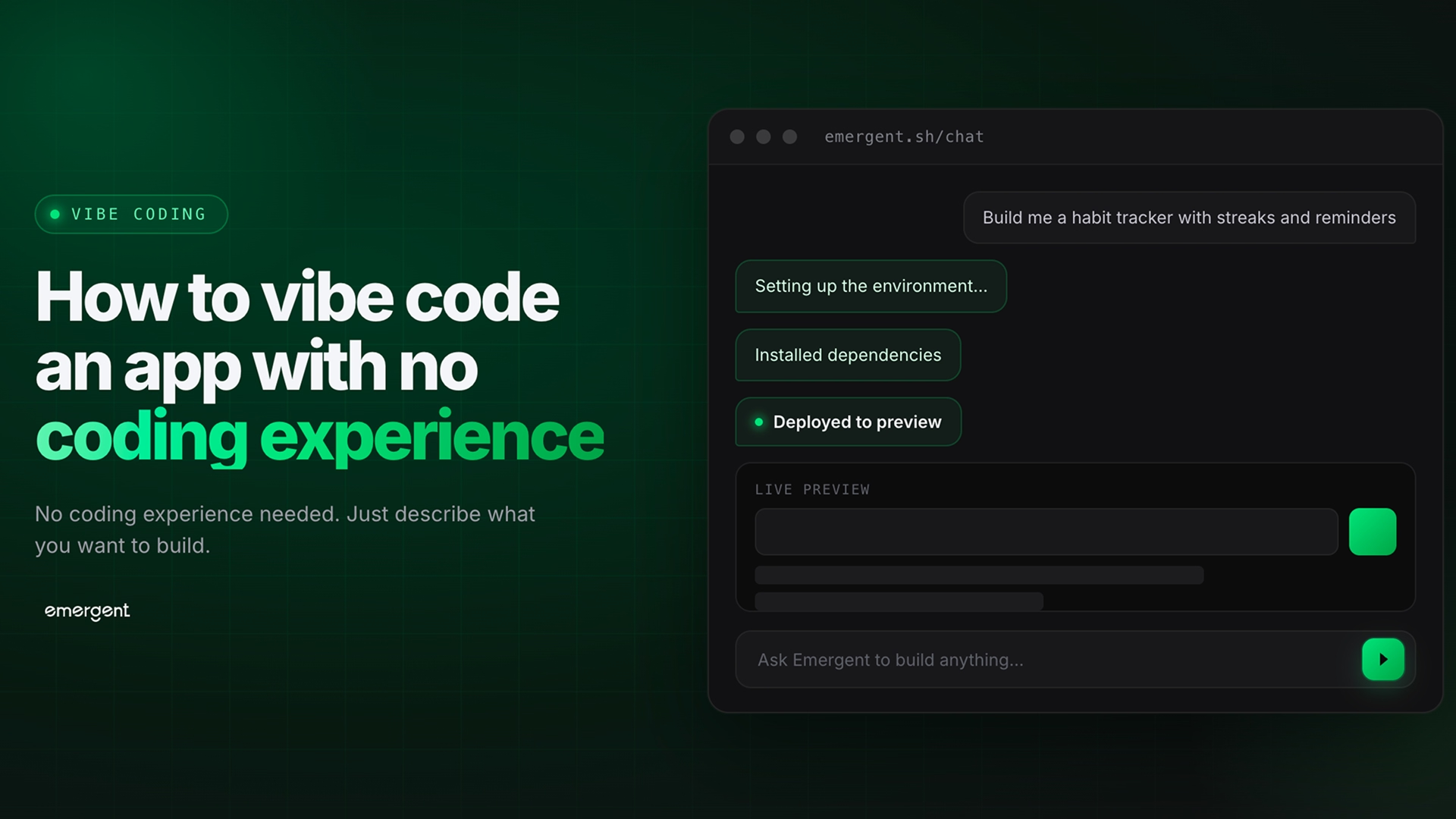
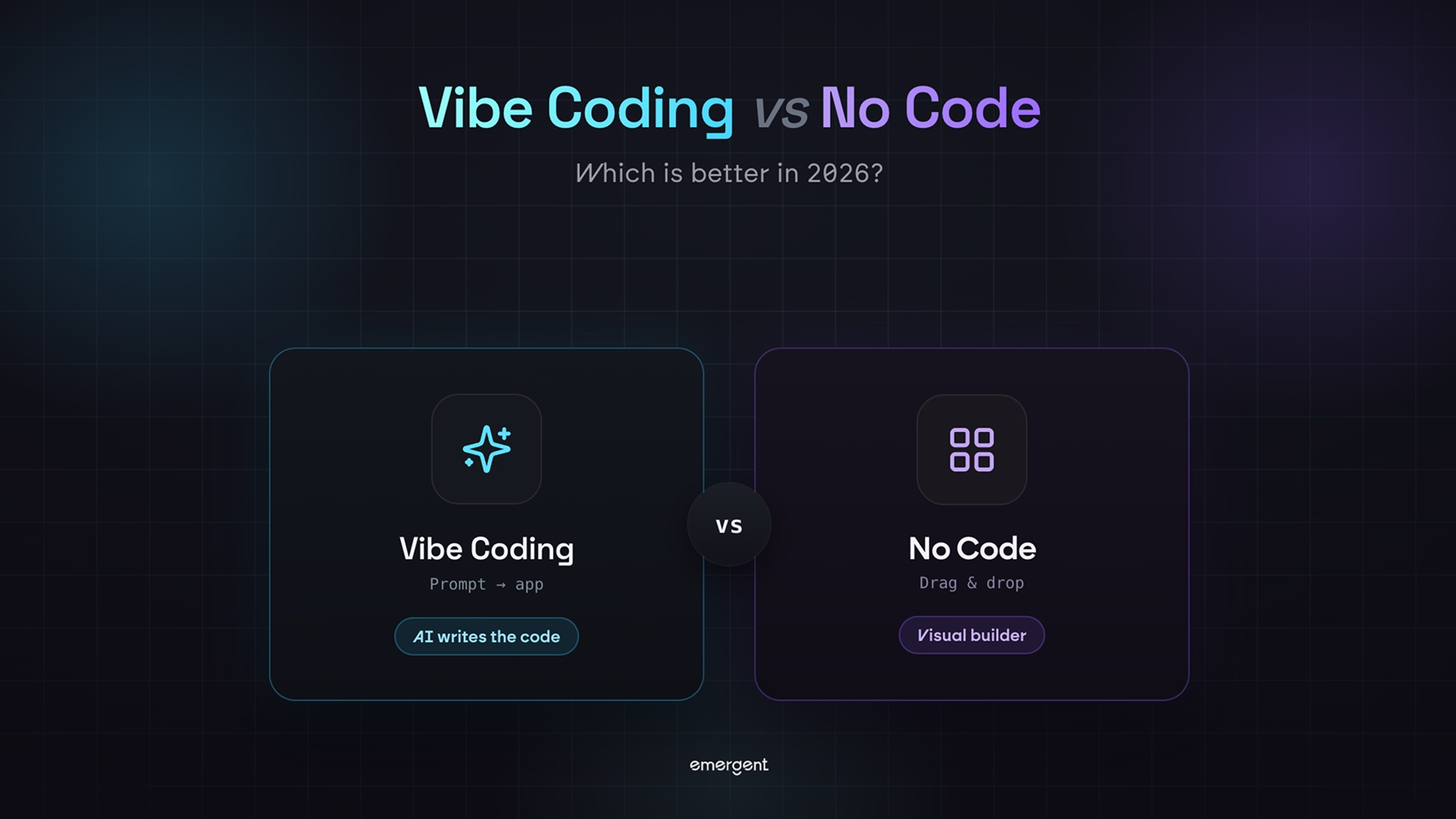
That gap gave rise to a new way of building software entirely. Vibe coding, a term coined by OpenAI co-founder Andrej Karpathy, describes the practice of building applications by describing what you want in plain language and letting AI generate the code. You are not writing syntax; you are steering. The AI does the heavy lifting while you focus on the idea and the outcome.
As vibe coding has matured, so have the tools built around it. Early on, it mostly meant pasting prompts into ChatGPT and copying code into an editor. Now, purpose-built platforms handle the entire process end-to-end. Emergent is one of the more holistic examples. It lets you go from a plain-language idea to a fully functional, deployed application, handling not just the code generation but the broader workflow around it.
For anyone who has used ChatGPT to think through what they want to build, vibe coding is the natural next step, and platforms like Emergent are where that step becomes practical.
Conclusion
ChatGPT has shifted from being a novelty to being a genuine productivity tool for millions of people. It is not magic, and it is not infallible, but used well, it can save you significant time, help you think more clearly, and get things done faster than you would on your own.
The best way to understand it is to use it. Start with something practical, a task you actually need to do, and see what it produces. From there, you can refine your prompts, explore the features available on your plan, and develop a sense of where it earns its place in your workflow and where you still need to rely on your own judgment. And when you are ready to go further, from ideas into actual products, vibe coding platforms like Emergent are the natural place to continue that journey.
Most AI app builders stop at prototypes. Emergent creates production-ready apps you can actually launch.
- Production-ready apps
- Web & mobile apps
- Deploy in minutes