


Anthropic has expanded its Claude 5.5 family by launching Haiku 5.5 on October 7, 2026. Designed for high-volume tasks like summarization, classification, routing, subagent workflows, and real-time applications, the new model brings several improvements over its predecessor, Haiku 4.5.
Haiku 4.5 was already known for its speed, cost efficiency, coding, computer use, and agentic capabilities. Haiku 5.5 introduces improvements that go beyond speed and efficiency. The key differences include a larger context window, adaptive thinking, increased output limits, updated tokenization, lower API pricing, and changes in API behavior.
Haiku 5.5 vs Haiku 4.5: Differences at a Glance
Haiku 5.5 builds on Haiku 4.5's focus on speed and efficiency, with improvements in context capacity, reasoning, performance, and pricing. The table below highlights the key differences between the two models.
Table 1: Claude Haiku 5.5 vs Haiku 4.5: specifications, pricing, and capabilities.
What's New in Haiku 5.5?
There are numerous upgrades that will be useful beyond short and repetitive tasks. The most critical one is the increase in information processing. In addition, there are improvements in reasoning and how it can perform in complex workflows.
Larger Context Window and Output Limits
Haiku 5.5 expands the context window from 200,000 to 1 million tokens, a fivefold increase. Its maximum output limit also doubles from 64,000 to 128,000 tokens. The maximum output also doubles to 128,000 from 64,000 tokens. This gives the developers more space for processing lengthy documents, analyzing larger codebases, and maintaining context across extended conversations.
However, the larger context window is not an automatic guarantee of better accuracy and using longer prompts can result in higher pricing.
Adaptive Thinking and Effort Controls
Unlike Haiku 4.5, which supports manually configured extended thinking, Haiku 5.5 introduces adaptive thinking. The model determines when additional reasoning is needed and adjusts its thinking accordingly.
Developers also have the option of using effort settings to balance response quality, cost, and latency. For instance, a direct classification task may need less reasoning compared to a task consisting of debugging a complex application.
Adaptive thinking is enabled by default, although developers can disable it under supported configurations.
If neither version fits, our Haiku 5.5 alternatives guide covers what else competes at this tier.
Improved Performance on Complex Tasks
Haiku 5.5 delivers substantial improvements across computer use, agentic coding, knowledge work, and multidisciplinary reasoning benchmarks.
These gains make the model more suitable for tasks such as navigating interfaces, extracting information from documents, and assisting larger models with narrowly defined coding workflows.
However, stronger benchmark results do not mean Haiku 5.5 will outperform larger models on every task. Developers should evaluate performance against their own application requirements before switching.
Haiku 5.5 vs Haiku 4.5: Benchmark Comparison
Anthropic’s published benchmarks illustrate how Haiku 5.5 outperforms its predecessor across different areas, including computer use, coding, knowledge work, and complex reasoning.
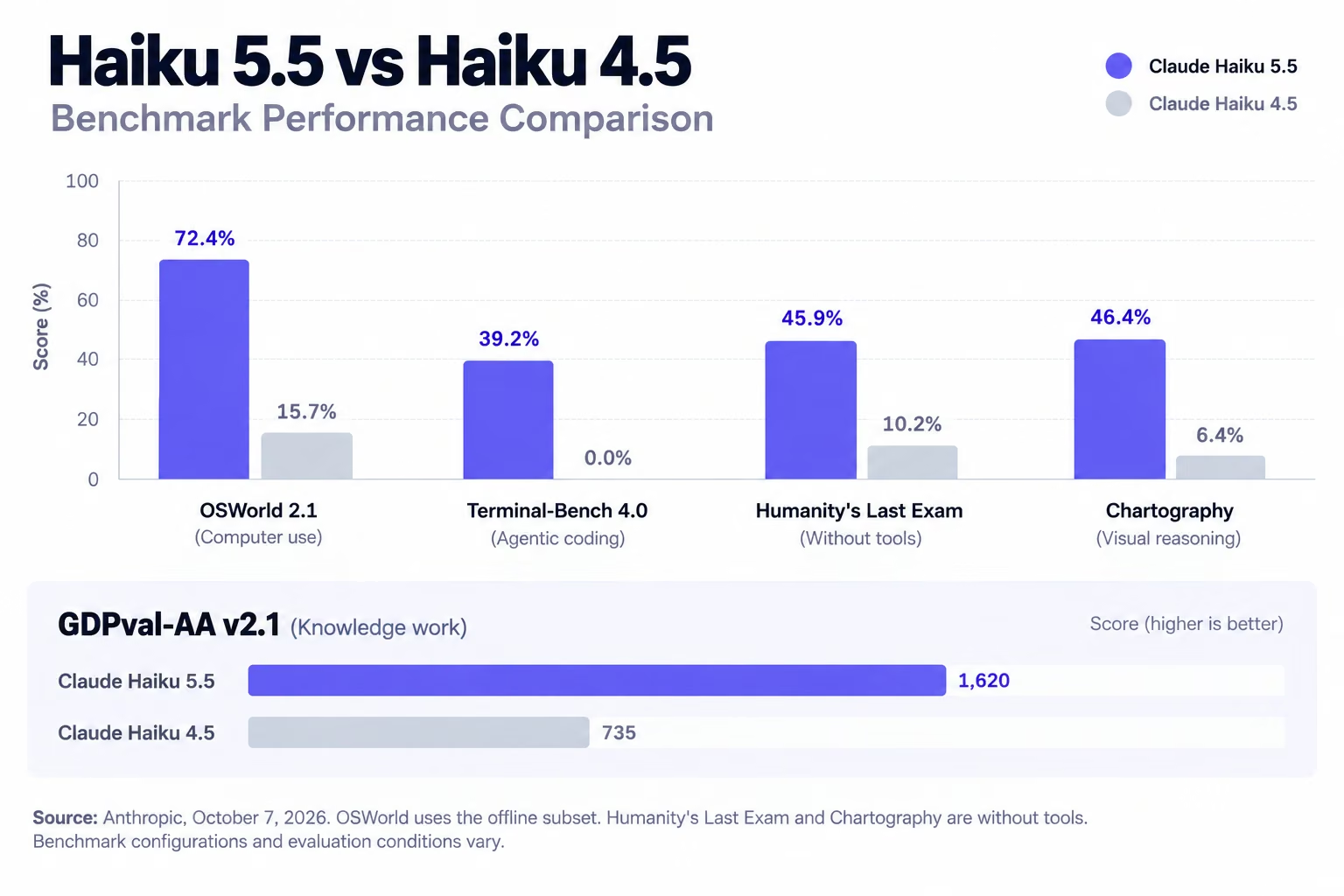
Figure 1: Benchmark performance across computer use, coding, reasoning, and knowledge work. Source: Anthropic (2026). Anthropic (2026).
The most significant gains appear in computer use and complex reasoning. On OSWorld 2.1, Haiku 5.5 scores 72.4%, compared with 15.7% for Haiku 4.5. Its score on Humanity's Last Exam also increases from 10.2% to 45.9% without tools.
Agentic coding performance shows a similar improvement, with Haiku 5.5 scoring 39.2% on Terminal-Bench 4.0, compared with 0.0% for Haiku 4.5. These results suggest stronger capabilities for multi-step workflows, although developers should test both models against their own applications before migrating.
The performance is considerably better when it comes to agentic coding evaluations. It is important to note that benchmark improvements do not directly translate into gains in every production application. Developers should test both the models against representative tasks before making the migration decision.
For a broader comparison beyond Anthropic's model lineup, see our Claude Haiku 5.5 vs GPT-6 Luna analysis, which examines how the two models compare across performance and capabilities.
Haiku 5.5 vs Haiku 4.5: Pricing Comparison
Haiku 5.5 is significantly cheaper than Haiku 4.5, particularly for requests containing up to 100,000 input tokens. However, its tiered pricing means the cost depends on prompt length.
Source: Anthropic's official model pricing, October 2026.
What Does the Price Difference Mean in Practice?
Let us consider an application processing 1 million input tokens and generating 200,000 output tokens across multiple requests. Each contains lesser than 100,000 input tokens. The pricing will be:
- Haiku 4.5 Pricing will be $2.00
- Haiku 5.5 Pricing will be $0.20
- Savings shall be $1.80, or 90%
These figures assume the stated token volumes, standard API rates, and no caching or batch discounts.
A critical consideration here should be tokenization. Anthropic suggests that same text produces approximately 30% more input tokens with Haiku 5.5 than with Haiku 4.5. This implies that developers should consider and recalculate token usage and not assume identical token counts while estimating the cost of migration.
Anthropic estimates that Haiku 5.5 costs approximately 75% less overall, accounting for its pricing structure and changes in token consumption.
API Changes and Migration Considerations
There are a few API changes that might impact existing integrations:
- Model ID: Replace claude-haiku-4-5 with claude-haiku-5-5 on the Claude API.
- Thinking configuration: Review existing budget_tokens settings and migrate to Haiku 5.5's supported adaptive-thinking configuration. Use effort controls to balance reasoning quality, latency, and cost.
- Sampling parameters: Remove temperature, top_p, and top_k from existing API requests. Haiku 5.5 restricts these parameters, and unsupported values or combinations return HTTP 400 errors. Use prompting to guide model behavior instead.
- Assistant prefill: Requests can no longer end with a partially completed assistant message.
- Response handling: Applications should identify content blocks by type, as responses may begin with thinking blocks.
- Computer use: Integrations using the older computer_20250124 tool must migrate to computer_toolset_20260801 on supported platforms.
Developers also need to take account of token limits, handle refusal responses, and test existing prompts before deploying Haiku 5.5 in production.
At this tier, cost usually decides it. Our Haiku 5.5 pricing guide covers the rates and what they work out to at volume.
Haiku 5.5 vs Haiku 4.5: Which Should You Choose?
Haiku 5.5 should be the stronger choice for most new applications, especially the ones that require complex reasoning, coding, computer use, and large amounts of information. As the API pricing is lower, it is quite attractive for high-volume workloads.
However, Haiku 4.5 can still be relevant and suitable for applications that already perform reliably and where the developers feel the migration costs and efforts may be higher.
Choose Haiku 5.5 if you:
- Need to process lengthy documents or large codebases.
- Build AI agents that perform multi-step tasks or interact with software.
- Want stronger reasoning and coding performance.
- Handle high request volumes and want to reduce API costs.
Consider retaining Haiku 4.5 if you:
- Have an existing integration that meets your performance requirements.
- Depend on API behaviors that have changed in Haiku 5.5.
- Need additional time to validate prompts, outputs, and application compatibility.
Building AI Applications with Haiku 5.5
With lower API costs, a larger context window, and better reasoning capabilities, Haiku 5.5 can be worth considering for AI-powered applications. Some of the potential use cases can include CRM assistants, document analysis tools, coding assistants, and automating workflows.
However, building these applications involves more than selecting an AI model. Developers also need to consider user interfaces, data integrations, authentication, and deployment.
With Emergent, you can describe the application you want to build in natural language and use AI-assisted development to create and refine its functionality. This offers a practical path to turn an application idea into a working product without building every component from scratch.
Build Your AI Application with Emergent
Final Verdict: Is Haiku 5.5 Worth the Upgrade?
Haiku 5.5 offers meaningful improvements over its predecessor. With lower API pricing and stronger reasoning and coding capabilities, it is an attractive option for building new applications and managing high-volume workloads.
For Haiku 4.5 users, switching to the new version shouldn't be automatic. Changes in tokenization, thinking controls, and API behavior may require adjustments to current integrations.
Overall, Haiku 5.5 is a good option for most new projects, but you should decide whether to migrate existing ones after evaluating compatibility, performance, and actual costs.
Most AI app builders stop at prototypes. Emergent creates production-ready apps you can actually launch.
- Production-ready apps
- Web & mobile apps
- Deploy in minutes







