



Haiku 5.5 alternatives matter because Claude Haiku 5.5 is cheap and fast, but it is not the best fit for every job. Five models beat it somewhere that counts: cost on long prompts, cost per finished task, open weights, factual recall, or raw capability.
This guide compares the five best Claude Haiku 5.5 alternatives by price, independent benchmark scores, and the jobs each one does best. Anthropic released Haiku 5.5 on October 7, 2026, so scores can still move. Prices and scores are as of October 9, 2026.
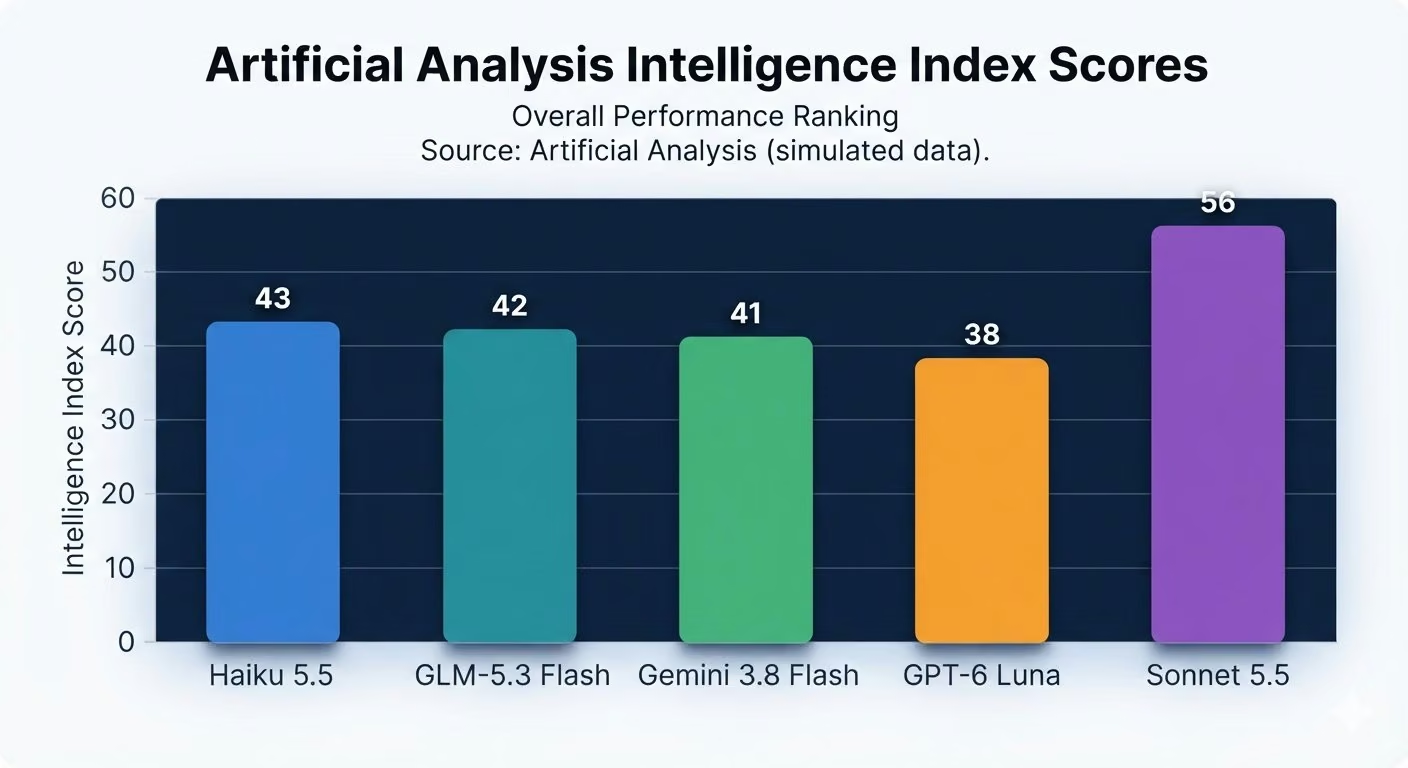
IMAGE 1: Bar chart of Artificial Analysis Intelligence Index scores for Haiku 5.5 (43), GLM-5.3 Flash (42), Gemini 3.8 Flash (41), GPT-6 Luna (38), and Sonnet 5.5 (56).
Source credit: Emergent
Why Look for a Haiku 5.5 Alternative?
Five things push teams to look at other cheap AI models. Each one is documented in independent tests or in Anthropic's own pricing.
- A price cliff at 100,000 tokens: Every rate rises five times once a prompt passes that line, so input goes from $0.10 to $0.50. Our guide to what Claude Haiku 5.5 is covers the full tier table.
- Heavy token use at high effort: At max effort, Haiku 5.5 used about 162,000 output tokens per task, roughly three times GPT-6 Luna, according to Artificial Analysis.
- Weaker factual recall: It answered 36% of factual questions correctly, against 55% for Gemini 3.8 Flash and 44% for GPT-6 Luna, per the same analysis.
- A low automation score: Haiku 5.5 scored 35% on AutomationBench-AA, against 53% to 60% for Luna, Gemini, and GLM. Artificial Analysis says a safety refusal bug likely understated that result and plans to re-run it.
- Closed weights: You can only reach Haiku 5.5 through Anthropic's API and partner clouds. Some teams need a model they can host themselves.
Quick Comparison: Haiku 5.5 vs. Its Alternatives
The table compares each model on short-prompt price, independent score, and weights.
Prices are from each vendor's published rates as of October 2026. Intelligence Index scores from Artificial Analysis (index v4.3.2); the DeepSeek score comes from Yotta Labs' comparison of the same data.
The five models sit within five points of each other, except Sonnet 5.5. At this level, price and task fit decide the winner more than the headline score.
What the Benchmark Scores Measure
Each benchmark tests a different skill, so a high score on one says little about the others. Here is what the main ones mean for you.
Descriptions follow the benchmark explanations in Claude Haiku 5.5 vs GPT-6 Luna comparison.
1. GPT-6 Luna: Best All-Round Haiku 5.5 Alternative
GPT-6 Luna is the best Haiku 5.5 alternative for most teams. It matches Haiku's short-prompt price, keeps that price much longer, and uses far fewer tokens per task.
What It Is
OpenAI's GPT-6 Luna is its most efficient model for focused, high-volume work. It has a 1.05 million-token context window, takes text and images, and offers effort settings from none to max.
Where It Beats Haiku 5.5
- Price tiers: Luna charges $0.10 input and $0.50 output up to 272,000 tokens, then $0.20 and $0.75. Haiku jumps to $0.50 and $2.50 after 100,000.
- Cost per task: Artificial Analysis lists Luna at $0.07 per task at max effort, against $0.21 for Haiku. Artificial Analysis notes its Haiku figure does not yet include the price step-up, so the real gap is likely wider.
- Automation: Luna scored 53% on AutomationBench-AA, against Haiku's 35%.
Where Haiku 5.5 Still Wins
- Overall score: Haiku leads 43 to 38 on the Intelligence Index.
- Terminal work: Haiku scored 33% on Terminal-Bench 4.0, against 13% for Luna.
- Made-up answers: Haiku's hallucination rate is 40%, against 77% for Luna. Luna recalls more facts, at 44% accuracy against 36%.
Pricing
$0.10 input and $0.50 output per million tokens up to 272,000 input tokens, $0.20 and $0.75 above that. For the full breakdown, read the Claude Haiku 5.5 vs GPT-6 Luna comparison and guide to GPT-6 Luna benchmarks.
Best for: Long document summaries, multi-step business automation, and teams that want the lowest cost per finished task.
2. GLM-5.3 Flash: Best Open-Weights Alternative
GLM-5.3 Flash is the best open-weights alternative. It scores 42 on the Intelligence Index, one point under Haiku 5.5, and charges one flat price at any prompt length.
What It Is
GLM-5.3 Flash is Z.ai's small, fast model with a 1 million-token context window. Artificial Analysis lists it among open-weight models and says it accepts image input. Yotta Labs adds that it takes video as well.
Where It Beats Haiku 5.5
- No price cliff: It costs $0.15 input and $0.50 output at every length, per Artificial Analysis. A 150,000-token prompt costs about $0.024 against $0.080 on Haiku 5.5.
- Self-hosting: You can download the weights and run them yourself. Yotta Labs says that takes an 8-GPU node.
- Automation: It scores in the same 53% to 60% AutomationBench-AA range as Luna and Gemini, well above Haiku's 35%.
Where Haiku 5.5 Still Wins
- Score and speed of thinking: Haiku leads 43 to 42 overall.
- Knowledge work: On AA-Briefcase, a test of realistic knowledge tasks, Haiku reaches 1,578 Elo, ahead of GLM-5.3.
- Token use: Artificial Analysis calls GLM "very verbose," at 180 million output tokens across its index. It prices GLM at $0.25 per task.
Pricing
$0.15 per million input tokens and $0.50 per million output tokens, with no long-prompt surcharge.
Best for: Teams that want to self-host, need image or video input, or process long prompts at a steady price. For more options in this class, see the guide to GLM 5.3 alternatives.
3. DeepSeek V4.1 Flash: Best for Off-Peak Batch Work
DeepSeek V4.1 Flash is the best alternative for batch jobs you can schedule. Off-peak, it costs $0.15 input and $0.60 output, and cached input drops to $0.003.
What It Is
DeepSeek V4.1 Flash is DeepSeek's open-weights Flash model. Its API name is deepseek-flash. Yotta Labs reports a checkpoint of about 510 GB that needs an 8-GPU node to self-host.
How Its Pricing Works
DeepSeek charges by time of day. Its pricing page lists these rates:
Peak hours run 01:00 to 04:00 and 06:00 to 10:00 UTC, Monday to Friday. Every other hour counts as off-peak, including weekends.
Where It Beats Haiku 5.5
- Cache-heavy work: Reusing the same instructions or documents costs a fraction of a cent.
- Speed: Yotta Labs measured 214 output tokens per second on hosted APIs, twice GLM-5.3 Flash's 107.
- Automation: Yotta Labs reports it leads AutomationBench-AA, which Haiku scores only 35% on.
Where Haiku 5.5 Still Wins
- Score: The index shows 43 for Haiku against about 40 for DeepSeek.
- Predictable cost: Peak and off-peak billing makes monthly bills harder to forecast than a flat rate.
Best for: Overnight batch jobs, prompts that reuse the same context, and teams that want open weights.
4. Gemini 3.8 Flash: Best for Factual Recall and Multimodal Work
Gemini 3.8 Flash is the best alternative when answering from memory matters. It scores 55% on factual accuracy, against Haiku's 36%, but it costs more and the price doubles in January.
What It Is
Google's Gemini 3.8 Flash is its fast, multimodal model, with a 1 million-token context window. It launched September 2, 2026, and reaches 41 on the Intelligence Index.
Where It Beats Haiku 5.5
- Factual recall: Gemini scored 55% accuracy on AA-Omniscience, against 36% for Haiku.
- Automation: It sits in the 53% to 60% AutomationBench-AA range, above Haiku's 35%.
- Multimodal input: Artificial Analysis lists it as multimodal, which helps when your app reads images or other media.
Where Haiku 5.5 Still Wins
- Price: Gemini costs 7.5 times more on input and 7.5 times more on output.
- Made-up answers: Gemini's hallucination rate is 55%, against Haiku's 40%.
- Terminal work: Gemini scored 20% on Terminal-Bench 4.0, against Haiku's 33%.
Pricing
Google's pricing page lists the rates:
Price any production plan at the 2027 rates. For more choices, see the guide to Gemini 3.8 Flash alternatives.
Best for: Apps that answer questions from general knowledge, or that read images and other media.
5. Claude Sonnet 5.5: Best When You Need More Power
Claude Sonnet 5.5 is the alternative to pick when Haiku 5.5 is not capable enough. It scores 56 on the Intelligence Index, 13 points above Haiku, but costs 20 times more per token on short prompts.
What It Is
Sonnet 5.5 is Anthropic's mid-tier model for well-scoped coding and agent work. It costs $2 per million input tokens and $10 per million output tokens.
Where It Beats Haiku 5.5
- Command-line coding: Sonnet scored 70.6% on Terminal-Bench 4.0, against 39.2% for Haiku, in Anthropic's own tests.
- Computer use: It scored 83.9% on OSWorld 2.1, against Haiku's 72.4%.
- Expert reasoning: It scored 64.5% on Humanity's Last Exam with tools, against 57.4%.
Where Haiku 5.5 Still Wins
- Cost: Haiku is 20 times cheaper per token on short prompts.
- Speed: Anthropic positions Haiku as its fastest model.
The two work well together. A larger Claude model plans the work, and Haiku handles the small, repeated pieces. Read the Claude Sonnet 5.5 benchmarks guide, or step higher with Claude Opus 5.5 and Claude Fable 5.1.
Best for: Complex coding, long agent tasks, and jobs where mistakes are expensive.
Also Worth a Look
- Claude Haiku 4.5: It costs $1 input and $5 output with a 200,000-token window, and Anthropic now lists it as legacy. Move to Haiku 5.5 unless you need to stay put.
- Kimi K3: It scores 44 on the index, one point above Haiku 5.5, and ships open weights. At 2.8 trillion parameters, it needs large GPU clusters, and it sits at flagship prices. See the Kimi K3 alternatives guide.
What These Models Cost in Practice
The real gap shows up when you multiply by volume. The table uses list prices with no thinking tokens, caching, or retries.
Calculated from list prices as of October 2026. Haiku 5.5 and Luna figures match the Haiku 5.5 vs Luna comparison.
On short prompts, Haiku 5.5 and Luna tie at the bottom. On long prompts, Luna, GLM, and DeepSeek all beat Haiku, and Gemini stays the most expensive.
Which Alternative Should You Choose?
Pick by prompt length first, then by task. This table sums up the choice.
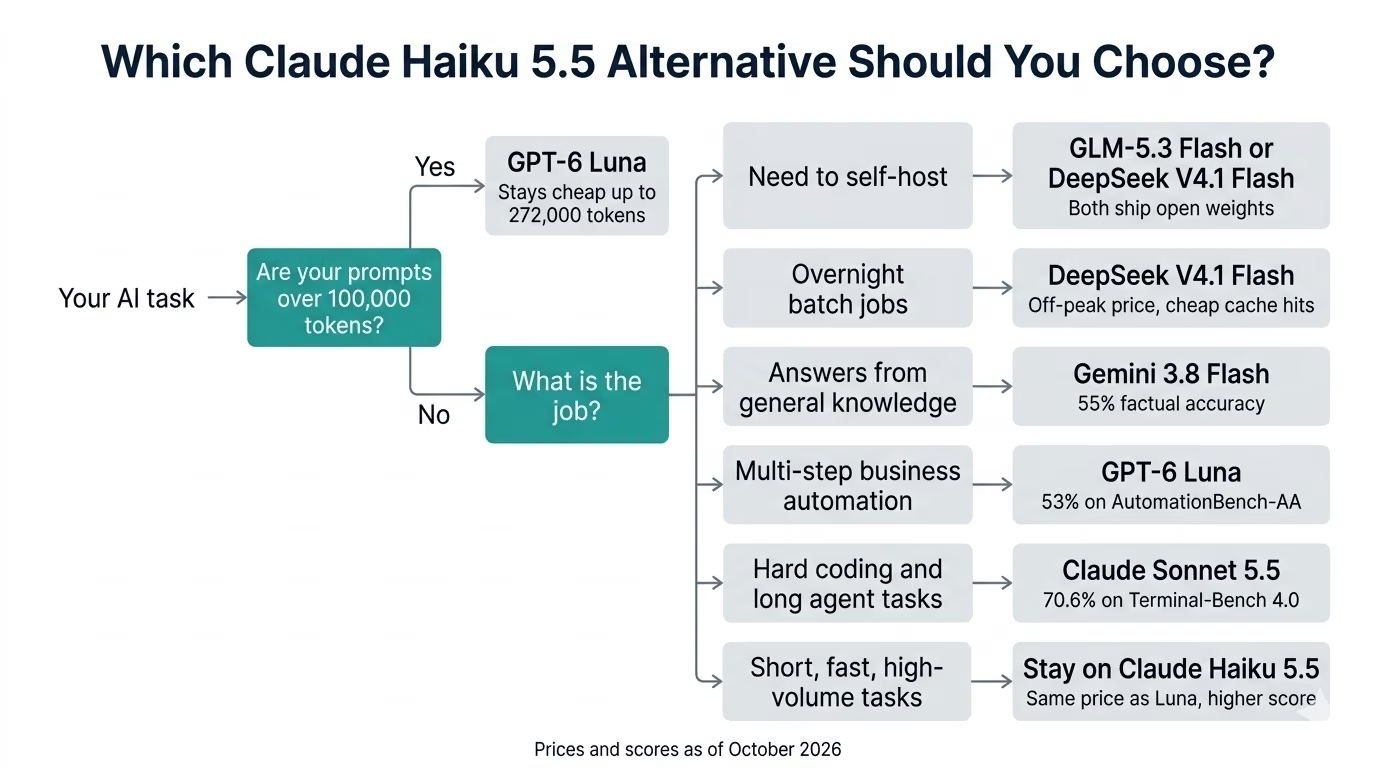
IMAGE 2: Decision flowchart from prompt length and task type to the recommended model. Recreate with AI.
Source credit: Emergent
If you run mixed traffic, consider routing. Send short requests to Haiku 5.5 and long ones to Luna. That split only pays off when a large share of your prompts pass 100,000 tokens.
Final Thoughts
Haiku 5.5 is still the better default for short, high-volume work, but five alternatives each win somewhere. GPT-6 Luna wins on long prompts and cost per task. GLM-5.3 Flash and DeepSeek V4.1 Flash win on open weights. Gemini 3.8 Flash wins on factual recall, and Sonnet 5.5 wins on capability.
The best next step is a small test. Consider running 20 to 50 real requests from your own app through two or three of these models, then compare answer quality and cost per finished task. Scores for models like this tend to move, so recheck them before you commit.
If you are turning those AI features into an app, Emergent is a vibe coding platform where you describe what you want, and AI agents build and deploy it. With an AI app builder, you can add features like ticket tagging or document summaries in plain English. Emergent's Universal LLM Key gives your app access to Claude, GPT, and Gemini models through one credential, with usage drawn from your Emergent credits. Model lineups change as new versions launch, so confirm the current list in your workspace before you build.
Most AI app builders stop at prototypes. Emergent creates production-ready apps you can actually launch.
- Production-ready apps
- Web & mobile apps
- Deploy in minutes







