Claude Haiku 5.5 is the better choice for fast, affordable, high-volume AI tasks, while Claude Opus 5.5 is designed for complex agentic coding and demanding knowledge work. Haiku 5.5 starts at $0.10 per million input tokens and $0.50 per million output tokens, compared with $4 and $20, respectively, for Opus 5.5. Both models support a 1-million-token context window and up to 128K output tokens, but differ in cost, speed, and task capabilities. For developers and businesses, the right choice depends on workload complexity, response quality, and budget. This comparison explores their pricing, features, performance, and use cases.
Haiku 5.5 vs Opus 5.5 at a Glance
Understanding Claude Opus 5.5 and Claude Haiku 5.5

AI-Generated: Source1, Source2
Let’s start by simplifying what is Claude Opus 5.5 and what Claude Haiku 5.5 can do.
- Claude Haiku 5.5 → fastest and cheapest
- Claude Opus 5.5 → most capable for difficult work
What Is Claude Haiku 5.5?
Claude Haiku 5.5 is Anthropic's small, fast, cost-efficient model for repetitive and high-volume AI workloads. It is intended for applications that need to process many requests without incurring the expense of a larger model for every interaction.
Common use cases include:
- Classification and data extraction
- Text summarization and conversation compaction
- Customer support and live responses
- Database queries and information retrieval
- Browser-based workflows
- Subagents supporting larger AI systems
Haiku 5.5 also works as a subagent alongside larger Claude models. For example, an application could use Haiku to classify incoming requests or summarise retrieved documents before passing more complicated work to Opus.
What is Claude Opus 5.5?
Claude Opus 5.5 is the most advanced Claude 5.5 model. Anthropic built it specifically for long-term agentic programming and knowledge work. Opus 5.5 is what you would use for the kind of problem where you prioritize getting good results over worrying too much about paying for each token.
Some of the things that Opus 5.5 can do include:
- Complex software development
- Massive code rewrites
- Long-term programming agents
- Hard research
- Knowledge work
- Multi-step logic
- Ambiguous problems
- Critical professional workflow
- Computer usage workflow
According to Anthropic, early testers used Opus 5.5 to complete a 680,000-line code migration in under a day, which could otherwise take an engineering team weeks. This is the sort of workload that Anthropic wanted Opus to handle.
Claude Haiku 5.5 vs Opus 5.5 Pricing
Pricing is one of the clearest differences between the two models. Haiku 5.5 is designed to make large numbers of relatively simple model calls affordable. Opus 5.5 pricing is much higher per token, reflecting its positioning for more demanding workloads.
Pricing Comparison
Haiku 5.5's standard input/output ratio is 40 times lower than Opus 5.5's for prompts under 100K tokens. Its cache read cost is also much cheaper. The increased rate is applicable only when the prompt is above 100K tokens, and that should be considered in its cost calculation.
Both models support Batch API processing. This offers a 50% discount on input and output tokens for eligible workloads. Batch is useful for background jobs that do not require immediate responses, such as document processing, data classification, and large-scale summarization.
Which Model Performs Better?
The two models are designed for different levels of difficulty, so the best choice depends on what the application needs to accomplish.
Haiku 5.5: Speed and High-Volume Processing
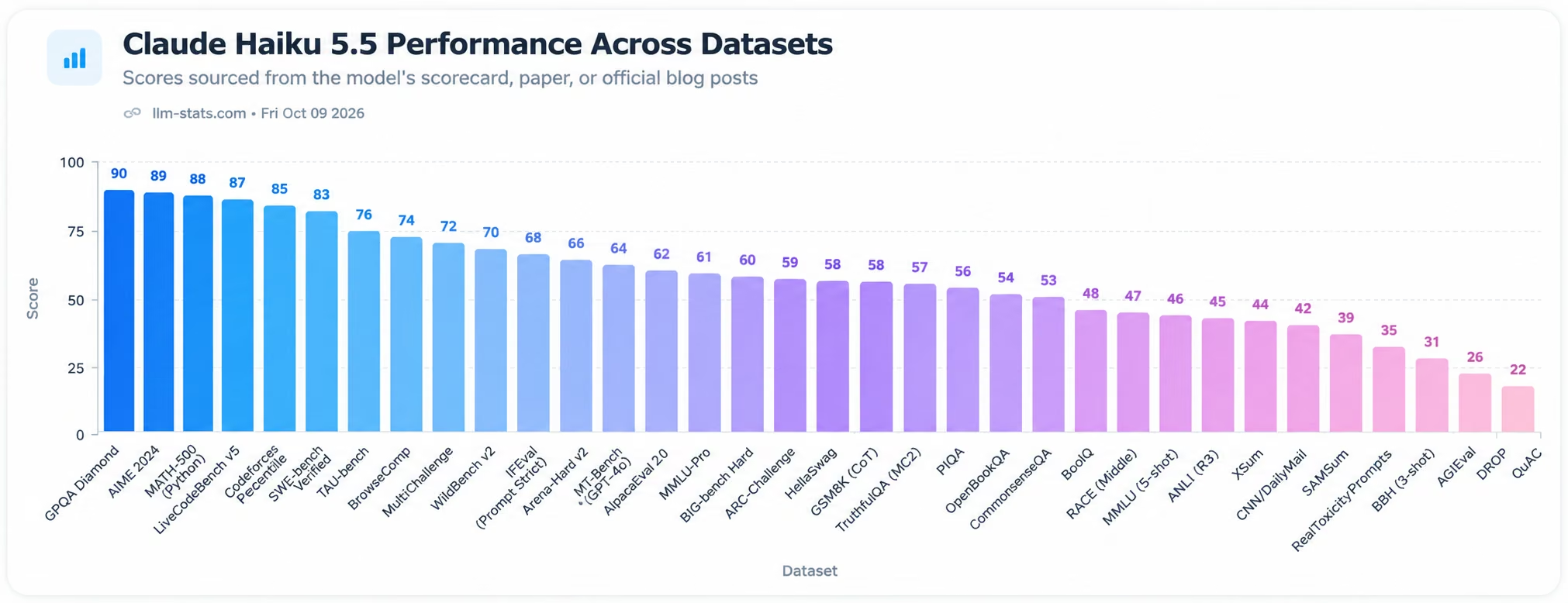
Anthropic describes Haiku 5.5 as its fastest model at standard speed. It is designed for quick, repetitive tasks where latency and cost matter, including customer support, classification, summarization, and browser use.
Haiku is a strong fit when tasks follow predictable patterns, the required output is clearly defined, and requests can be processed independently. It can also handle subagent tasks in a larger workflow, allowing a more capable model to focus on the parts that require deeper reasoning.
However, speed is not the only criterion that makes Haiku suitable for all workflows, as complex debugging, unclear problems to investigate, or multiple sequential decisions can require greater coding knowledge.
Opus 5.5: Complex Reasoning and Agentic Work
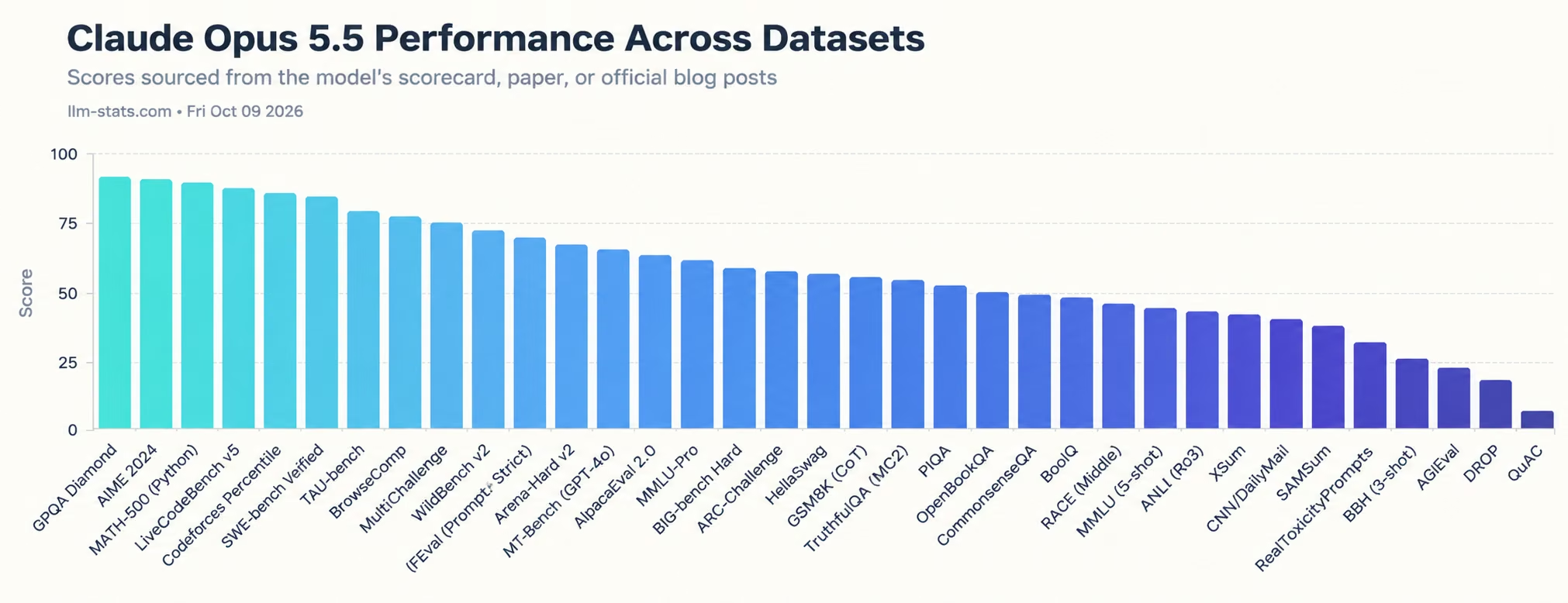
Opus 5.5 is built for long-running agentic coding and knowledge work. These tasks can require a model to understand a large codebase, plan changes, use tools, inspect results, and adjust its approach when something fails.
Anthropic reports that Opus 5.5 performs strongly in agentic coding, computer use, and knowledge work. Those are vendor-reported capability claims; results in a particular application will still depend on the task, prompts, tools, and evaluation method.
Opus comes in handy when there are costly errors, multiple interdependent stages in a task or successful completion demands reasoning. It's hard to justify the extra cost for tasks Haiku can do well.
In practice, Haiku is designed to handle many requests. Opus is designed to handle more difficult tasks. Don't choose one based only on size or reputation. Test both with tasks typical of the real application.
Coding: Haiku 5.5 vs Opus 5.5
Coding is an area where the choice depends heavily on task complexity.
Haiku 5.5 is useful for smaller, well-scoped development tasks, such as explaining a short code snippet, generating boilerplate, classifying bug reports, writing simple tests, or summarising code changes. It can also act as a subagent that handles routine steps in a larger development workflow.
Opus 5.5 is the stronger candidate for long-running coding agents, that need to inspect unfamiliar repositories, reason across multiple files, debug complicated failures, or carry out a series of connected changes. These workflows can benefit from a model designed for sustained agentic work.
These are starting recommendations, not guarantees. The best model for a coding task should be determined through tests using the team's repository, toolchain, and acceptance criteria.
For the within-tier comparison, read our Haiku 5.5 vs Haiku 4.5 breakdown.
Context Window, Speed, and Thinking
Both models support a 1-million-token context window and up to 128K output tokens. This means the decision is not simply about which model can accept a large amount of context. Both can handle extensive material, but the cost of processing it differs substantially.
The Haiku 5.5 system uses adaptive thinking with an adaptive effort-setting mechanism. As a result, developers can adjust the reasoning effort to suit different tasks. It is aimed at tasks that require quick responses at a regular speed.
On the other hand, Opus 5.5 uses adaptive thinking, which is always enabled. The default effort setting in Opus 5.5 is medium. Its comparative latency is moderate.
For applications that process large documents or lengthy conversations, both models support long context. Making the right choice depends on whether the task needs inexpensive processing or more extensive reasoning. A large context window doesn't mean every request needs the most expensive model.
When You Can Choose Claude Haiku 5.5
Haiku 5.5 is a good starting point for repeatable tasks with clear success criteria and low error costs. For decisions involving significant financial, operational, or reputational risks, test the model carefully and include appropriate human review. Names such as classification, extraction, routing, and subagent tasks belong to the Anthropic category.
From the business perspective, these could be: ticket categorization, extraction of fields from invoices, file naming, routing of queries to the right person, and first-pass summarization of content that will be later read by humans. Tasks with a known good output.
It might not be ideal when you need judgment you can’t foresee in advance, when clients see something without your preview, or when being confidently wrong is costly. The problem with an inexpensive model is not that it won’t respond – it is that it will respond anyway.
When You Can Choose Opus 5.5
Anthropic recommends Opus 5.5 as a daily driver for coding and knowledge work in their documentation, which is a much stronger recommendation than their pricing would suggest. It is built for long-term, sustained agentic programming and work, and it’s thinking all the time.
Remember that a better model does not guarantee against automation mistakes. Whatever you choose, work that involves sending, publishing, paying, or deleting data still requires proper permissions and human review. A better model might need fewer corrections, but only you can test whether that’s true for you.
How costly is making a mistake here? Sending email, editing live documents, moving money around or writing production-grade code with an agent is very different from a first draft you’re going to rewrite. If Opus 5.5 will indeed correct fewer mistakes to justify the price is up to your task – this is precisely what we will try to find out in our practical comparison.
Build AI Applications With Emergent
Choosing a model is only one part of building an AI-powered product. A production application also needs an interface, workflows, backend logic, integrations, and a way to handle errors and user feedback.
Emergent is a vibe-coding tool that helps users build applications by describing what they want in natural language. It can help turn an AI idea into an application with the interface and supporting workflows, rather than leaving the developer with only an API call.
When designing a product that uses Claude models, the critical issue is ensuring that every task is assigned an adequate level of capability and cost. For example, a routine workflow step can run on a lighter, faster Claude model, while an analytical or coding task could be handled by a more capable one, all accessed through Emergent's Universal LLM Key.
Start building with Emergent to turn an AI workflow into a working application.
Final Verdict
Haiku 5.5 and Opus 5.5 serve different purposes within Anthropic's family of models. Haiku 5.5 is the economic model to choose for batch processing, common requests, and simple subagent work. Opus 5.5 was made specifically for complex coding work that involves agency, computer usage, and intensive knowledge processing.
The two models differ significantly in price, but price alone should not be the only criterion for choosing. Compare which model can complete the given tasks most accurately and how much intervention is needed on your part. Determine the price of success for both models in terms of the cost of each good outcome.

Most AI app builders stop at prototypes. Emergent creates production-ready apps you can actually launch.
- Production-ready apps
- Web & mobile apps
- Deploy in minutes