One-to-One Comparisons
•
Lovable vs Bolt.new: Choose The Best Option For Your Needs
Compare Lovable and Bolt in 2026. See clear differences in AI app building, full-stack generation, React and Supabase integration, hosting, deployment, and advanced features to choose the best fit for how you build.
Written By :

Devansh Bansal
If you are comparing Lovable and Bolt.new, you are evaluating two AI-powered app builders that promise fast idea-to-app execution. Both focus on reducing development time, but they differ in workflow depth, architectural control, and target audience.
Lovable positions itself as an intuitive AI app generator with strong UI simplicity and beginner accessibility.
Bolt.new focuses on prompt-to-full-stack generation with integrated preview and deployment capabilities.
Key Takeaways
Choose Lovable if you want a simple, beginner-friendly AI app builder.
Choose Bolt.new if you want fast full-stack generation with integrated execution.
Lovable emphasizes usability and UX clarity.
Bolt.new emphasizes rapid app scaffolding and deployment.
Quick Comparison Table
Parameter | Lovable | Bolt.new |
Development Approach | Prompt-driven AI app builder with simplified visual workflows. ⭐️⭐️⭐️⭐️ | Prompt-to-full-stack AI builder with integrated preview and hosting. ⭐️⭐️⭐️⭐️ |
Primary Use Case | Rapid MVP creation with minimal technical friction. | Generate runnable full-stack web apps from prompts. |
Coding Required | Minimal. Designed for non-technical builders. ⭐️⭐️⭐️⭐️⭐️ | Partial. AI generates structure but manual refinement may be required. ⭐️⭐️⭐️⭐️ |
Full Stack from Prompts | Generates functional apps with backend support within ecosystem limits. ⭐️⭐️⭐️⭐️ | Generates full-stack runnable apps including frontend and backend. ⭐️⭐️⭐️⭐️⭐️ |
Hosting & Deployment | Built-in publishing within platform plans. ⭐️⭐️⭐️⭐️ | Built-in preview and deployment workflows. ⭐️⭐️⭐️⭐️⭐️ |
Scalability | Scales within platform constraints and credit-based usage model. ⭐️⭐️⭐️⭐️ | Scales within token and infrastructure limits depending on plan. ⭐️⭐️⭐️⭐️ |
Collaboration | Basic collaboration features depending on tier. ⭐️⭐️⭐️ | Collaboration and shared project workflows supported. ⭐️⭐️⭐️⭐️ |
Code Ownership | Export options vary by plan; ecosystem dependent. ⭐️⭐️⭐️ | Exportable project structure depending on plan. ⭐️⭐️⭐️⭐️ |
Best For | Non-technical founders and rapid validators. | Indie hackers and builders seeking fast full-stack output. |
Lovable vs Bolt.new: Key Features Comparison in Detail
Ease of Setup & Getting Started
The first interaction with any AI builder determines how quickly you can move from idea to working product. Simplicity and clarity during onboarding matter significantly.
Lovable
Lovable is designed for immediate usability. You enter a prompt describing your app idea, and the platform generates a working interface quickly.
The workflow feels lightweight and beginner-friendly. Users do not need to configure backend services manually at the start.
This makes Lovable approachable for non-technical founders who want to see tangible output fast.
Read More About: 9 Best Lovable Alternatives
Bolt.new
Bolt.new also starts with a prompt-driven workflow. It generates a runnable full-stack project structure including frontend and backend components.
The output often feels more developer-oriented compared to Lovable’s simplified interface.
While onboarding is fast, understanding the generated structure may require slightly more technical familiarity.
Our Recommendation:
If ease and simplicity are your priority, Lovable feels more beginner-friendly.
If you want immediate full-stack scaffolding, Bolt.new provides deeper initial structure.
AI Workflow Depth
Not all AI builders operate at the same level of architectural depth. Some prioritize UI generation, while others generate more structured codebases.
Lovable
Lovable focuses on generating functional applications with intuitive UI and basic backend logic.
Its AI assistance emphasizes accessibility and fast iteration rather than deep architectural control.
For lightweight applications and MVPs, this approach works well.
Bolt.new
Bolt.new generates structured full-stack code, often including frontend, backend, and routing logic.
The AI attempts to scaffold more complete system structures from the beginning.
This provides stronger technical foundations but may require refinement as complexity increases.
Our Recommendation:
For surface-level app building and usability, Lovable is efficient.
For deeper full-stack scaffolding, Bolt.new provides more structural depth.
Development Flexibility & Customization
As applications evolve, flexibility becomes critical. Early simplicity can become restrictive.
Lovable
Lovable abstracts much of the infrastructure to keep things simple.
Customization depends on the platform’s exposed features and integration capabilities.
For advanced backend modifications or complex architecture changes, limitations may appear depending on ecosystem boundaries.
Bolt.new
Bolt.new offers more structural flexibility because it generates a more traditional full-stack layout.
Developers can refine logic and adjust architecture within the generated codebase.
However, deep infrastructure-level changes may still depend on export and hosting options available in the plan.
Our Recommendation:
For straightforward apps and minimal customization needs, Lovable works well.
For builders who anticipate modifying architecture, Bolt.new offers more flexibility.
Deployment & Production Readiness
Shipping the app to real users requires stable deployment workflows and hosting clarity.
Lovable
Lovable includes built-in publishing capabilities within its platform tiers.
Deployment is streamlined and does not require external configuration for standard use cases.
This makes it convenient for fast public launches and testing.
Bolt.new
Bolt.new includes preview and deployment workflows. Generated apps can be tested and deployed within its ecosystem.
Because the platform focuses on full-stack generation, production readiness may depend on refining generated logic before scaling traffic.
Our Recommendation:
For quick public deployment with minimal setup, both platforms perform well.
For structured full-stack production refinement, Bolt.new provides slightly more technical control.
Scalability & Long-Term Growth
The true test of any AI builder is whether it can handle growth beyond the MVP stage.
Lovable
Lovable scales within its managed infrastructure and credit-based usage model.
It works effectively for lightweight applications and early traction.
For complex, high-traffic systems, evaluating export options and platform constraints becomes important.
Bolt.new
Bolt.new scales based on token usage and hosting limits tied to subscription tiers.
Because it generates more structured full-stack projects, scaling potential may be stronger if architecture is refined properly.
However, platform limits and infrastructure boundaries still apply.
Our Recommendation:
For lightweight and early-stage apps, Lovable is sufficient.
For builders aiming at more technically structured growth, Bolt.new offers stronger scaling foundations.
Code Export & Portability
As products mature, portability becomes a serious strategic consideration. Platform dependency can affect long-term flexibility.
Lovable
Lovable allows project export depending on plan tier, but projects are typically built within its managed ecosystem.
While frontend and logic can be extracted in certain cases, deep backend portability may depend on how integrations were configured.
For simple applications, export flexibility may be sufficient. For complex systems, migration planning should be evaluated early.
Bolt.new
Bolt.new generates structured full-stack code. Depending on plan and deployment method, generated projects can be exported.
Because the structure resembles traditional development stacks, portability tends to be clearer than purely visual no-code systems.
However, hosting integrations tied to the platform may require reconfiguration if migrating externally.
Our Recommendation:
For higher portability potential, Bolt.new offers more traditional code-based flexibility.
Lovable is suitable if long-term migration is not a primary concern.
Integration Ecosystem & API Connectivity
Modern applications depend heavily on third-party services such as payments, authentication, and analytics.
Lovable
Lovable supports integrations through its platform connectors and backend services.
It focuses on simplifying common use cases like authentication and database connections.
Advanced integration patterns may depend on available connectors and platform exposure.
Bolt.new
Bolt.new supports API integrations within the generated full-stack code.
Because the output resembles traditional web apps, integrating external APIs can follow common development practices.
This can provide broader integration flexibility for technical users.
Our Recommendation:
For straightforward integrations with minimal configuration, Lovable works well.
For broader API customization and advanced integrations, Bolt.new offers more flexibility.
Iterative Editing & AI Regeneration Stability
AI builders often regenerate parts of the project. Stability during iteration matters.
Lovable
Lovable emphasizes rapid regeneration cycles for fast iteration.
While this accelerates experimentation, larger structural updates may require careful review to avoid unintended changes.
Bolt.new
Bolt.new regenerates code within a more structured project layout.
Because it generates full-stack components, updates may be more predictable if the architecture is well-defined.
However, as with all AI builders, manual oversight remains important.
Our Recommendation:
For quick experimentation, Lovable excels.
For structured iteration within a traditional layout, Bolt.new may feel more stable.
Learning Curve & Builder Profile
Understanding who the tool is truly designed for helps avoid mismatched expectations.
Lovable
Lovable targets non-technical founders and beginner builders.
Its interface and AI abstraction reduce cognitive load significantly.
The learning curve is lower for users without engineering backgrounds.
Bolt.new
Bolt.new is slightly more technical in orientation.
While it reduces coding effort, understanding full-stack concepts improves outcomes significantly.
It appeals more to indie hackers and technically inclined builders.
Read More About: 5 Best Bolt.new Alternatives
Our Recommendation:
If you are completely non-technical, Lovable is easier to adopt.
If you have technical familiarity and want more structural output, Bolt.new fits better.
Review Comparisons
Star Ratings Overview
Platform | G2 Rating | Capterra Rating | Product Hunt |
Lovable | ⭐⭐⭐⭐☆ (4.6 / 5 from 205 reviews) | ⭐⭐⭐⭐⭐ (5.0 / 5 from 3 reviews) | ⭐⭐⭐⭐☆ (4.6 / 5 from 161 reviews) |
Bolt.new | ⭐⭐⭐☆ (3.8 / 5 from 3 reviews) | No verified listing found | ⭐⭐⭐⭐☆ (4.4 / 5 from 40 reviews) |
Ratings reflect publicly visible listings at the time of verification.
Review Summary Analysis
Lovable
G2:
Lovable has a strong and statistically meaningful rating with over 200 reviews. This indicates consistent positive sentiment across a sizable user base.
Capterra:
While perfect, the review count is very small, so it should not be interpreted as broad statistical validation.
Product Hunt:
Strong early adopter enthusiasm with high engagement.
Overall Sentiment:
Lovable shows consistent high ratings across platforms with meaningful review volume on G2 and Product Hunt.
Bolt.new
G2:
Bolt.new has a significantly smaller review base on G2. The 3.8 rating is based on only 3 reviews, which limits statistical reliability.
Product Hunt:
Higher early adopter enthusiasm compared to its G2 score.
Capterra:
No verified listing found at this time.
Overall Sentiment:
Bolt.new shows stronger sentiment on Product Hunt compared to G2, but review volume is relatively limited across platforms.
What Users Are Saying
Below are recent Reddit discussions relevant to Lovable vs Bolt.new, summarized strictly from the threads you provided.
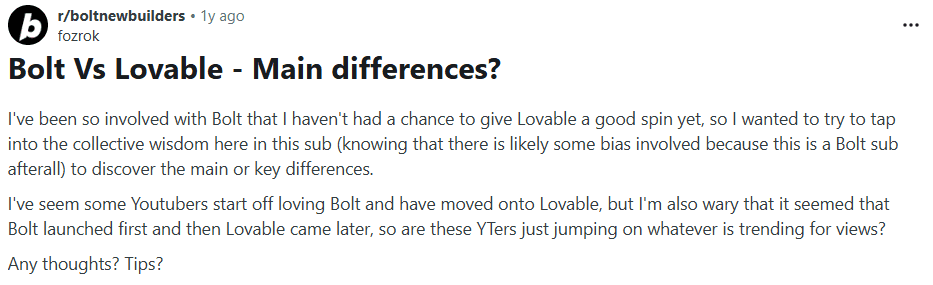
r/boltnewbuilders – “Bolt vs Lovable – Main Differences?”
In this thread, users directly compare Bolt.new and Lovable from a builder’s perspective.
Commenters highlight that Bolt.new tends to generate more structured full-stack output, while Lovable feels more beginner-oriented and UI-focused. Some users mention that Bolt’s generated structure can be more flexible for technical refinement, whereas Lovable prioritizes speed and simplicity.
Source: r/boltnewbuilders
Reddit
Insight: The community sees Bolt.new as more technically structured, while Lovable is viewed as more accessible and beginner-friendly.
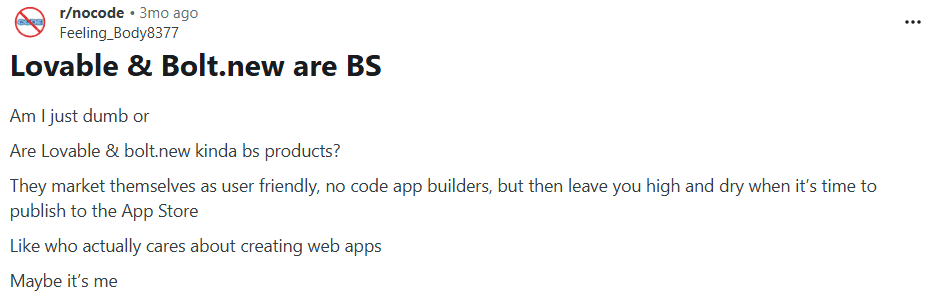
r/nocode – “Lovable & Bolt.new are BS?”
This discussion takes a critical tone toward AI app builders in general.
Users question the reliability of prompt-generated apps and raise concerns about production readiness and scalability. Some argue that while these tools are impressive for demos and MVPs, they may struggle with complex production systems without significant manual oversight.
The criticism is not platform-specific but highlights common limitations of AI-generated app builders.
Source: r/nocode
Reddit
Insight: Skepticism exists around AI app builders’ long-term scalability and production robustness, including both Lovable and Bolt.new.
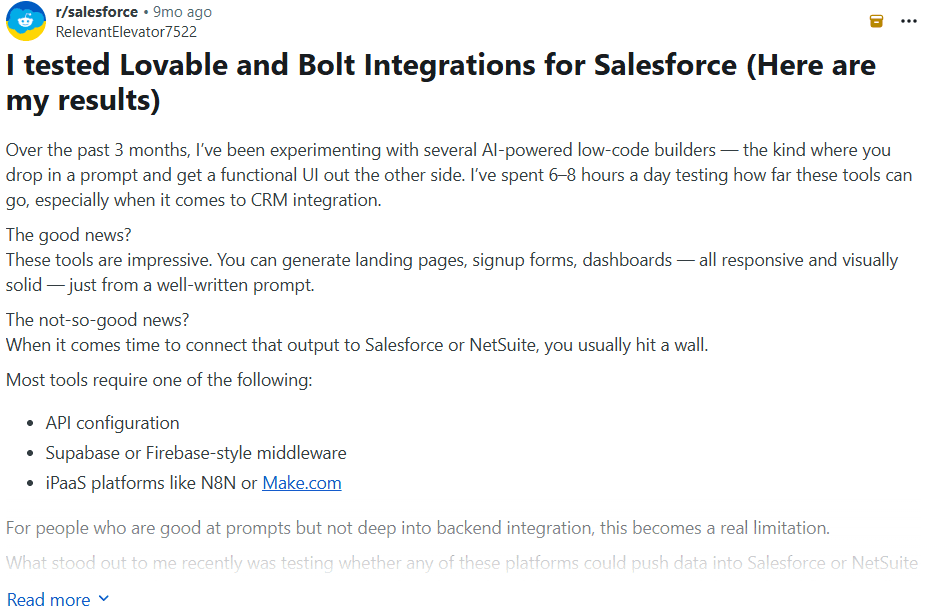
r/salesforce – “I tested Lovable and Bolt integrations for…”
In this thread, a user evaluates integration capabilities.
The discussion focuses on how well Lovable and Bolt.new handle third-party integrations and backend connectivity. Users note that while both platforms can connect to external services, deeper enterprise-grade integration may require careful configuration and understanding of APIs.
Source: r/salesforce
Reddit
This conversation leans more toward technical validation than beginner usability.
Insight: Integration depth and enterprise readiness are key differentiators that advanced users scrutinize when comparing Lovable and Bolt.new.
Pricing Comparison
Plan Tier | Lovable | Bolt.new |
Free | $0/month • 5 daily credits (up to 30/month) • Public projects • Unlimited collaborators • 5 lovable.app domains • Cloud | $0 • Public & private projects • 300K tokens daily • 1M tokens/month • Bolt branding • 10MB uploads • Website hosting • 333K web requests • Unlimited databases |
Pro | $25/month (shared across unlimited users) • 100 monthly credits • 5 daily credits (up to 150/month) • Usage-based Cloud + AI • Credit rollovers • Custom domains | $25/month (billed monthly) • No daily token limit • Starts at 10M tokens/month • No Bolt branding • Private sharing • 100MB uploads • 1M web requests • Token rollover • Custom domains |
Business / Teams | $50/month (shared across unlimited users) • Internal publish • SSO • Team workspace • Role-based access • Security center | $30/month per member • Centralized billing • Team-level access • Admin controls • Org sharing • Private NPM support |
Enterprise | Custom • Dedicated support • Onboarding • SCIM • Publishing controls | Custom • SSO & compliance • Dedicated account manager • SLAs • Data governance |
Pricing Insight:
Lovable’s official pricing includes clear tiers with increasing monthly credits and features.
Bolt.new usually follows a token-based subscription model across tiers, though official published pricing varies by plan and upgrades.
Introducing Emergent
When comparing Lovable and Bolt.new, both focus heavily on prompt-to-app generation. The primary difference lies in how much structural control and long-term system clarity you get.
Emergent positions itself differently.
Instead of only generating UI or scaffolding full-stack code from prompts, Emergent emphasizes structured AI-native building with system clarity from day one. The goal is not just speed, but architectural direction and execution discipline.
Below is a positioning comparison across differentiated dimensions, avoiding overlap with the quick comparison table.
Parameter | Emergent | Lovable | Bolt.new |
AI-Driven System Structuring | Guides architecture along with generation, reducing structural drift over time. ⭐️⭐️⭐️⭐️⭐️ | Focused on fast prompt-driven UI + app generation. ⭐️⭐️⭐️⭐️ | Generates full-stack structure but refinement depends on user. ⭐️⭐️⭐️⭐️ |
Execution Workflow Clarity | Encourages staged build logic and scalable patterns. ⭐️⭐️⭐️⭐️⭐️ | Rapid iteration with simplified abstraction. ⭐️⭐️⭐️⭐️ | Strong scaffolding but less guided system evolution. ⭐️⭐️⭐️⭐️ |
Team-Oriented System Thinking | Structured for long-term product lifecycle management. ⭐️⭐️⭐️⭐️⭐️ | Suitable for MVPs and fast-moving teams. ⭐️⭐️⭐️⭐️ | Better for indie hackers and technical builders. ⭐️⭐️⭐️⭐️ |
Scalability Discipline | Encourages architectural planning from early stage. ⭐️⭐️⭐️⭐️⭐️ | Scales within platform credit limits. ⭐️⭐️⭐️⭐️ | Scales based on generated full-stack logic and hosting limits. ⭐️⭐️⭐️⭐️ |
Control vs Abstraction Balance | Balanced AI guidance with structural oversight. ⭐️⭐️⭐️⭐️⭐️ | Higher abstraction, lower architectural control. ⭐️⭐️⭐️⭐️ | Moderate abstraction with structural flexibility. ⭐️⭐️⭐️⭐️ |
Positioning Insight:
If Lovable optimizes for simplicity and Bolt.new optimizes for rapid full-stack scaffolding, Emergent optimizes for structured AI-native product development with long-term clarity.
How to Choose the Best AI Builder
Choosing between Lovable, Bolt.new, and Emergent depends on your builder profile and long-term goals.
Are You Prioritizing Speed Over Structure?
If your goal is rapid idea validation with minimal friction, Lovable is highly accessible and beginner-friendly.
Bolt.new also delivers speed but generates more structured output.
Emergent balances speed with system guidance.
Do You Need Full-Stack Code Output?
Bolt.new is stronger if you want structured full-stack scaffolding from prompts.
Lovable abstracts more of the system.
Emergent emphasizes guided system architecture rather than pure scaffolding.
Are You Building for Long-Term Product Evolution?
Lovable works well for MVPs and early traction.
Bolt.new supports structured builds but requires oversight.
Emergent focuses on minimizing architectural drift and improving system clarity as products scale.
Is Team Governance Important?
Lovable’s Business and Enterprise plans introduce team features.
Bolt.new Teams plan adds centralized billing and admin controls.
Emergent emphasizes structured product lifecycle thinking across teams.
What Type of Builder Are You?
Non-technical founder → Lovable
Technical indie hacker → Bolt.new
AI-native product team focused on structured growth → Emergent
Conclusion
When comparing Lovable vs Bolt.new, the real decision comes down to speed versus structure, simplicity versus technical depth.
Lovable is built for accessibility. With strong ratings across platforms and a simple credit-based model, it is well-suited for non-technical founders and teams who want to move from idea to live product quickly. Its interface reduces friction, making MVP validation fast and collaborative.
Bolt.new, on the other hand, leans more toward structured full-stack generation. It provides deeper scaffolding and clearer architectural output from prompts. While it may require slightly more technical familiarity, it offers stronger system-level flexibility for builders who want more control.
If your priority is rapid, beginner-friendly app creation, Lovable is often the easier starting point.
If your priority is structured full-stack scaffolding with greater architectural visibility, Bolt.new may offer more control.
Ultimately, the best AI app builder depends on your technical background, scalability goals, and how much system control you want from the beginning.
it mod
FAQs
1. Which is better for building a startup MVP, Lovable or Bolt?
Lovable is ideal for design-first MVPs with fast UI validation, while Bolt is better for developer-led MVPs that require framework flexibility and deeper architectural control.