


AI Decision Making: Elevating Judgment Without Ending Duty

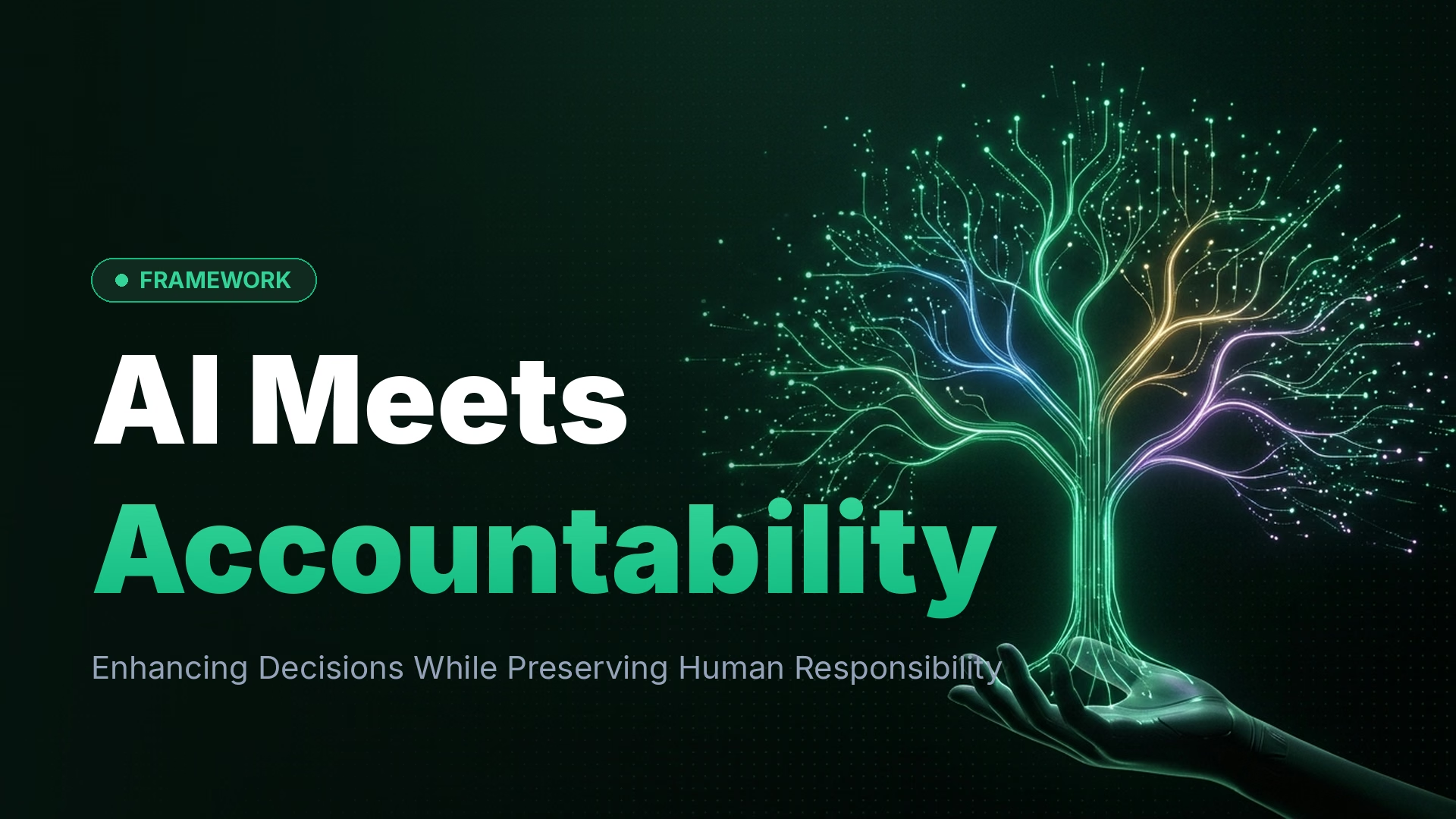
As artificial intelligence systems become embedded in enterprise operations, a critical tension has emerged between automation efficiency and human accountability. Leaders across industries are wrestling with a fundamental question: how can organizations leverage AI's analytical power without abdicating the responsibility that defines effective decision-making? The answer lies not in choosing between human judgment and machine intelligence, but in architecting systems where AI elevates rather than replaces the decision-maker's role.
The Accountability Gap in AI Deployment
Organizations implementing AI decision support tools often face an unintended consequence: the diffusion of responsibility. When algorithms recommend actions or automate choices, individual decision-makers may feel less ownership over outcomes. This accountability gap creates operational and ethical risks, particularly in high-stakes domains like healthcare diagnostics, financial lending, or strategic resource allocation. The technology performs pattern recognition at scales humans cannot match, yet it lacks the contextual wisdom and moral reasoning that complex decisions demand.
Recent enterprise case studies reveal that the most successful AI implementations maintain clear human accountability chains. Decision-makers receive AI-generated insights as inputs, not verdicts. They weigh algorithmic recommendations against organizational values, stakeholder needs, and situational nuances that training data cannot capture. This approach preserves the irreplaceable element of judgment while harnessing computational advantages.
Governance Frameworks for Responsible AI
Establishing robust governance requires organizations to map their decision landscape and designate AI's role in each domain. Critical choices affecting human welfare, legal compliance, or strategic direction should retain mandatory human oversight. AI can surface relevant data, model scenarios, and identify risks, but the final call rests with an accountable individual or team.
Effective frameworks include several components:
- Explicit delineation of AI-assisted versus AI-autonomous decisions
- Audit trails documenting how human decision-makers incorporated or overrode AI recommendations
- Regular reviews of algorithmic outputs for bias, drift, or unintended patterns
- Training programs equipping leaders to critically evaluate AI-generated insights
These structures ensure transparency and preserve accountability even as AI capabilities expand. They transform AI from a black-box oracle into a transparent tool that enhances rather than obscures the decision-making process.
Officially Launched on October 16, 2026
This framework perspective enters public discourse today as organizations face mounting pressure to balance innovation with responsibility. Industry analysts note that regulatory bodies worldwide are scrutinizing AI deployment practices, with particular focus on accountability mechanisms. Companies that establish clear governance now position themselves ahead of likely compliance requirements while building stakeholder trust.
Preserving Human Judgment in the AI Era
The case for maintaining human responsibility extends beyond ethics into performance. Research consistently shows that human-AI collaboration outperforms either component alone in complex domains. Humans contribute creativity, ethical reasoning, and adaptability to novel situations. AI provides speed, consistency, and the ability to process vast information sets. The synergy emerges when each component operates within its strengths while compensating for the other's limitations.
Leaders must resist the temptation to use AI as a shield against difficult choices. Deploying an algorithm to make contentious decisions may seem efficient, but it erodes organizational accountability and stakeholder confidence. When AI recommends layoffs, denies loan applications, or allocates scarce resources, a human decision-maker should own that choice and be prepared to defend it with reasoning beyond algorithmic output.
What This Means
The AI revolution in decision-making is not about replacing human judgment but amplifying it with unprecedented analytical capabilities. Organizations that thrive will be those that architect systems preserving clear accountability while leveraging AI's strengths. This requires deliberate governance, ongoing evaluation, and a cultural commitment to responsibility. As AI tools grow more sophisticated, the human capacity for ethical reasoning, contextual wisdom, and accountable leadership becomes more valuable, not less. The future belongs to leaders who use AI to make better decisions while never surrendering the duty to own those decisions completely.

on Emergent today




