


Ai2 Opens ToyBlocks Robot Sim With 85K Tabletop Demos

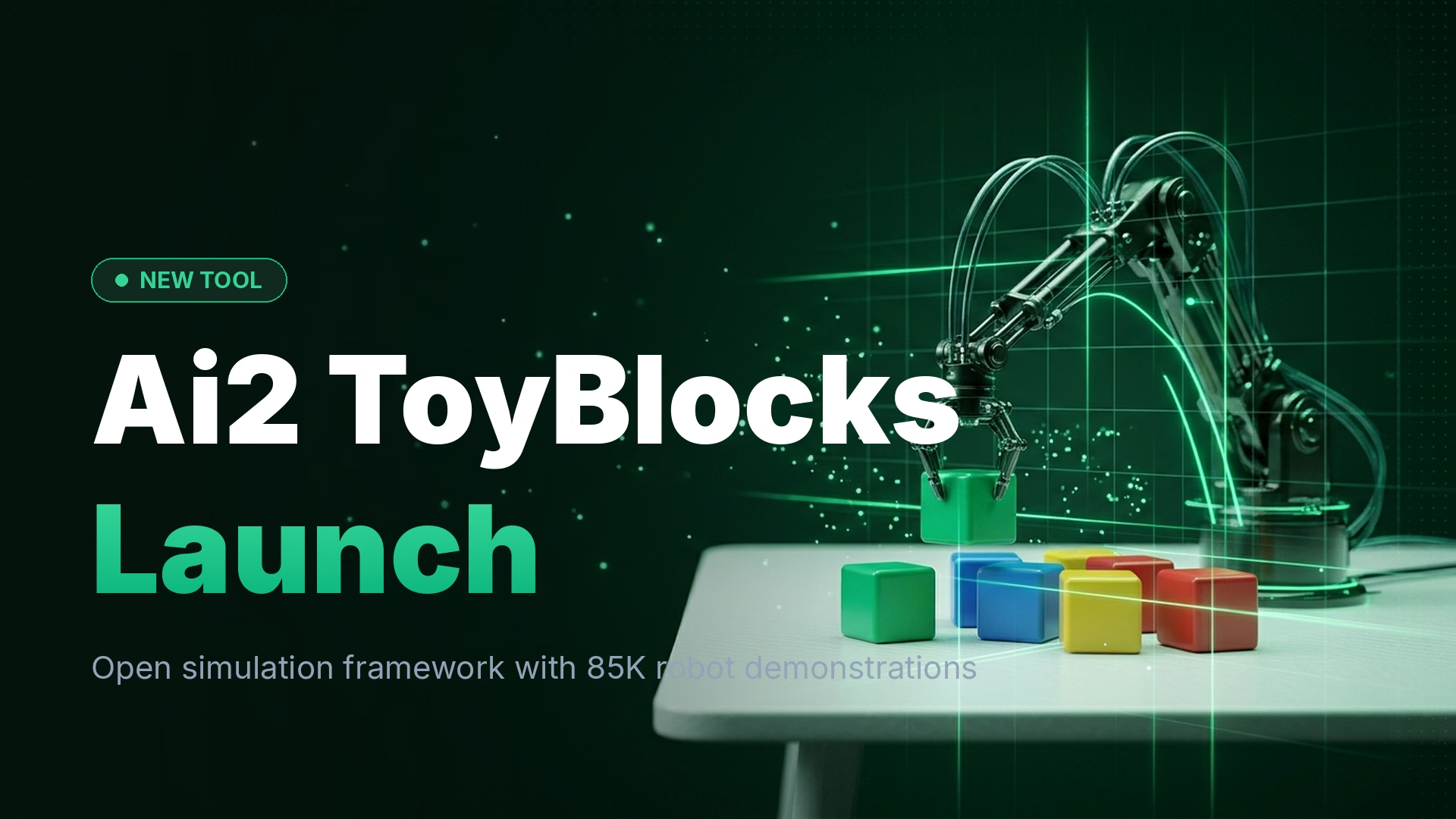
The Allen Institute for AI has released ToyBlocks, an open simulation framework designed to accelerate robotics research by eliminating the bottleneck of manual human demonstrations. Officially launched on November 6, 2026, the platform pairs a virtual robot arm with tabletop blocks and ships with 85,336 auto-generated demonstrations spanning roughly 1,600 hours and 144 million frames. Researchers worldwide can now train and test robot policies on an identical setup, building on a shared foundation rather than starting from scratch.
Why Traditional Robot Training Falls Short
Most robots today learn by watching humans steer them through tasks repeatedly. This approach is expensive, slow, and fundamentally unscalable. Florian Shkurti, an Ai2 team member and visiting research scientist from the University of Toronto, described the problem plainly: getting 10 times more training examples means paying for far more hours of human labor. Ai2's robotics team, led by Dieter Fox after his move from Nvidia's Seattle lab, concluded that academia and industry needed a different path forward.
ToyBlocks addresses this by automatically generating thousands of practice runs in a virtual environment. The software simulates Ai2's real lab setup in Seattle, including the table, blocks, and robotic arm. AI models controlling the robot learn from these computer simulations, then researchers test how well those skills transfer to physical hardware. The approach has gained momentum in 2026 as powerful AI models from OpenAI and Anthropic made it possible to build detailed simulated scenes on request.
What the 85K Demonstrations Reveal
The dataset includes training code and model weights alongside the demonstrations. Policies trained exclusively in simulation achieved 81.1% success rates on atomic skills like stacking and flipping blocks. But the research exposed a critical weakness: when Ai2 gave a leading robot AI model from San Francisco startup Physical Intelligence 1,000 simulated examples of stacking a green block on a red one, it succeeded almost every time on the same patch of table. Move the blocks to another spot, and the robot failed completely.
Fox explained that the robot hadn't learned to stack blocks in general. It had learned to stack blocks in one specific location. For a person, this would be trivial. For current AI systems, it highlights a fundamental generalization gap. ToyBlocks provides a standardized benchmark where researchers can change one variable at a time, like block position or size, to pinpoint exactly where a robot fails.
The Path From Simulation to Real Robots
Until recently, many roboticists doubted that simulation data was high quality or abundant enough to be effective. Russ Tedrake, a robotics professor at MIT and CEO of Walden Robotics, noted that longtime skeptics are now suddenly hiring simulation engineers. The reason: robotics development has long been slowed by the need for real-world experiments. If training were only limited by data and computing power, researchers could simply let systems run at scale.
Ai2's strategy with ToyBlocks is to establish a shared foundation for the robotics community. With a team of about 15 researchers, Fox acknowledged they are too small to advance the field alone. The goal is to create better foundational tools and put robotics research on a more scientific footing. Eventually, Fox envisions robots being let loose in virtual worlds for extended periods, learning by exploration the way children learn by playing with blocks.
Release Date and Availability
ToyBlocks was officially released on November 6, 2026, and is freely available for public use. Anyone can now train and test robots on the identical setup Ai2 uses in Seattle, building off the dataset, code, and weights. The framework includes an evaluation system that allows researchers to compare robot performance systematically, something the field has lacked. Tedrake pointed out there has been no real way to say whether one robot is better than another across different labs.
What This Means
ToyBlocks represents a shift toward simulation-driven robotics training, addressing scalability problems that have held the field back. While Fox described progress as quite dramatic, he stopped short of predicting when fully autonomous robots that can navigate dynamic, changing situations will arrive. The 85,336 demonstrations and open framework give researchers a common benchmark and dataset to test whether more diverse data solves the generalization problem that causes robots to fail when conditions change. For now, the work at Ai2 is about building the infrastructure that could eventually enable the kind of robotics breakthroughs researchers have long hoped for.
on Emergent today


