


Andrew Ng: AI Chatbots Horrible for Learning at Summit

Officially launched on October 22, 2026.
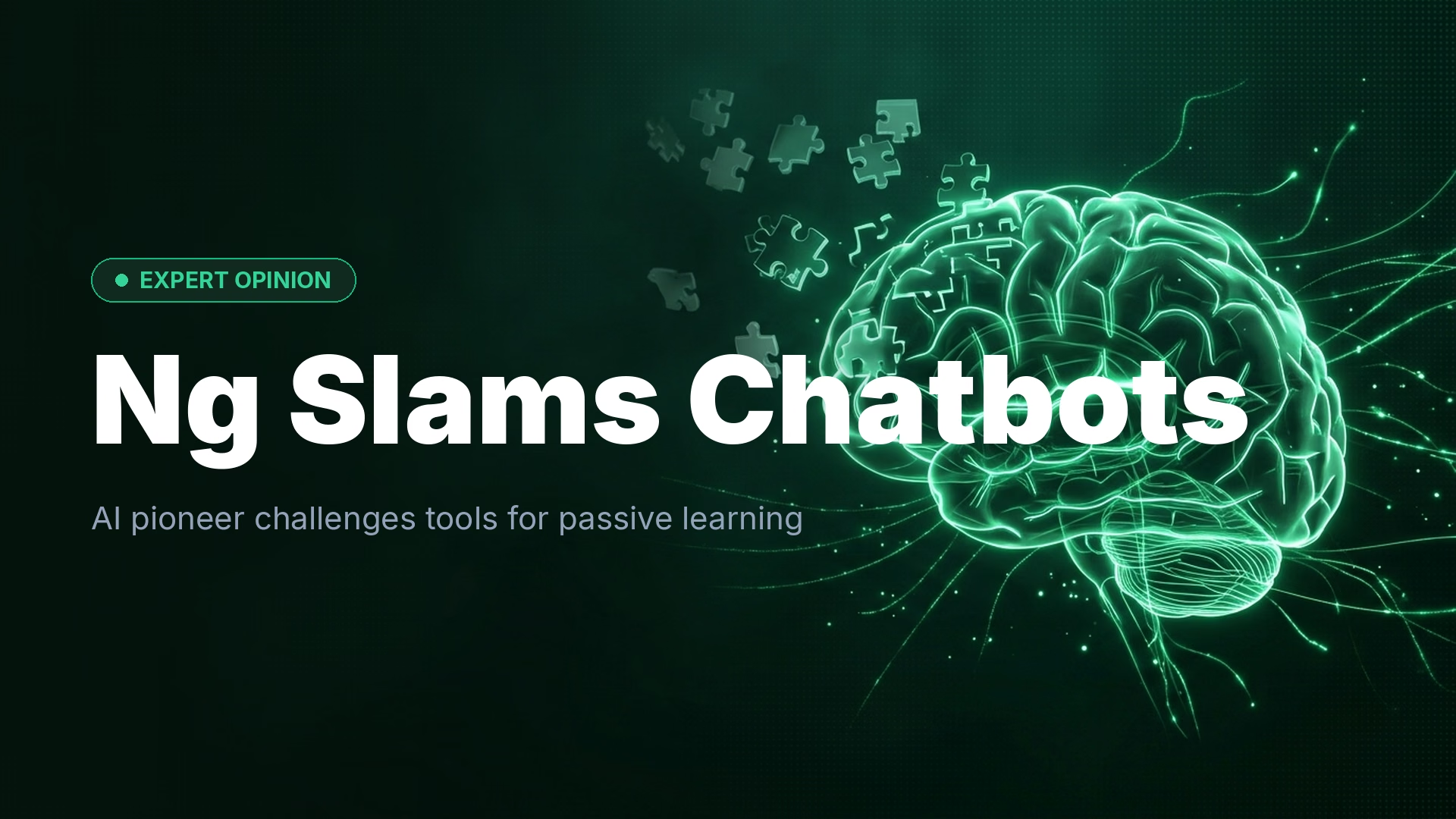
Andrew Ng, a leading AI educator and co-founder of Google Brain, delivered a sharp critique of AI chatbots at the NDTV World Summit on October 22, 2026, calling them "horrible for learning." Speaking to a global audience, Ng argued that the passive question-answer design of popular chatbot interfaces fundamentally undermines effective education, promoting rote responses over critical thinking and active engagement.
Why Chatbots Fail Students
Ng pointed to the core problem: most AI chatbots respond instantly to user queries with polished answers, creating a dependency on passive consumption rather than active problem-solving. "When students ask a chatbot for an answer, they bypass the cognitive struggle that builds mastery," Ng explained. He emphasized that learning requires iteration, error correction, and metacognitive reflection, none of which are fostered by tools that deliver ready-made solutions on demand.
The critique extends beyond student laziness. Ng noted that chatbot interfaces encourage surface-level interactions, where users extract information without synthesizing knowledge or challenging assumptions. This design, he argued, conflicts with decades of educational research showing that active learning strategies like Socratic dialogue, spaced repetition, and deliberate practice produce deeper retention and transfer.
The Case for Active Learning AI
Rather than abandoning AI in education, Ng called for a fundamental redesign. He proposed that future AI tools should guide learners through structured problem-solving sequences, pose probing questions to surface misconceptions, and require students to articulate reasoning before providing feedback. "The AI should act as a tutor that scaffolds thinking, not a search engine that hands over answers," he said.
Ng highlighted emerging research on AI-driven active learning systems that adaptively adjust difficulty, simulate peer collaboration, and enforce productive struggle. These systems, still largely experimental, prioritize learner agency and sustained engagement over speed and convenience. According to Ng, such tools could transform education, but only if developers resist the temptation to optimize for user satisfaction at the expense of learning outcomes.
Industry Response and Implications
Ng's remarks sparked immediate debate among educators and AI developers. Critics of current chatbot platforms argue that companies prioritize user retention and engagement metrics that reward quick, frictionless interactions, often misaligned with pedagogical goals. Some educators have already restricted chatbot use in classrooms, citing concerns about academic integrity and cognitive atrophy.
However, defenders of chatbot technology note that access to instant information can democratize learning for underserved students and support differentiated instruction. The challenge, as Ng framed it, is not whether to use AI in education, but how to design systems that prioritize long-term skill development over short-term convenience.
What This Means
Andrew Ng's critique at the NDTV World Summit underscores a growing tension in AI education: the tools best suited for information retrieval may be poorly suited for knowledge construction. As generative AI continues to permeate classrooms, Ng's call for active learning design principles challenges developers to move beyond chatbot paradigms and build systems that truly serve learners. The question is whether the industry will heed this warning or continue optimizing for engagement at the expense of education.
on Emergent today


